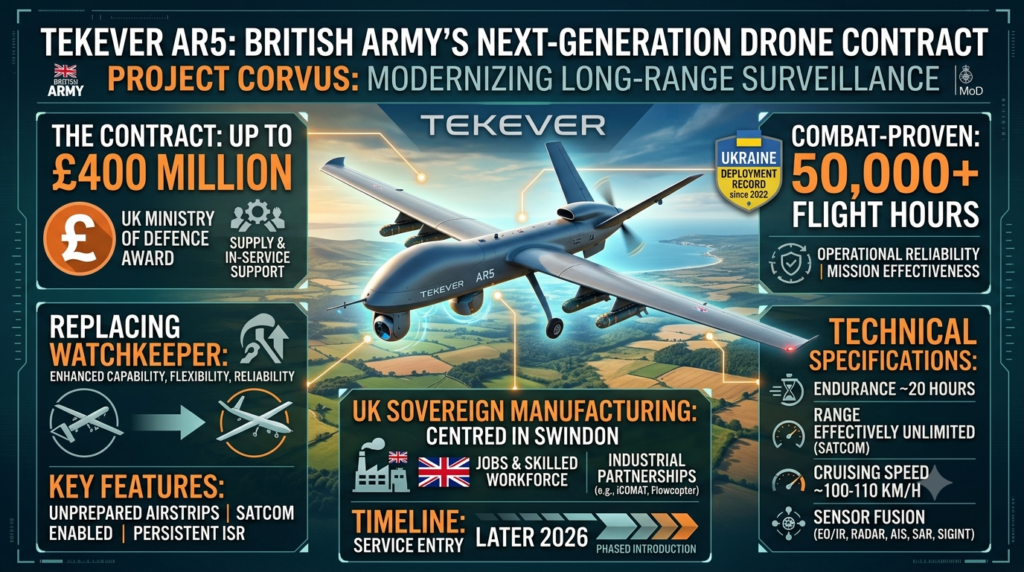
The UK Ministry of Defence has awarded TEKEVER a contract worth up to £400 million to supply the TEKEVER AR5 long-endurance drone to the British Army under Project CORVUS. The deal replaces the aging Watchkeeper fleet with a combat-proven uncrewed aircraft that has already logged more than 50,000 flight hours in Ukraine.
This isn’t a research programme or a paper promise, it’s a signed contract, a named delivery site in Swindon, and a platform already flying real missions. Below, we break down what the TEKEVER AR5 does, why the British Army chose it, how it compares to the system it’s replacing, and what it means for the UK’s defence industrial base.
What Is the TEKEVER AR5 Contract? (Quick Answer)
In September 2026, the UK Ministry of Defence signed a contract worth up to £400 million with Portuguese defence company TEKEVER to deliver the TEKEVER AR5, a long-range fixed-wing uncrewed aerial system (UAS), to the British Army. The programme, known as Project CORVUS, will give British Army commanders persistent, long-endurance intelligence, surveillance, and reconnaissance (ISR) coverage, and the aircraft is scheduled to begin entering service later in 2026.
That’s the short version. Here’s the full picture.
Understanding Project CORVUS
Project CORVUS is the British Army’s programme to modernize its long-range surveillance drone fleet, and the TEKEVER AR5 sits at the centre of it. Rather than a one-off equipment purchase, CORVUS is structured as an evolving capability, the contract explicitly commits TEKEVER to continue developing the system throughout its service life rather than delivering a fixed, unchanging airframe.
Contract Value and Scope
The agreement is worth up to £400 million and covers the manufacture, delivery, and in-service support of the TEKEVER AR5 for the British Army. It sits within TEKEVER’s broader £400 million OVERMATCH investment programme, which anchors the company’s UK-based engineering, manufacturing, training, and operational support infrastructure. In practical terms, this means the contract funds not just aircraft, but sovereign UK capability to build, maintain, and evolve them.
Why the British Army Chose TEKEVER
Karl Brew, TEKEVER UK Managing Director, described the signing as the start of “a new chapter” in the company’s relationship with the British Army, framing CORVUS as more than a surveillance system, a capability designed to continuously evolve alongside operational demands. Luke Pollard, the UK’s Minister for Defence Readiness and Industry, put it in blunter terms: the goal is to give commanders “better intelligence over the battlefield” and transform the Army’s ability to “see, understand and act first.”
Three factors appear to have driven the selection:
- Combat validation. The AR5 has flown tens of thousands of operational hours in an active conflict zone, not just test ranges.
- Sovereign manufacturing. TEKEVER committed to centring production in the UK rather than importing a finished platform.
- Evolving capability. The contract structure allows the system to be upgraded throughout its service life instead of becoming obsolete on delivery.
TEKEVER AR5: Technical Specifications
Understanding what the TEKEVER AR5 actually is helps explain why it won this competition. It’s a medium-altitude, medium-endurance fixed-wing UAS purpose-built for wide-area ISR, maritime patrol, and land surveillance missions.
Endurance, Range and Payload
The TEKEVER AR5 is built around persistence rather than speed. It measures roughly 7.3 by 4.0 metres, cruises at around 100–110 km/h, and can remain airborne for extended endurance windows that stretch well beyond what a crewed aircraft or rotary-wing UAS could sustain on a single sortie. Its satellite communications link gives it effectively unlimited communications range, meaning operators aren’t constrained to line-of-sight control. It also carries a meaningful payload capacity, enough for multiple simultaneous sensor packages, and is designed to launch and recover from short, unprepared airstrips, which matters enormously for forward-deployed army units that won’t always have a paved runway nearby.
Sensors and Mission Systems
Where the TEKEVER AR5 earns its ISR reputation is the sensor suite it can carry simultaneously. Configurations typically combine electro-optical/infrared (EO/IR) cameras, maritime radar, and Automatic Identification System (AIS) tracking, with options for synthetic aperture radar (SAR) and signals intelligence (SIGINT) payloads. This “sensor fusion” approach, running multiple detection systems at once rather than swapping payloads between missions, is what allows a single airframe to support land surveillance one day and maritime patrol the next.
| Specification | TEKEVER AR5 |
| Role | Long-range ISR / maritime & land surveillance |
| Endurance | Up to ~20 hours |
| Cruise speed | ~100–110 km/h |
| Communications | SATCOM-enabled, effectively unlimited range |
| Sensors | EO/IR, radar, AIS, optional SAR/SIGINT |
| Launch/recovery | Unprepared airstrips |
| Combat history | 50,000+ flight hours in Ukraine since 2022 |
Replacing Watchkeeper: What Changes for the British Army
The TEKEVER AR5 is stepping in to replace the British Army’s Watchkeeper WK450, a system that had been in service for over a decade but faced persistent criticism over cost, reliability, and delayed capability upgrades. Where Watchkeeper required more infrastructure-dependent operations, the AR5’s ability to launch from unprepared strips gives commanders far more flexibility in where and how the aircraft is deployed. Just as importantly, the AR5 arrives with an active combat track record rather than a clean-sheet design still working through early-service issues, a meaningful difference for a British Army that needs a system it can trust from day one.
UK Sovereign Manufacturing and OVERMATCH Investment
A defining feature of this contract is where the aircraft will actually be built. TEKEVER has committed to centring TEKEVER AR5 manufacturing at its Swindon facility, backed by a wider UK footprint and a consortium of British SME partners.
Swindon Facility and Jobs
Platform manufacturing, along with engineering, training, and operational support, will be based in the UK rather than imported from overseas. This aligns with the UK government’s broader push for sovereign defence capability, procurement that doesn’t just buy equipment but builds domestic industrial capacity and skilled jobs alongside it.
Industrial Partnerships
TEKEVER has been steadily expanding its UK supply chain ahead of this contract. It has already partnered with composite manufacturing specialist iCOMAT to scale AR5 production using advanced materials techniques, and it recently acquired Edinburgh-based Flowcopter to accelerate heavy-lift autonomous flight development. Together, these moves suggest the AR5 contract is one piece of a much larger UK industrial strategy, not a standalone drone sale.
Combat-Proven: The AR5’s Ukraine Deployment Record
One detail sets this procurement apart from many defence programmes: the TEKEVER AR5 isn’t unproven. TEKEVER states the platform has accumulated more than 50,000 flight hours in Ukraine since 2022, flying real ISR missions in an active, contested electromagnetic and air-defence environment. For a military buyer, that operational data is worth more than any lab test, it demonstrates reliability, survivability, and mission effectiveness under conditions a training range simply can’t replicate.
Timeline: When Will the AR5 Enter Service?
According to the announcement, the TEKEVER AR5 is scheduled to begin entering service with the British Army later in 2026. The stated goals for this initial rollout are enhanced endurance, improved reliability, and stronger intelligence-gathering capability to support both operational decision-making and the protection of personnel on the ground. Given the contract’s structure, expect a phased introduction rather than a single mass delivery, with capability upgrades continuing to roll out across the platform’s service life.
TEKEVER AR5 vs Comparable Long-Endurance UAS
How does the TEKEVER AR5 stack up against other systems in its class? The table below compares it to two reference points: the Watchkeeper system it replaces, and a typical MALE (medium-altitude, long-endurance) UAS used for broader comparison.
| Feature | TEKEVER AR5 | Watchkeeper WK450 | Typical MALE UAS |
| Combat track record | 50,000+ hrs (Ukraine) | Limited operational use | Varies by platform |
| Launch requirement | Unprepared airstrip | Runway-dependent | Runway-dependent |
| Endurance | ~20 hours | ~14–16 hours | 20–30+ hours |
| Manufacturing base | UK (Swindon) sovereign | UK-assembled | Often foreign-built |
| Sensor fusion | EO/IR + radar + AIS simultaneously | EO/IR + radar | Varies |
| Contract structure | Continuously evolving capability | Fixed baseline | Varies |
Frequently Asked Questions
What is Project CORVUS? Project CORVUS is the British Army’s programme to field the TEKEVER AR5 as its next long-range ISR drone, replacing the Watchkeeper fleet with a platform designed to evolve throughout its service life.
How much is the TEKEVER AR5 contract worth? The contract is worth up to £400 million and forms part of TEKEVER’s wider £400 million OVERMATCH investment in UK sovereign manufacturing and support infrastructure.
Where will the TEKEVER AR5 be built? Manufacturing will be centred at TEKEVER’s facility in Swindon, England, supported by a network of British SME partners across the country.
What is the TEKEVER AR5 used for? It’s a medium-altitude, long-endurance fixed-wing UAS used for ISR, maritime patrol, border surveillance, and land surveillance missions, capable of carrying EO/IR, radar, AIS, and optional SAR/SIGINT payloads.
When does the AR5 enter British Army service? The system is scheduled to begin entering service later in 2026, according to the UK Ministry of Defence.
What is the AR5 replacing? It replaces the British Army’s Watchkeeper WK450 drone fleet, which had faced longstanding criticism over cost and reliability.
What This Means for UK Defence Industry
Beyond the aircraft itself, this contract signals a shift in how the UK approaches defence procurement: buying capability that’s tied directly to domestic manufacturing, skilled jobs, and an industrial supply chain rather than simply importing a finished product. For TEKEVER, it cements the TEKEVER AR5 as the centrepiece of its UK strategy. For the British Army, it delivers a battle-tested ISR platform with room to grow, which, in an era where drone technology evolves month to month rather than year to year, may prove to be the most valuable part of the deal.