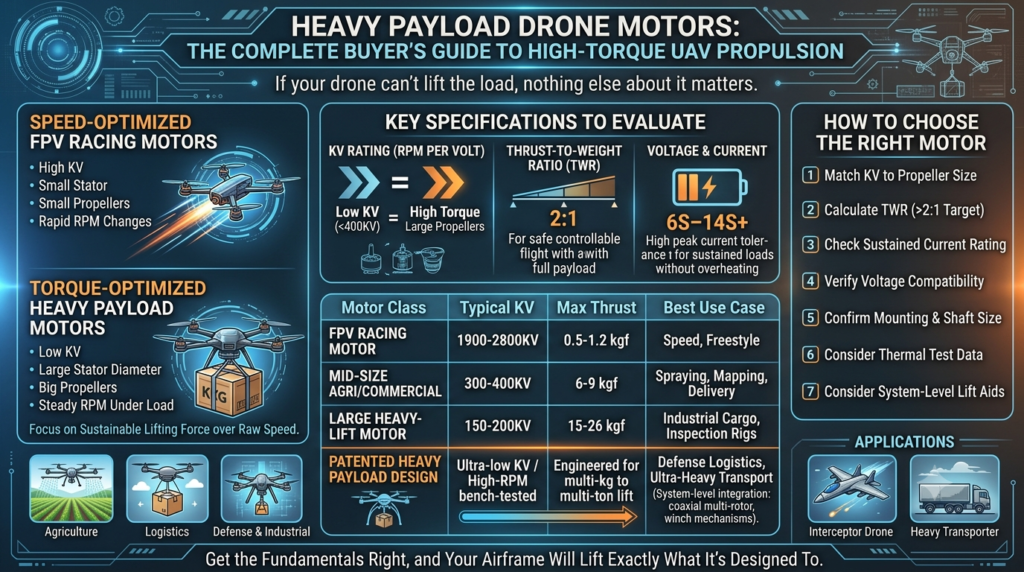
If your drone can’t lift the load, nothing else about it matters. Heavy payload drone motors are the brushless propulsion units engineered specifically to generate high thrust at low RPM, letting a UAV carry cameras, cargo, spray tanks, or defense payloads without burning out or losing flight stability. This guide breaks down exactly what separates a heavy-lift motor from a standard racing motor, how to read the spec sheet, and how to pick the right one for your airframe.
Whether you’re building an agricultural spraying drone, a logistics UAV, or an industrial inspection platform, the motor is the single component that determines how much weight you can actually get off the ground, and keep there.
What Are Heavy Payload Drone Motors?
Heavy payload drone motors are brushless DC (BLDC) motors purpose-built to deliver high torque and sustained thrust rather than raw RPM. Unlike FPV racing motors, which chase speed with high KV ratings, heavy payload drone motors are wound for low KV and high current tolerance, converting more electrical energy directly into lifting force.
This design choice matters because payload capacity isn’t just about a bigger motor, it’s about the relationship between torque, propeller size, and sustained power delivery. A motor that can spin fast but can’t hold torque under load will overheat and fail the moment you strap on real cargo. That’s precisely the gap heavy payload drone motors are engineered to close.
Definition: Torque vs. Speed in Drone Propulsion
- Torque-optimized motors (used for heavy payload drone motors): low KV, large stator diameter, big propellers, steady RPM under load
- Speed-optimized motors (used for racing/FPV): high KV, small stator, small propellers, rapid RPM changes
Heavy-lift UAV motors almost always fall into the first category, paired with propellers 15 inches or larger to move more air at lower rotational speed.
Why Heavy Payload Drone Motors Matter for Modern UAVs
The commercial drone industry has shifted from “how fast can it fly” to “how much can it carry, how far, and how reliably.” That shift has made heavy payload drone motors a core engineering focus rather than an afterthought.
Agriculture and Logistics
Spraying drones routinely carry 10–50 liters of liquid payload, and delivery drones are increasingly expected to carry multi-kilogram parcels over multi-kilometer routes. Both applications demand heavy payload drone motors that sustain high thrust for extended flight times without thermal throttling.
Defense and Industrial Use
Interceptor drones, surveillance platforms, and heavy-lift logistics UAVs used in defense and industrial settings push payload requirements even further, sometimes into hundreds of kilograms using coaxial multi-rotor or tethered/winch configurations. This is where patented high-power-density motor designs start to matter more than off-the-shelf components.
Key Specifications to Evaluate
Before buying heavy payload drone motors, you need to read past the marketing copy and understand five core numbers: KV rating, max thrust, voltage range, peak current, and weight.
What Is KV Rating in a Drone Motor?
Direct answer: KV rating tells you how many RPM a motor produces per volt applied, with no load attached. For heavy payload drone motors, lower KV (typically under 400KV) is preferred because it favors torque over raw spin speed, which is exactly what’s needed to swing large, heavy-lift propellers efficiently.
A motor rated at 160KV, for example, will turn far slower than a 2500KV racing motor at the same voltage, but it will produce dramatically more usable torque when paired with a large propeller, which is the entire point of heavy payload drone motors.
Thrust-to-Weight Ratio: The Real Payload Indicator
Direct answer: Thrust-to-weight ratio (TWR) is the single best predictor of how much cargo a drone can actually carry. A safe operating TWR for payload-carrying UAVs is generally 2:1 or higher, meaning the total thrust output of all motors combined should be at least double the fully loaded aircraft weight.
This is why manufacturers of heavy payload drone motors publish max thrust figures in kilograms-force (kgf) or grams-force (gf) rather than just wattage, thrust is what actually fights gravity.
Voltage and Current Handling
High-capacity heavy payload drone motors are typically rated across wide voltage bands (6S–14S or higher) and must tolerate high peak current for sustained periods, often 60–180 seconds continuous, without thermal degradation. This is a key differentiator from consumer drone motors, which are rarely tested for sustained heavy-load operation.
Comparison Table: Motor Classes for Payload Applications
| Motor Class | Typical KV | Max Thrust | Voltage Range | Best Use Case |
| FPV Racing Motor | 1900–2800KV | 0.5–1.2 kgf | 4S–6S | Speed, freestyle flying |
| Mid-Size Agri/Commercial Motor | 300–400KV | 6–9 kgf | 6S–14S | Spraying, mapping, delivery |
| Large Heavy-Lift Motor | 150–200KV | 15–26 kgf | 9S–14S+ | Industrial cargo, inspection rigs |
| Patented Heavy Payload Racing Motor | Ultra-low KV / high-RPM bench-tested design | Engineered for multi-kg to multi-ton system-level lift (with winch/coaxial gear) | Application-specific, high-voltage | Defense logistics, ultra-heavy transport |
Figures are representative ranges compiled from publicly available motor spec sheets across commercial manufacturers, not a single product’s exact ratings.
As the table shows, the jump from racing motors to true heavy payload drone motors isn’t incremental, it’s a completely different design philosophy centered on torque density rather than RPM.
Case Study: Kerael Robotics’ Black Bird Heavy Payload Motors
One of the more notable recent developments in India’s heavy-lift UAV space comes from Bengaluru-based Kerael Robotics. The company has announced indigenous drone technology aimed at extreme logistics, defense mobility, and ultra-heavy industrial applications, claiming a payload capacity of 2,500 kg as a new benchmark in high-lift propulsion for aerial transport. idrw
Kerael Robotics’ “Black Bird” OEM heavy payload racing motors are described as high-power-density, patented propulsion systems, with the company reportedly demonstrating over 60,000 RPM on a test bench while lifting 150 kg on a dedicated test-bed. The stated multi-tonne payload figures are achieved not by the motor alone, but through a system-level combination of a custom frame, coaxial multi-rotor propulsion, and integrated tether and winch mechanisms for long-range logistics applications.
Separately, Kerael Robotics’ earlier Black Bird concept, designed by Raj Jawahar, was built around missile-inspired aerodynamics to combine high flight speed with meaningful payload capacity for interceptor-class UAV roles, addressing the classic design tension between speed and cargo capacity in combat drones. That program reportedly used specialized Black Bird motors engineered for a high power-to-weight ratio and extremely high thrust output, underscoring how the “Black Bird” motor line has been positioned across both interceptor and heavy-lift logistics applications.
This case illustrates an important trend: the most advanced heavy payload drone motors are increasingly paired with system-level engineering, winches, coaxial rotors, custom frames, rather than being sold as a standalone thrust solution.
How to Choose the Right Heavy Payload Drone Motor
Selecting heavy payload drone motors is a systems decision, not just a spec-sheet comparison. Use this checklist before you buy:
- Match KV to your propeller size, larger, heavier propellers need lower KV motors to avoid overloading the windings
- Calculate your target TWR, aim for at least 2:1 thrust-to-weight at maximum payload
- Check sustained (not peak) current rating, a motor that survives a 5-second burst test isn’t proven for a 20-minute payload flight
- Verify voltage compatibility with your ESC and battery pack (6S, 10S, 12S, 14S, etc.)
- Confirm shaft diameter and mounting pattern match your frame’s motor mounts
- Ask for thermal test data, not just bench RPM numbers, heat is the primary failure mode under sustained payload
- Consider system-level lift aids (winches, coaxial configurations) if you’re targeting extreme payload weights beyond single-motor capability
Common Mistakes to Avoid
Even experienced builders make avoidable errors when specifying heavy payload drone motors:
- Chasing high KV for “more power”, this backfires for payload applications; low KV with large propellers almost always outperforms high KV for lifting capacity.
- Ignoring duty cycle ratings, a motor rated for 60-second bursts will fail on a 15-minute agricultural spraying run.
- Underestimating propeller-motor matching, pairing the wrong propeller pitch with a heavy-lift motor wastes torque and increases current draw unnecessarily.
- Skipping thermal testing before field deployment, bench specs rarely reflect real-world payload + ambient temperature conditions.
Frequently Asked Questions
What KV rating is best for heavy payload drones?
Generally under 400KV, with true heavy-lift industrial motors often falling between 150–300KV, since lower KV favors torque delivery over raw RPM.
Do heavy payload drone motors need special ESCs?
Yes. High-current, high-voltage heavy payload drone motors require ESCs rated to match or exceed their peak current draw, typically with active cooling for sustained payload operations.
Can a standard racing drone motor lift heavy cargo?
Not reliably. Racing motors are optimized for speed and quick RPM changes, not sustained torque, and will overheat or underperform under real payload weight.
How is drone motor payload capacity calculated?
By comparing total system thrust (all motors combined) against fully loaded aircraft weight, targeting a thrust-to-weight ratio of at least 2:1 for safe, controllable flight.
Are patented heavy-lift motor designs worth it?
For extreme payload applications, defense logistics, industrial multi-kilogram cargo, patented high-power-density designs often justify their cost through better thermal management and torque efficiency at scale.
Conclusion
Choosing the right heavy payload drone motors comes down to understanding torque over speed, verifying sustained (not just peak) performance ratings, and matching the motor to your propeller, frame, and mission profile. As UAV applications expand into agriculture, logistics, and defense-grade heavy lift, as seen with developments like Kerael Robotics’ Black Bird line, the gap between racing-grade and true heavy payload drone motors will only continue to widen. Get the fundamentals right, and your airframe will lift exactly what it’s designed to.