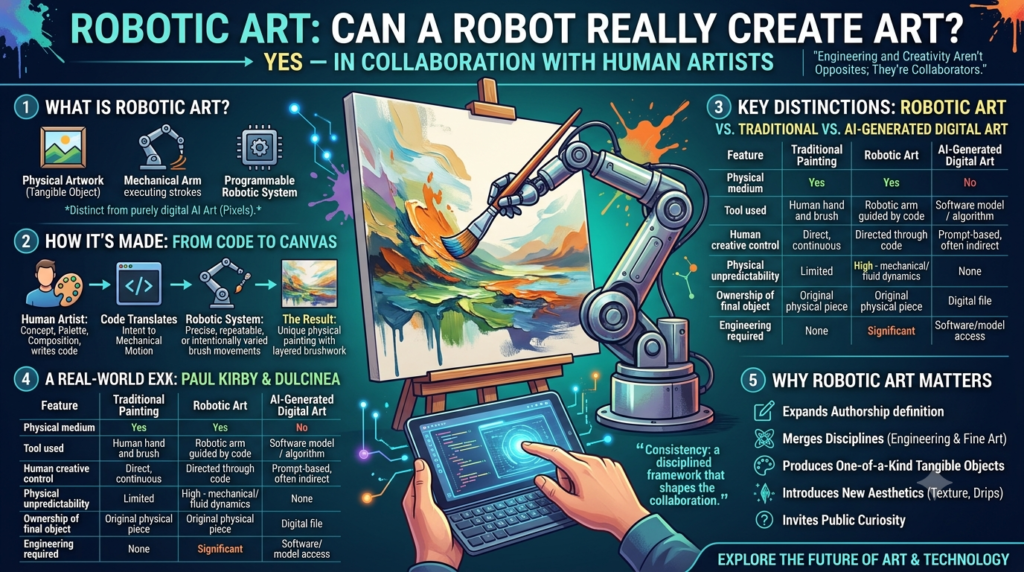
Yes, robots can create art, but not alone. Robotic art is the result of a human artist directing a machine that executes physical brushstrokes, and the most compelling examples today prove that engineering and creativity aren’t opposites; they’re collaborators.
That idea sits at the center of a growing movement in contemporary art, one where painters like Paul Kirby work alongside a robot named Dulcinea to produce one-of-a-kind paintings that blur the line between human intention and machine execution. If you’ve ever wondered whether a robot can genuinely make art, or just imitate it, this guide breaks down what robotic art actually is, how it’s made, and why it matters.
What Is Robotic Art?
Robotic art is physical artwork, typically paintings, sculptures, or installations, created through the collaboration of a human artist and a programmable robotic system. Unlike purely digital AI art, which exists only as pixels on a screen, robotic art results in a tangible object: a canvas with real paint, real texture, and real brushstrokes applied by a mechanical arm following instructions written and refined by a person.
The term covers a wide spectrum of practice. On one end are artists who write code that guides a robotic arm’s movement, speed, and pressure. On the other are hybrid systems where a robot proposes compositions and a human artist selects, adjusts, or finishes the piece by hand. What unites all of it is this: robotic art treats the robot as an instrument, like a paintbrush or a chisel, rather than as an independent creator working without human input.
This distinguishes robotic art from generative AI art tools that produce images from text prompts. Robotic art requires physical engineering: motors, actuators, custom brush mechanisms, and code that translates artistic intent into mechanical motion.
Can a Robot Really Create Art?
Here’s the direct answer: a robot can execute a painting, but the creative decisions, composition, color palette, emotional intent, when a piece is finished, still originate with a human artist. Robotic art is best understood as a new medium, not a replacement for human creativity.
This question echoes a much older one in art history: does the tool make the art, or does the artist? No one asks whether a camera “really” creates photography, or whether a chisel “really” creates sculpture. Robotic art asks the same question of code and motors, and the answer tends to follow the same logic, the instrument extends what the artist can do, but doesn’t replace the artist’s judgment.
That said, the robot isn’t passive. A well-built art robot can execute movements with a precision and consistency no human hand can match, and it can also introduce physical unpredictability, paint drips, fluid dynamics, brush wear, that becomes part of the final work’s character. The result is a genuine partnership between deliberate human design and the robot’s own physical behavior.
How Robotic Art Is Made: From Code to Canvas
Producing a robotic art piece is a multi-stage process that blends software engineering, mechanical design, and traditional painting skill.
The Role of the Human Artist
The human artist typically:
- Chooses the concept, color palette, and overall composition
- Writes or adjusts the code that controls brush movement, pressure, and stroke sequencing
- Selects paints, canvas size, and physical materials
- Reviews the robot’s output mid-painting and can intervene, layer additional strokes, or restart sections
- Decides when a piece is finished, a judgment call no algorithm makes on its own
The Role of the Machine
The robotic system typically:
- Executes precise, repeatable, or intentionally varied brush movements
- Applies paint at controlled speed and pressure across hundreds or thousands of individual strokes
- Introduces physical effects, like fluid dynamics in wet paint, that are difficult to plan in advance
- Follows programmed logic while still producing outcomes that surprise even the artist who wrote the code
This back-and-forth between planning and physical surprise is part of what makes robotic art distinct from digital image generation. A painting made this way carries real texture and layered brushwork you can see and touch, not just render on a screen.
Robotic Art vs. Traditional Painting vs. AI-Generated Digital Art
To understand where robotic art fits, it helps to compare it directly against the two mediums it sits between.
| Feature | Traditional Painting | Robotic Art | AI-Generated Digital Art |
| Physical medium | Yes, paint, canvas | Yes, paint, canvas, applied by machine | No, digital pixels only |
| Tool used | Human hand and brush | Robotic arm guided by code | Software model / algorithm |
| Human creative control | Direct, continuous | Directed through code and mid-process decisions | Prompt-based, often indirect |
| Physical unpredictability | Limited to hand and material variance | High, mechanical and fluid dynamics add texture | None, output is digital |
| Ownership of final object | Original physical piece | Original physical piece | Digital file, sometimes printed |
| Engineering required | None | Significant, robotics, code, calibration | Software/model access only |
This comparison makes the middle ground clear: robotic art keeps the tangible, one-of-a-kind quality of traditional painting while introducing the precision, scalability, and novelty of a programmable machine.
A Real-World Example: Paul Kirby and Dulcinea
One of the clearest examples of robotic art in practice comes from artist Paul Kirby and his painting robot, Dulcinea, whose collaborative studio work is documented at The Fuse Pathway.
Meet Dulcinea, the Painting Robot
Dulcinea is a robotic system built and programmed by Kirby specifically to produce paintings, not reproductions of existing images, but original compositions developed through the interplay of code, brush mechanics, and paint. The resulting gallery includes pieces with names like Early Light, Tadpoles, Swirling Timbers of Chaos, and Meditation Upon Death, each with its own artistic and technical backstory. Some works reportedly take shape across a few hundred brush strokes, resulting in paintings with distinct movement, texture, and color relationships.
The Two Rules Behind the Work
Kirby has described following two consistent guiding rules throughout his development of this robotic art practice, principles that inform both the engineering and the artistic choices behind each piece. The details of those rules are explored in his own video content, but the underlying theme is consistency: a disciplined framework that shapes the collaboration between artist and machine, painting after painting.
Brushstroke: The Documentary
Kirby and Dulcinea’s story was chronicled in the short documentary Brushstroke, which was nominated for Best Short Film at the 2021 Vail Film Festival and recognized as an official selection in the Portland Film Festival’s Short Documentary category that same year. The film traces Kirby’s personal path into robotic art and illustrates how an unconventional idea, teaching a machine to paint, turned into a genuine creative practice.
Why Robotic Art Matters
Robotic art isn’t just a novelty; it represents a meaningful shift in how creative work can be produced and experienced. A few reasons this medium is gaining attention:
- It expands the definition of authorship. Robotic art forces a re-examination of what “making” a piece of art actually means when a machine executes the physical work.
- It merges disciplines. Painters working in this space need fluency in mechanical engineering and programming, not just traditional technique, creating a genuinely interdisciplinary art form.
- It produces one-of-a-kind physical objects. Unlike purely digital AI art, each robotic art piece is a unique, tangible artifact that can’t be perfectly duplicated.
- It introduces new aesthetics. The physical behavior of paint under robotic application, drips, fluid dynamics, layered strokes, creates visual effects distinct from both hand-painted and digitally generated work.
- It invites public curiosity. Robotic art tends to spark conversation about creativity, automation, and what makes something “art”, making it a natural subject for galleries, documentaries, and educational experiences like virtual studio tours.
Common Questions About Robotic Art
Is robotic art the same as AI art?
No. AI art usually refers to digital images generated by machine learning models from text prompts, with no physical object produced. Robotic art involves a physical robot applying real paint to a real canvas, typically under close human direction throughout the process.
Do robots choose what to paint?
Generally, no. In most robotic art practices, including Paul Kirby’s work with Dulcinea, the human artist determines the concept, palette, and composition. The robot’s role is executing the physical application of paint according to programmed instructions and real-time adjustments.
Can robotic art be considered “real” art?
Most art historians and critics would say yes, with the same caveat applied to any new medium: the value lies in the intention, skill, and outcome, not the specific tool used. Photography, printmaking, and digital art all faced similar questions when they emerged, and robotic art is following a similar path toward acceptance.
How is a robotic art piece different from a print or reproduction?
A robotic art piece is an original work, the robot applies wet paint directly to canvas during the creation process, producing a unique physical object. This differs fundamentally from a print, which reproduces an existing image onto paper or canvas after the fact.
What skills does creating robotic art require?
Creating robotic art typically requires knowledge of robotics engineering, programming, and traditional painting or compositional skill. It’s a genuinely interdisciplinary practice, which is part of why relatively few artists work in this specific medium today.
How to Experience Robotic Art Yourself
If robotic art sounds abstract in description, it tends to click once you see it in motion, paint drying in layered, deliberate strokes that look hand-painted until you learn a machine applied them. Studios working in this space, like Paul Kirby’s, have increasingly turned to immersive formats such as virtual reality gallery tours to let people examine the brushwork and hear the story behind each piece up close, even remotely.
Whether you encounter it through a gallery, a documentary film, or a virtual studio tour, robotic art offers a rare chance to watch two very different disciplines, mechanical engineering and fine art, genuinely need each other to produce something neither could make alone.