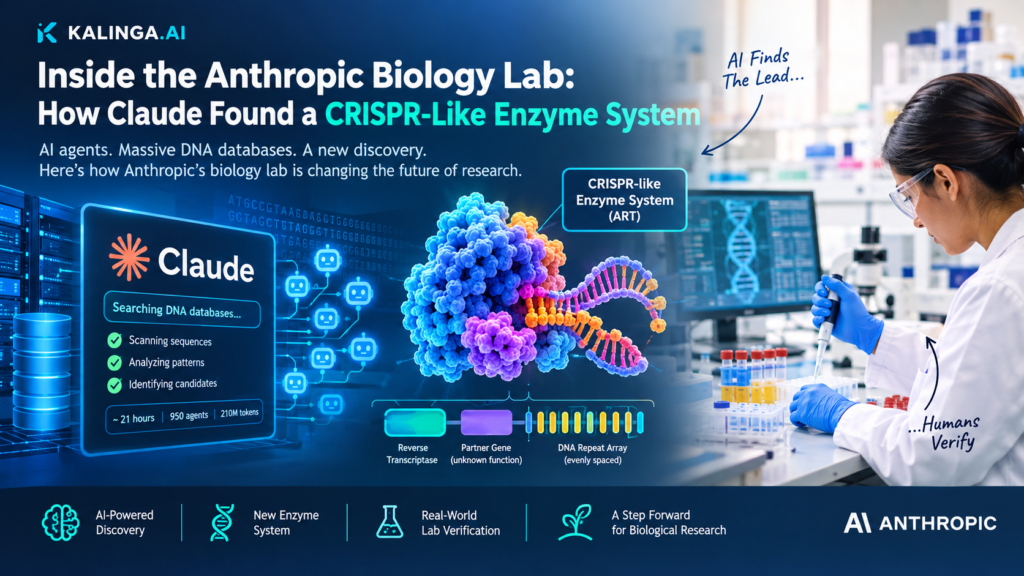
The Anthropic biology lab is a conventional molecular biology lab in the Bay Area where human scientists test biological candidates that Claude agents pull out of enormous DNA databases. Its first public result, announced on September 23, 2026, is a previously undescribed enzyme system with CRISPR-like features. Claude agents found it after roughly 21 hours of search time, and its exact function is still unknown.
That pairing of fast machine discovery and slow, careful human verification is the real story. This guide explains what the Anthropic biology lab found, how Claude found it, what has and hasn’t been verified, and why the workflow matters to anyone following AI-driven biology research.
The Quick Answer: What Did Anthropic Announce?
Anthropic announced two things at once: a new life sciences research group with its own physical lab, and an early result from that group. The result is a CRISPR-like enzyme system that Anthropic calls array-associated reverse transcriptases, or ART. It lives in bacteriophages, the viruses that infect bacteria.
Key facts at a glance:
- Announcement date: September 23, 2026
- What was found: ART, a three-part system made of a reverse transcriptase, a partner gene of unknown function, and a long array of evenly spaced DNA repeats
- Why it’s notable: the layout resembles a CRISPR array, and its combination of features has previously been seen together in only a handful of systems
- Search effort: about 950 Claude agents, 21 hours, 210 million tokens
- Current status: function unknown, a preprint has been released, and the wider research community has yet to validate it
- Human role: scientists wrote the initial prompt and did all of the physical lab work
What Is the Anthropic Biology Lab?
Definition: The Anthropic biology lab is the wet-lab arm of Anthropic’s life sciences organization, built to test whether general-purpose AI models can systematize and speed up biological discovery.
Expansion: Anthropic says it formed the research group in spring 2026 with a single team covering everything from training Claude in biology to running experiments. TechCrunch, which covered the announcement, notes that the lab is only a few months old, though Anthropic declined to say exactly how many. The scientists say they’ve spent their careers on unusual proteins and computational analysis of DNA, including work on CRISPR evolution and enzymes for cell and gene therapies. The group sits beside other teams in Anthropic’s life sciences organization, including drug discovery and the training of Claude in biology and chemistry.
Where does it operate, and how safe is the work?
The lab sits in the Bay Area and looks like a typical molecular biology lab. According to Anthropic, the Anthropic biology lab does research at only the lower biosafety levels, BSL-1 and BSL-2, and does not handle pathogens that can infect humans. All lab work is performed by human scientists.
Why build a physical lab at all?
Anthropic’s argument is that faster discovery will come from a new way of doing biology, one where agents collaborate with humans at every step. That required a single team that could go from model training to bench experiments without handoffs between organizations. Anthropic has experimented with using AI to speed up lab work itself, through initiatives like its Model Hardware Standard. It says that approach suits the ad hoc workflows of molecular biology research less well, so the humans stay at the bench.
What Did Claude Discover?
Claude discovered an enzyme system built around a reverse transcriptase, associated with an unusual array of DNA repeats. To understand why that’s interesting, two definitions help.
What is a reverse transcriptase?
Definition: A reverse transcriptase (RT) is an enzyme that copies RNA into DNA.
Expansion: In recent years, researchers have found many new RTs, most of them in bacteria, where they act as part of the immune system. Nearly all of these families were found through genome mining. That means searching sequence databases for uncharacterized genes, noticing the odd ones, and working out what they do.
What is CRISPR?
Definition: CRISPR is a natural bacterial immune system for fighting viruses, and it has become a widely used gene-editing technology.
Expansion: CRISPR was first noticed as an unusual repeat sequence in the DNA of certain bacteria. The repeat array stores a bank of distinct RNA sequences, which is what makes CRISPR-Cas systems programmable and useful as biotechnology tools.
What is the ART system?
The system Claude found, array-associated reverse transcriptases, appears mainly in bacteriophages and has three parts:
- A reverse transcriptase
- A partner gene beside it, whose function is unknown
- A long array of evenly spaced DNA repeat sequences
Anthropic notes that the underlying RT, from a jumbo phage, had been identified in earlier studies. What Claude appears to have been first to notice is the system’s defining features: the associated array of non-coding DNA and the extra accessory protein. Early experiments show the array is expressed as a set of distinct short RNAs. That suggests something analogous to CRISPR may be happening, though Anthropic is careful to say it doesn’t yet know the system’s function.
What does “CRISPR-like” actually mean here?
It means ART shares structural hints with CRISPR, not that it is a proven gene-editing tool. Anthropic says the combination of characteristics it found has only ever been seen together in a handful of other systems, all of which are programmable and perform operations like cutting, copying and pasting DNA. Several of those systems are now in development as promising tools. ART is a lead worth investigating, and Anthropic itself frames it that way.
How the Anthropic Biology Lab Found ART
The Anthropic biology lab found ART through a funnel: Claude agents screened a huge pool of sequences, eliminated most candidates, and escalated a handful to human scientists. The process mirrors how a human genome-mining project works, only far faster.
The funnel, step by step
- Prompt: Scientists asked Claude to search a massive DNA sequence database for interesting new examples of reverse transcriptases.
- Collection: Claude agents gathered over 200,000 RTs.
- Shortlisting: They picked out 3,500 new candidate systems.
- Deep analysis: They narrowed those to the 20 most compelling and wrote human-readable reports on each.
- The catch: While reading raw sequence near one unusual RT, an agent noticed a tandem repeat array. In its own words, the DNA was “spectacular.”
- Verification: The agent counted repeats, measured spacing, compared the layout with known RT systems, searched the literature for prior reports, and then filed a report for human review.
- Lab testing: Human scientists tested the candidate in the lab, with Claude helping to interpret the data.
Anthropic notes that for an expert scientist, the analysis in steps 2 to 4 can take weeks to months.
What does the typical Claude workflow look like?
Anthropic describes a repeatable pattern. Claude surveys a protein family, reads the literature and reproduces established results from public data to check its own methods. It then searches for family members or genomic neighbors that fit no described system, and writes a short report proposing a function and laying out the evidence. In follow-up passes, Claude critically evaluates that evidence, and most candidates are eliminated at this stage. A survey may end with one candidate worth testing, or with none.
Where did humans step in?
Humans wrote the initial prompt, did the physical lab work, and reviewed the final reports. When a candidate survives, scientists express the protein in standard laboratory strains and characterize it biochemically and structurally. Anthropic says the team works in Claude Science and Claude Code, the same tools available to any scientist, and sometimes uses a custom harness that coordinates many Claude sessions in parallel.
The hypotheses themselves have also become an object of study. With hundreds to thousands of candidate reports from a single campaign, the team asks what separates the proposals it judges worth testing from those it sets aside. What it learns goes back into the instructions given to Claude, teaching the model to mimic the scientists’ own taste.
Traditional Genome Mining vs. the Claude-Agent Approach
The table below contrasts the conventional workflow with the agent-driven workflow Anthropic describes. It reflects Anthropic’s account, not an independent benchmark.
| Dimension | Traditional genome mining | Claude-agent workflow described by Anthropic |
|---|---|---|
| Who searches the data | Individual researchers | Roughly 950 parallel Claude agents |
| Scale of first-pass screening | Limited by researcher time | 200,000+ RTs collected, 3,500 candidates flagged |
| Time to analyze top candidates | Weeks to months for an expert | 21 hours of agent time for the full search |
| Candidate triage | Researcher judgment | Agents write reports, then critique their own evidence |
| Hypothesis volume | Handful at a time | Hundreds to thousands of reports per campaign |
| Physical experiments | Human scientists | Human scientists (no autonomous lab control) |
| Final judgment | Human experts | Human experts, plus community peer review |
The pattern is that AI expands the top of the funnel, while humans still control the bottom, where claims become experiments.
Did Claude Really Discover This on Its Own?
Direct answer: Mostly, according to Anthropic. The company says its involvement was limited to the initial prompt and the lab work, while Claude agents combed the database, investigated the RT families, and used their own judgment to pick candidates. CEO Dario Amodei framed it as found “mostly, though not entirely, by Claude.”
Is the discovery brand new?
Not entirely, and Anthropic doesn’t claim it is. The underlying RT had been identified before. Amodei acknowledged on X that a Stanford team previously found a system that is in some ways similar to the one Claude found. TechCrunch stresses that it will be up to the broader research community to judge how big, or how new, the discovery really is.
What have outside experts said?
Anthropic quotes Feng Zhang, a CRISPR genome editing pioneer at MIT and the Broad Institute, who reviewed the preprint. In short, he called it an exciting example of AI agents contributing to biological discovery, said the RNA-repeat arrays associated with reverse transcriptases are genuinely intriguing and deserve further study, and hoped it would encourage more scientists to explore AI in their research. Note that this is an endorsement of the lead as worth investigating, not a confirmation of what ART does.
Safety and the Human-in-the-Loop Question
The safety framing may be the most important part of the announcement. TechCrunch’s Julie Bort argues that the biggest reveal may not be the discovery but the fact that Claude hasn’t been let loose in the lab.
That matters because of the surrounding context. TechCrunch notes that Amodei has said one of his biggest fears is AI being used for bioterrorism, while he also believes AI could help cure most diseases within 5 to 10 years. Anthropic has clearly decided the potential rewards justify continued work, and the design of the Anthropic biology lab reflects how it is managing that trade-off:
- Low biosafety levels only: BSL-1 and BSL-2 research, with no human-infecting pathogens
- Humans at the bench: all physical experiments are run by human scientists
- Human review of AI output: Claude files reports, and scientists decide what to test
- No autonomous equipment control today: Amodei said Claude might eventually operate lab equipment safely with appropriate safeguards, but that this is not being done now
Why It Matters for AI-Driven Biology Research
AI-driven biology research is not new, and TechCrunch points out that Anthropic isn’t alone. Stanford researchers recently published work on LLMs and CRISPR, UC San Francisco researchers have used AI to design enzymes, and Google launched AlphaFold back in 2020. What is different about the Anthropic biology lab is the reported role of a general-purpose model: not a specialized biology tool, but agents that read literature, spot anomalies and write their own hypotheses.
Three shifts stand out:
- Hypothesis generation becomes cheap. When candidate reports number in the thousands, the scarce skill moves from generating ideas to choosing which to test.
- Screening becomes parallel. Roughly 950 agents working simultaneously compresses work that would take a human team weeks or months.
- Validation stays slow, on purpose. A pattern in sequence data is a lead. The lab work, and eventually peer review, determine whether it is a tool.
Anthropic says it hopes to work with outside scientists to extend this approach to other questions in genomics and other fields.
Takeaways for Students, Founders and Content Teams
If you’re learning, building or writing about AI, here is what this announcement teaches beyond the enzyme itself:
- Read claims at the right level. “Discovered a novel enzyme system with CRISPR-like properties” is not the same as “discovered a new gene editor.”
- Look for the human checkpoint. The credibility of the Anthropic biology lab’s result rests on humans running and verifying the experiments.
- Watch the workflow, not just the model. The funnel from 200,000 RTs to one lead is a design pattern you can apply to research, security review, market analysis and more.
- Track primary sources. Anthropic’s announcement and preprint, TechCrunch’s reporting, and future independent replications will each tell you something different.
Frequently Asked Questions
What did Claude discover?
A previously uncharacterized enzyme system in bacteriophages, called array-associated reverse transcriptases (ART), made of a reverse transcriptase, a partner gene and a CRISPR-like array of DNA repeats.
Is ART the next CRISPR?
Nobody knows yet. Anthropic says the system’s function is still unknown and further experiments are underway. It shares features with programmable DNA-editing systems, but that is not proof it will become a tool.
Did Claude run the lab experiments?
No. According to Anthropic, all lab work is performed by human scientists, and Claude helps interpret data and generate analyses.
How long did the discovery take?
About 21 hours of concerted agent search, using roughly 950 agents and 210 million tokens, followed by human-run lab testing.
Where can I read the primary source?
Anthropic’s announcement, “Claude discovers a novel enzyme system with CRISPR-like repeats,” and its linked preprint. TechCrunch’s September 23, 2026 article by Julie Bort adds outside context.
The Bottom Line
The Anthropic biology lab has produced an intriguing lead, not a finished breakthrough. Claude agents screened hundreds of thousands of sequences, surfaced a CRISPR-like repeat pattern next to a reverse transcriptase, and handed it to human scientists who confirmed that something unusual is being expressed. What ART does, and how novel it truly is, will be settled by further experiments and the wider research community. The lasting lesson is the division of labor: AI widens the search, humans stay in charge of the experiments.