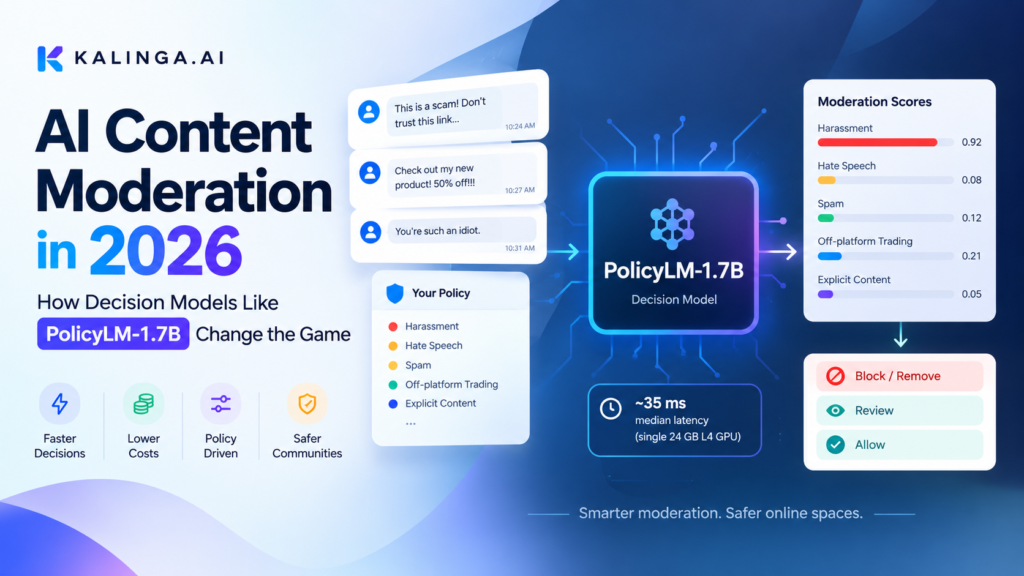
Decision models make AI content moderation fast, cheap and flexible at the same time. Instead of writing text like a chatbot, a decision model reads your policy plus a message and returns a score for each category in a single pass, which means a platform can apply a plain-English rulebook to every message in under 100 milliseconds, with no retraining when the rules change.
That is the promise behind PolicyLM-1.7B, an open-weights model that moderation startup Musubi released on October 6, 2026. If you run a community, a game, a marketplace or any product with user-generated content, this release is worth understanding, because it points to a different way of building a safety stack. This guide explains what is new, how it compares with the tools you already use, where it falls short, and how to test it yourself.
Key Takeaways
- A decision model outputs a score or choice instead of generated text, which makes it much faster and cheaper than a large language model (LLM).
- PolicyLM-1.7B reads your own policy with every message, so a rule edit takes effect immediately.
- It is released under the Apache 2.0 license, so you can download it, fine-tune it and host it yourself.
- Musubi reports a median of 35 ms per short chat message on a single 24 GB L4 GPU, with six categories.
- It cannot explain its decisions, only sees one message at a time, and is text-only.
- The smartest setups will combine small specialized models with bigger LLMs rather than pick just one.
What Is AI Content Moderation?
AI content moderation is the use of machine learning models to detect, label and act on user-generated content that breaks a platform’s rules. It covers text, images, audio and video, and it exists because human reviewers alone cannot keep up with the volume of posts, comments, chats and usernames that a modern platform receives every day.
In practice, AI content moderation sits between two extremes. At one end, an automated system blocks obvious spam or abuse instantly. At the other, a human moderator reviews a tricky appeal. Most platforms need both, plus a way to decide which cases go where.
How AI Content Moderation Evolved
The tools have moved through three broad stages:
- Human review and keyword filters. Accurate for nuance, but slow, expensive and hard to scale. Keyword lists are easy to evade and flag innocent text.
- Fixed machine learning classifiers. These score content against categories decided at training time. They are quick and affordable, but they only know the taxonomy they were trained on.
- LLM-based moderation. Large language models can read a written policy and reason about edge cases, but they are usually too slow and costly to run on every message in a live conversation.
Decision models are an attempt to keep the best of stages two and three: the speed of a classifier with the policy-reading flexibility of a language model.
Why the Old Trade-Off Hurts
A fixed classifier forces a painful workflow. When your rules change, someone has to collect and annotate new examples, retrain the model and redeploy it. If you rely on a vendor’s classifier, you are also limited to the vendor’s labels. An LLM avoids that by reading your policy from the prompt, yet its latency and price push teams to sample traffic rather than score all of it. Sampling means gaps, and gaps are where harm slips through.
What Is a Decision Model?
A decision model is an AI model that returns a decision, such as a probability or a choice from a fixed list, rather than writing out free-form text. It is built on the same transformer architecture as modern LLMs, so it keeps their ability to understand language, but because its output is limited to predetermined options, it runs far faster and costs far less.
The idea drew wide attention in September 2026, when Typesafe AI released a model called Jev. OpenAI and Amazon followed with their own decision models shortly after, according to TechCrunch’s reporting. Early interest focused on keeping AI agents in line, and moderation is a natural next target: the same technology can judge human behavior on a platform.
Decision Model vs. LLM: The Core Difference
An LLM generates its answer one token at a time, then you parse that text. A decision model skips the writing step. It reads the input and emits scores directly. That is why the output is easy to threshold, easy to log and quick to produce.
Meet PolicyLM-1.7B: A Decision Model Built for AI Content Moderation
PolicyLM-1.7B is a 1.7-billion-parameter decision model that reads a content policy and a message together and returns a 0 to 1 score for every category in that policy. Musubi built it for teams that need to act on every message right away, such as live chat, game lobbies, direct messages and usernames.
What Does PolicyLM-1.7B Actually Do?
You define categories in plain language, for example “Harassment” or “Off-platform trading,” each with a short rule describing what to flag and what not to flag. You send a message. The model returns a score per category in one pass and generates no text. You then choose a threshold for each category and decide what happens above it, such as hiding a message, queueing it for review or issuing a warning.
Key Specifications at a Glance
- Speed: under 100 ms, with a reported median of 35 ms per short chat message on a 24 GB L4 GPU using six categories.
- Hardware: runs on a laptop or a single 24 GB GPU.
- Output: multi-label, so one message can trigger several categories at once.
- Context window: 2,048 tokens, shared by the policy and the message.
- Languages: evaluated in 19, with English the strongest.
- License: open weights under Apache 2.0.
- Presets: a “precision” cutoff by default, suited to live chat where violations are rare, and a “balanced” cutoff that catches more.
How Accurate Is It?
On Musubi’s custom-policy benchmark, the company says PolicyLM-1.7B reached roughly 83 percent accuracy and beat every other model it tested under 20 billion parameters. Only gpt-oss-safeguard-20B and CoPE-B-A4B scored as high or higher, and both are larger than 20 billion parameters. Treat this as a vendor-run result: it is useful for orientation, but you should always test on a sample of your own content before trusting it.
The company also notes it has deployed a custom fine-tuned version in production on a platform that handles more than a million messages a day, which suggests the approach can work at real volume.
How Was It Built?
According to Musubi, the model starts from BidirLM-1.7B-Embedding, an open encoder derived from Qwen3-1.7B-Base. It was trained on public safety datasets, including NVIDIA’s Nemotron Safety Guard Dataset v3, Alibaba’s XGuard-Train-Open-200K and PolyGuardMix, along with synthetic and LLM-written examples.
Fixed Classifier vs. LLM vs. Decision Model
The table below summarizes how the three approaches to AI content moderation compare, based on the details Musubi published.
| Factor | Fixed ML classifier | Large language model | Decision model (PolicyLM-1.7B) |
| How it decides | Scores against categories set at training time | Writes a verdict token by token | Scores your policy in one pass, no text generated |
| Typical speed | Tens of milliseconds | Hundreds of milliseconds or more | Under 100 ms |
| Reads your policy | No; changes need relabeling and retraining | Yes, from the prompt | Yes, with every message |
| Custom labels | Limited to its taxonomy | Unlimited | Unlimited, defined in plain language |
| Output | Score per built-in category | Text answer you must parse | 0 to 1 score per custom category |
| Explanations | Score only | Can write a rationale | Score only |
| Where it runs | Vendor API or your servers | Usually a hosted API | Your own infrastructure or Musubi |
| Best for | Stable, well-defined harms | Appeals, bans, novel judgment calls | A decision on every message when you cannot wait |
The takeaway is not that one column wins. Each approach has a job, and the decision model fills the gap between the other two.
How Do Policy Changes Work With a Decision Model?
Policy changes take effect immediately because the model re-reads your rules with every message. There is no annotation project, no retraining run and no cache to rebuild. A policy manager can edit a rule, test it and ship it the same afternoon.
That matters because online rules are never static. New scams appear, a game launches a trading feature, a regulator asks for tighter handling of a topic. With a fixed classifier, each of those is an engineering project. With a policy-reading decision model, it is closer to editing a document.
Who Picks the Labels, and Who Defines Them?
Musubi draws a useful distinction when people say a model is “steerable.” There are two separate questions:
- Who chooses the labels? With PolicyLM-1.7B, you do, at whatever level of detail you need. You can also use the built-in Aegis taxonomy, which is NVIDIA’s public list of 23 standard harm categories.
- Who defines what a label means? The model starts with meanings it learned in training and applies your labels and exceptions on top. Your instructions can shift scores, but they are not meant to redefine abuse as something acceptable.
Musubi argues this “anchored” design is safer for enforcement, because models that let you fully redefine or invert a label make it easier for a user’s message or an accidental edit to undermine a rule. Whether you agree or not, it is a design choice worth knowing about before you adopt any policy-adaptive model.
Handling Disguised Violations
Real abuse often hides. People swap in look-alike characters, space out letters or encode text. PolicyLM-1.7B ships with a helper that cleans text before scoring, undoing look-alike characters, spaced-out letters and base64. Musubi says this caught 10 to 12 points more disguised violations on its test set at the balanced cutoff, with no rise in false flags. Leetspeak, however, mostly gets through, so you should not assume the cleaning step solves evasion entirely.
Where Do Decision Models Fit in Real-Time AI Content Moderation?
Decision models fit best wherever a verdict must arrive before the conversation moves on. Examples include:
- Live chat and in-game messaging
- Direct messages
- Username and profile checks at signup
- Marketplace listings and off-platform payment attempts
- Comment sections where volume is high and violations are rare
In each case, speed and cost let you score everything instead of a sample. For a small team, that shift from sampling to full coverage is the real gain. You find out what is actually happening on your platform, not what a spot check happens to reveal.
Labeling, Not Just Blocking
TechCrunch’s coverage highlights a point that is easy to miss: Musubi’s co-founder and chief AI officer, Filip Jankovic, frames the technology as a way for product teams to understand and label content proactively, not only to remove it. The model can also tag positive, pro-social content. That opens up uses such as finding helpful contributors, measuring community health or routing content for different treatment.
What Are the Limits of PolicyLM-1.7B?
The main limits are no explanations, no conversation history, and text-only input. Musubi is open about these, and they should shape how you deploy it:
- One message at a time. It cannot see earlier messages, so it can miss harassment that only makes sense across a thread.
- Text only. Images, audio and video need other tools.
- No reasons. You get a score, not a written rationale, which matters for appeals and transparency reports.
- Uneven language coverage. English is strongest, Tamil is the weakest of the 19 languages tested, and every custom policy Musubi tested was written in English.
- False flags in tricky cases. Benign content that merely sounds harmful, long texts, and calls with many unrelated categories can raise false positives.
- Short context. 2,048 tokens must hold both policy and message, so very long policies need care.
If your community writes in code-mixed languages or regional scripts, test thoroughly before relying on any single score.
Why Hybrid Stacks Beat a Single Model
The most practical lesson is that AI content moderation works best as a routed system, not a single model. Musubi says big models are best for reasoning through appeals and nuanced policies, while small specialized models excel at labeling content at scale, and it expects teams to run several side by side.
A sensible pattern looks like this:
- A fast decision model scores every message.
- Clear violations and clear passes are handled automatically.
- Borderline scores are escalated to a larger LLM that can reason and write a rationale.
- The hardest cases go to human reviewers.
Musubi and the open-source safety group ROOST have published a guide called “Choosing and Routing Open Safety Models” to help with exactly this. Part one covers how to select a model by accuracy on your policy, cost at your scale, speed and steerability. Part two covers routing, including when to cascade from a small model to a larger one and how to set thresholds and escalation paths. PolicyLM-1.7B has also joined the ROOST Model Community, and the two organizations are hosting a workshop on October 27 where participants can run their own policies across several models and compare results.
How to Pilot a Decision Model on Your Own Platform
You do not need a big budget to try this. Here is a simple, low-risk approach.
Step 1: Write Your Categories in Plain Language
Start with three to six categories. For each, write one sentence describing what to flag and one describing what not to flag. The “not a violation” rule is often where accuracy improves most, for example excluding trash talk about the game itself from a harassment category.
Step 2: Build a Test Set From Your Own Content
Pull a few hundred real messages, including easy passes, clear violations and tricky edge cases. Have a human label them. Do not rely on a benchmark that was built from someone else’s data.
Step 3: Run the Model and Tune Thresholds
Begin with the default “precision” preset, then try “balanced.” Set a threshold per category and measure false positives and missed violations separately. Decide which error costs you more in each category.
Step 4: Run in Shadow Mode First
Score live traffic without taking action, and compare the results with your existing system and human moderators for a couple of weeks. Only then connect it to enforcement.
Step 5: Plan Escalation and Appeals
Because the model gives scores rather than reasons, decide in advance where borderline cases go and how users can appeal. Pair the model with a larger LLM or human review for anything that needs an explanation.
How Do You Run It?
Musubi publishes the weights and model card on Hugging Face under the name musubilabs/policylm-1.7b, along with a quickstart script. Its documentation notes the helper currently needs transformers version 4.57.6, because version 5.x is not yet supported. Always follow the current instructions on the model card, since requirements can change.
What This Means for Builders, Students and Small Teams
Open decision models lower the barrier to building serious safety tooling. A few years ago, a custom moderation system meant a data-labeling operation and a machine learning team. Now a small startup, a student community or a regional platform can download a model, write a policy in ordinary language and have a working first version in an afternoon.
That is a real opportunity for anyone learning AI engineering. A strong portfolio project would be to take an open decision model, write a policy for a hypothetical community, build a test set, tune thresholds and document the trade-offs. It teaches evaluation, prompt-style policy design, latency budgeting and responsible deployment, which are all skills employers value.
It also carries responsibility. Moderation decisions affect real people’s speech and safety. Small teams should keep humans in the loop for consequential actions, document their policies, and watch for uneven performance across languages and dialects.
Frequently Asked Questions
What is AI content moderation in simple terms?
It is software that automatically checks user posts, messages and uploads against a platform’s rules and flags or removes the ones that break them. Models handle the volume, and humans handle the hard calls.
How is a decision model different from a chatbot?
A chatbot writes sentences. A decision model returns a score or a choice from a set of options. Because it does not generate text, it is faster and cheaper, which makes it suitable for checking every message in real time.
Is PolicyLM-1.7B free to use?
Yes. Musubi released it with open weights under the Apache 2.0 license, so you can download and use it freely. You will still pay for the hardware you run it on, and Musubi also offers to fine-tune and manage it as a service.
Can it replace human moderators?
No. It cannot explain its decisions, cannot see conversation history, and can produce false flags on benign content that sounds harmful. It is best used to label and prioritize at scale, with humans and larger models handling appeals and nuanced cases.
Does it work for languages other than English?
It was evaluated in 19 languages, with English the strongest and Tamil the weakest. Every custom policy tested was in English, so if your community writes in other languages, build a test set in those languages before deploying.
How fast is it?
Musubi reports under 100 ms overall, with a median of 35 ms for a short chat message on a 24 GB L4 GPU with six categories. Your results will depend on hardware, message length and number of categories.
Conclusion: A New Layer in the Safety Stack
Decision models do not replace the tools platforms already use. They add a missing layer: a model that is cheap and fast enough to score everything, yet flexible enough to read a policy you can rewrite at will. PolicyLM-1.7B is an early, open example of that idea applied to AI content moderation, with honest limits that Musubi itself spells out.
If you run or build products with user-generated content, the practical next step is simple. Download the model, write a small policy, test it on your own data in shadow mode, and see where it agrees and disagrees with your current system. The teams that learn how to route between small and large models, and between machines and people, will be best placed as the volume of content keeps growing.