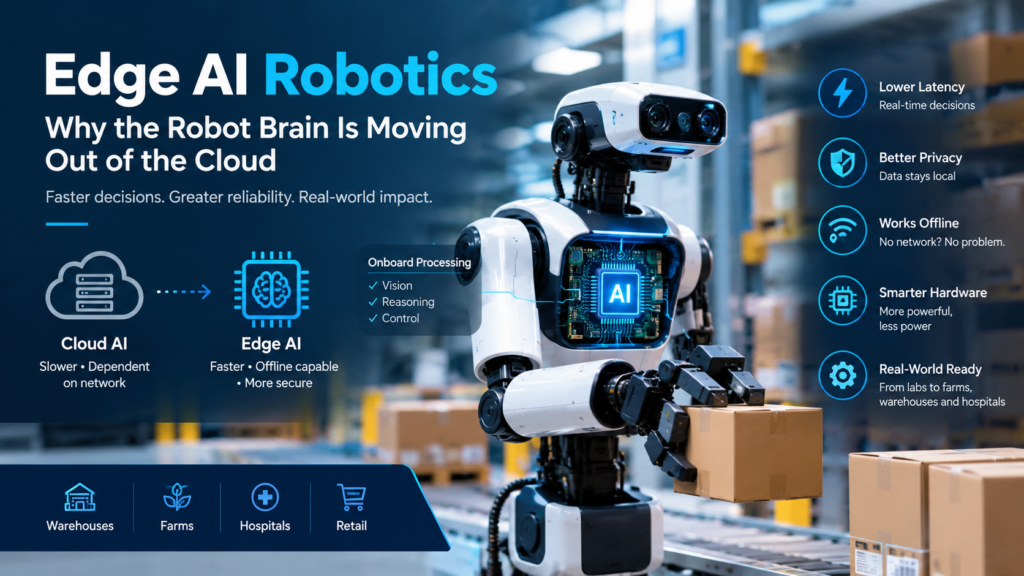
Robots are leaving the lab and walking into warehouses, farms, hospitals and grocery stores, and their intelligence is leaving the data center with them. Edge AI robotics is the practice of running a robot’s perception, reasoning and control models directly on the machine, so it can see, decide and act in milliseconds without depending on a network connection. That one design choice explains why the next generation of useful robots will look very different from the chatbot-style AI most of us use on a screen today.
This guide explains what the idea means, why it is accelerating in 2026, which technologies make it work, where it is already being used, and how students and engineers can build skills in it. Each section is written to stand alone, so you can jump straight to the part you need.
Quick answer
- Robots act in the physical world, where a delayed decision can mean a dropped package or a safety incident.
- Running models on the device removes the network round trip and keeps working when connectivity fails.
- Local processing also keeps camera and sensor data on the machine, which helps with privacy.
- Smaller, more capable models and low-power chips have made this practical.
- The hard part is no longer the demo. It is deploying, updating and securing thousands of machines.
What Is Edge AI Robotics?
Definition: Edge AI Robotics in One Paragraph
Edge AI robotics combines two ideas. “Edge AI” means running machine learning models on or near the device that collects the data, instead of sending that data to a remote server. “Robotics” means machines that sense their surroundings and take physical action. Put together, the robot carries its own decision-making brain: cameras, microphones, radar, motion sensors and force sensors feed models that run on the robot’s onboard processors, and those models drive the motors, grippers and wheels.
Expansion: What “The Edge” Actually Means
The edge is not one place. It is a spectrum of locations where computing happens close to the source of data. At one end sits a tiny microcontroller inside a sensor that runs a model in a few kilobytes of memory. At the other end sits a powerful embedded computer inside a humanoid robot or an autonomous vehicle. In between you will find gateways, factory-floor servers and on-premises edge nodes. One engineer’s framing, shared in a talk at an Edge AI Foundation meeting in London, is that edge AI is better understood as a set of constraints (power, latency, precision, reliability and safety) than as a physical location.
How Edge AI Robotics Differs From Cloud Robotics
Cloud robotics sends sensor data to a remote data center, runs heavy models there, and returns instructions. That approach is flexible and easy to update, but every decision pays a network toll. In an edge-first design, the time-critical loop (see, decide, act) runs locally, and the cloud is used only for jobs that can tolerate delay, such as long-term analytics, fleet management or retraining models.
Edge AI vs. Physical AI vs. On-Device AI
These three terms overlap, and people often use them interchangeably. They describe different things:
- Edge AI describes where the computation happens: near the data source rather than in a remote data center.
- Physical AI describes what the system does: perceive, reason and act on the real world through robots, vehicles or industrial machines. Analog Devices uses the related term “physical intelligence” for AI systems that perceive, reason and act locally on real-world signals such as motion and sound.
- On-device AI describes how the model is deployed: the model’s weights and inference run on the product itself, such as a phone, a camera or a robot.
A warehouse robot that runs its vision model on its own processor is all three at once. Physical AI gives the robot its purpose, and on-device AI is the deployment method. Edge AI is the architecture that ties them together.
Why Robots Are Moving Intelligence to the Edge
Latency: Physical Systems Cannot Wait
A chatbot that pauses for two seconds is mildly annoying. A robot arm that pauses for two seconds while a person’s hand is nearby is a hazard. Control loops in robotics often need responses in milliseconds, and the round trip to a cloud data center is both slower and less predictable than local inference. Processing on the machine removes that variable delay.
Privacy: Sensor Data Stays Local
Robots working in homes, hospitals and shops capture video, audio and spatial maps of private places. When the model runs on the device, raw footage does not have to leave the building. Only compact results, such as “shelf three is empty” or “person detected in zone B”, need to be transmitted. This reduces exposure and makes compliance conversations easier.
Connectivity: Robots Must Work When the Network Does Not
Farms, mines, ships, construction sites and many factory floors have patchy connectivity. An edge-first robot keeps working through a dropout. This resilience is a core reason industrial buyers are interested in the approach.
Energy and Cost: Less Data Moving, Less Money Spent
Streaming high-resolution video from hundreds of machines to the cloud is expensive in bandwidth and cloud compute. Doing the first pass of analysis on the device means only the useful signal travels. Evgeni Gousev, Chair of the Edge AI Foundation, has described edge AI as arguably the only scalable way to run AI in the real world, because it collects, analyzes and acts on data where that data lives.
Question → Direct Answer: Why Not Just Use the Cloud?
Can’t robots simply use powerful cloud models? They can for non-urgent work. But a robot that depends on the cloud for every decision inherits the network’s delays, outages and costs. The practical answer for most deployments is a hybrid: fast, safety-critical decisions at the edge, and heavy or slow tasks in the cloud.
Cloud vs. Edge vs. Hybrid: How Robot Architectures Compare
The table below summarizes the trade-offs between the three common designs.
| Factor | Cloud-Only Robot | Edge-First Robot | Hybrid Robot |
| Decision latency | Higher and variable (network dependent) | Low and predictable | Low for critical loops, higher for planning |
| Works offline | No | Yes | Yes, with reduced features |
| Data privacy | Raw data leaves the site | Raw data can stay on-device | Only summaries leave the site |
| Model size | Very large models possible | Limited by onboard power and memory | Large models for planning, small for control |
| Running cost | Ongoing cloud compute and bandwidth | Higher upfront hardware, lower running cost | Balanced |
| Updating models | Instant, centralized | Requires over-the-air update process | Needs a managed update pipeline |
| Best suited for | Non-urgent analysis, simulation | Safety-critical, real-time tasks | Most commercial robots at scale |
For most commercial products, the hybrid column is where the industry is heading, with the time-critical loop firmly at the edge.
The Technology Stack Behind Edge AI Robotics
A modern edge-powered robot is a stack of hardware and software layers. Understanding each layer helps you decide where to learn first.
Sensors: How Robots Perceive the World
Cameras are the best-known sensor, but they are not the only one. Radar, lidar, microphones, inertial sensors and tactile sensors all contribute. A growing area is signal-based sensing, where radar or other signals replace cameras for tasks like presence detection. That matters in places where cameras raise privacy concerns.
Edge AI Chips: The Processing Muscle
Edge AI chips are processors designed to run neural networks efficiently within tight power and thermal budgets. They include neural processing units (NPUs), GPUs for embedded systems, digital signal processors and ultra-low-power microcontrollers. When evaluating them, engineers look at performance per watt, memory bandwidth, supported model formats and software tooling. Hardware matters, but the software toolchain often decides whether a team can ship on time.
Compact Models: Capable AI That Fits on a Device
The biggest enabler has been the improvement of smaller models. Industry newsletters in 2026 have described a shift in which models in the range of a few billion to a few tens of billions of parameters are moving onto edge hardware, and open model families such as Google’s Gemma 4 are pushing multimodal capability onto devices. Techniques like quantization, pruning and distillation shrink models further while keeping most of their accuracy.
ROS 2 and Middleware: The Plumbing
Robot Operating System 2 (ROS 2) is a widely used open-source framework that connects sensors, planners and actuators. Chip vendors now publish tutorials for running AI workloads on their hardware within ROS 2 pipelines, which lowers the barrier for teams that do not want to build everything from scratch.
Fleet Management: Updating Robots in the Field
Deploying a model to one robot is a project. Deploying and monitoring it across thousands is an operations problem. Teams need secure over-the-air updates, version control for models, telemetry, rollback and remote diagnostics. Speakers at industry events in 2026 have pointed to orchestration, safety and continuous learning in distributed environments as the main open challenges for scaling agentic behavior at the edge.
Real-World Use Cases of Edge AI Robotics
Edge-powered robots are already finding work. Examples that illustrate the range:
- Grocery and warehouse fulfillment: Companies such as Blue Collar Robotics are building remotely operated, task-specific robots that augment workers, starting with grocery picking and expanding into other physical industries. The goal discussed on a CES 2026 panel was to address labor shortages without replacing people.
- Factories and industrial inspection: Local vision models can check parts on a line in real time and flag defects without sending every image to the cloud.
- Agriculture: Robots and sensors in fields can identify weeds or crop stress where connectivity is poor.
- Healthcare: Devices that listen, measure and respond in real time can support clinicians while keeping sensitive patient data close to the source.
- Smart cities and infrastructure: Autonomous inspection drones and roadside sensors can analyze conditions locally and report only exceptions.
- Consumer devices: Home robots, appliances and wearables benefit from instant response and from keeping personal data inside the home.
A recurring theme from these examples is that the AI must be reliable first and impressive second. In safety-critical settings, a system has to match or beat human performance to be worth deploying.
The Edge AI Foundation’s Role in Physical AI
The Edge AI Foundation is a global non-profit community focused on efficient, affordable and scalable edge AI. It began in 2018 as the tinyML Foundation and rebranded in 2024 to reflect a broader scope that now stretches from ultra-low-power machine learning to more advanced edge computing. According to coverage of the rebrand, the community supports more than 100,000 individuals through education and events.
Its initiatives include Edge AI Labs, a hub for shared datasets, models and code, and Edge AIP, a partnership between academia and industry that is planning certificates and scholarships. For anyone entering the field, this combination of community, open resources and training pathways is a useful starting point. It also shows why tinyML skills (running small models on very constrained devices) remain relevant even as robots grow more powerful: the discipline of fitting intelligence into tight power and memory budgets is exactly what edge deployments demand.
Challenges Still Ahead
Optimism should be balanced with realism. Several obstacles slow adoption:
- Fragmented software ecosystems. Different chips come with different toolchains, which makes models harder to port. Gousev has pointed to this fragmentation and to the shortage of skilled integrators as real barriers to deploying edge AI at scale.
- The demo-to-deployment gap. A robot that works in a controlled demo can fail in a cluttered, changing environment. Industry commentary in 2026 stresses that the hardest work starts after the demo.
- Safety and validation. Proving that a learned model behaves safely across thousands of edge cases is difficult and expensive.
- Security. Every deployed robot is a networked computer with cameras and actuators, so device identity, secure boot and signed updates are essential.
- Power and thermal limits. Bigger models drain batteries and generate heat, so engineers constantly trade capability against runtime.
- Continuous learning. Robots need to improve from experience without drifting into unsafe behavior, which requires careful data and evaluation pipelines.
What Edge AI Robotics Means for Students and Engineers in India
India has a large pool of engineering graduates, a growing electronics and embedded ecosystem, and strong demand for automation in manufacturing, logistics and agriculture. That combination makes the field a promising career path for students and early-career professionals, especially those who can combine machine learning knowledge with embedded systems skills.
Skills Worth Building First
- Python and C/C++: Python for model work and C/C++ for performance-critical embedded code.
- Machine learning fundamentals: Computer vision, sensor fusion and model evaluation.
- Model optimization: Quantization, pruning and conversion to formats that run on edge hardware.
- Embedded systems: Microcontrollers, single-board computers and basic electronics.
- ROS 2: The standard way to connect robot components.
- MLOps for devices: Versioning, deployment and monitoring of models on fleets.
Why Early Learners Have an Advantage
Edge AI is a young discipline, and the open datasets, community events and free tooling mean beginners can build real projects on inexpensive hardware. A portfolio that shows a working model running on a small device, with measured latency and power use, is more convincing to employers than a certificate alone.
How to Get Started With Edge AI Robotics
If you want to move from reading to building, follow this path:
- Pick one narrow problem. For example, detecting whether a shelf is empty or whether a door is open.
- Train a small model. Use a public dataset and a lightweight architecture.
- Optimize it. Quantize the model and measure the accuracy you lose.
- Deploy it on real hardware. A single-board computer or a microcontroller board is enough.
- Measure what matters. Record latency, memory use, power draw and error rate.
- Connect it to action. Use ROS 2 or a simple motor controller so the model’s output triggers a physical response.
- Add a safety layer. Define what the system does when confidence is low.
Document every step publicly. Writing about your measurements is as valuable as the code.
Frequently Asked Questions
What is edge AI robotics in simple terms?
It is robots that think for themselves on their own hardware, rather than asking a distant server what to do. Their sensors feed models running on the machine, and the machine acts on the result immediately.
Is edge AI the same as physical AI?
No. Edge AI describes where the computing happens, close to the data source. Physical AI describes AI that perceives and acts in the real world. Many robots use both, which is why the terms are often mentioned together.
Do edge-powered robots still need the cloud?
Usually yes, but for different jobs. The cloud handles fleet monitoring, large-scale analytics, simulation and model retraining. The robot handles the real-time decisions on its own.
Which hardware runs AI at the edge?
Options include microcontrollers for tiny models, embedded GPUs and neural processing units for heavier vision and language models, and specialized accelerators. The right choice depends on power budget, model size and cost.
How do I learn it without expensive equipment?
Start with a low-cost single-board computer or microcontroller, a public dataset and open-source tools. Free community resources, including those from the Edge AI Foundation, can guide your first projects.
Will edge AI robots replace human workers?
Evidence from current deployments points to augmentation more than replacement, with robots handling repetitive or hazardous tasks while people supervise and handle exceptions. Outcomes will vary by industry and by how companies choose to deploy the technology.
Conclusion: The Robot Brain Belongs Where the Action Is
The central idea is simple. When a machine has to act in the physical world, its intelligence works best close to the action. That is why edge AI robotics is moving from research prototypes to commercial products: models are getting smaller, chips are getting more efficient, and the economics of sending everything to the cloud are getting harder to justify.
The opportunity is real, but so is the work. Teams that succeed will treat deployment, safety and fleet operations as seriously as model accuracy. For learners, the path is open: pick a small problem, run a model on real hardware, measure it honestly, and keep building.