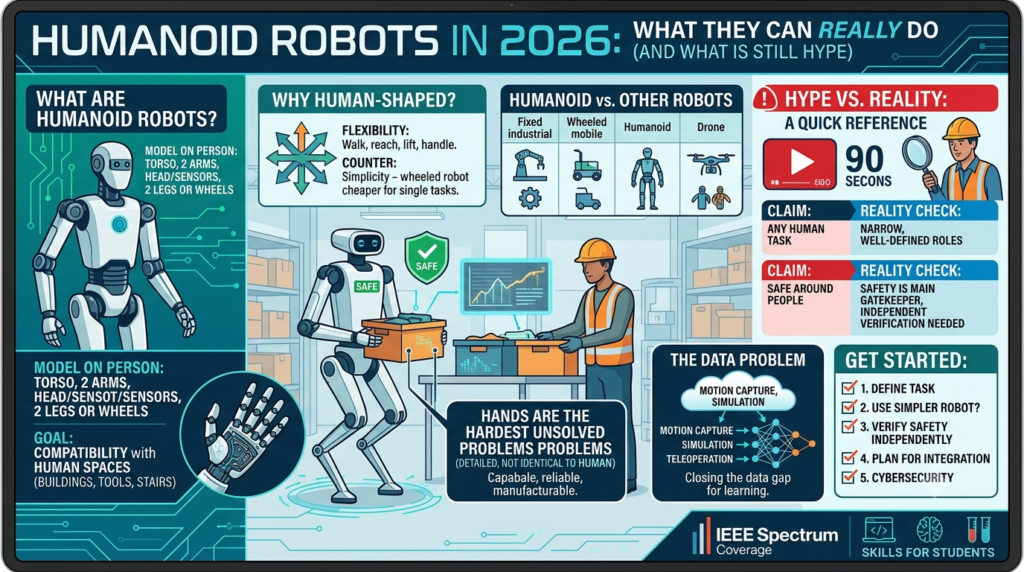
Humanoid robots are human-shaped machines built to work in spaces designed for people, and in 2026 they are useful but narrow. They can handle repetitive, well-defined tasks under controlled conditions, while safety, dexterous hands, and reliability decide where they can actually be deployed. For founders, students, and operations leaders, the practical answer is to plan for pilots and specialized roles, not for a general-purpose robot butler.humanoid robots 2026
Every few months a new demo video goes viral, and every few months an engineer points out that a 90-second clip is not a full shift on a factory floor. This guide separates the two. You will get plain definitions, direct answers to the questions people ask AI assistants most, comparison tables, and a checklist for judging any robot claim. It draws on recent coverage in IEEE Spectrum’s robotics section, which shows real progress on safety and hardware alongside a sober look at scaling.
Key takeaways
- Human shape is a compatibility strategy, not a goal in itself. It pays off only when the environment cannot be redesigned.
- Safety is the main gate to deployment. A machine that can fall, grip, and carry is harder to certify than a fenced-off arm.
- Hands, data, and reliability are the hardest unsolved problems, more than walking.
- Treat vendor demos, sponsored content, and whitepapers as claims to verify, not as evidence.
What Are Humanoid Robots?
Definition: A humanoid robot is a machine whose body plan is modeled on a person: a torso, two arms, a head or sensor pod, and either two legs or a wheeled base.
Expansion: The point is not to imitate people for its own sake. The point is compatibility. Buildings, shelves, tools, stairs, and vehicles were all designed around human proportions. A machine with similar reach and height can use that existing infrastructure without anyone rebuilding it around the robot. That is the whole business case in one sentence: one adaptable platform instead of a custom machine for every job.
Why Build a Human-Shaped Machine?
The strongest argument is flexibility. A factory or warehouse that changes its layout often cannot keep re-tooling around fixed machines. A general body that can walk, reach, lift, and use handles built for people could, in theory, move between tasks with only a software change.
The strongest counterargument is simplicity. For many jobs, a wheeled robot with a lift and a gripper is cheaper, more stable, and easier to certify. The honest rule of thumb: choose a human-shaped body only when the space cannot be changed and the tasks vary.
How Do They Compare With Other Robots?
| Robot type | Best for | Main strength | Main limitation |
|---|---|---|---|
| Fixed industrial arm | Repetitive work in a fixed cell | Speed, precision, mature safety standards | Cannot move; usually needs a fenced workspace |
| Wheeled mobile robot | Hauling goods across a warehouse | Simple, stable, cost-effective | Limited manipulation; struggles with stairs and clutter |
| Humanoid (legged or wheeled) | Varied tasks in spaces built for people | Reach, tool reuse, access to human-scale environments | High complexity and cost; safety and reliability still maturing |
| Drone | Inspection and aerial work | Access to hard-to-reach places | Short flight time; limited payload and manipulation |
How Do Humanoid Robots Work?
Direct answer: They combine three layers: sensors that perceive the world, software that decides what to do, and actuators that move the body. Modern systems increasingly use machine learning for the decision layer, which is where the term “physical AI” comes in.
Perception: Seeing and Sensing
Cameras, depth sensors, and force or touch sensors give the machine a picture of its surroundings and of what its hands are doing. Perception is harder than it sounds. A box in a warehouse can be dented, shiny, partly hidden, or stacked at an angle, and the robot has to cope without a human adjusting the scene.
Decision-Making: Physical AI
Definition: Physical AI refers to AI models that perceive and act in the physical world, as opposed to models that only read and write text or generate images.
Expansion: A language model can be wrong and the cost is a bad paragraph. A physical AI system that is wrong can drop a tote, collide with a person, or tip over. That is why the field spends so much effort on testing, simulation, and fallback behavior, and why progress looks slower in practice than in demos.
Movement and Balance
Actuators (motors and joints) turn commands into motion, while control software keeps the body balanced. Walking on two legs is an ongoing balancing act, which is one reason many commercial designs stay conservative about speed and environment.
Why Safety Is the Real Gatekeeper
If you remember one idea from this article, make it this one: humanoid robot safety, not intelligence, often decides whether a robot can leave the lab.
Physical Safety: Working Next to People
Traditional industrial robots are usually fenced off so that people never share their workspace. A mobile, human-sized machine that is meant to work among people cannot rely on a fence. It has to be designed so that a failure does not hurt anyone.
IEEE Spectrum reported in September 2026 that Agility Robotics’ Digit 5 may be the first humanoid worker that is truly safe, describing it as big enough and safe enough to do useful work. Note the careful wording: “may be.” Safety claims deserve independent validation, a documented risk assessment, and clear limits on where and how the machine may operate.
Cybersecurity: The Other Half of Safety
A connected robot with cameras, microphones, and powerful motors is both an IT device and a physical hazard. A sponsored article on IEEE Spectrum in September 2026 argued that AI-driven robots need protection against stealthy cyber threats. It is vendor-sponsored, so read it as one company’s perspective, but the underlying point is sound: if software can be compromised, the consequences are physical, not just digital.
Why Robotic Hands Are the Hardest Problem
Walking gets the headlines, but robotic hands are where many projects stall. A hand has to be strong enough to lift, gentle enough to hold something fragile, durable enough to survive thousands of cycles, and cheap enough to manufacture. IEEE Spectrum’s October 2026 coverage of a new hand for the Atlas robot makes the same point: building a hand that is capable, reliable, and manufacturable is a very hard problem. The article also suggests the new design may outperform humanlike hands.
That is a useful lesson. Humanoid robots may end up with hands that look nothing like ours. Another recent Spectrum story, on a detached robotic hand that uses its fingers to walk, shows researchers treating body parts as multipurpose tools rather than copying human anatomy. Human-shaped does not have to mean human-identical.
The Data Problem Behind Robot Learning
Language models learned from enormous amounts of text already on the internet. There is no equivalent library of “how to handle a box” or “how to fold a towel.” Teams therefore collect their own demonstrations using motion capture, remote operation by people, and simulation.
A whitepaper published through IEEE Spectrum in October 2026 describes HiPHI, a large motion-capture benchmark from Noitom Robotics, as an attempt to close the data gap that limits how well humanoid robots can learn. It is a company-published whitepaper, so treat it as a claim rather than a verdict. Still, it shows where the field is investing: better data, not just better hardware.
Hype vs. Reality: A Quick Reference
IEEE Spectrum’s September 2025 feature “Reality Is Ruining the Humanoid Robot Hype” argued that scaling is far harder than viral videos suggest. The table below turns that skepticism into practical questions you can ask. Keep it handy whenever you watch demos of humanoid robots.
| Common claim | Reality check | Question to ask the vendor |
|---|---|---|
| “It can do any task a person can” | Most deployments cover a narrow set of tasks | Which three tasks does it do reliably today, and at what success rate? |
| “It works safely around people” | Safety depends on design, environment, and certification | What independent safety assessment has it passed, and under what conditions? |
| “The demo shows full autonomy” | Demos may be edited, rehearsed, or remotely operated | Was the demo continuous, unedited, and fully autonomous? |
| “It will pay for itself quickly” | Costs include maintenance, downtime, and integration | What is the total cost of ownership over three years? |
| “It learns new tasks on its own” | New tasks usually need data, tuning, and testing | How long does it take to add a new task, and who does the work? |
Where Are Humanoid Robots Used Today?
Most real deployments are pilots and specialized roles. Common areas include:
- Warehouse automation: Moving totes and containers is the most frequently cited early use case, because the tasks are repetitive and the environment is structured.
- Research and education: Universities and labs use these platforms to study locomotion, manipulation, and learning, and many of the newest designs first appear here.
- Disaster response and inspection: Researchers are testing modular and bioinspired robots for hard-to-reach or hazardous environments, as Spectrum’s weekly video roundups regularly show.
- Assistive robotics: Mobile manipulators designed to help people with everyday tasks at home are an active research area, though they remain far from mass adoption.
How Should You Evaluate a Humanoid Robot Project?
Whether you are buying, investing, or writing about this field, a simple checklist helps:
- Define the task first. Write down the exact job, the environment, and the success metric before looking at any robot.
- Ask whether a simpler robot would do. A wheeled platform or fixed arm may meet the need at lower cost and risk.
- Verify safety independently. Request documentation, assessments, and operating limits, not just assurances.
- Test reliability over time. One good run proves little. Look for results across many hours and many conditions.
- Check the cybersecurity posture. Ask how updates, remote access, and data are protected.
- Plan for integration. Software, training, maintenance, and workflow changes are often the largest cost.
Frequently Asked Questions
Are humanoid robots safe to work around?
It depends on the design, the environment, and the controls in place. Some newer platforms are explicitly engineered for safer operation near people, but safety claims should be verified independently, and no machine is safe in every context. Always follow the manufacturer’s guidance and your local safety requirements.
Can humanoid robots do household chores?
Not reliably yet. Homes are cluttered, unpredictable, and full of fragile objects, which makes them far harder than a structured warehouse. Research on assistive robots is advancing, but a general household helper remains a long-term goal rather than a product you can count on today.
Will humanoid robots replace human workers?
In the near term, they are more likely to take on specific repetitive or physically demanding tasks than to replace whole jobs. The wider effect on employment is genuinely uncertain and depends on cost, reliability, and how companies reorganize work, so be cautious of anyone who claims to know exactly how it will play out.
Do these machines need AI to function?
They need software that controls movement and balance, and many use machine learning for perception and decision-making. How much “AI” is involved varies widely, which is another reason to ask vendors precisely what their system does on its own.
What is the difference between robotics and physical AI?
Robotics is the broader engineering field covering bodies, sensors, and control. Physical AI is the subset that uses learned models to let machines perceive and act in the real world. Most modern projects combine both.
Skills for Students and Early-Career Engineers
If you want to build a career around this field, the demand is not only for mechanical engineers. Useful skills include:
- Programming and control basics: Python, C++, and an understanding of control systems.
- Machine learning for perception and planning: Computer vision, reinforcement learning, and imitation learning.
- Simulation and testing: Building and validating behavior in simulated environments before it touches the real world.
- Safety and security thinking: Risk assessment, functional safety concepts, and basic cybersecurity.
Hands-on projects matter more than certificates. Even a small mobile robot with a camera teaches the core loop of sensing, deciding, and acting.
Conclusion: A Realistic Outlook
The outlook for humanoid robots is neither a hype bubble about to pop nor a revolution about to land in your living room. It is a field making real progress on safety, hands, and learning data, while still struggling with cost, reliability, and scale. The most useful stance is informed optimism: watch the demos, ask the hard questions, and judge each system by what it does reliably in a real environment.
Start with the task, not the robot. If a simpler machine does the job, use it. If the environment really is built for people and the work really does vary, a human-shaped platform may earn its place, provided the safety and security case holds up.