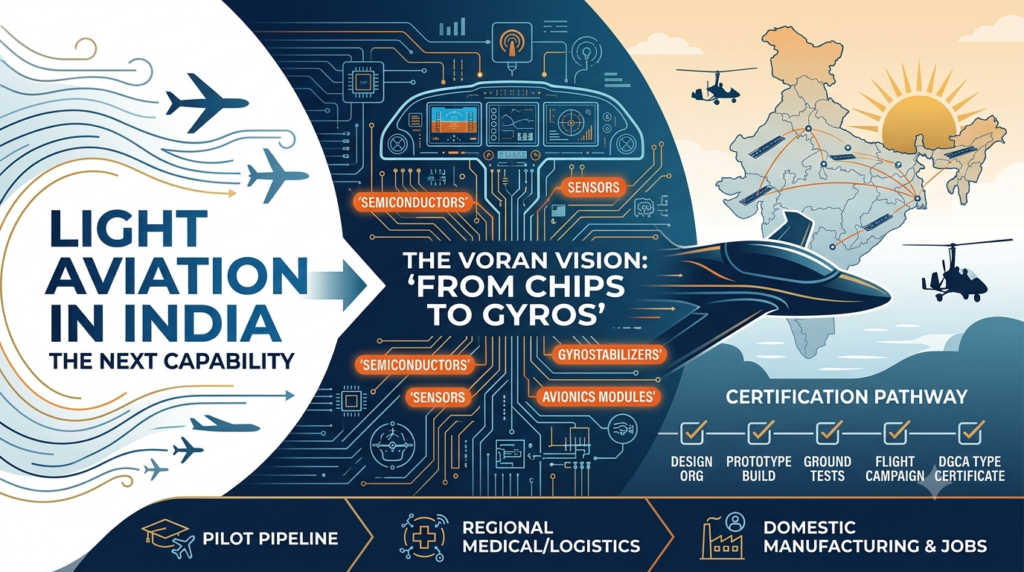
Light aviation in India is the small-aircraft segment of civil flying, covering training planes, private aircraft, microlights and survey platforms, and it is the part of Indian aerospace with the widest gap between demand and domestic supply. That gap is the opening a new company called VORAN says it wants to address, according to a press release titled “From Chips to Gyros” published by Bots & Drones India.
If you have ever wondered why India builds satellites and fighter jets but still imports most of the small aeroplanes its flying schools use, this guide is for you. Below, you will find clear definitions, direct answers to the questions people actually ask, a comparison of imported and indigenous aircraft, a certification roadmap, and an honest look at what is and is not publicly known about VORAN.
At a Glance
- What it is: a segment of general aviation using small, lightweight aircraft, usually with one to four seats.
- Who regulates it: the Directorate General of Civil Aviation (DGCA) under the Ministry of Civil Aviation.
- The core problem: a large share of the aircraft flying in this segment are designed and built overseas.
- The VORAN angle: its press release headline points to a path that starts with electronics and sensing (“chips to gyros”) rather than a finished airframe.
- The hard part: certification, supply chains and sustained funding, not the engineering concept itself.
What Is Light Aviation in India?
Definition: Light aviation is the category of civil flying that uses small, lightweight aircraft, typically with one to four seats and piston or electric propulsion, instead of large airliners.
Expansion: In practice, the category includes trainer aircraft used by flying schools, privately owned aeroplanes, microlights and ultralights, aerial survey and patrol platforms, and, depending on the definition, light gyroplanes and small helicopters. Within the wider picture of Indian aviation, these aircraft belong to general aviation, which regulators treat separately from scheduled airline operations. For an Indian reader, the simplest mental model is this: if the aircraft is not carrying paying airline passengers on a schedule and is small enough to land at a modest airstrip, it probably belongs here.
Which Aircraft Count as “Light”?
Question: Is there a single official weight limit?
Direct answer: No single number fits every context. Weight and seat limits differ between regulatory categories such as microlight, light sport and small certified aeroplanes. Internationally, small aeroplanes are commonly certified against standards such as FAA Part 23 or EASA CS-23, and national authorities define their own lighter categories on top of that. For the exact thresholds that apply in India, check the current DGCA Civil Aviation Requirements.
Who Regulates the Sector?
Question: Which agency approves a light aircraft in India?
Direct answer: The Directorate General of Civil Aviation (DGCA) is the primary regulator for aircraft airworthiness, pilot licensing and flying training organisations. The Airports Authority of India manages much of the airspace and airport infrastructure, and the Bureau of Civil Aviation Security handles security rules. Any company that wants to build and sell a new aircraft type has to work through DGCA processes, which is why certification features so heavily later in this guide.
Why India Needs a Stronger Light Aviation Base
The case for investing in light aviation in India rests on three connected pressures: the pilot pipeline, regional connectivity and import dependence. Each one is a unit of meaning on its own, so each gets its own short explanation.
The Pilot Pipeline Is Under Pressure
Question: Why does India need more light aircraft?
Direct answer: Because every airline pilot starts in a small aircraft. Indian airlines announced very large aircraft orders in 2023, including orders in the hundreds from both IndiGo and Air India, and large fleets need large numbers of trained crews. Flying schools need affordable, available trainers to produce those pilots, and a significant number of Indian trainees have historically completed part of their training abroad because domestic capacity is limited or expensive. A deeper domestic supply of trainers helps close that gap.
Regional Connectivity Needs Small Aircraft and Small Airstrips
India launched the UDAN regional connectivity scheme in 2016 to link smaller towns to the national air network. The scheme has mostly leaned on conventional turboprop and regional jet operations, yet the broader goal of making short, thin routes viable is one that smaller, cheaper aircraft could also serve in some contexts. Light aircraft are not a replacement for airline service, but they can support air taxi experiments, medical transport, aerial inspection and last-mile logistics where runways are short or unpaved.
Import Dependence Raises Costs
Most light aircraft in Indian service were designed and built overseas, with types from manufacturers such as Cessna, Piper, Diamond and Tecnam appearing frequently in training fleets. Imports expose buyers to currency swings, customs duties, long spare-parts lead times and limited customisation for Indian heat, dust and monsoon operations. This is one reason policymakers and entrepreneurs keep returning to Indian aircraft manufacturing as a strategic priority, even though the sector has a mixed record.
Who Is VORAN and What Has It Announced?
Definition: VORAN is a company that, according to a Bots & Drones India press release, has set out to build India’s next light aviation capability, with Rajiv Rawat identified as Founder and CEO.
Expansion: The press release headline, “From Chips to Gyros: VORAN Sets Out to Build India’s Next Light Aviation Capability,” frames the effort as one that begins with semiconductors and inertial sensing and works upward toward aircraft.
What Can Be Verified
At the time of writing, the publicly visible details from the source are limited to the following:
- The announcement appeared as a press release on the Bots & Drones India news platform.
- The headline describes the ambition as building India’s next light aviation capability.
- Rajiv Rawat is named as Founder and CEO of VORAN.
What Has Not Been Confirmed
Funding, aircraft specifications, certification timelines, manufacturing locations and partnerships were not available in the sources reviewed for this article. Because accuracy matters more than speculation, this guide does not fill those gaps. If you are researching VORAN for investment, partnership or career reasons, read the full press release directly and treat any claim not attributed to the company as unverified. This article will be most useful as a framework for judging VORAN’s progress as official details emerge.
What “From Chips to Gyros” Suggests
This section is an interpretation of the headline, not a statement of company plans. The phrase hints at a strategy that begins with electronic components and inertial sensors, the building blocks of flight instruments and flight control, before moving to complete aircraft. That is a plausible sequence, and the next section explains why.
Chips and Gyros: Why Avionics Is a Smart Entry Point
Starting with electronics is a pattern seen across many aerospace programmes, because avionics is where software, sensors and certification meet. For anyone tracking indigenous avionics, the logic is easy to follow.
Why Do Gyroscopes Matter in Light Aircraft?
Question: What does a gyro actually do in a small aircraft?
Direct answer: A gyroscope measures rotation, which lets a flight instrument or autopilot know the aircraft’s attitude and heading. Modern light aircraft often use compact electronic gyroscopes inside attitude and heading reference systems that feed glass cockpit displays. Mechanical gyros have largely given way to solid-state sensors because they are lighter, cheaper and easier to integrate with digital systems. A company that masters sensing, filtering and display can sell avionics to many aircraft builders, not just its own.
Where Do Semiconductors Fit?
Question: Why does a light aircraft company care about chips?
Direct answer: Because modern avionics are computers. Sensor fusion, display drivers, communication links and engine monitoring all run on silicon. India’s own semiconductor ambitions give this idea a policy backdrop: the India Semiconductor Mission was approved in late 2021 with an outlay of roughly ₹76,000 crore, aimed at building chip design, fabrication and packaging capacity. A domestic aerospace company that designs its own electronics could, over time, benefit from that wider ecosystem.
Why Start With Subsystems Instead of a Whole Aircraft?
A complete aircraft needs an airframe, an engine, systems, a design organisation, a flight test programme and a type certificate. A subsystem such as an avionics unit still needs approval, but the scope is narrower, the cost is lower, and the product can earn revenue sooner. Many successful aerospace companies grew by supplying components first and expanding later, and the same logic could apply to light aviation in India. Whether VORAN follows that path is for the company to confirm.
Imported vs. Indigenous Light Aircraft: A Practical Comparison
The table below compares the two routes at a general level. It describes typical trade-offs, not specific VORAN products.
| Factor | Imported light aircraft | Indigenous light aircraft (emerging) |
|---|---|---|
| Design authority | Overseas manufacturer | Indian design organisation |
| Upfront price drivers | Foreign currency, import duties, shipping | Development cost spread over early production |
| Certification path | Existing foreign certificate, validated by DGCA | New type certificate built through DGCA processes |
| Spares and support | Often shipped from abroad, longer lead times | Potentially local, depends on supplier base |
| Customisation for Indian conditions | Limited, depends on manufacturer | Greater flexibility for heat, dust and short strips |
| Track record | Proven, large global fleets | Limited operating history at first |
| Ecosystem benefit | Mostly in dealer and maintenance roles | Engineering, manufacturing and supplier jobs |
| Time to market | Immediate, if available | Years, due to development and testing |
The honest takeaway for light aviation in India is that imports win on maturity and indigenous aircraft win on long-term control. Neither choice is wrong, and a healthy market usually contains both.
The Certification Roadmap: How a New Aircraft or Avionics Unit Gets Approved
Question: How long does DGCA certification take?
Direct answer: There is no fixed duration, because it depends on aircraft complexity, the maturity of the design organisation and how quickly test evidence is produced. Programmes that are new to certification should plan for multiple years, not months. The steps below describe a typical sequence, and the current DGCA Civil Aviation Requirements govern the real process.
- Design organisation setup: build the engineering team, quality system and documentation habits that regulators expect.
- Certification basis agreement: agree with the regulator which airworthiness standards the design will be measured against, often aligned with FAA or EASA standards for small aeroplanes.
- Prototype build and ground testing: verify structures, systems and software behaviour before any flight.
- Flight test campaign: demonstrate performance, handling and safety margins under documented conditions.
- Type certificate: receive formal approval of the design from the regulator.
- Production approval: show that every aircraft built matches the approved design.
- Individual airworthiness certificates: each aircraft receives its own certificate before it can operate.
- Continuing airworthiness: maintenance, inspections and service bulletins keep the fleet safe over time.
For avionics, airborne software and hardware development commonly references industry assurance standards such as DO-178C for software and DO-254 for electronic hardware. Teams that understand these standards early save a great deal of rework later, which is one reason DGCA certification expertise is itself a scarce and valuable skill in India.
Opportunities and Risks for Light Aviation in India
The Opportunities
- Training capacity: affordable domestic trainers could lower the cost of producing commercial pilots.
- New use cases: aerial survey, agriculture support, medical transport and inspection missions all suit small aircraft.
- Supplier ecosystem: each aircraft programme pulls in machining, composites, wiring, electronics and software vendors.
- Policy tailwinds: Make in India and semiconductor initiatives create a supportive backdrop for aerospace manufacturing.
- Adjacent drone expertise: India’s fast-growing drone sector, supported by the liberalised Drone Rules of 2021, is building sensor, autopilot and flight control talent that overlaps with light aircraft needs.
The Risks
- Certification cost and delay: new designs routinely take longer and cost more than first plans suggest.
- Capital intensity: aircraft programmes need patient funding well before revenue arrives.
- Engine and component dependence: even an Indian airframe may rely on imported engines, propellers and certain avionics.
- Small domestic market at first: low early volumes make it hard to reach economies of scale.
- Safety reputation: any early accident can damage a young brand and slow regulator confidence.
What This Means for Indian Students, Engineers and Young Professionals
The story is not only about companies and regulators, because every aircraft programme is also a hiring programme. For students and early-career professionals, the signal worth noticing is that avionics, embedded systems and certification are skill areas where Indian demand is likely to grow as light aviation in India develops.
Skills Worth Building
- Embedded systems: C and C++ programming for microcontrollers, real-time operating systems and hardware interfaces.
- Control systems and sensor fusion: the mathematics behind attitude estimation and autopilot behaviour.
- Airworthiness standards: a working awareness of DO-178C, DO-254 and the way certification evidence is produced.
- Flight test and data analysis: collecting, cleaning and interpreting flight data.
- AI-assisted engineering: using machine learning for predictive maintenance, anomaly detection and simulation, always under proper safety assurance.
Career Paths to Watch
Roles include avionics engineer, embedded software engineer, systems engineer, flight test engineer, airworthiness and certification specialist, and manufacturing quality engineer. Freshers do not need an aerospace degree to begin, because electronics, computer science and mechanical backgrounds all feed into these teams. A practical first step is to build a small project, such as an attitude estimator using an inexpensive inertial sensor, and document it carefully.
Frequently Asked Questions
What is light aviation in India?
It is the small-aircraft segment of civil aviation, including trainers, private aeroplanes, microlights and survey platforms, regulated mainly by the DGCA and part of the broader general aviation category.
What is VORAN?
VORAN is a company whose Founder and CEO, Rajiv Rawat, is named in a Bots & Drones India press release that says VORAN is setting out to build India’s next light aviation capability. Detailed specifications and timelines were not available in the sources reviewed.
What does “From Chips to Gyros” mean?
It is the title of the press release. A reasonable reading is that the work begins with electronic components and inertial sensing before moving toward aircraft, but this is an interpretation, so confirm it with the company’s own statements.
Does India make its own light aircraft?
India has a history of designing and building aircraft, including trainers and transport aircraft through public sector and research organisations, but most light aircraft in civil service remain imported. Building a commercially competitive domestic light aircraft industry is still an open challenge.
Why does certification matter so much?
Certification is the regulator’s proof that a design is safe and that every aircraft built matches it. Without it, an aircraft or avionics unit cannot be sold for normal civil use, so it is often the longest and most expensive stage of any programme.
How can a student prepare for a career in this sector?
Build strong foundations in embedded systems, control theory and programming, learn the basics of airworthiness standards, and complete a small hardware-and-software project you can show to employers.
Conclusion: What to Watch Next
Light aviation in India has the demand, the policy attention and the talent base to grow, but it still lacks a deep domestic manufacturing core. VORAN’s announcement is one of several attempts to change that, and its “chips to gyros” framing suggests an electronics-first approach that deserves a close, evidence-based look. The signals to watch are concrete: a named product, a certification basis agreed with the regulator, flight test milestones, funding disclosures and supplier partnerships. Until those appear, treat the story as a promising direction rather than a delivered capability.
Want more clear, India-focused breakdowns of AI, deep tech and emerging industries? Explore the latest guides, workshops and learning resources at Kalinga.ai