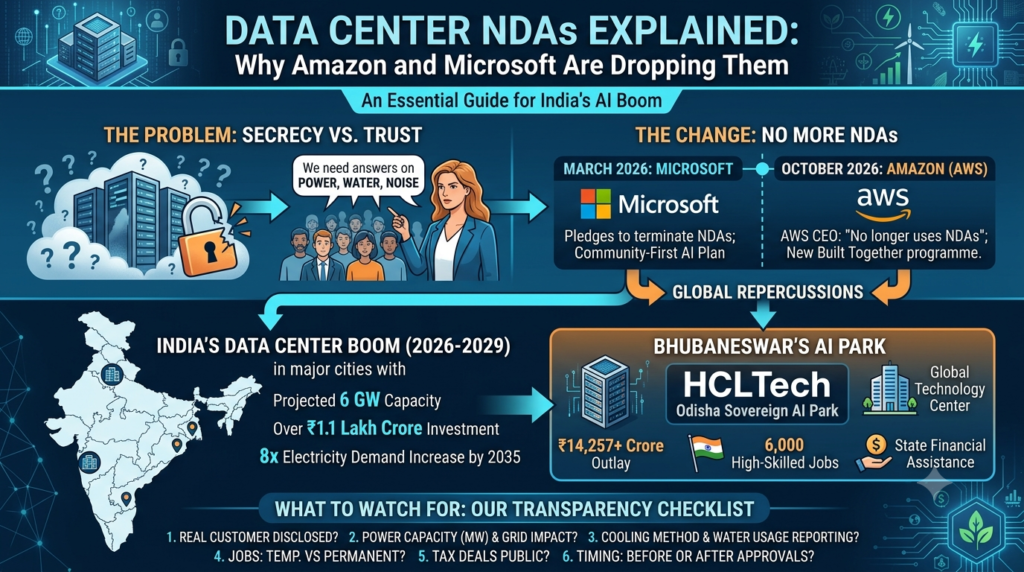
Data center NDAs are confidentiality agreements that tech companies ask local governments to sign while a project is still being planned, and both Microsoft and Amazon have now said they will stop using them. Microsoft announced its decision in March 2026, and Amazon followed on October 2, 2026, in a blog post by AWS CEO Matt Garman. The reason is simple: secrecy has become one of the loudest complaints in the AI data center backlash, and the companies need public trust to keep building.
If you are a student, fresher or young professional in India, this story matters more than it first appears. The same AI boom that powers tools like ChatGPT, Gemini and Claude needs enormous buildings full of servers, and those buildings are now being planned across India, including in Bhubaneswar. How the world’s biggest cloud companies deal with local communities today will shape how that build-out happens here.
In this guide, we explain what data center NDAs are, what Amazon and Microsoft promised (and did not promise), why governments from New York to San Francisco are pausing new projects, and what Indian readers should watch for. We also separate verified facts from company claims, because the two are not always the same thing.
What Are Data Center NDAs? (The Short Answer)
A plain-English definition
A data center is a large facility that houses thousands of computers (servers) which store data, run websites and apps, and increasingly train and run AI models. An NDA, or non-disclosure agreement, is a legal contract in which one party promises not to share certain information with others.
So data center NDAs are agreements, usually signed between a technology company and a city, county or other government body, that restrict officials from telling the public who the real customer is, how big the project will be, or what resources it will need. Reporters and local residents often learned about a project only after approvals were already moving.
Why developers asked for them
Companies did not invent NDAs to be villains. Microsoft itself explains that it sometimes used them in the early stages of development to protect sensitive commercial information, address early security considerations, and comply with local permitting processes. It also calls NDAs a common industry practice for protecting early proposals.
There are practical reasons behind that logic:
- Land prices: If sellers learn a giant buyer is coming, prices can jump.
- Competition: Rivals could learn where a company plans to expand.
- Security: Detailed designs of power and cooling systems are sensitive.
The problem is the trade-off. The same secrecy that protects a company’s plans also keeps residents in the dark about electricity use, water needs, noise and tax deals, which are exactly the issues people care about most.
What Microsoft and Amazon Actually Announced
Microsoft (March 2026)
On March 18, 2026, Microsoft published a post titled “Putting communities first,” saying it had decided to end NDAs with local governments. This followed its January 2026 Community-First AI Infrastructure Plan, which had called for more local transparency.
Key details from Microsoft’s own FAQ:
- It is working to identify active NDAs worldwide and contact local governments to terminate them.
- It may still ask to protect genuine trade secrets, for example detailed design and security specifications required for building permits, where the law allows.
- It says it may not have every project detail at the outset, because development happens in stages (land purchase, design, site grading, construction).
That last point is important. Ending NDAs does not mean a company must publish everything on day one.
Amazon (October 2026)
Amazon’s announcement is one sentence inside a long post by AWS CEO Matt Garman. Under a section called “Engaging Communities,” Amazon says it no longer uses non-disclosure agreements with the government agencies it works with on its projects. The post also commits to community open houses and to sharing plans “as early as possible.”
TechCrunch’s report notes that the same post is mostly a defence of data centers. Amazon attempts to counter four “myths” (about water, electricity prices, pollution and community benefits) and launches a new community programme called Built Together, which Amazon says will add more than $1 billion over five years.
Side-by-side comparison
| Feature | Microsoft | Amazon |
|---|---|---|
| Date announced | March 18, 2026 | October 2, 2026 (blog post) |
| Who the pledge covers | Local governments | Government agencies it works with on projects |
| Existing NDAs | Says it is working to identify and terminate them | Post says it “no longer” uses NDAs; it does not detail what happens to older ones |
| Trade secrets | May still seek protection from public-records disclosure where law allows | Not addressed in the sections we reviewed |
| Wider package | Community-First AI Infrastructure Plan (January 2026) | “Amazon Data Center Commitment” and Built Together programme |
| Official source | Microsoft Local | About Amazon |
Why Secrecy Became the Flashpoint in the AI Data Center Backlash
The AI data center backlash is not just about NDAs. Residents worry about electricity bills, water use, noise, pollution and the sheer size of new projects. But secrecy sits underneath many of those fears, because people cannot judge a project they were never told about.
Environmental activist Erin Brockovich said she received nearly 4,000 submissions in a month after asking communities to report data center issues, and that the most common concern was transparency, ahead of noise, water and bills, according to TechCrunch’s summary. She described a repeating pattern: projects announced after permits are secured, developers who do not return calls, and local officials who signed NDAs before neighbours knew anything.
TechCrunch’s Equity podcast team made a similar point on the show that inspired this article. Sean O’Kane argued that many of these projects are negotiated essentially in secret, and that this goes back to a long-running tech-industry habit. He compared it to the mid-2010s, when Uber negotiated with local governments out of public view. Co-host Anthony Ha added that dropping NDAs will not instantly win over opponents, but it is a fair starting point, because the first question residents ask is what exactly is being built.
There is also a broader trust problem. TechCrunch cites a Pew Research report finding that only 10% of Americans were more excited than concerned about AI in daily life. And Anthropic CEO Dario Amodei has described the AI backlash as fundamentally a crisis of trust. In that context, a company that hides its plans looks like it has something to hide, even when it does not.
The Data Center Moratorium Wave
A data center moratorium is a temporary pause on approving or permitting new data centers while officials study the effects. Several have appeared in 2026.
New York
On July 14, 2026, New York Governor Kathy Hochul signed an executive order that temporarily bars the state from approving new permits for data centers of 50 megawatts or larger. (A megawatt is a unit of power; 50 MW is a very large facility.) TechCrunch reported it as the first such state-level halt. The pause is expected to last until an environmental review is complete, which Hochul expects to take about a year. The same report says officials are also considering requiring data centers to pay into a fund supporting the electric grid.
San Francisco, Oakland, Santa Clara and Los Angeles County
According to KTVU, San Francisco’s supervisors unanimously approved a 45-day moratorium on data center approvals on October 6, 2026. Oakland was weighing a similar 45-day pause, and Los Angeles County received a proposal to permanently ban very large “hyperscale” data centers. (Hyperscale means extremely large facilities built by the biggest cloud companies.)
Meanwhile, Santa Clara, home to 56 data centers according to KTVU, is starting a one-year review of its rules, showing that even long-time hosts are rethinking.
Amazon’s Matt Garman claims more than 100 data center moratoriums are being considered across the United States. That figure comes from Amazon itself, and we could not verify it independently.
Do moratoriums even matter?
On the Equity podcast, Rebecca Bellan was sceptical. Many moratoriums last only a year or two, she noted, while many data centers will not come online for several more years anyway because of zoning and funding delays. Anthony Ha countered that builders clearly seem worried, and that moratoriums are often framed as time to study rather than permanent rejection, leaving room to approve later.
Our reading: the immediate effect on construction may be modest, but the political signal is large. Moratoriums force companies to answer questions in public, and ending NDAs is one of the first answers.
Will Ending NDAs Win Over Opponents?
Probably not by itself. Here are three honest reasons why dropping data center NDAs will not settle the argument.
- Transparency is necessary, not sufficient. Knowing what a company plans to build does not make the plan acceptable. Residents may still object to the electricity demand or the water use once they see the numbers.
- Trust is already low. TechCrunch quotes writer Jasmine Sun saying that when opponents hear tech companies’ arguments, the typical reaction is disbelief.
- The pledge has limits. Amazon’s language covers government agencies; it does not explain what happens to older agreements. Microsoft says it will still protect certain trade secrets. Neither company has promised to publish everything.
On the other hand, scrapping data center NDAs removes an easy criticism. When officials are free to talk, residents can ask better questions and journalists can verify claims. That is a real, if modest, improvement.
Company Claims vs Independent Evidence
Because Amazon’s post is a company document, readers should treat its numbers as company-reported claims. Here is how the main claims stack up, based only on what we could verify.
| Topic | What Amazon says | What else we found | Status |
|---|---|---|---|
| Water | Direct data center water use is about 0.5% of U.S. direct industrial water use | TechCrunch notes Amazon’s and Nvidia’s claims seem to ignore water used in power generation and chip manufacturing; scientists say independent study is needed because there are no federal or state reporting requirements | Company-reported; incomplete picture |
| Electricity prices | Rates have risen in some states and fallen or grown more slowly in others; old grids are the main cause where prices rise | TechCrunch cites an independent watchdog blaming data centers as the main culprit for a 76% year-over-year price rise on America’s largest grid | Disputed |
| Backup generators | Generators sit idle 99.9% of the time (about 10 hours per year) | TechCrunch notes a planned Amazon Texas facility is permitted for very large emissions, which Amazon says reflects maximum permit limits, not actual use | Company-reported |
| Community money | More than $1 billion contributed to U.S. communities over three years; Built Together adds $1 billion+ over five years | We found no independent audit | Company-reported |
| NDAs | No longer used with government agencies | Confirmed as a stated policy in Amazon’s post; independent verification of practice is not possible yet | Stated policy |
This table is not a verdict. It shows why transparency matters: without independent data, every side can cite numbers the public cannot check.
What This Means for India and Odisha
India’s data center boom in numbers
India is in the middle of its own build-out. According to a JLL report summarised in Indian trade media, installed capacity is expected to rise from about 1.6 GW (gigawatts) in June 2026 to 6 GW by 2029, backed by roughly $110 billion of investment. Other analysts give slightly different figures: a CBRE-based summary puts 2025 capacity near 1,700 MW, and another report puts live capacity at 1.7 GW. The difference comes from how and when capacity is counted.
On power, BloombergNEF’s projection, reported by Energetica India, says India’s data center electricity demand could grow more than eightfold, from 11 terawatt-hours in 2025 to 91 terawatt-hours in 2035. That is a forecast, not a certainty.
Bhubaneswar’s own AI data center
For readers in Odisha, the story is local. On July 24, 2026, HCLTech signed memorandums of understanding (MoUs, or formal agreements of intent) with the Odisha government to set up an AI data center at a planned Odisha Sovereign AI Park, developed with AI company Sarvam, along with a Global Technology Center in Bhubaneswar. Reporting on HCLTech’s filings puts the data center’s planned capital outlay at about ₹14,257 crore, including financial assistance from the state, and the Global Technology Center is expected to open by 2028. News agency UNI reports that the projects together attract around ₹15,000 crore over five years, with HCLTech’s Global Delivery Centre investment at about ₹730 crore and more than 6,000 high-skilled jobs expected.
A caution: different outlets attach the ₹730 crore figure and the 6,000-job figure to different parts of the project, so check HCLTech’s official filings before quoting exact numbers.
We found no evidence about whether NDAs were used in these Indian projects, and we are not suggesting they were. The US debate is simply a useful preview of the questions Indian communities may ask.
A transparency checklist for any city
Based on the complaints documented above, here is a practical checklist (our own framework, not an official standard) that residents, journalists and students can use when a large data center is proposed near them:
- Who is the end user? Is the real customer disclosed?
- How much power? What is the capacity in megawatts, and who pays for grid upgrades?
- How much water? What cooling method is used, and is usage reported publicly?
- What jobs? How many are construction (temporary) versus permanent operations?
- What tax or incentive deals? Are they public?
- When was it first disclosed? Before or after approvals?
What Students and Freshers Can Take Away
- AI is physical. Behind every chatbot is land, power, cooling and fibre. Careers in data center operations, electrical and mechanical engineering, networking and energy are growing alongside AI roles.
- Communication is a skill. As Sean O’Kane argued on the Equity podcast, the industry often explains itself poorly. People who can explain technology clearly, in writing and in local languages, will be valuable.
- Read primary sources. The most useful documents here were company blog posts, government orders and local news. Learning to read them critically is a career skill.
- Watch policy. Moratoriums, tax rules and environmental reviews shape where tech jobs appear.
FAQs
What are data center NDAs?
Data center NDAs are confidentiality agreements that tech companies ask local governments to sign during early project planning. They limit what officials can disclose publicly, such as the end customer or the project’s size, until the company allows it.
Which companies have stopped using NDAs for data centers?
Microsoft announced in March 2026 that it would end NDAs with local governments, and Amazon said on October 2, 2026 that it no longer uses NDAs with government agencies on its projects. We did not verify the position of other companies.
Does ending NDAs mean data center plans will be fully public?
No. Microsoft says it may still seek to protect trade secrets and sensitive design details where the law permits, and that it may not have all details at the start of a project. Ending NDAs removes a secrecy tool; it does not guarantee full disclosure.
What is a data center moratorium?
A data center moratorium is a temporary pause on approving new data centers, usually while officials study impacts on power, water and communities. New York’s order covers projects of 50 MW or more and is expected to last about a year; San Francisco approved a 45-day pause.
Why are people opposing data centers?
Common concerns include electricity bills, water use, noise, pollution and secrecy. Erin Brockovich said transparency was the most common concern in the reports she collected, and Pew Research found that few Americans are more excited than concerned about AI.
Is this relevant to India?
Yes. India’s data center capacity is projected to grow sharply by 2029, and major projects, including HCLTech’s planned AI data center in Bhubaneswar, are underway. We found no evidence about NDAs in Indian projects, but the questions raised in the US apply anywhere large facilities are proposed.
Conclusion
Data center NDAs were designed to protect early-stage business plans, but they also hid information that communities wanted most. Microsoft and Amazon dropping them is a meaningful first step in the AI data center backlash, though not a cure: trust, independent data and honest answers on power and water still matter more than any single policy. For India, where capacity is expected to multiply within a few years, the smartest move is to ask the transparency questions early.