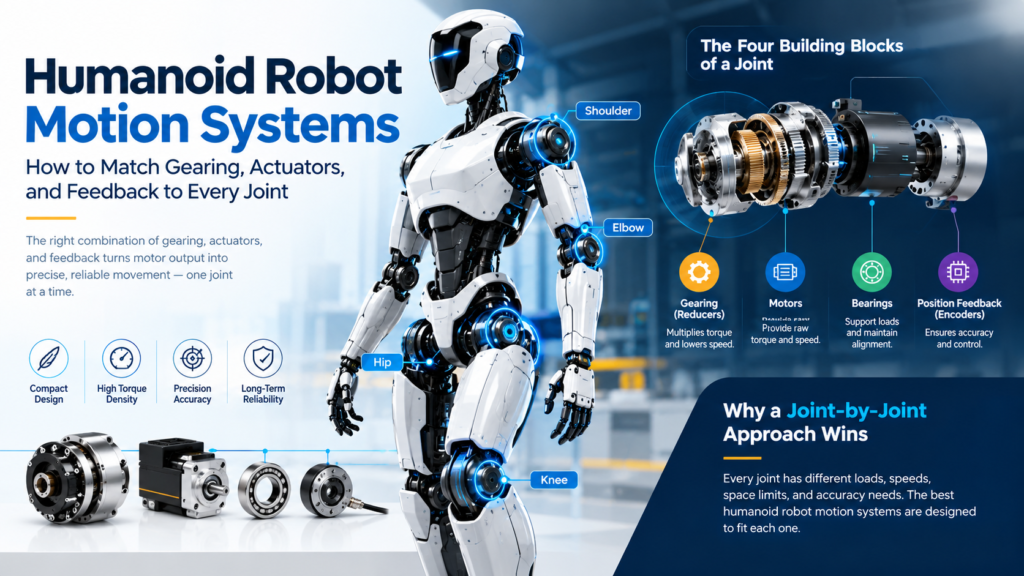
The best humanoid robot motion systems are engineered one joint at a time. Start with what each joint must do (the load it carries, the speed it needs, the accuracy it must hold, and the space it has), then choose gearing, motors, bearings, and feedback to fit.
Humanoid demos win the headlines, but the hardware hidden inside each joint decides whether a robot still performs on its ten-thousandth work cycle. This guide explains what humanoid robot motion systems are, how the main gearing technologies compare, how Timken Precision Drives approaches the problem, and a simple framework for briefing a motion supplier. It draws on The Robot Report’s October 14, 2026 coverage of Timken Precision Drives and on wider industry discussion of humanoid joint design.
What Are Humanoid Robot Motion Systems?
Humanoid robot motion systems are the combined mechanical and sensing assemblies that convert motor output into controlled, repeatable movement at each joint of a humanoid robot. They typically include a speed reducer, a motor, bearings, and position feedback, packaged into a space shaped like a human limb rather than an industrial machine.
That last point matters. A factory arm can hide a large gearbox in a bulky base. A humanoid cannot. Every gram and every cubic centimeter in a shoulder, elbow, or fingertip competes with batteries, wiring, cooling, and structure. For that reason, motion design sits at the intersection of mechanical engineering, controls, and manufacturing. It is not just component selection.
The Four Building Blocks of a Joint
A humanoid joint is usually built from four elements. Here is the job each one performs:
- Gearing (reducers): Multiplies motor torque and lowers speed to useful levels. Strain wave, cycloidal, and planetary designs are the common families.
- Motors: Supply raw torque and speed. Their size, heat output, and efficiency are tightly limited by battery capacity and enclosure space.
- Bearings: Support loads and keep rotating parts aligned, which directly affects stiffness and service life.
- Position feedback (encoders): Reports where the joint actually is, so the controller can correct errors. This sets the ceiling on positioning accuracy.
Because these parts interact, a decision on one changes the options for the others. A tighter envelope may force a different gear type, which changes how feedback is mounted, which changes how the housing is machined. These interactions, more than any single component, are what make humanoid robot motion systems difficult to get right.
Why Are Humanoids Harder to Engineer Than Industrial Arms?
Humanoids are harder because they must carry their own weight, coordinate dozens of joints, and work in spaces designed for people. The Robot Report has described humanoid motion requirements as far more complex than those of conventional industrial robots, since the machine must handle objects of varying size and weight while supporting itself and moving through unpredictable surroundings.
Three practical consequences follow:
- Weight is a first-order constraint. Heavy joints at the shoulder or hip force larger motors and bigger batteries elsewhere in the robot.
- Heat and energy matter. Many joints running on a limited onboard battery make efficiency and temperature rise design drivers, not afterthoughts.
- Reliability compounds. A robot with dozens of joints needs every one of them to be dependable, because a single weak joint can sideline the whole machine.
Why Must Humanoid Robot Motion Systems Be Designed Joint by Joint?
Each joint faces a different mix of loads, speeds, stiffness requirements, and space limits, so no single gearbox or actuator is best everywhere on the robot. Teams that standardize on one reducer for the whole body usually end up compromising somewhere. They carry excess weight in the wrists or run short of capacity in the legs.
Load-Bearing Joints: Hips, Knees, and Shoulders
These joints support the robot’s weight and the payloads it lifts. The priorities are torque capacity, stiffness, and durability under repeated loading. Gearing here tends to favor designs with strong torque transmission and load-handling capability. Bearing selection becomes just as important as the reducer, because deflection in a hip or shoulder shows up as lost accuracy at the end of the limb.
Compact Wrists and Forearms
Wrists must fit a slim envelope while still positioning a tool or hand accurately. Size and weight dominate here. Designers look for compact packaging, high torque density, and minimal backlash so that small movements stay precise. A system that works well in a hip may be far too large for a wrist, which is exactly why one-size-fits-all choices fail.
Hands and End Effectors
Hands are the most space-constrained assemblies on the robot. A human hand has roughly 27 degrees of freedom. One motor manufacturer has argued that a similarly agile robotic hand needs at least a dozen small motors, each of which must be tiny, precise, and durable at the same time. Meeting all three requirements inside a fingertip-sized footprint is why hand development often takes longer than people expect.
A Zone-by-Zone Mindset Is Spreading
Other suppliers are arriving at the same view. Kollmorgen, for example, announced a RoboBusiness session that treats humanoid motion as separate body zones with their own demands, aimed at the gap between a working prototype and a manufacturable product. The message across vendors is consistent: design for the joint, not for the average.
How Does Timken Precision Drives Approach Humanoid Motion?
Timken Precision Drives starts with the application, asking what motion is required, what loads the system must support, where the current design falls short, and what needs to change. The platform is part of The Timken Co. and brings together Cone Drive, SPINEA, CGI Motion, and Timken Encoders, so engineers can look across several technologies instead of a single product line.
According to The Robot Report, the outcome may be a standard component, a modified design, or a custom solution that combines technologies. Starting early also lets teams think through how gearing, motors, bearings, and feedback will interact in the available space. It also informs choices about reduction ratio, load capacity, allowable deflection, duty cycle, and service life. For anyone building humanoid robot motion systems, this “application first” order of operations is the most transferable idea in the approach.
Cone Drive: Strain Wave Gearing
Cone Drive contributes strain wave gearing expertise for applications that need compact packaging, high torque density, and zero-backlash positioning. Strain wave gearing is a compact reduction method that uses a flexible component to deliver high ratios in a thin, light package. Component and housed configurations give teams a starting point for application-specific designs, with room to integrate further depending on customer needs.
SPINEA: Cycloidal Gearing and Integrated Actuation
SPINEA brings cycloidal gearing and integrated actuation. Its TwinSpin reducers and DriveSpin servo actuators target applications where torsional stiffness, torque transmission, and load handling are key design considerations. Cycloidal gearing is a reduction method known for stiffness and load capacity, which makes it a natural candidate for joints that carry weight.
CGI Motion: Planetary and Micro Gearing
CGI Motion adds precision planetary and micro gearing, plus custom design and manufacturing for compact mechanisms. This capability fits cases where size, configuration, and performance demands call for a tailored approach, such as wrists, fingers, and other small assemblies.
Timken Encoders: Magnetic Position Feedback
Timken Encoders completes the mechanical portfolio with magnetic position feedback technology, available in both absolute and incremental options. Feedback is easy to treat as an afterthought, but it determines how accurately the controller knows where a joint is.
How the Pieces Fit Together
Because the four brands sit under one platform, a team can evaluate gearing and feedback together rather than shopping for each in isolation. That is valuable because feedback placement, gear choice, and housing design are tightly coupled in humanoid robot motion systems. Timken describes this breadth as the ability to look across technologies when working with customers on their specific motion requirements.
Strain Wave vs. Cycloidal vs. Planetary Gearing: Which Fits Which Joint?
Strain wave gearing suits compact, high-torque-density joints; cycloidal gearing suits stiffness- and load-critical joints; planetary and micro gearing suit compact, tailored mechanisms. The table below summarizes the trade-offs in general engineering terms. Actual performance depends on the specific product and application, so always validate against supplier data.
| Criterion | Strain wave gearing | Cycloidal gearing | Planetary / micro gearing |
|---|---|---|---|
| Core strength | Compact packaging, high torque density, zero-backlash positioning | Torsional stiffness, torque transmission, load handling | Compact, customizable mechanisms with a familiar architecture |
| Typical humanoid use | Wrists, compact arm joints | Load-bearing joints such as hips, knees, shoulders | Fingers, small joints, custom compact assemblies |
| Common trade-off | Generally lower torsional stiffness than cycloidal designs | Often larger or heavier for a given ratio | Backlash and per-stage ratio need careful attention |
| Timken Precision Drives example | Cone Drive | SPINEA TwinSpin reducers, DriveSpin actuators | CGI Motion |
| Best when | Size and precision dominate | Rigidity and load capacity dominate | Footprint and customization dominate |
Is There One Best Gearing Type for Humanoid Robots?
No. Most humanoid robots use a mix of gearing types, chosen joint by joint. For most humanoid robot motion systems, the answer is a hybrid: one family where stiffness matters most, another where weight and thickness matter most, and a tailored design where space is tightest. The goal is not to crown a winner but to match each technology to the demands of the joint.
What Does “Zero-Backlash” Mean?
Backlash is the small amount of free play between mating gear teeth, and a zero-backlash design removes that lost motion when direction reverses. In a humanoid, backlash shows up as imprecise movement and can complicate balance control. That is why compact, zero-backlash positioning is a headline feature for wrist and arm joints.
The Joint-by-Joint Motion Brief: A Seven-Point Framework
The Joint-by-Joint Motion Brief is a seven-point checklist you complete for every joint before talking to a supplier. It turns a vague request (“we need an actuator”) into a specification a motion engineer can answer. Complete it separately for each joint, because the answers will differ between a hip, a wrist, and a hand.
Here are the seven points, each stated as the question you should be able to answer:
- Motion profile: What range, speed, and acceleration must the joint deliver, and how often does it reverse direction? A joint that sweeps slowly through a wide arc has very different needs from one that makes rapid, small corrections.
- Load: What static and dynamic loads will it carry, including shocks from walking, impacts, or dropped payloads? Peak loads, not just average loads, drive durability.
- Reduction ratio: What ratio matches the motor’s speed and torque to the load? This choice shapes which gearing families are even viable.
- Allowable deflection: How much flex can the joint tolerate before accuracy suffers? Joints far from the body core amplify small deflections into large positioning errors.
- Duty cycle: How long and how hard does the joint work during a shift? Continuous operation raises heat and wear concerns that a short demo never reveals.
- Service life: How many hours or cycles must the joint last, and what maintenance is acceptable? Service expectations differ sharply between a research prototype and a deployed fleet.
- Envelope and feedback: What size and weight limits apply, and what position feedback is needed and where will it mount? These two are linked, because feedback hardware also takes space.
Points three through six mirror the factors Timken Precision Drives highlights when it works through application requirements with customers. Points one, two, and seven add the motion, load, and packaging context that makes those factors answerable. A complete brief gives suppliers what they need to propose humanoid robot motion systems that fit the joint rather than a generic catalog part.
What Should You Ask Before Choosing a Partner for Humanoid Robot Motion Systems?
Ask whether the partner starts with your application, can look across more than one technology, and can support you from concept through production. These three questions separate catalog sellers from engineering collaborators. Here are the questions in more detail:
- Do they start with the application? A good partner asks about motion, loads, and where your current design falls short before recommending anything.
- Can they combine technologies? Joints often need gearing, bearings, and feedback to work together. A partner that spans several technologies can balance them instead of optimizing one at the expense of the others.
- Can they customize? Humanoid packaging is unforgiving. Ask whether a standard part, a modified design, or a custom solution is on the table.
- Do they support production? A solution that works for ten prototypes but cannot scale is a trap. Ask about global engineering and manufacturing resources.
Timken Precision Drives positions itself on these points, describing application engineering plus specialized product expertise backed by Timken’s global engineering and manufacturing resources. Whatever supplier you evaluate, hold them to the same standard.
How Do You Move Humanoid Robot Motion Systems From Prototype to Production?
Move from prototype to production by locking joint-level requirements early, validating against real duty cycles, and choosing designs that can be manufactured at volume. Kollmorgen has framed the central challenge for humanoid makers as bridging the gap between a working prototype and a manufacturable, scalable product, and motion hardware is a big part of that gap.
Use this sequence:
- Document each joint using the Motion Brief. Capture requirements while the design is still flexible.
- Prototype with realistic loads. Light-duty bench tests hide problems in stiffness, heat, and wear.
- Test at the duty cycle you plan to sell. Run joints through the hours and cycles customers will demand.
- Review the manufacturing path early. Ask which gearing, housing, and feedback choices can scale without redesign.
- Plan for service. Decide how joints will be inspected, replaced, or repaired in the field.
Teams that skip these steps often discover late that a joint passed the demo but cannot survive deployment.
Which Mistakes Weaken Humanoid Robot Motion Systems?
The most damaging mistakes are choosing components before defining requirements, ignoring how parts interact, and treating every joint the same. Each of these is avoidable with early planning.
Picking a Part Before Defining the Problem
Starting from a catalog number locks in assumptions. Starting from the application, as Timken Precision Drives advocates, keeps options open until the requirements are clear.
Ignoring Interactions Between Parts
Gearing, motors, bearings, and feedback share one small envelope. Optimizing the reducer alone can leave no room for the encoder or force an awkward housing. Evaluate them together.
Treating All Joints Alike
A load-bearing hip and a fingertip joint have almost nothing in common. Uniform specifications waste weight in some places and starve others.
Designing for the Demo, Not the Duty Cycle
Short demonstrations hide fatigue, heat, and wear. Specify duty cycle and service life up front, even if the first prototype does not need them.
Leaving Feedback Until Last
Position feedback determines how well the controller can correct errors. Treat it as a design input from the start, not an accessory added at the end.
Where Can Engineers Discuss Humanoid Motion Challenges Next?
Timken Precision Drives plans to exhibit at Humanoids Summit Silicon Valley on December 1 and 2 at the San Mateo County Event Center. Visitors to the booth can explore the platform’s motion technologies and talk through design challenges with the team, including requirements and integration questions.
If you attend, bring a completed Joint-by-Joint Motion Brief for your toughest joint. A concrete brief makes conversations about humanoid robot motion systems far more productive than a general discussion of products. RoboBusiness 2026, which The Robot Report notes is celebrating its 20th year, is another venue where suppliers are discussing humanoid motion.
FAQ
What Is the Biggest Challenge in Humanoid Robot Motion Systems?
The biggest challenge is balancing torque, speed, stiffness, weight, accuracy, and space in each joint at the same time. Improving one usually costs another, and the right trade-off changes from the hip to the wrist to the hand. That is why joint-level design beats one-size-fits-all choices.
What Gearing Is Used in Humanoid Robots?
Humanoid robots commonly use strain wave, cycloidal, and planetary gearing, often in combination. Strain wave gearing favors compact, zero-backlash positioning. Cycloidal gearing favors stiffness and load handling. Planetary and micro gearing suit compact, customizable mechanisms. The right mix depends on each joint’s demands.
How Many Degrees of Freedom Does a Humanoid Robot Have?
It varies by design, but full-size research humanoids have shown 36 to 38 degrees of freedom. Published research on motion planning cites a 36-degree-of-freedom Boston Dynamics Atlas and a 38-degree-of-freedom NASA Valkyrie. Each degree of freedom generally means another joint that needs its own motion hardware.
Why Does Position Feedback Matter?
Position feedback tells the controller where each joint actually is, which sets the limit on accuracy and control quality. Magnetic encoders, available in absolute and incremental forms, are one way to provide it. Feedback should be designed alongside gearing, not added afterward.
Should I Choose a Standard Component or a Custom Solution?
Choose a standard component if it meets your joint’s requirements, and a modified or custom design if size, stiffness, or integration needs go beyond it. Timken Precision Drives describes all three paths: standard, modified, and custom solutions combining several technologies. A completed Motion Brief makes this decision much easier.
Conclusion
Successful humanoid robot motion systems begin with the joint, not the catalog. Define what each joint must do, compare gearing options against those needs, and treat gearing, bearings, motors, and feedback as one interacting assembly. The Timken Precision Drives approach of starting with the application, then looking across complementary technologies, reflects a broader industry shift toward joint-by-joint design.
Use the seven-point Joint-by-Joint Motion Brief on your next joint, ask suppliers the four partner questions, and test against real duty cycles before committing to production. Teams that do this early tend to avoid the expensive discoveries that come later. Applied consistently, the same discipline will make your humanoid robot motion systems lighter, more precise, and more dependable.