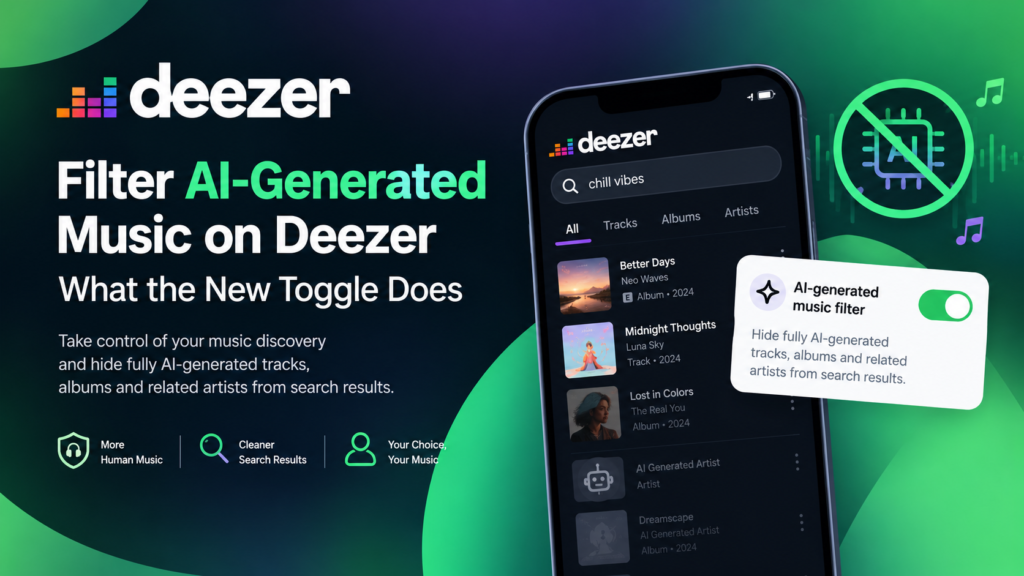
Deezer is building an on/off switch that lets you filter AI-generated music out of search. Once it is on, AI-generated tracks, albums, and related artists stop appearing in your search results, and turning it off brings that content back. The company says the feature will roll out globally before the end of 2026. Deezer will soon let you filter out AI-generated music +2
If you have ever wondered whether the song on repeat was written by a person or generated from a text prompt, you are not alone. Streaming catalogs are filling up with synthetic tracks faster than most listeners can notice. This guide covers how the toggle works, what it does and doesn’t hide, why Deezer built it, and how to filter AI-generated music today, before the feature ships.
What Is Deezer’s AI Music Toggle?
Deezer’s AI music toggle is a user setting that excludes fully AI-generated music from search results on the platform. It is the newest layer in a set of controls Deezer has built since early 2025.
Until now, Deezer’s main tools worked behind the scenes or as labels. The toggle puts the decision in the listener’s hands. Deezer’s CEO described the goal as giving people the option to remove this content from their experience and focus on human creators if they wish. The company framed it around transparency and choice rather than a ban. That distinction matters, because listeners who want to hear AI tracks can switch the setting off. musicbusinessworldwide
The toggle has three practical traits:
- It is opt-in. Listeners decide whether to use it.
- It is reversible. You can turn it off at any time.
- It targets search. Reports describe the effect on search results, not on every surface of the app.
What Does It Mean to Filter AI-Generated Music?
To filter AI-generated music means to use a platform’s own controls to keep machine-made songs out of what you see and hear. Filtering can happen at several levels, and it helps to separate them.
- Labeling: The platform tells you a track or album is AI-generated, and you decide what to do.
- De-prioritizing: The platform keeps AI tracks out of recommendations and editorial playlists.
- Excluding: The platform removes AI tracks from a surface entirely, such as search.
Deezer already did the first two. The toggle adds the third. The ability to filter AI-generated music at the search level is the part that is new.
Fully AI-Generated vs. AI-Assisted: Where the Line Falls
The toggle is aimed at fully AI-generated music, not songs where a human used AI as one tool among many. One report noted that songs made by humans with limited AI help fall outside the scope. Another said the filter applies to music generated entirely on platforms such as Suno, Udio, and Riffusion. allhiphopmezha
This is the right place to draw the line, because “AI-assisted” covers a huge range. A producer using AI to clean up vocals is doing something very different from someone typing a prompt and uploading the output. Deezer’s approach targets the second case. The catch is that no detector draws that line perfectly, which I cover below.
How Does the Deezer Toggle Work?
The setting is simple on the surface. These Q→A units cover what you are most likely to ask.
What Gets Hidden When You Filter AI-Generated Music?
Fully AI-generated tracks, albums, and the artists tied to them disappear from search results. Deezer said the toggle will stop you from seeing AI-generated tracks, albums, and related artists in search. TechCrunch
Including related artists matters. It suggests Deezer wants the filter to work at the artist level, so a profile built entirely on synthetic releases does not keep surfacing under another name.
Can You Turn the Filter Off?
Yes. The toggle is a standard on/off switch. Switching it off restores access to AI-generated tracks. That makes it a personal preference rather than a platform-wide policy. musicbusinessworldwide
When Will You Be Able to Filter AI-Generated Music on Deezer?
Deezer says the rollout will be global and complete before the end of 2026. The announcement did not include a precise launch date. Expect a staged release rather than a single day when everyone gets it. allhiphop
Is the AI Music Toggle Free?
The announcements I reviewed do not say whether the toggle is free or tied to a subscription tier. Check Deezer’s official channels when the feature lands rather than assuming either way.
Why Is Deezer Adding This Now?
Three pressures explain the timing: a flood of uploads, clear listener demand, and fraud.
The Flood of AI Uploads
AI-generated uploads have grown dramatically in about 18 months. When Deezer introduced tagging in June 2025, it reported that about 18% of daily uploads, over 20,000 tracks, were fully AI-generated. By June 2026, Deezer said 44% of new uploads were AI-generated, roughly 75,000 songs a day. TechCrunchwestfield
Upload share is not listening share. Deezer put AI music at between 1% and 3% of streams. A catalog can be crowded with synthetic tracks that almost nobody plays, but the clutter still makes it harder to find real artists. westfield
Listener Demand
A meaningful share of listeners say they want to filter AI-generated music. A Deezer/Ipsos study from November 2025 found that 45% of music streaming users would like to filter out 100% AI-generated music. Other findings from the same research point the same way: 73% of streaming users want transparency about whether they are hearing AI music, and 52% believe it should not compete with human songs in main charts. musicweekalternativeto
These are company-commissioned numbers, so read them as directional. Still, a toggle is a low-cost way to respond to that sentiment.
Streaming Fraud
Fraud is a major reason AI music is a business problem and not just a taste issue. Deezer said about 85% of listens to AI-generated tracks were tied to suspected fraudulent activity such as bot-driven streaming. Fraudulent streams are filtered out of royalty payments, so they do not drain the pool that pays human artists. westfieldTechCrunch
The toggle does not stop fraud directly. But a filter that hides synthetic catalog from search reduces the places where fraudulent uploads can pick up organic plays.
Deezer’s AI Music Timeline: From Detection to Toggle
The toggle is the latest step in a sequence. The table below shows how the controls stack.
| Stage | Control | What it does | Who decides |
|---|---|---|---|
| Early 2025 | Detection and exclusion | Keeps detected AI tracks out of algorithmic and editorial recommendations | Deezer |
| June 2025 | AI tagging | Explicitly labels AI-generated music; Deezer was the first platform to do so | Deezer (listener sees label) |
| Summer 2026 | Free multi-platform detector | Scans playlists on Spotify, Apple Music, YouTube Music, and SoundCloud for AI tracks | Listener |
| Before end of 2026 | Search toggle | Hides AI tracks, albums, and related artists from search | Listener Deezer to let users filter out AI-generated music +2 |
The pattern is worth noting. Early controls were set by the platform. The newer ones are handed to the listener. Deezer reports that it detected and excluded more than 42 million AI tracks from recommendations between January 2025 and August 2026, and that it has tagged over 14 million albums. musicbusinessworldwidealternativeto
How Does AI-Generated Music Detection Work?
AI-generated music detection is the process of analyzing audio for signals that indicate it was produced by a generative model. Deezer says it built its system by studying songs from popular generators. The company developed the detector by studying songs created with tools including Suno and Udio. westfield
Detection quality is the foundation of any decision to filter AI-generated music. If the detector is wrong, the filter hides the wrong songs. When Deezer launched tagging in 2025, its CEO said the in-house tool spotted AI markers with 98 percent accuracy. That is a company claim, and I did not find independent verification in the coverage I reviewed. ahram
Limits Worth Knowing
Even a strong detector has blind spots:
- Hybrid tracks. Songs that mix human and AI elements are hard to classify, which is part of why the toggle targets fully AI-generated work.
- New generators. Detectors are trained on known tools and must keep up as new ones appear. Deezer has said it plans to expand coverage to more sources.
- False positives and negatives. No system is perfect, so some human tracks may be flagged and some synthetic ones missed.
Treat the toggle as a strong filter, not a guarantee.
Should You Filter AI-Generated Music?
It depends on what you want from streaming. There is no single right answer, and the toggle is designed so you can change your mind.
Reasons to turn it on:
- You want to discover and support human artists.
- You are tired of generic tracks cluttering search results.
- You care about how royalty money is distributed.
- You want a listening experience that matches a “human-made only” preference.
Reasons to leave it off:
- You enjoy AI-generated music and want full access to it.
- You are curious and want to explore what generators can do.
- You worry about detection errors hiding legitimate songs.
- You mostly use playlists and recommendations rather than search.
If you are undecided, try it for a few weeks. Because the setting is reversible, trying it costs you nothing.
How to Filter AI-Generated Music Today
The toggle is not live yet, but you can already take several steps:
- Check the labels. Albums containing fully AI-generated tracks on Deezer carry an AI-generated content notice. Look for it before you save an album.
- Lean on recommendations. Because Deezer excludes detected AI tracks from recommendations and editorial playlists, its algorithmic suggestions are already less likely to surface them.
- Scan your playlists. Deezer’s free tool works with playlists from several services and does not require a Deezer account. There is a limitation: you have to delete suspect tracks yourself. westfieldwestfield
- Curate by source. Follow artists with a verifiable history, live shows, or interviews. Human context is hard to fake.
- Revisit when the toggle ships. When it arrives, enable it and see how your search results change.
Taken together, these habits get you most of the way to a human-first library before the formal option exists.
How Other Platforms Compare
Deezer is not the only service wrestling with this, but its approach is among the most specific. The table below summarizes what the sources I reviewed say. Policies change quickly, so verify current details with each service.
| Platform | Reported approach | Search-level AI filter? |
|---|---|---|
| Deezer | Tags albums, excludes AI from recommendations, offers a detector, and plans a search toggle | Announced, due before end of 2026 |
| Apple Music | Variety reported in August that Apple Music was looking to label AI tracks by the end of the year | Not reported |
| Spotify | In 2025, Spotify had not demonetized AI content and pointed to the lack of a clear definition for fully AI-generated audio | Not found in sources reviewed TechCrunchahram |
This table captures a snapshot, not a verdict. If you want to filter AI-generated music on another service, check its settings and policy pages directly.
What the Toggle Means for Artists
For human artists, the toggle could improve discoverability, but it is not a cure-all. If a large group of listeners switch it on, human-made music faces less competition in search. Combined with royalty protections, that supports the claim that Deezer wants to prioritize human creators.
There are risks too. An artist whose music is wrongly classified could lose visibility. Artists who use AI as a creative tool will want clarity on where the line sits. Transparent appeals and clear definitions will matter as the feature rolls out.
What the Toggle Means for Listeners
For listeners, the toggle is about control. You choose whether synthetic music is part of your experience. That framing is more flexible than a blanket ban, and it respects that tastes differ.
The practical effect depends on how you listen. If you search often, the ability to filter AI-generated music will change your results noticeably. If you mostly follow curated playlists and recommendations, you may feel less difference, since those already exclude detected AI tracks.
Frequently Asked Questions
Does the toggle remove AI music from my existing playlists?
The announcements describe the effect on search results. They do not say what happens to tracks already saved in playlists, so wait for Deezer’s rollout details.
Will the toggle hide songs where artists used AI for only part of the work?
Probably not. Reports say the scope is fully AI-generated music, and that human-made songs with limited AI help fall outside it.
Can I filter AI-generated music on Spotify or Apple Music?
I did not find an equivalent search toggle on either service in the sources I reviewed. Apple Music was reportedly working on labeling. Check each app’s current settings.
Does Deezer delete AI-generated music?
Not according to earlier reporting. In 2025, AI tracks were not removed from the library but demonetized. The toggle likewise hides content for users who opt in rather than deleting it. ahram
How accurate is the detection behind the filter?
Deezer has claimed high accuracy, but independent verification is limited. Treat any filter as strong but imperfect.
Key Takeaways
- Deezer will let you filter AI-generated music from search with a reversible toggle, rolling out globally before the end of 2026.
- The setting hides fully AI-generated tracks, albums, and related artists, not songs with limited AI assistance.
- It follows labels, recommendation exclusion, and a free detector, and moves control to the listener.
- Demand is real: 45% of surveyed users said they would like to filter out fully AI-generated music.
- Detection is imperfect, so expect some errors in both directions.
- You can already label-check, scan playlists, and lean on Deezer’s recommendation exclusions.
Conclusion
The toggle marks a shift from labeling AI music to letting listeners opt out of it. Whether you want to filter AI-generated music to support human artists, cut through catalog clutter, or simply listen on your own terms, the feature gives you a clear switch to flip. Its value will depend on detection accuracy, how clearly “fully AI-generated” is defined, and how smoothly the rollout goes.
For now, the smartest move is to prepare. Use labels, scan your playlists, and watch for the launch. When the toggle arrives, you will be able to filter AI-generated music in a few taps and change your mind just as quickly.