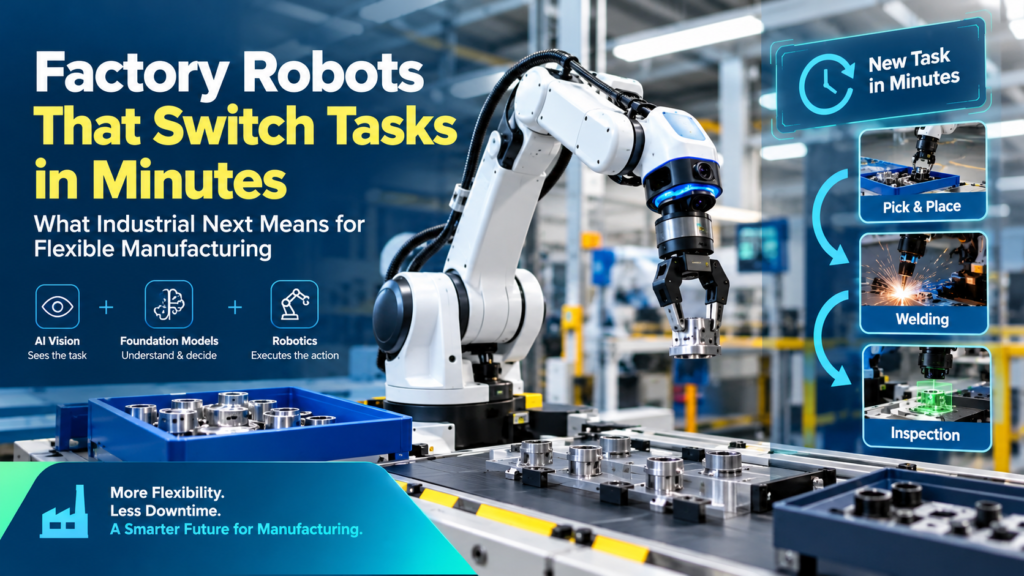
Factory robots can be retrained for a new job in minutes instead of weeks when they learn from vision and demonstration rather than hand-written code. That is the promise behind Industrial Next, a San Francisco startup that wants to retool a production line without a programming team, and it signals a real change in how factory robots will be bought, deployed, and reused.
If you run a plant, advise one, or track industrial AI, this guide gives you a clear definition, an explanation of how the technology works, a comparison table, and a checklist of questions to ask before you believe any “minutes, not weeks” claim. TechCrunch covered the company on October 13, 2026. This guide adds context on how earlier attempts at fast robot retooling fared and what to verify before you invest. Each section stands on its own, so jump to whatever you need.
What Are Factory Robots, and Why Is Retooling So Slow?
What are factory robots?
Factory robots are programmable machines, usually robotic arms fitted with grippers, cameras, and sensors, that carry out physical production tasks such as welding, picking, placing, inspecting, and packing.
For most of their history, factory robots were built for repetition. A robot welded the same seam or moved the same part along the same path, millions of times, inside a cell designed around that single job. That design is superb for high-volume lines and painful for anything that changes. The more a robot depends on fixed positions and fixed fixtures, the more expensive every change becomes.
Newer machines add machine vision and machine learning so they can tolerate variation. Even so, the programming burden has often stayed with the customer. Someone still has to tell the robot exactly what to do, and that someone is usually a scarce, expensive specialist.
Why does it take weeks to switch a robot to a new task?
It takes weeks because specialists typically have to rewrite motion paths, recalibrate cameras and fixtures, and test the new routine before production can restart.
Think of it as a changeover tax. Every time a manufacturer introduces a new part or product variant, the line pauses while engineers reprogram and validate. A 2013 World Economic Forum profile of the Baxter robot quoted roboticist Rodney Brooks saying that four months was considered an amazingly short time to get a conventional industrial robot working on one task. Traditional robots were also often caged or separated from workers for safety reasons. For plants that change products often, that delay makes conventional factory robots hard to justify. weforum
The result is a quiet bias in automation. Manufacturers automate the tasks that never change and leave everything else to people, which limits how far automation can spread. Anything that shortens robot retooling widens the range of work a robot can economically take on.
How Does Industrial Next Want Factory Robots to Switch Tasks in Minutes?
Who is Industrial Next?
Industrial Next is a robotics company that builds AI-defined work cells: robotic stations powered by proprietary foundation models that connect vision, task context, and motion. According to its company profile, it was founded in 2021 by former Tesla autonomous-manufacturing leads Allen Pan and Lukas Pankau, is based in San Francisco, and has raised roughly $22 million in rounds led by Khosla Ventures. A separate write-up places it in Y Combinator’s Winter 2022 batch. yespressyespress
Its product list covers AI-defined work cells, intelligent vision cameras, a demonstration and simulation training platform, and a flexible production line concept called Matrix. The stated target customers are automakers and electronics manufacturers, two industries where product variants multiply quickly and downtime is expensive. yespress
How does the technology work?
In short, Industrial Next’s system maps sight to action. Where a chatbot’s model maps text to text, the company’s model links visual perception, the context of the task, and the robot’s motion in one loop. Because the camera and robot are built together, the model that recognizes a part is the same one that decides how to grab it. yespressyespress
Teaching happens through robot learning from demonstration and simulation rather than code. The company describes a platform for teaching robots new tasks by showing them, with deployment in days and retooling in minutes. In practice, that means a technician demonstrates or simulates the new job, and the model generalizes from those examples instead of waiting for a programmer to script every motion. yespress
The claim is also deliberately narrow. One profile points out that the company is not promising a walking humanoid or a general robot brain. It is attacking the one bottleneck that slows most factory robots: changeover time. That focus is a big part of why the pitch is credible. Solving one expensive problem is easier than solving robotics in general. yespress
What performance has the company reported?
Company profiles report accuracy above 99.9 percent and cycle times under 3.3 seconds on production lines. Those are company-reported figures, and the profile does not say which tasks, parts, or conditions they cover. Treat them as a reason to run a pilot, not as a specification you can plan around. yespress
How Do the Main Types of Factory Robots Compare?
The table below compares three approaches on the criteria that matter most when your product mix changes often. Changeover figures reflect vendor or press reports cited in this article, not independent benchmarks.
| Criteria | Traditional industrial robot | Collaborative robot (cobot) | AI-defined work cell |
|---|---|---|---|
| How it is taught | Specialist programming | Hand-guiding or guided setup | Demonstration, simulation, and vision-based models |
| Typical changeover | Weeks to months | Minutes to hours (vendor-reported) | Minutes (company-reported) |
| Role of vision | Optional add-on | Optional, task-specific | Central to every action |
| Best fit | High-volume, unchanging lines | Short runs, machine tending, packing | High-mix lines with frequent product changes |
| Main limitation | Slow and costly to change | Limited speed and payload | Early stage; results not yet independently verified |
| Maturity | Decades of deployment | Broad commercial use | Emerging |
When should you choose each?
- Choose a traditional industrial robot when one product will run for years at high volume and the cell will rarely change.
- Choose a collaborative robot when you need proven, flexible automation for short runs, machine tending, or packing, and you can accept moderate speed.
- Choose an AI-defined work cell when your line changes often, you lack in-house robot programmers, and you can run a structured pilot to verify the claims.
The right choice among these options depends on how often your product changes. A plant that changes its product mix weekly has very different needs from one that runs the same part for a decade.
Is Robot Retooling in Minutes Actually New?
Partly. Earlier products made similar promises for narrower jobs. The new claim is that vision-driven foundation models can stretch that promise to more complex work. The history below shows the demand is real and the idea is not brand new.
- 2013, Baxter: The two-armed Baxter could be trained by grabbing its arm and showing it the task. Brooks said a new task could be set up in just a few minutes. weforum
- Donnelly Custom Manufacturing: This short-run injection molder is equipped for more than 13,000 mold changeovers a year, and it deployed two Rethink Robotics robots that can shift to a new task in minutes as the line changes. robotics247
- 2022, Rapid Robotics: The company said its Smart Setup feature let operators get its machine-tending robot back in action in minutes, and that the robot arrived pre-trained on hundreds of common tasks. robotics247
- 2026, research: A June 2026 industry podcast summary of the IEEE robotics conference in Vienna says researchers showed manipulators learning new tasks from a few human demonstrations, pointing toward changeovers in hours rather than weeks. That is a secondary source, so treat it as directional. castfox
So what is different now? Earlier systems leaned on guided teaching or libraries of pre-trained skills. Industrial Next’s pitch relies on foundation models that fuse perception and motion, which in theory could handle parts and conditions nobody scripted in advance. The Donnelly example shows why this matters. When changeovers happen several times a day, minutes versus weeks decides whether automation pays off at all.
The honest caveat is that the broader claim is still a claim. Fast retooling has been demonstrated for bounded tasks. Whether it holds across the messy variety of a real plant is the open question.
Who Benefits Most From Fast-Switching Factory Robots?
Fast robot retooling is a flexible manufacturing story, so the winners are the plants where change is constant. These manufacturers gain the most from factory robots that retool in minutes, because they change what they build often:
- Contract manufacturers: They change products constantly and run on thin margins, so cutting retooling time translates directly into value. yespress
- Electronics makers: Short product lifecycles and many variants mean the line is rarely static for long.
- Automotive suppliers: Model-year updates and option variants create frequent small changes that are costly to reprogram.
- Short-run molders and fabricators: Daily changeovers, like Donnelly’s, are where minutes-level switching pays off fastest.
- Mid-size plants without robotics teams: If no programming is required, the skill barrier drops and automation becomes an option for plants that could never staff an integration team.
- Operations with demand swings: When demand spikes, a single robot can be reassigned to a different task, which avoids buying extra hardware and saves floor space. mfgrobots
What Are the Limits and Open Questions of AI-Trained Robots?
Does faster retooling mean you no longer need robotics engineers?
No. Even the most adaptable factory robots still need people to design fixtures, validate safety, define quality standards, and handle exceptions.
Faster retooling changes who does the work and how long it takes, not whether expertise matters. A technician may now teach a task by demonstration, but someone still has to decide what “good” looks like, confirm the cell is safe around people, and integrate it with upstream and downstream equipment. Expect the role of the engineer to shift toward oversight and process design.
Will the reported results hold up outside a demo?
Not automatically. Accuracy and cycle-time numbers depend on the task, the part, the lighting, and how much variation the line sees.
A system that performs well on a curated demo can struggle with reflective surfaces, deformable parts, or a supplier switching materials. Ask for results on your parts, under your conditions, measured over weeks rather than hours. Independent pilot data is worth far more than a polished video.
Is an early-stage vendor a risk?
Yes, as with any young company. Industrial Next is described as a team of roughly 11 people. Small teams can move fast, but they raise real questions about support coverage, spare parts, long-term roadmap, and what happens if the company is acquired or runs out of runway. yespress
Before committing, ask about service-level agreements, access to your trained models and data if you leave, and how updates are tested before they reach your line.
How Should You Evaluate Factory Robots That Promise Fast Retooling?
Changeover time is the elapsed time between the last good part of one product and the first good part of the next, including setup, teaching, validation, and quality checks. Many vendors measure only the teaching step. You care about the whole interval.
That distinction is the single most useful lens for any retooling claim. A robot that learns a new motion in minutes but needs a day of quality validation has not given you a minutes-long changeover.
Use this checklist when comparing factory robots from different vendors:
- Define “retool” in writing: Confirm whether the quoted time covers teaching only, or teaching plus validation and first-good-part.
- Test on your own parts: Run a live changeover on two or three real SKUs, including your most awkward one.
- Measure under variation: Check accuracy and cycle time with real lighting, part tolerances, and material changes.
- Verify safety certification: Ask which safety standards apply to the complete cell and who is responsible for the risk assessment.
- Check integration: Confirm compatibility with your PLCs, conveyors, and manufacturing execution systems.
- Understand the commercial model: Compare purchase, lease, and subscription pricing, and clarify who owns the trained models.
- Ask about support: Get response times, on-site service options, and update policies in the contract.
A sensible pilot starts small: pick two high-mix tasks, record your current changeover baseline, run the new system for several weeks, and compare end-to-end changeover time, defect rates, and operator effort. The baseline is the part most teams skip, and without it you can’t tell whether the new system actually improved anything.
Frequently Asked Questions
Can factory robots really be retooled in minutes?
Sometimes. For narrow, well-defined changes within a task a system already handles, minutes-level switching has been reported by several vendors over the past decade. Broader changes, such as a new part family with different handling needs, usually take longer. Always ask what the quoted time includes.
What does Industrial Next sell?
It sells AI-defined work cells, intelligent vision cameras, a demonstration and simulation training platform, and a flexible production line concept called Matrix. yespress
Who founded Industrial Next?
Allen Pan and Lukas Pankau, who previously led autonomous-factory efforts at Tesla, founded the company in 2021. yespress
Do I need programming skills to teach a robot a new task?
The company says no programming is required. Its approach teaches tasks through demonstration and simulation instead of code. Someone on your team still needs to understand the process well enough to demonstrate it correctly and judge the result.
Are AI-trained factory robots safe around people?
Safety depends on the whole cell, not just the robot’s software. A system that learns quickly is not automatically safe, and compliance with applicable robot safety standards must be assessed for each deployment, including guarding, speed limits, and emergency stops. Ask your vendor for the risk assessment and certification documents.
What is the best first project for fast-switching factory robots?
Start with machine tending or pick-and-place on a high-mix line. These tasks change often, the success criteria are easy to measure, and a failed pilot is cheap to unwind. Avoid starting with your most safety-critical or highest-precision process.
Bottom Line: What Faster Retooling Means for Factory Robots
The headline idea is simple and attractive: teach a robot by showing it, and change a production line in minutes rather than weeks. Industrial Next is one of the newest companies pursuing that goal, and its approach of fusing vision, task context, and motion in one model is a credible attempt at the problem. Earlier products from Rethink and Rapid Robotics prove the demand is real, and the reported numbers are promising.
The proof still has to come from your floor, not a press release. Define what “retool” means, test on your own parts, verify safety, and measure the end-to-end changeover. Whether or not Industrial Next delivers at scale, the direction is clear: the future of factory robots belongs to machines that adapt quickly, and buyers who learn to evaluate that adaptability will be best placed to benefit.