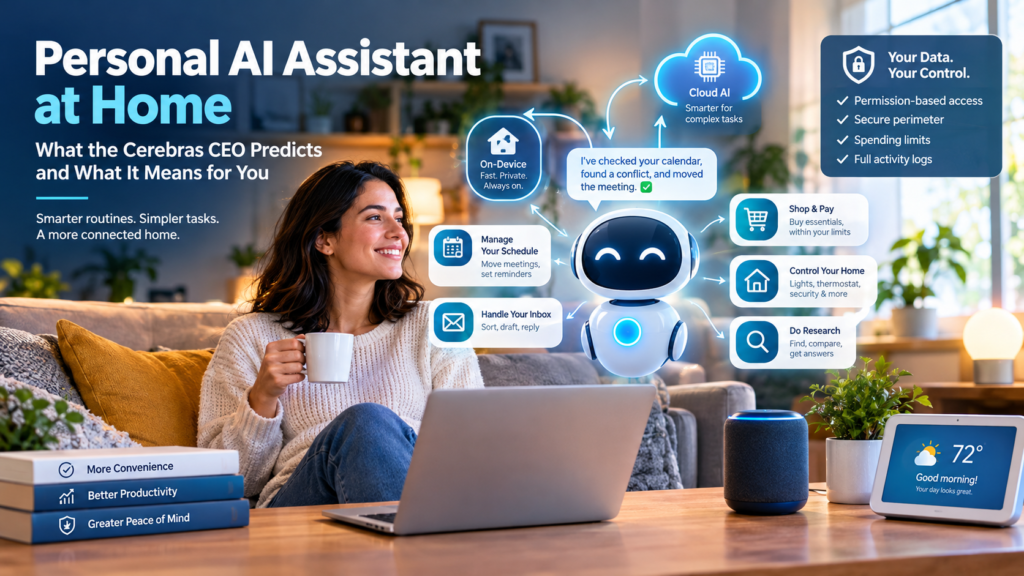
A personal AI assistant is an AI agent that learns your routines, acts on your behalf, and runs partly on a device in your home and partly in the cloud. Cerebras CEO Andrew Feldman says that future is close: asked at TechCrunch Disrupt 2026 what must happen before AI becomes a home appliance, he answered, “Actually, I don’t think that’s very far away.” TechCrunch
This guide explains what a personal AI assistant does, how an AI assistant at home would work, what Feldman actually said on stage, why his role as a chip executive calls for a careful read, and how to prepare. Every section stands on its own, so you can jump straight to the question you care about.
What Is a Personal AI Assistant?
A personal AI assistant is software that serves one person or household, remembers context over time, and takes actions for them, such as scheduling, researching, drafting, and buying.
The word “personal” does real work in that definition. A search engine returns links, and a general chatbot returns answers. An assistant built around you returns finished tasks, and it improves at them because it accumulates knowledge of your calendar, contacts, preferences, and habits. The word “assistant” matters as well. The software acts under your direction and within limits you set, rather than pursuing goals of its own.
How Is It Different From a Chatbot or a Smart Speaker?
A chatbot answers prompts, a smart speaker runs narrow commands, and an assistant combines memory, judgment, and delegated permission to finish multi-step tasks without being re-briefed each time.
Ask a chatbot when your flight lands and you get an answer. Ask a smart speaker for a playlist and it plays one. Tell an assistant, “Make sure I’m not double-booked next week and move anything that clashes with school pickup,” and it checks calendars, proposes changes, and confirms them with you. The difference lies in the chain of actions, not in the quality of any single reply.
What Three Traits Define a Real Home AI Assistant?
Three traits separate a true personal AI assistant from a generic AI tool:
- Persistent context: it remembers your preferences, relationships, and past decisions instead of starting from zero every session.
- Delegated action: it does things as well as saying things, including sending messages, booking appointments, and paying for items.
- Defined boundaries: it works inside permissions you control and can explain what it did and why.
If a product lacks one of these three, it is better described as a chatbot or an automation script. That distinction will matter more as vendors start attaching the “assistant” label to everything.
What Did the Cerebras CEO Actually Say About Home AI?
He said consumer AI is approaching the point where everyone has an AI appliance at home, with assistants that split their work between the local device and the cloud.
Feldman, who co-founded Cerebras Systems and serves as its CEO, made the remarks at TechCrunch Disrupt 2026 on Tuesday, October 13, in response to a question about what would have to happen for AI to become a household appliance. He pointed to consumer AI agents such as Meta’s Muse and Instinct, a startup now valued at $10 billion, as evidence that AI is finding its footing with everyday users. TechCrunchTechCrunch
Three ideas from his comments are worth separating, because each can be evaluated on its own.
Why Does the Hybrid Model Matter?
The hybrid model matters because it lets a home assistant be fast and private for everyday tasks while still reaching large cloud models for hard problems.
Feldman compared the setup to a cell phone, which does some of its work on the device and sends some work back to the cloud. That analogy is useful because people already understand it. Your phone recognizes your face locally, yet it streams video and fetches search results from remote servers without you thinking about the split. TechCrunch
In practice, hybrid cloud AI means a small model on a home device handles quick, repetitive, or sensitive requests, such as “what’s on my calendar tomorrow?” Heavier reasoning, like planning a week of travel across several constraints, goes to a larger model in a data center. The user sees one assistant, and the system decides where each task runs. That routing logic, not any single chip, is the hard part.
What Did He Say About Security and Purchases?
He expects these assistants to know their owners well, sit inside a security perimeter, and be able to spend money on the owner’s behalf.
He predicted that the assistants will get to know their owners very well, that owners will have a security perimeter around them, and that they will have access to credit cards and be able to buy things for them. He added that he thinks they will make a meaningful difference in improving our lives. TechCrunchTechCrunch
Two details deserve attention. First, “a security perimeter” is a design promise, not a shipped product, and nothing in the reporting describes how it would work. Second, giving an assistant payment access moves it from advisor to actor, which is exactly where the risk profile changes. Later sections cover how to handle that.
Does Feldman Use AI Agents Himself?
Yes, he says he already uses several. He relies on a collection of agents to sweep his calendar and pull up information about the people he is about to speak with. He says he is most excited about possibilities that did not exist before, but he leaves those ideas to other founders, because he prefers building infrastructure that other people’s ideas run on. TechCrunchTechCrunch
That last point is a useful reality check. Feldman is describing the plumbing, not a finished consumer product. The home AI he predicts will depend on companies that build the experience on top.
Why Would a Chipmaker Want You to Believe This?
Because widespread home AI would increase demand for the hardware that runs it, and TechCrunch itself noted that the vision is appealing for an AI chipmaker.
The article observes that a home AI appliance, or at least broad consumer adoption of agentic technology, is certainly attractive to a company in Feldman’s position. That does not make him wrong. Executives often see technology curves early. It does mean his forecast should be read as an informed prediction from an interested party, not as a neutral measurement. TechCrunch
Here are four questions that help when you evaluate any vendor forecast about AI in the home:
- Who benefits if the prediction comes true? Hardware, cloud, and software vendors each gain in different ways.
- Is a product shipping that supports the claim? Demos and funding rounds are not deployments.
- What would have to be solved first? Reliability, privacy, and cost are the usual blockers.
- Is there a date? The reported remarks describe the future as not far away but, in the article, give no specific timeline or product launch. TechCrunch
Applying those questions to Feldman’s comments yields a balanced conclusion: the direction is plausible and supported by real consumer activity, while the speed is unproven.
How Would a Personal AI Assistant Work Inside Your Home?
A home personal AI assistant would run lightweight, private, latency-sensitive tasks on a local device, send heavier reasoning to cloud models, and use a permission layer to control what each side can see and do.
This section is my analysis of how such a system could be built, drawing on the hybrid model Feldman described. Think of four stages that repeat constantly:
- Sense: the assistant gathers context from your calendar, messages, location, and connected home devices, within granted permissions.
- Understand: a local model interprets the request and decides whether it can be handled on the device.
- Decide: simple tasks stay local, while complex ones are routed to a larger model with only the data needed for that task.
- Act: the assistant sends the message, moves the meeting, or places the order, then logs what it did.
The privacy value comes from stage three. If the system only sends the minimum necessary data off the device, much of your daily life never leaves your home network.
Cloud, On-Device, or Hybrid: Which Architecture Fits?
For most households, a hybrid architecture is the best fit, because it balances speed, capability, and data exposure. The table compares the three approaches on the criteria that matter most.
| Criterion | Cloud-only | On-device only | Hybrid |
|---|---|---|---|
| Speed on simple tasks | Depends on connection quality | Fast, no network round trip | Fast for local tasks |
| Capability on hard problems | Highest, uses the largest models | Limited by device hardware | High, offloads hard work to the cloud |
| Data exposure | More data leaves the home | Least data leaves the home | Selective, controlled by routing rules |
| Works offline | No | Yes | Partially |
| Cost profile | Ongoing usage fees | Upfront hardware cost | A mix of both |
| Best for | Heavy reasoning, shared services | Privacy-first, always-on basics | Most households |
When to choose each option:
- Choose cloud-only if you want the most capable model and accept that more data leaves your home.
- Choose on-device only if privacy and offline reliability outrank raw capability.
- Choose hybrid if you want everyday speed and privacy with access to stronger models when needed.
What Is a Security Perimeter in This Context?
A security perimeter is the set of technical and policy limits that define what an assistant can see, which accounts it can use, and which actions require your approval.
Think of it as a fence with gates. Inside the fence, the assistant can read your calendar and draft replies. At the gates, it must ask you before spending above a set amount or sharing sensitive documents. A well-designed perimeter typically includes scoped credentials, so each connected account grants only the access needed, approval thresholds for risky actions, an activity log you can audit, and a kill switch that revokes access instantly. Feldman’s reference to a perimeter signals that the idea is on the industry’s radar, but the quality of any given implementation is what will matter.
What Can a Personal AI Assistant Do Today?
Today, a capable assistant can handle calendar management, meeting preparation, inbox triage, research, and simple purchases, though reliability still varies.
Here are the main categories of work, framed as tasks you can delegate:
- Calendar sweeps: finding conflicts, proposing reschedules, and protecting focus time. This matches what Feldman says he uses agents for.
- Meeting preparation: pulling background on the people you are about to speak with, which is another use he describes.
- Inbox triage: sorting messages, drafting replies, and flagging what needs a human decision.
- Research: gathering sources, comparing options, and summarizing findings.
- Household logistics: coordinating schedules, reminders, and routine reorders.
- Purchases within limits: buying low-stakes items under a spending cap.
The first two items come directly from Feldman’s account. The rest are common uses of AI agents more broadly. Expect mistakes, especially on tasks with many steps. That is why the safest pattern today is “draft and confirm” rather than “act and report.”
Is It Safe to Let a Personal AI Assistant Buy Things for You?
It can be safe, but only if the spending authority is narrow, capped, and reversible.
Feldman expects these assistants to have access to credit cards and to buy things for their owners. That convenience comes with real exposure: a misunderstood instruction, a manipulated web page, or a compromised account could trigger an unwanted purchase. The guardrails below are my recommendations, not features Feldman described. TechCrunch
Use this framed list of controls before granting any assistant payment access:
- Per-transaction and monthly caps: set a low ceiling and raise it only after the assistant proves reliable.
- Merchant allowlists: limit purchases to stores you already trust.
- Approval above a threshold: require a tap or confirmation for anything above a set amount.
- A dedicated virtual card: isolate assistant spending from your main accounts so you can freeze it without disruption.
- Full transaction logs: review them weekly, at least at first.
- Fast revocation: know exactly how to cut off access in one step.
The principle is simple. Treat the assistant like a new employee with a company card: start with small limits, watch the receipts, and expand trust gradually.
Will Every Home Really Have a Personal AI Assistant Soon?
Nobody can promise a date. Feldman’s view is that it is near, but that is a forecast, and several conditions must hold first.
The case for “soon” rests on visible momentum. Feldman cited consumer agents like Meta’s Muse and a $10 billion startup called Instinct as signs that AI is gaining traction with everyday users. Large companies and well-funded startups are racing to make agents useful to ordinary people, not just developers. TechCrunch
The case for “not yet” rests on four unsolved problems:
- Reliability: assistants must complete multi-step tasks correctly far more often than they do today.
- Trust and consent: people need clear control over what data the assistant holds and shares.
- Affordability: local hardware capable of running strong models has to become cheap enough for ordinary homes.
- Interoperability: the assistant must work across the apps, accounts, and devices a household already uses.
A fair reading is that the first wave of home assistants is likely to arrive as software on existing phones, speakers, and computers rather than as a new box on the shelf. Whether a dedicated “AI appliance” follows depends on how those four problems are solved.
How Should You Prepare for a Personal AI Assistant at Home?
Start now by organizing your accounts, deciding what data should stay local, and practicing with low-stakes agents. Preparation takes little effort and pays off whichever product wins.
- Audit your digital life. List the accounts an assistant would need, such as email, calendar, banking, and shopping, and note which are sensitive.
- Decide your data boundaries. Choose in advance what must stay on your own devices and what you are comfortable sending to the cloud.
- Write a spending policy. Pick caps, approved merchants, and the confirmation rules you would want before your first personal AI assistant ever touches a payment method.
- Start with a low-stakes agent. Let an existing tool handle calendar sweeps or meeting prep, the same use cases Feldman mentions, and judge its accuracy.
- Keep a human in the loop. Review actions and logs regularly, and extend autonomy only where the assistant has earned it.
Personal AI Assistant FAQ: Quick Answers
Will a personal AI assistant replace my smartphone?
Probably not. Feldman likened the model to a cell phone, with some work on the device and some in the cloud, which suggests assistants will coexist with phones and may run on them. The more likely change is that your phone, speaker, and computer become better at acting for you. TechCrunch
Can a personal AI assistant work without an internet connection?
Partly. In a hybrid design, tasks handled by the local model can continue offline, while requests that need a large cloud model cannot. How much works offline depends on the device’s hardware and the software’s design.
Who is Andrew Feldman?
He is the co-founder and CEO of Cerebras Systems, a company focused on accelerating AI computing. His biography describes him as the founder and CEO of Cerebras, which builds computers optimized for AI work, and notes that he previously founded the server company SeaMicro. oreilly
Is a home AI assistant only for tech enthusiasts?
Not by design. The point of the products Feldman describes is that ordinary users can delegate tasks in plain language. Early adopters will likely come first, as with most technology, but the target is the mainstream household.
The Bottom Line on the Personal AI Assistant
A personal AI assistant is software that remembers your context, acts within your limits, and splits its work between your device and the cloud. Feldman’s prediction at TechCrunch Disrupt 2026 is that this is close to becoming normal, and the consumer momentum he cites is real. His position as a chipmaker means you should treat the timeline as an informed forecast, not a guarantee.
The practical takeaway is to prepare on your own terms. Organize your accounts, set your data boundaries, cap any spending authority, and keep a human in the loop. Do that, and you will be ready for whichever version of the home AI future arrives first.