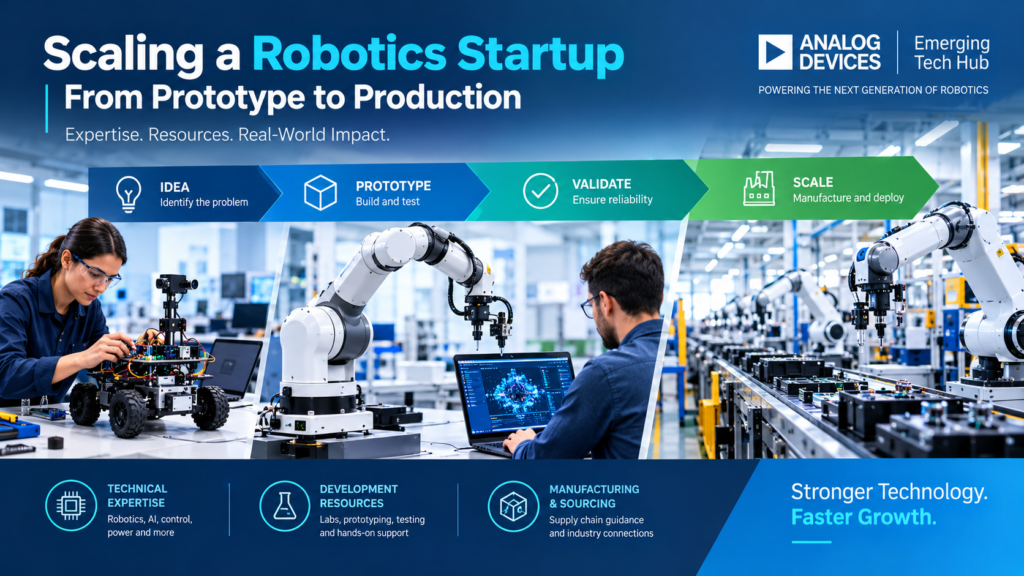
Scaling a robotics startup means turning a working prototype into a product that can be built, validated, and deployed reliably at volume. The hardest obstacles are usually engineering depth and speed, not the original idea. Analog Devices (ADI) is addressing this with its Emerging Tech Hub, a robotics-focused initiative within Analog Garage that gives companies access to ADI engineers, prototyping and testing resources, and manufacturing and sourcing expertise. therobotreport
Every robotics founder knows the moment. The arm picks, the robot navigates, the demo lands, and the room nods. Then someone asks how many units you can build next quarter, and how each one will behave in a warehouse, a hospital, and a factory. That question is where most roadmaps get tested, and it is why scaling a robotics startup needs its own playbook.
This guide covers that playbook, what ADI is building, and how to judge corporate engineering help without giving up control of your technology. The primary reporting, published by The Robot Report on October 15, 2026, was labeled as sponsored by ADI. Treat the program details as ADI’s own positioning and confirm specifics with the company directly.
Key takeaways
- A demo proves a concept. A product has to perform consistently across conditions, volumes, and supply chains.
- ADI describes the journey in four stages: Idea, Prototype, Validate, and Scale. therobotreport
- The Emerging Tech Hub combines technical expertise, development resources, and sourcing guidance.
- ADI says startups retain their intellectual property under its proposed model. therobotreport
- The hub is still being prepared for wider participation, with applications expected to open by the end of 2026. therobotreport
What Does Scaling a Robotics Startup Actually Mean?
Definition: Scaling a robotics startup is the process of moving from a proof-of-concept machine to a repeatable product with predictable performance, cost, supply, and support as volumes grow.
Expansion: The work spans three areas at once.
- Engineering: redesigning hardware for manufacturability, hardening electronics, and integrating subsystems.
- Operations: securing components, planning production, and holding quality steady as volumes rise.
- Business: converting pilots into contracts and finding partners who can help you reach customers.
Software companies can often scale by adding servers. Scaling a robotics startup means adding physical machines, each with sensors, actuators, power systems, and compute that must all work together. A flaw that is invisible in one prototype can become a recurring field failure across a fleet.
Prototype versus product
A prototype answers one question: can this work? A product answers a harder one: will this work every time, in varied conditions, at a cost customers accept? ADI makes the same distinction, noting that a prototype shows whether technology can work, while commercialization requires the complete system to perform consistently under different operating conditions. therobotreport
Why the timing matters
Robotics companies are developing new capabilities quickly, from autonomous mobile robots to humanoid systems. Customers compare new entrants against established vendors, and investors expect evidence of manufacturability, not just clever demos. The window to move from prototype to production is shorter than it used to be. therobotreport
Why Is Scaling a Robotics Startup So Difficult?
Short answer: Scaling a robotics startup is hard because rapid technology change collides with the slow, detail-heavy work of electronics, integration, validation, and manufacturing. Small teams rarely have deep expertise in all of them.
The industry moves faster than most teams
Cameron Villone, a senior product technology manager at ADI, identifies the speed of the industry as the biggest challenge he sees robotics startups facing. New sensors, processors, and AI models appear constantly. A team that spends months on a component choice may find a better option by the time it ships. therobotreport
Startup strengths and commercialization gaps
Startups often excel at adopting next-generation technology in sensing, motion control, and AI. Commercialization, however, requires additional expertise in electronics, system integration, validation, and manufacturing, which can stretch small engineering teams. The skills that win a seed round are not always the skills that deliver ten thousand units. therobotreport
The physical AI dependency chain
Definition: Physical AI is the combination of sensing, perception, reasoning, and control that lets machines act in the real world, as opposed to AI that only produces text or images.
Expansion: ADI’s whitepaper, The Race to Make AI Physical, describes physical AI as bringing together sensing, signal conversion, perception, reasoning, control, computing, and validation, and notes that these functions must work together for reliable performance. therobotreport
Even when a robot makes the right decision, executing it depends on accurate sensor data, timely control signals, and enough power to drive the actuators. therobotreport
Here is an illustrative example (not from the source). A mobile robot’s navigation software correctly decides to stop for a person. A noisy sensor delays the reading, a control loop misses its timing, and the robot stops a few centimeters too late. The AI was right and the product still failed. Problems like this usually surface during validation, which is why that stage matters so much.
What Are the Four Stages of Taking a Robot to Market?
Short answer: ADI frames the path as Idea, Prototype, Validate, and Scale. Each stage asks a different question and carries a different risk.
| Stage | Core question | Typical work | Common risk |
|---|---|---|---|
| Idea | Is the problem worth solving? | Concept definition, architecture sketches, feasibility checks | Building without a clear customer need |
| Prototype | Can the technology work? | Proof-of-concept hardware, early software, bench tests | Mistaking a lab success for a product |
| Validate | Does the whole system hold up? | Integrated testing, fault finding, design optimization | Late discovery of integration problems |
| Scale | Can we build and ship it repeatably? | Component sourcing, production planning, quality control | Supply gaps and inconsistent quality |
ADI notes that the early stages focus on developing and demonstrating the concept, validation tests the integrated system and optimizes the design before production, and scaling adds manufacturing and supply chain requirements. therobotreport
Locating your current stage honestly is the first practical step in scaling a robotics startup efficiently. Many teams believe they are at “validate” when they are still refining a prototype, and that gap shows up later as schedule slips.
What Is ADI’s Emerging Tech Hub?
Definition: The Emerging Tech Hub is a robotics-focused initiative being developed within ADI’s Analog Garage. It aims to bring startups and established robotics companies closer to ADI’s technical teams, including engineers working on newly released or still-in-development technologies. therobotreport
Expansion: Analog Garage is ADI’s internal corporate venture and incubator group. It pairs ADI’s technical expertise with seed funding and engineering resources to turn disruptive ideas into production-ready realities. The hub applies that model to robotics specifically. massrobotics
The three pillars of support
The hub brings together three areas of support: therobotreport
- Technical expertise across robotics, control, edge AI, power, and system integration.
- Development resources, including labs, prototyping tools, reference designs, testing and validation capabilities, and hands-on engineering support.
- Production support, meaning sourcing guidance and industry connections for companies preparing to increase volume.
A concrete example: camera connectivity
Villone cited ADI’s GMSL technology as an example of expertise that helps robotics developers with camera connectivity and integration. The point is that support goes beyond picking a part. It extends to how a technology fits inside the wider robotic system, which is where many integration problems begin. therobotreport
Who it is for and when it opens
ADI positions the hub for both startups and established companies. For founders scaling a robotics startup, the practical question is whether the hub’s engineers and labs can fill a specific gap in your team. The hub is not yet open to everyone. Applications are expected by the end of 2026, so details may change before launch. therobotreport
ADI has also been visible in the startup ecosystem more broadly. In August 2026, MassRobotics announced that ADI had renewed its commitment as a strategic sponsor. roboticstomorrow
How Does ADI’s Co-Development Approach Work?
Short answer: It starts with a conversation, not a contract. Villone calls the approach co-development: the first step is to establish a company’s current capabilities, what it is trying to achieve, and how that fits the hub’s mission. Only then do both sides decide what kind of collaboration makes sense. therobotreport
The type of help depends on the company’s stage:
- A mature developer may need one particular semiconductor component.
- A team with a specific engineering problem may be matched with specialists elsewhere in ADI.
- An early-stage startup may need broader guidance to clarify its architecture and identify what further development requires.
This staged matching matters because a seed-stage team and a company approaching production have almost nothing in common in what they need. A fair first call should feel like a diagnosis, not a sales pitch.
Can Startups Use Corporate Partnerships Without Losing Control?
Short answer: Yes, if the terms are explicit. ADI says the model is collaborative and startup-friendly, and that startups keep their intellectual property. Founders should still verify this in writing.
The tension is real
Villone acknowledges that some startups hesitate to work with larger corporations because of what the relationship could mean for their business. Founders worry about slow processes, scope creep, and IP leakage. Those concerns are reasonable, and well-structured corporate partnerships can still accelerate scaling a robotics startup when expectations are clear on both sides. therobotreport
Be clear-eyed about incentives
ADI’s interest is in enabling robotics applications that use its semiconductors, while startups gain expertise and resources that would be hard to build alone. That is a legitimate exchange, but it is a commercial one. A semiconductor vendor has good reasons to want its parts in your design. Weigh its advice with that in mind, and keep alternatives open. therobotreport
Questions to ask any corporate partner
- Who owns the IP created during joint work?
- What is the engagement process, and who makes decisions?
- Are you locked into specific components or suppliers?
- What is the exit path if priorities change?
- Who is the named technical contact, and how quickly do they respond?
A live discussion to watch
RoboBusiness will host “Robotics Startup Boot Camp Part 2: Challenges & Best Practices for Working with Corporate Partners” on October 20. Colm Prendergast, head of the Emerging Tech Hub at ADI, will join representatives from MassRobotics and WiBotic. The session is expected to cover proofs of concept and pilots, how corporations evaluate partners, and how startup agility can coexist with corporate processes. therobotreport
How Do Your Engineering Support Options Compare?
The Emerging Tech Hub is one route among several. This table is a general comparison, not a ranking, and the details vary by provider.
| Option | Best for | Strengths | Trade-offs |
|---|---|---|---|
| Hire in-house | Teams with funding and a clear roadmap | Full control, deep product knowledge | Slow to recruit; expensive; hard to cover every specialty |
| Semiconductor vendor program (e.g., ADI’s hub) | Teams needing component-level and systems expertise | Access to specialists, labs, and sourcing insight | Vendor has a commercial interest in its own parts |
| Accelerator or incubator (e.g., MassRobotics) | Early teams needing network and mentorship | Introductions to funders, customers, and peers | Less hands-on hardware engineering |
| Contract design firm | One-off design or manufacturing challenges | Flexible, project-based capacity | Cost per project; knowledge leaves with the contract |
Most strong teams combine several. A startup might hire core engineers, join an accelerator for network access, and tap a vendor program for specific integration problems.
A Practical Playbook for Scaling a Robotics Startup
- Name your stage. Place your product on the Idea, Prototype, Validate, Scale ladder. Be skeptical of your own optimism.
- List your gaps. Write down which of electronics, integration, validation, and manufacturing your team lacks. Specific gaps get specific help.
- Design for production early. Choose parts with supply in mind, and ask whether each design decision survives volume.
- Treat validation as a stage, not an event. Test the integrated system across temperatures, loads, and failure modes before committing to production.
- Map your supply chain. Identify single-source components and lead-time risks before they become surprises.
- Approach partners with a clear ask. A defined problem gets better engineering help than a general “let’s collaborate.”
- Protect your IP in writing. Agree on ownership before joint work begins, and keep records.
- Re-check the plan quarterly. Technology moves fast, and every decision in scaling a robotics startup should be revisited as components and customer needs change.
What Mistakes Do Robotics Startups Make When Scaling?
- Skipping validation. Shipping straight from a good demo exposes customers to your integration bugs.
- Optimizing the wrong thing. Teams polish AI behavior while an unreliable sensor or power supply limits real performance.
- Ignoring sourcing until late. A design that cannot be sourced at volume is not finished.
- Avoiding help out of pride or fear. The most expensive error in scaling a robotics startup is learning a lesson that a specialist could have taught in a week.
- Treating partners as saviors. Even good partners cannot replace a clear product focus.
Frequently Asked Questions
What is the first step in scaling a robotics startup?
The first step in scaling a robotics startup is an honest assessment of your stage and gaps. Know whether you are still proving the concept or ready to validate the whole system, and identify which expertise your team lacks.
When should a startup seek help from a component maker?
Seek help when a specific technical bottleneck, such as sensing, connectivity, power, or control, slows your progress and the expertise to solve it is not on your team. Earlier is usually cheaper than later.
Does ADI take equity or charge fees through the hub?
The reporting reviewed for this article does not say. ADI states that startups retain their IP, but terms like equity, fees, or exclusivity should be clarified directly with the company.
When can startups apply to the Emerging Tech Hub?
Applications are expected to open by the end of 2026. The hub is still being prepared for wider external participation, so check ADI’s official channels for current details.
How is physical AI different from other AI?
Physical AI acts in the real world, so it must manage sensor noise, timing, power, and safety. Those constraints make validation and integration central to success.
Conclusion
Scaling a robotics startup rewards teams that treat commercialization as a discipline of its own. Moving from prototype to production demands engineering expertise, system validation, production planning, reliable sourcing, and trusted relationships. Programs like ADI’s Emerging Tech Hub aim to supply some of those ingredients, with the usual caveat that vendor programs serve vendor interests as well as yours.
The best next step is concrete. Map your stage, name your gaps, and decide what kind of help would shorten your path. If you are weighing corporate partnerships, watch the RoboBusiness session on October 20 and ask hard questions about IP, process, and exit terms. The work of scaling a robotics startup is long, but a clear plan and the right collaborators make it far more predictable.