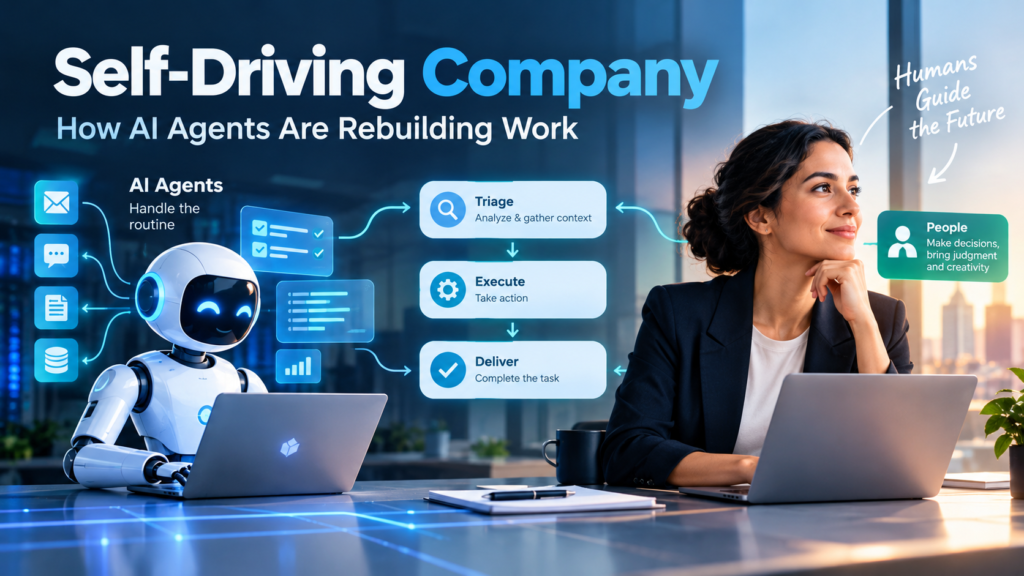
A self-driving company is an organization where AI agents handle most routine operational work, while people supply the judgment, taste, and direction that agents lack. Replit CEO and co-founder Amjad Masad described the idea at TechCrunch Disrupt in San Francisco on October 15, 2026, and it is one of the clearest pictures yet of where the future of work is heading.
If your job feels different from how it did twelve months ago, you are not imagining it. Masad told the Disrupt audience that nearly everyone’s work changed over the past year, and that a large part of the world has not yet noticed. This guide explains the self-driving company model in plain language, walks through how Replit applies it to customer support, compares it with traditional and AI-assisted organizations, and gives you a six-step plan for moving your own team in that direction.
A note on sourcing: the account of Replit’s workflow comes from TechCrunch’s reporting on Masad’s remarks. It is one executive describing his own company, so treat it as an informed case study rather than independent research. Where this guide goes beyond his comments, it says so.
The Self-Driving Company at a Glance: Five Facts
Here are the five facts that matter most about this model:
- Origin: Amjad Masad, co-founder and CEO of Replit, presented the idea on stage at TechCrunch Disrupt.
- Core idea: AI agents take on the grunt work, and people become more valued for their judgment and taste.
- Proof point: At Replit, incoming support tickets are examined by an agent before a person ever sees them.
- Human role: A person stays in the middle of the loop to make the call, and Masad does not expect that to change anytime soon.
- Timing: Masad tied the shift to AI agents becoming more reliable earlier this year.
What Is a Self-Driving Company?
Definition and Expansion
A self-driving company is a business whose day-to-day work is driven mainly by AI agents, with humans setting direction and making the key decisions. The name borrows from autonomous vehicles, though Masad was clear that he does not mean robotaxi makers.
The analogy works like this. A self-driving car handles steering, braking, and lane changes, while the passenger chooses the destination and takes over when something unusual happens. In the same way, agents in this kind of organization handle triage, investigation, and routine execution, while people choose what to build and decide when a situation needs a human call.
The second half of the idea is self-improvement. Masad described Replit as sort of self-improving, because agents now drive a large share of the work and that work feeds back into how the company operates. He said the closest analogy for how Replit now runs is a self-driving company, and that his team arrived at the description after reflecting on how AI changed their own workplace.
What This Model Is Not
The concept is easy to misread. It differs from common misconceptions in four ways:
- It is not a company without employees. People remain, and Masad argued their roles become more valued, not less.
- It is not fully autonomous. Human judgment sits in the middle of the workflow by design.
- It is not a chatbot bolted onto old processes. The workflow itself is rebuilt around agents doing first-pass work.
- It is not about cars. The term is a metaphor for how an organization operates, not a reference to the automotive industry.
Who Is Behind the Idea, and Why Now?
Who Is Amjad Masad?
Amjad Masad is the co-founder and CEO of Replit, a company whose AI coding tools help businesses build and launch their own software. That vantage point is useful. Replit sells to companies adopting AI, and it is also a company that has reorganized its own work around AI agents.
It is worth remembering that he is a vendor in this market, so his optimism comes with an interest attached. That does not make the Replit example wrong. It does mean readers should weigh it as a first-hand account, not a controlled study.
Why Did AI Agents Change the Equation This Year?
Short answer: reliability. Masad said the Replit team had been reflecting on how AI technology affected their own workplace over the past year, particularly after AI agents became more reliable sometime earlier this year.
In practical terms, reliability decides who does the checking. When agents are wrong often, supervising them costs more than doing the work yourself. Once they are right often enough, a person can review a first pass in minutes rather than produce it in hours. That threshold is what makes the model practical rather than aspirational. This explanation is an inference from Masad’s comments, not something he spelled out in those words.
How Does a Self-Driving Company Work in Practice?
Direct answer: Agents do the first pass on repetitive work, a human makes the decision, and agents help carry out the follow-through. Replit’s support workflow shows the loop clearly.
The Replit Support Loop, Step by Step
The loop Masad described has five stages:
- A support ticket arrives. The request enters the same queue it always did.
- An agent triages it. Before any person looks, the agent examines GitHub issues, the codebase, and Linear tickets related to the request.
- The agent hands off with context. By the time a person sees the request, the additional information needed to decide is already attached.
- A person decides. The support person chooses how best to proceed, using the context the agent gathered.
- Execution is one click away. When the person decides to submit a patch, a single click deploys another agent to take it forward.
The result, in Masad’s words as reported by TechCrunch, is an entire loop in which agents did most of the work and humans supplied the crucial judgment.
Where Do Humans Fit in the Loop?
In the middle, at the decision point. Masad summarized the loop as agents doing most of the work with human judgment in the middle, and said he does not see that going away soon. The person is not removed. The person is moved to the step where judgment has the most leverage.
This is the design principle that separates the model from simple automation. Automation removes steps. This approach rearranges who does what, so that humans spend their attention on decisions instead of on gathering information. For readers who want a name for it, this is a human-in-the-loop design where the loop is built around the human’s best contribution.
Self-Driving Company vs. Traditional vs. AI-Assisted Teams
The table below compares three operating models. The third column reflects Masad’s description of Replit. The first two columns are general patterns, and the comparison itself is this guide’s own framing.
| Criteria | Traditional company | AI-assisted company | Self-driving company |
|---|---|---|---|
| Who does first-pass work | People | People, with AI helpers on request | AI agents |
| Role of humans | Execute and decide | Execute faster and decide | Decide, direct, and review |
| Workflow design | Built around human handoffs | Old workflow with AI added at some steps | Rebuilt around agent-first triage and execution |
| Where context gathering happens | Manually, by the person | Partly manual, prompted by the person | Automatically, before a person sees the task |
| Main bottleneck | Human hours | Human attention switching between tools | Quality of human judgment and taste |
| Where people spend time | Doing the work | Doing the work and prompting | Deciding what to work on, architecture, and discussion |
| Best fit | Regulated, low-volume, high-touch work | Teams just starting with AI | High-volume, text- or code-heavy, well-documented work |
When should you choose each model? Stay traditional where regulation, safety, or relationships demand human execution from end to end. Choose the AI-assisted approach when you are experimenting and want low risk. Move toward the third column when work is high-volume, well documented, and easy to check, since those are the conditions where an agent’s first pass pays off most.
What Do People Do When Agents Handle the Grunt Work?
Will AI Agents Take My Job?
Direct answer: In Masad’s account, agents are changing what people work on rather than replacing them. At Replit, he said the team now spends more time figuring out what to work on. He described more discussion, more whiteboarding, and more time on architecture and how to build things.
That is one company’s experience. Broader labor-market effects are still debated, and outcomes will differ by role, industry, and how leaders choose to deploy agents. A fair reading is that the model changes the mix of tasks in a job, and that the mix can shift faster than people expect.
Which Skills Become More Valuable?
Masad named two skills explicitly: judgment and taste. Several related skills follow naturally from his description. These are this guide’s extensions, not his claims:
- Prioritization: deciding what is worth building at all.
- Evaluation: judging whether an agent’s output is correct, safe, and good enough.
- System design: shaping architecture so agents can work reliably.
- Clear specification: describing goals precisely enough that agents can act on them.
- Cross-team discussion: debating direction, which Masad said is increasing at Replit.
Can Work Become More Enjoyable?
Masad argued that it can. In conversations with other businesses, he said the focus is on how AI can help people become more productive and happier at work, partly because agents make the work less boring and more creative. He added that Silicon Valley is not putting out a positive vision of the world, and that Replit hopes to do so.
Skeptics will reasonably ask whether productivity gains reach employees or only employers. That question deserves real attention from any leader who adopts this model, because the answer shapes whether teams embrace the change or resist it.
Frequently Asked Questions About Agent-Run Organizations
What Does the Term Mean?
A self-driving company is one where AI agents run most routine work and people steer. The phrase is a metaphor from autonomous vehicles. Agents drive the day-to-day tasks, and humans choose the destination, review hard cases, and keep the final say on decisions that need judgment.
Who Introduced the Idea?
Replit CEO Amjad Masad described it at TechCrunch Disrupt in San Francisco on October 15, 2026, in remarks reported by TechCrunch’s Sarah Perez on October 16.
Does It Mean No Humans Are Involved?
No. Masad stressed that human judgment and taste remain necessary, and that people sit in the middle of the workflow. Agents take over the information-gathering and execution around those human decisions.
What Tasks Do Agents Take On First?
At Replit, the first task was support triage. Agents examine GitHub issues, the codebase, and Linear tickets so that a person receives a request with context attached. Triage is a good starting point because it is repetitive, information-heavy, and easy for a human to check.
Is This Only for Software Companies?
Not necessarily, but software teams are the natural starting point. Masad’s example comes from a software company, where agents can read codebases and tickets directly. The TechCrunch report does not cover examples outside software, so other industries should treat this as untested territory and pilot carefully.
How Reliable Do Agents Need to Be?
Reliable enough that reviewing a first pass costs less than producing it. Masad pointed to improved reliability earlier this year as a turning point at Replit. Each team should set its own threshold by task, and start where mistakes are cheap to catch.
How to Build a Self-Driving Company in Six Steps
This playbook is a synthesis built on the Replit example. It is not a method Masad published, so use it as a starting framework and adapt it to your own context.
- Pick one high-volume workflow. Choose a process that repeats often and is easy to check, such as support intake, bug triage, or internal request routing.
- Map the context a human gathers. Write down every system a person opens before making a decision. Replit’s agent pulls from GitHub issues, the codebase, and Linear tickets, which shows how much of the work is simply gathering information.
- Give agents access to those systems. Grant the minimum permissions needed, and log what agents read and change.
- Place a human at the decision point. Decide which step truly needs judgment, and make sure the person sees the agent’s findings at that step rather than raw inputs.
- Make execution a click. Once the person decides, the follow-through should be one action, as in Replit’s one-click deployment of another agent.
- Measure and shift human time upstream. Track how much time people now spend on deciding what to work on, architecture, and discussion, which are the activities Masad said increased at Replit.
Following this sequence turns a self-driving company from a slogan into an operating model: you redesign one loop, prove it, and then repeat the pattern elsewhere.
Common Mistakes to Avoid
- Automating without a clear human decision point. If no one owns the judgment step, errors pass through unchecked.
- Starting with a low-volume, high-ambiguity workflow. You will not collect enough examples to learn from.
- Measuring only speed. Track quality and employee experience too, or you will optimize the wrong thing.
- Ignoring permissions and security. Agents that can read and change systems need the same care as any privileged user.
Risks and Limits of the Self-Driving Company Model
Short answer: the main risks are over-trust, thin evidence, uneven benefits, and access control. The following points are this guide’s analysis, not claims from the TechCrunch report.
- Over-trust in agents. A reliable agent still makes mistakes. Without a real human review step, small errors can scale quickly.
- Thin public evidence. The case for the model rests on one company’s account. Independent studies and results from other industries would strengthen it.
- Uneven benefits. Productivity gains may not reach every employee equally, which is why Masad’s emphasis on happier, more creative work deserves follow-up.
- Access and security. The more systems agents can read and change, the more important permissions, logging, and rollback become.
- Vendor perspective. Replit sells AI coding tools, so readers should weigh its enthusiasm accordingly while still taking the workflow example seriously.
What This Means for the Future of Work
Masad framed the idea as a way to discover what AI transformation actually means for an organization. That framing is useful because it shifts the conversation away from a simple question of jobs lost or saved and toward a design question: how should work be arranged when agents handle the first pass?
Three implications stand out from his comments:
- Judgment becomes the scarce input. If agents handle the grunt work, the value of a person lies in knowing what is worth doing and what good looks like.
- Roles shift toward direction. More time goes to deciding what to work on, designing systems, and discussing options.
- Awareness is uneven. Masad noted that a large part of the world does not yet know the change is coming, so early adopters may have a head start.
The future of work he describes is not a world without people. It is a world where people spend less time on information-gathering and more on choices.
Conclusion: Start With One Loop
A self-driving company puts AI agents on the repetitive first pass and puts people where judgment matters most. Replit’s support workflow shows what that looks like in practice: an agent triages the ticket, a person decides, and another agent helps carry out the fix.
You do not need to reorganize your whole business to try it. Pick one high-volume workflow, map the context a human gathers, let agents collect it, and keep a person at the decision point. Then watch where your team’s time goes. If Masad’s account holds up in your setting, you will see more time spent on deciding what to work on, and less on chasing information.