Published October 16, 2026. Based on TechCrunch’s Disrupt coverage by Aisha Malik, with added context and analysis.
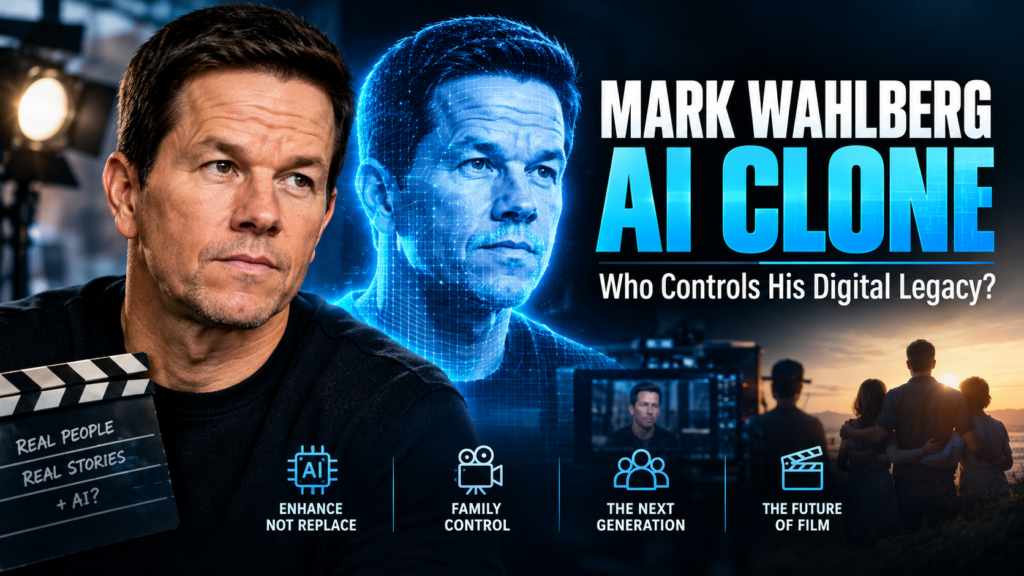
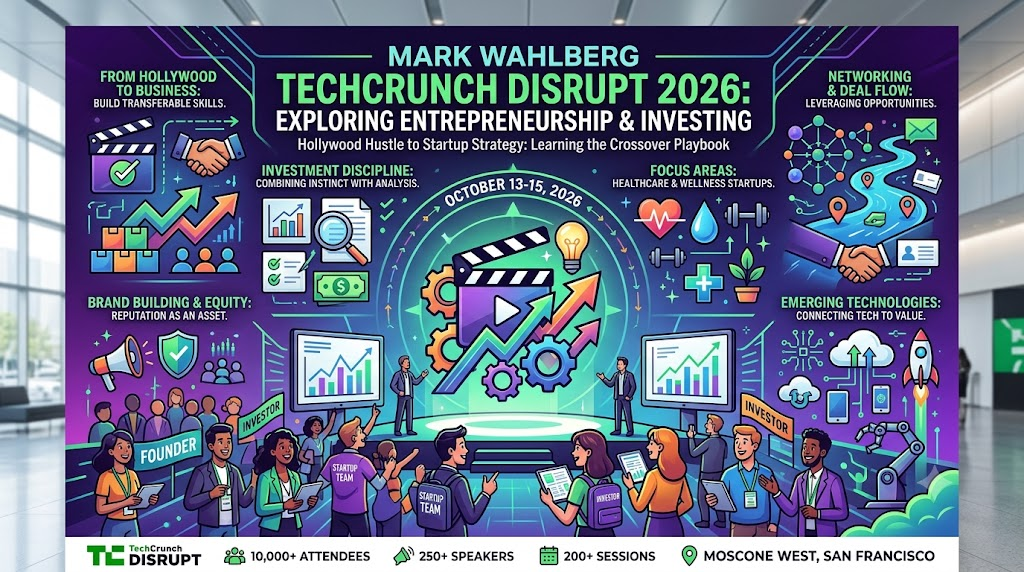
Mark Wahlberg says AI belongs in filmmaking only when it supports real human work, and he would be comfortable with an AI version of himself continuing his legacy after he is gone. That is the short answer to the Mark Wahlberg AI debate that came out of TechCrunch Disrupt, where the actor spoke on stage with TechCrunch Editor-in-Chief Connie Loizos. TechCrunch
His remarks carry weight for two reasons. He is a working movie star who is also an entrepreneur and angel investor, and he spoke while Hollywood is still divided over AI in filmmaking. This post covers what he said, defines what an AI clone in film involves, compares his stance with other recent cases, and flags the questions his comments leave unanswered.
Key Takeaways From the Mark Wahlberg AI Conversation
- The headline: The Mark Wahlberg AI stance is conditional support, not blanket approval.
- The rule: He backs AI when it improves existing work, which in his words means using it “to enhance what you’re doing.” TechCrunch
- The red line: He objected to feeding an idea to a chatbot, taking the script it produces, and making the film without real actors. TechCrunch
- The next project: He may use AI to enhance parts of the upcoming Pete Rose biopic, in which he will play Rose. TechCrunch
- The legacy idea: He is open to his children or grandchildren controlling his likeness and image. TechCrunch
- The animated series: He would not object to his upcoming animated series “Ted” continuing for decades with an AI version of him. TechCrunch
- The vault: He has not visited the CAA Vault but says he would be interested. TechCrunch
- The priority: He values real storytelling over effects-driven spectacle. TechCrunch
What Did Mark Wahlberg Say About AI in Film?
Wahlberg said AI is acceptable when it improves what filmmakers are already doing and unacceptable when it replaces writers and actors outright. The Mark Wahlberg AI position can be summed up as enhance, don’t replace.
The Setting: TechCrunch Disrupt
Wahlberg took the stage at TechCrunch Disrupt to discuss AI’s role in filmmaking and his openness to an AI likeness of himself. KRON described a packed three-day conference featuring executives from companies such as Anthropic, Amazon and Nvidia, yet reported that the Hollywood star drew the biggest crowd. That detail shows how much public interest sits where AI and entertainment meet. TechCrunchkron4
The Enhance-Don’t-Replace Rule
The core of the conversation was a simple test. Wahlberg said he would not support a workflow where someone puts an idea into ChatGPT, gets a script back, and then makes the movie without real actors. If AI can be used “to enhance what you’re doing,” he is fully on board. TechCrunch
That framing is useful because it sets a standard anyone can apply. If human work comes first and the technology improves it, he approves. If the technology replaces the human work, he does not. For anyone searching for the Mark Wahlberg AI view in one line, that is it.
Storytelling Over Spectacle
Wahlberg noted that he has made big, effects-driven movies and was active during the early computer-generated imagery era around Jurassic Park and The Perfect Storm. He said those were cutting-edge technology moments, but that he is no longer passionate about effects-driven films compared with real storytelling. TechCrunchTechCrunch
This matters because it shows his comfort with AI is not driven by love of the technology itself. He treats it as one more production tool, like CGI before it, and says storytelling should stay at the center of the work.
What Is an AI Clone in Film?
Definition: An AI clone in film is a digital replica of a real performer’s face, body, movement and voice. It is built from scans and recordings and can perform material the person never actually filmed.
Expansion: Building one generally involves three stages:
- Capture. The performer is scanned and recorded so a system has detailed data on their appearance, movement and voice.
- Modeling. That data is used to create a replica that can be directed to say and do new things.
- Deployment. The replica is placed into a production, such as a feature film, an animated series, or an interactive experience.
An AI clone is different from a standard visual effect. A traditional effect alters or extends footage of a performance that really happened. A clone can generate performance that never happened, and that is why the topic raises sharper questions about consent and ownership.
What the CAA Vault Does
The CAA Vault is a Creative Artists Agency facility that lets actors use scanning technology to capture their bodies, faces, movements and voices to create AI replicas. When Loizos asked whether he had visited, Wahlberg said he had not, but that he would be open to the idea. So the CAA Vault is the practical infrastructure behind the idea of a lasting AI likeness, and Wahlberg has so far only expressed interest in it. TechCrunchTechCrunch
Three Kinds of AI Use in Filmmaking
The table below maps each category of AI in filmmaking to the Mark Wahlberg AI comments.
| Type of AI use | What it does | Example in this story | Wahlberg’s stated stance |
|---|---|---|---|
| Enhancement | Improves environments, visuals or details of a human-made production | Upgrading the stadium setting in the Pete Rose biopic | Supportive |
| Likeness replica | Recreates an actor’s face, voice and movement for new performances | CAA Vault scans; a long-running “Ted” | Open, citing family control and audience interest |
| Full generative authorship | Produces a script or film from a prompt, sidelining real actors | An idea typed into a chatbot, a script produced, no actors | Opposed |
The distinction between these rows is the key to reading his comments correctly. He is not offering one verdict on “AI.” He is treating different uses differently.
Mark Wahlberg AI Likeness: What He Said About His Legacy
Would Wahlberg want an AI version of himself to continue after he is gone? He said he would be open to it.
The clearest signal in the Mark Wahlberg AI interview came when he discussed the future of his own image. He said that, if things move in that direction, it would be cool for his children or grandchildren to be in charge of his likeness and, ideally, put him in good movies. KRON’s report carried a similar remark, with the hope that descendants would place him in good films. TechCrunchkron4
Passing a Likeness to the Next Generation
The detail worth noticing is who holds control. Wahlberg did not describe a studio owning his AI likeness. He pictured his family managing it. That is a hypothetical, not an announced deal, and the reporting does not describe contract terms, compensation, or approval rights. It is still a meaningful signal about the kind of arrangement he finds acceptable.
Why the “Ted” Comment Stands Out
Wahlberg said he would not be opposed if his upcoming animated series “Ted” continued for decades with an AI version of his likeness. He framed it as acceptable if he can no longer do it, or no longer exists, and people still want to see it. TechCrunchTechCrunch
He also tied the idea to nostalgia. He said there are things from his childhood he wishes still existed, and that audiences should be entitled to what they want to see. That makes his argument about audience choice and continuity rather than about technology for its own sake. TechCrunch
How Could AI Appear in the Pete Rose Biopic?
Is Wahlberg planning to use AI in his next movie? He said he may, in a limited way.
He said he potentially plans to use AI to enhance certain aspects of the upcoming Pete Rose biopic, in which he stars in the title role. He described it as a fairly expensive film and pointed to enhancing the stadium setting and similar elements. TechCrunchTechCrunch
So far, the Mark Wahlberg AI plans for the film are limited to the production environment. He did not say AI would replace any performer, and he did not describe AI-generated dialogue or scenes. That fits the enhancement category in the table above. Specific details about scope, tools and vendors were not reported, so it would be a mistake to assume more than that.
How the Mark Wahlberg AI Stance Compares With Other Hollywood Cases
Wahlberg’s comments are easier to evaluate next to recent cases that show where the industry’s lines are being drawn.
- A posthumous performance with estate support. Val Kilmer, who died in 2025 at age 65, is set to appear in As Deep as the Grave, with filmmakers recreating his performance using AI with support from his estate. The AI version is reported to appear in a significant portion of the film. The film’s teaser debuted at CinemaCon in April 2026. val kilmer appears posthumously via ai +2
- AI content made without consent. ByteDance’s Seedance 2.0 AI produced a fight scene between Tom Cruise and Brad Pitt without the consent of either actor. asiaiplaw
| Case | Person’s status | Consent signal | What it illustrates |
|---|---|---|---|
| Wahlberg’s remarks | Living, speaking about the future | Stated openness; family control mentioned | Pre-planned legacy use |
| Val Kilmer in As Deep as the Grave | Deceased | Estate support reported | Posthumous use with permission |
| Cruise and Pitt fight scene | Living | No consent reported | Unauthorized AI likeness |
Consent is the dividing line across all three. Wahlberg’s position falls on the permission side of that line, since he is talking about his own likeness and his own family’s control. The Cruise and Pitt case sits on the opposite side. That contrast is why the idea of an AI likeness is not simply good or bad: the answer depends on who authorized it and under what terms.
What Questions Do His Comments Leave Open?
His remarks were conversational, not a policy statement. Several important questions remain.
Who Controls a Digital Likeness After Death?
Wahlberg named his children and grandchildren. Legal frameworks vary, and estates, studios and agencies can all claim a role. A hypothetical preference stated on a stage is not the same as enforceable control, which usually requires contracts and, in some places, specific laws.
Who Gets Paid When a Digital Replica Performs?
Compensation is the practical center of the debate. Digital replicas became a central bargaining issue during the 2023 SAG-AFTRA strike, and consent and pay for replicas remain a core concern for performers. Wahlberg’s comments did not address payment, so any fair reading should treat that as an open question rather than an implied answer.
Does Audience Demand Settle the Question?
The Mark Wahlberg AI argument leans on audience choice: if there is a real audience, people should get what they want to see. That is a coherent view, but it is not the only one. Critics could reasonably argue that demand alone does not answer whether a performer, or an estate, has truly agreed to a given use.
Where Does Enhancement End and Replacement Begin?
Upgrading a stadium backdrop is clearly enhancement. Extending a character for decades with a synthetic version of the actor blurs the line, because the technology is no longer improving a performance, it is generating one. His own examples span both categories, which suggests his rule needs more definition as projects get more ambitious.
What This Means for Actors, Producers, and Fans
- Actors: The Mark Wahlberg AI comments show that a high-profile performer is thinking about likeness as an asset to plan for, not just a threat. Performers may want to decide in advance who controls their replica and on what terms.
- Producers and studios: Enhancement uses like environments are the least controversial. Likeness replicas call for documented consent, and fully generated work without real actors runs against the line Wahlberg drew.
- Agencies: Facilities such as the CAA Vault are becoming part of how talent management handles digital rights.
- Fans: Long-running characters could continue past an actor’s career, which some audiences will welcome and others may find uncomfortable.
- Journalists and analysts: Treat “open to” as a statement of attitude, not an announced project, and ask who consents and who profits.
Frequently Asked Questions
What did Mark Wahlberg say about AI in filmmaking?
In the Mark Wahlberg AI remarks reported by TechCrunch, he said AI is fine when used to enhance what filmmakers are doing, but not to generate scripts and replace real actors. He also said he is open to an AI likeness of himself carrying on his legacy.
Is Mark Wahlberg for or against AI in movies?
He is for it with limits. He supports AI that improves a production and opposes AI that replaces human writers and actors.
Would Mark Wahlberg let an AI clone continue his work?
He said he would be open to it, particularly if his children or grandchildren were in charge of his likeness. He framed it as acceptable if audiences want it and he can no longer participate.
Has Mark Wahlberg visited the CAA Vault?
No. When asked, he said he had not visited, but that he would be interested.
Which project could involve AI?
The only project tied to the Mark Wahlberg AI discussion so far is the Pete Rose biopic, where he mentioned possibly enhancing the stadium setting. His animated series “Ted” came up as a hypothetical for long-term continuation.
Is this an official announcement?
No. These were comments made in an on-stage interview, not a studio announcement or contract disclosure.
The Bottom Line
The Mark Wahlberg AI story is not about a star embracing every use of artificial intelligence. It is about a clear, workable rule: use AI to enhance real work, keep real actors and real storytelling at the center, and consider letting family steward your likeness if audiences still want you. The enhancement example he offered, a better stadium for a baseball biopic, is modest. The legacy example, an AI version of himself continuing “Ted” for decades, is anything but.
What happens next will depend on questions he did not answer: consent, payment and control. As more cases like Val Kilmer’s and the unauthorized Cruise and Pitt clip emerge, the Mark Wahlberg AI conversation is likely to become a reference point for how actors talk about their own digital futures.