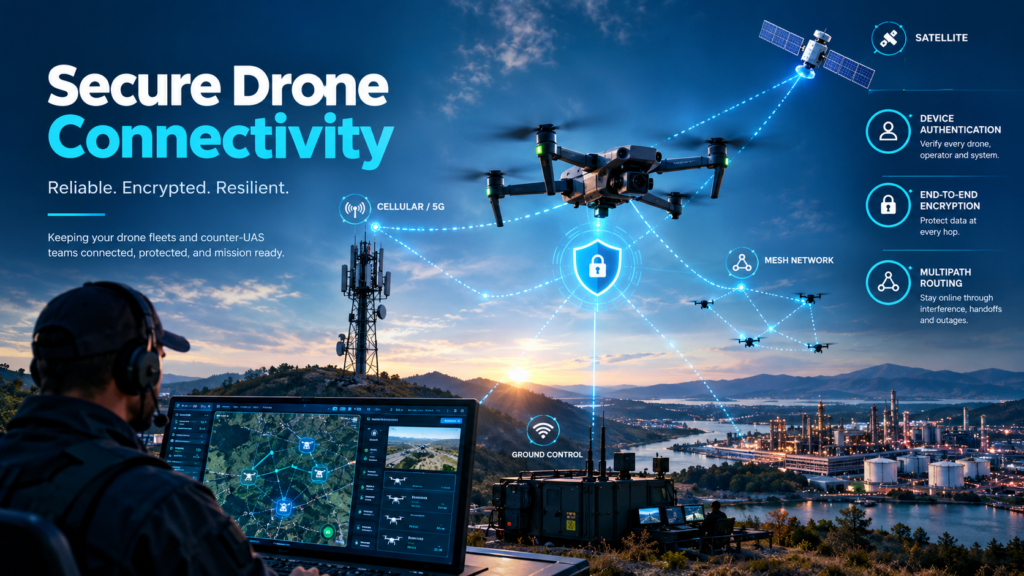
Secure drone connectivity means every link between a drone, its operators, and the systems around it is authenticated, encrypted, and able to survive interference, handoffs, and outages. The most reliable way to achieve it is to anchor trust in device identity, encrypt every packet end to end, and use software-defined networking so sessions persist as the aircraft moves between cellular, satellite, and mesh paths.
A drone that loses its link mid-mission stops being a tool and becomes a liability. It might be carrying a medical package, inspecting a pipeline, or intercepting an unauthorized aircraft. In every case, it is only as capable as its connection. A DroneLife feature published October 16, 2026 made this point: commercial drone fleets and counter-drone systems both depend on secure, reliable networking, and the two camps were visible side by side at the DroneX show in London. dronelife
This guide explains how secure drone connectivity works, which threats matter most, how modern overlay networks compare with older approaches, and how to evaluate a platform. Each section stands alone, so jump to whatever you need.
What Is Secure Drone Connectivity?
Secure drone connectivity is the combination of identity verification, encryption, and resilient routing that protects data and control traffic moving to and from an unmanned aircraft.
It covers command-and-control (C2) links, telemetry, video feeds, payload data, and fleet-management traffic. It also spans every path that traffic might take, including RF, Wi-Fi, LTE, 5G, and satellite. A drone with a strong password on its Wi-Fi link has one layer of protection. A drone with secure connectivity has verified identity, encrypted sessions, and a way to keep working when one path degrades. Secure Drone Connectivity
The Three Pillars
- Identity: every drone, ground station, and operator device proves who it is before it can join the network.
- Encryption: traffic is protected from source to destination, so intercepting a radio or cellular link yields nothing usable.
- Resilience: sessions survive path changes, such as a vertical handoff from cellular to satellite, without dropping the mission.
Weakness in any one pillar undermines the others. Encryption without identity can protect a link to the wrong endpoint. Identity without resilience gives you a secure connection that disappears when the aircraft leaves tower coverage.
How It Differs From Ordinary IT Networking
Office networks assume fixed locations, stable links, and a perimeter you can defend. Drones violate all three assumptions. They move quickly, change network paths mid-flight, operate over unreliable infrastructure, and often fly where an adversary can reach the radio link directly. Traditional perimeter security was never designed for that environment.
Why Secure Drone Connectivity Matters More Than Ever
Secure drone connectivity has moved from a nice-to-have to a baseline requirement because the number of aircraft, the value of their data, and the cost of failure are all rising together. Analysts cited by one networking vendor project that the global drone market will pass $90 billion by 2030, and every new aircraft is another device that must connect, communicate, and be defended. zerotier
The regulatory picture is shifting too. In the United States, a new framework extends certain counter-UAS authorities to qualified state, local, tribal, and territorial law enforcement, with separate tiers for detection and mitigation. On October 16, 2026, federal agencies also announced a temporary flight restriction along the U.S.-Mexico border that limits civilian drone flights near the line. More airspace rules and more defensive systems mean more networked equipment that has to be trusted. dronelifedronelife
Drone Fleets Are Distributed Systems
A fleet is not a collection of independent gadgets. It is a distributed system with shared dependencies. One analysis warns that when a centralized gateway handling fleet connectivity drops, every drone routed through it loses secure command and control. That is a single point of failure hiding inside what looks like a robust design. dailysecurityreview
Distributed systems need distributed trust. That means identity checks on every device, segmentation so one compromised unit cannot reach the rest, and routing that does not depend on a single chokepoint.
Counter-UAS Teams Face the Mirror-Image Problem
Counter-UAS (C-UAS) platforms link radars, RF sensors, cameras, command software, and mitigation tools, often across multiple vehicles or sites. If an adversary can spoof, disrupt, or eavesdrop on those links, the defense fails exactly when it is needed. Defenders need the same properties as fleet operators: verified identity, encrypted traffic, and failover that works under pressure.
What Threatens Drone Links?
The main threats to drone communications fall into a handful of categories. Understanding them clarifies what a good design must withstand.
- Interception: unencrypted or weakly encrypted video and telemetry can be captured over the air.
- Spoofing and impersonation: an attacker poses as a legitimate ground station or drone to inject commands.
- Jamming and interference: deliberate or accidental RF noise degrades or severs the link.
- Weak credentials: default or guessable Wi-Fi passwords expose consumer-grade links.
- Central gateway failure: one compromised or overloaded relay disrupts every connected aircraft.
- Handoff gaps: security that collapses when the aircraft switches networks leaves a window of exposure.
Academic work confirms the Wi-Fi risk is real. A recent study examined GPU-accelerated credential recovery against drone Wi-Fi networks as a route to non-destructive neutralization, and it noted that researchers classify drone communications into four domains: drone-to-drone, drone-to-ground-station, drone-to-network, and drone-to-satellite. The takeaway for defenders is that every one of those domains needs its own protection, and that links relying on a shared Wi-Fi password are a known soft target. nih
How Software-Defined Networking Delivers Secure Drone Connectivity
Software-defined networking for drones creates a virtual network layer, called an overlay, that sits on top of whatever physical links are available. Instead of tying security to a radio or a carrier, the overlay ties it to the device.
This is how vendors such as ZeroTier approach secure drone connectivity. ZeroTier’s platform forms secure peer-to-peer links between devices and behaves like a single local network. The sections below explain the building blocks that matter, using that model as the example. zerotier
Definition: What Is an Overlay Network?
An overlay network is a virtual network built on top of existing connections. Devices join it using their own identities and communicate as though they were on one local network, regardless of whether the traffic travels over LTE, satellite, or a local radio mesh.
For drone operators, the practical benefit is that applications do not need to know which physical path is active. A video stream or C2 session keeps its address and its encryption while the transport underneath changes.
Cryptographic Identity for Every Device
In an identity-based model, each device receives a unique cryptographic ID. According to one vendor description, a drone gets a cryptographic identity and a virtual network card the moment it boots. That identity, not an IP address or network location, decides what the device can access. zerotier
This matters because IP addresses change constantly as a drone moves between networks. A permanent cryptographic identity gives operators a stable handle for access policies, auditing, and revocation.
Multipath Routing and Failover
Multipath routing lets a drone use more than one connection at once and shift traffic to the best available path. ZeroTier states that if a C2 link becomes unstable or contested, it moves traffic to the next best path and keeps the session uninterrupted. The company also says defense users report sub-second failover, and cites up to 80% longer sustained connectivity between airborne and ground nodes under fluctuating RF conditions. Treat these as vendor-reported figures and validate them against your own flight profiles and radios. the tactical edge how zerotier supports uavs and drone swarms +2
Local Mesh When the Backhaul Disappears
Swarm and edge operations often lose their link to the wider internet. A well-designed overlay lets units keep talking to one another anyway. In ZeroTier’s description, if external connectivity is lost, the mesh keeps operating locally without relying on vendor-hosted infrastructure. For missions in remote or contested areas, that offline behavior can be the difference between a coordinated swarm and a scattered one. zerotier
Comparison: Approaches to Drone Networking
No single approach fits every mission. This table compares common options on the criteria that matter most for secure drone connectivity.
| Approach | Identity model | Failover across links | Central dependency | Hardware change needed | Best fit |
|---|---|---|---|---|---|
| Single radio or Wi-Fi link with shared password | Shared secret | None | None | None | Hobby and short-range consumer use |
| Hub-and-spoke VPN gateway | Per-user or per-device certificate | Limited, tied to the gateway | High, gateway is a single point of failure | Usually none | Small fleets with stable cellular coverage |
| Multi-link bonding appliance (e.g., Elsight Halo) | Device-level, vendor-specific | Strong, bonds multiple links | Medium, depends on the appliance and ground station | Yes, onboard hardware | BVLOS missions needing bonded LTE, 5G, SatCom, and RF |
| Software-defined overlay (e.g., ZeroTier) | Cryptographic ID per device | Strong, multipath with automatic path selection | Low, peer-to-peer with local mesh option | Typically software only | Mixed fleets, swarms, and multi-vendor environments |
On bonding, Elsight’s Halo, for example, creates a bonded tunnel of LTE, 5G, SatCom, and RF links between the drone and the ground control station. The approaches can also be combined. An overlay can run on top of bonded links, so the choice is often layered rather than either/or. unmannedairspace
Secure Drone Connectivity in Counter-UAS Operations
Counter-UAS systems depend on secure drone connectivity just as much as the fleets they defend against. A C-UAS deployment usually combines sensors, command software, and mitigation tools, sometimes including interceptor drones. If any link in that chain can be disrupted or spoofed, the whole system is compromised.
Why Defenders Need Encrypted Links
Detection data from radar and RF sensors is sensitive. Mitigation commands are more sensitive still, because a forged command could cause a system to engage the wrong target or stand down at the wrong moment. Encrypted drone communications and verified device identity protect both the data and the decisions built on it.
The DroneLife piece reported that ZeroTier’s chief commercial officer said the company was working with both drone fleet vendors and counter-UAS vendors. That dual use makes sense. The same overlay that keeps a delivery drone connected can keep a sensor-to-command link connected, because both face the same environment of changing networks and active adversaries. dronelife Secure Drone Connectivity
Detection Versus Mitigation
Federal testing is drawing a clear line between these two functions. DHS recently ran an assessment in which participants evaluated commercially available counter-UAS systems against several drones under operational conditions, with a specific focus on mitigation technologies. Agencies must meet federal requirements and receive authorization before using mitigation authorities. Networking choices will increasingly be part of that approval conversation, since a mitigation tool is only as trustworthy as the link controlling it. dronelife
Hardening Your Own Links First
Research into Wi-Fi weaknesses shows that adversaries study drone links as targets. Defenders can use that knowledge in reverse. Before deploying any C-UAS or fleet system, audit the wireless links it depends on, remove shared-password designs, and move to per-device identity and end-to-end encryption.
Quick Answers: Common Questions About Secure Drone Connectivity
What is secure drone connectivity in one sentence?
Secure drone connectivity is authenticated, encrypted, and resilient communication between a drone and everything it talks to, designed to keep working through interference, handoffs, and attacks.
What is the best way to achieve secure drone connectivity?
Combine three layers: a unique cryptographic identity per device, end-to-end encryption on all traffic, and multipath routing across more than one link. An overlay network built with software-defined networking is a practical way to deliver all three without redesigning your radios.
Does secure drone connectivity require new hardware?
Not necessarily. Software-based overlays run on existing drone compute and operating systems. ZeroTier says its platform lets units spin up private, battlefield-ready networks in minutes without buying new hardware. Bonding appliances and some radios do add hardware, so confirm what your platform requires. zerotier
Is encryption alone enough to protect a drone?
No. Encryption protects the content of a link but does not prove who is on the other end, and it does not keep the link alive when a path fails. Identity and resilience are separate requirements.
How does an overlay network handle switching from cellular to satellite?
The overlay keeps the same virtual address and encrypted session while the underlying transport changes. One vendor describes this as a vertical handoff that moves traffic between entirely different transports, such as cellular to SATCOM, when terrestrial coverage disappears. zerotier
How to Evaluate a Secure Drone Connectivity Platform
Use this checklist when comparing vendors or designing your own stack. Each item should have a concrete, testable answer, not a marketing claim. Secure Drone Connectivity
- Identity: does every device have a unique, non-shareable cryptographic identity, and can you revoke it instantly?
- Encryption scope: is traffic encrypted end to end, or only between the drone and a relay?
- Failover behavior: how long does a session take to recover when a link drops, and has that been measured on hardware like yours?
- Central dependency: what happens if the vendor’s cloud or your own gateway goes offline mid-flight?
- Offline operation: can units in a swarm or C-UAS cell keep communicating locally?
- Segmentation: can you restrict which devices talk to which, so one compromised drone cannot reach the fleet?
- Fleet visibility: is there a single console showing device status, access, and events?
- Integration effort: does it work with your current radios, operating systems, and flight controllers?
If a vendor cannot answer the failover and central-dependency questions with test data, treat that as a red flag. Secure drone connectivity should be proven under realistic conditions, not assumed.
A Five-Step Rollout Plan
A phased approach reduces risk. This plan suits most operators moving to secure drone connectivity for the first time.
- Map your links. List every path your drones use, including RF, Wi-Fi, cellular, and satellite, and every system they talk to.
- Remove shared secrets. Replace shared Wi-Fi passwords and static keys with per-device identity.
- Pilot on a small group. Join five to ten aircraft or sensors to the overlay and measure latency, throughput, and recovery time.
- Test failure on purpose. Disable links, block the gateway, and simulate interference. Record how sessions behave.
- Scale with policy. Add segmentation rules and monitoring, then expand to the full fleet or C-UAS network.
Keep the pilot honest. The point is to discover weaknesses while the stakes are low.
Common Mistakes to Avoid
Teams building secure drone connectivity tend to repeat the same errors:
- Treating the link as trusted by default. Assume the network is hostile and make identity the basis of trust.
- Routing everything through one gateway. It simplifies design and creates a single point of failure.
- Securing the ground but not the air. Hardening the control station while leaving the aircraft link weak protects very little.
- Skipping offline testing. Systems that work perfectly with cloud access can fail when it vanishes.
- Ignoring supply chain. Component and vendor risk is a live policy issue. A DroneLife report on the DJI and Autel debate noted that the restrictions reflect concerns about access to drone technology and critical components, not only individual model security. dronelife
The Road Ahead: Post-Quantum Protection
Drone data has a long shelf life. Intercepted traffic captured today could be decrypted later if cryptography weakens, which is why defense programs are looking at post-quantum cryptography (PQC). ZeroTier has begun positioning a product that brings post-quantum cryptography to the networking layer by combining its encrypted peer-to-peer architecture with quantum-resistant algorithms. zerotier
For manufacturers, the lesson is architectural. Build connectivity as a transport-agnostic layer that can swap cryptography and links over time. That way, upgrades to secure drone connectivity do not require redesigning the airframe.
Key Takeaways
- Secure drone connectivity rests on three pillars: identity, encryption, and resilience.
- Fleets and counter-UAS systems face the same networking problem, so the same architectural principles apply to both.
- Centralized gateways are a common single point of failure.
- Software-defined overlays can deliver multipath failover and local mesh operation, often without new hardware.
- Vendor performance claims are useful starting points, but you should verify them in your own tests.
- Plan for the future by choosing architectures that can adopt post-quantum cryptography.
Conclusion
Drones are becoming critical infrastructure, and so are the systems built to defend against misuse of them. Both depend on links that stay trusted and stay alive when conditions turn hostile. Treating secure drone connectivity as a core platform requirement, rather than a late-stage add-on, is the most effective step an operator or manufacturer can take. Start by mapping your links, removing shared secrets, and testing failure deliberately. From there, an identity-based overlay can give you the verified, encrypted, resilient foundation that modern missions demand.