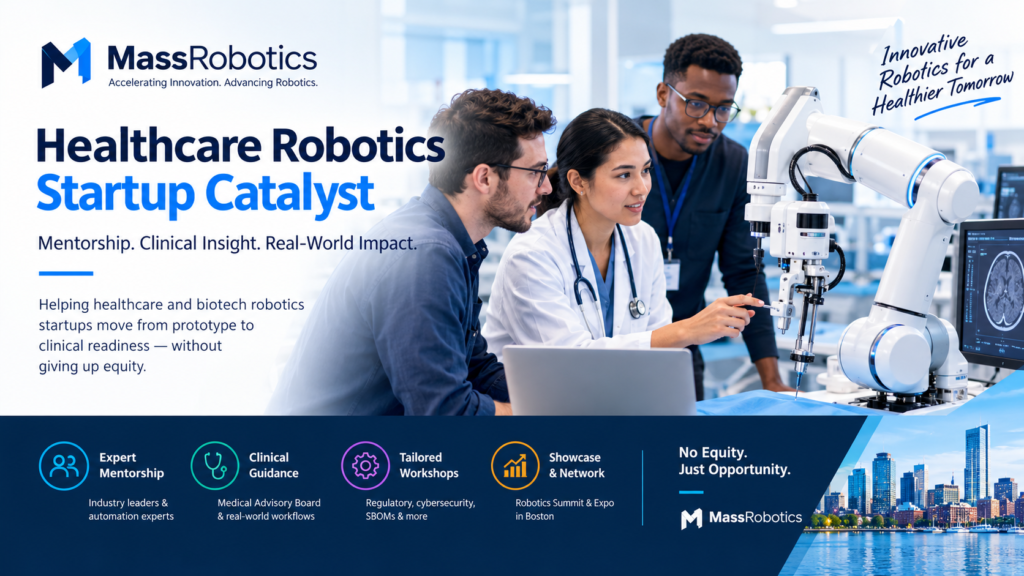
The Healthcare Robotics Startup Catalyst is a non-equity mentorship program run by MassRobotics that helps healthcare and biotech robotics startups move from prototype to clinical readiness. Selected teams receive senior industry mentors, clinical advisors, tailored workshops and a showcase stage in Boston, and they keep 100% of their equity. If you build robots for hospitals, laboratories, pharmacies or rehabilitation, this guide explains how the program works, who qualifies, what past cohorts looked like and how to prepare a competitive application.
Building a robot that works on a lab bench is hard. Getting that robot approved, trusted and purchased by a hospital is harder. Most healthcare robotics founders are brilliant engineers who have never navigated perioperative workflows, cybersecurity expectations or clinical pilot design. That gap between technological possibility and clinical reality is exactly where the Healthcare Robotics Startup Catalyst focuses its effort.
Status note (October 2026): Cohort 5 applications closed on December 1, 2025, and the cohort ran from January to May 2026. At the time of writing, I could not find a public call for Cohort 6, so check the official MassRobotics website for the next opening. Everything below is based on the published details of the most recent cohorts. Healthcare Robotics Startup Catalyst
What Is the Healthcare Robotics Startup Catalyst?
Definition
The Healthcare Robotics Startup Catalyst is a structured mentorship and resource program for startups building robotics and automation for healthcare, biotech and life sciences. It is presented by MassRobotics in collaboration with corporate partners including Festo, Novanta, Mitsubishi Electric Automation and MITRE.
Expansion: How the Program Actually Works
Think of the Healthcare Robotics Startup Catalyst as a guided runway rather than a classroom. Instead of a generic business curriculum, each startup works toward practical milestones such as a proof-of-concept build, a pilot design, a regulatory plan or a systems integration step. Mentors meet with teams on a regular cadence, and the cohort gains access to clinicians who can pressure-test assumptions about real hospital workflows. Healthcare Robotics Startup Catalyst.
The program is also deliberately lightweight on obligations. It is a five-month initiative, and it does not take equity in participating companies. That matters for founders who are wary of giving up ownership early or who already have investors and need practical help rather than another cap-table entry.
Who Is MassRobotics?
MassRobotics describes itself as the largest independent non-profit robotics hub dedicated to accelerating innovation and adoption in robotics. It is based in Boston and runs multiple startup initiatives, including accelerator programs and fellowships. The Healthcare Robotics Startup Catalyst is its dedicated pathway for health-focused teams.
A Short History of the Healthcare Robotics Startup Catalyst
Question: How Long Has the Program Been Running?
Direct answer: The program has been running since 2021, and Cohort 5 in 2026 was its fifth edition. Each cohort has gone through the application process, selection and a mentorship period that culminates in a public showcase. Healthcare Robotics Startup Catalyst.
| Cohort | Year | Notable Details |
|---|---|---|
| Cohort 1 | 2021 | Founding cohort; alumni include Eureka Robotics |
| Cohort 2 | 2022 | Alumni include Unlimited Robotics, which builds a service robot for healthcare and hospitality settings |
| Cohort 3 | 2024 | Alumni include AiM Medical Robotics, DOPL Technologies and RIF Robotics |
| Cohort 4 | 2025 | Applications ran in 2024 and closed November 1, 2024; alumni include OTSAW, Tenomix and Revimo |
| Cohort 5 | 2026 | Eleven startups selected; ran January to May 2026 with a hybrid structure for global teams |
Why the Growth in Corporate Support Matters
A Festo executive said the company has supported the program for three years, moving from founding member to mentor of startups that have since matured. That kind of continuity is valuable. Corporate partners from industrial automation bring deep knowledge of motion control, precision components and manufacturing scale, which are the unglamorous details that often decide whether a medical robot can be built reliably and affordably.
What Participants Receive From the Program
Definition: The Core Benefit Package
Participants in the Healthcare Robotics Startup Catalyst receive a bundle of mentorship, clinical insight and visibility. According to the Cohort 5 announcement, the package includes:
- Tailored mentorship with senior experts from leading automation providers
- Clinical perspective through the program’s Medical Advisory Board
- Structured onboarding and goal setting, followed by biweekly mentor working sessions
- Custom workshops shaped by cohort needs, covering regulatory strategy, cybersecurity, software bills of materials (SBOMs), clinical workflow, pilot design and more
- Visibility through MassRobotics channels and a showcase at the Robotics Summit & Expo in Boston
The Medical Advisory Board
For Cohort 5, MassRobotics expanded its Medical Advisory Board with additional advisors from Mass General Brigham and other institutions. The new expertise focuses on perioperative care, patient safety and clinical workflow integration. In practice, this means founders can ask a practicing clinician whether a workflow makes sense before investing months in engineering it. Healthcare Robotics Startup Catalyst.
The Showcase Moment
Every cohort ends in public. The 2026 cohort exhibited on the trade show floor of the Robotics Summit & Expo in Boston on May 27 to 28, 2026, and led a session on robotics innovation in healthcare. The program’s 2026 structure also included Healthcare in Robotics Week from March 16 to 20, 2026, with in-person events at MassRobotics headquarters, mentoring sessions and an investor open house.
For many startups, that showcase is where credibility starts to compound. Tenomix, a Cohort 4 company, said it demoed its pre-commercial robot at the Robotics Summit & Expo and received an excellent response. It also credited the community it met through the program for connections that are helping with its current investment round.
Who Should Apply to the Healthcare Robotics Startup Catalyst?
Question: What Types of Startups Qualify?
Direct answer: Startups building robotics or automation for healthcare and biotech qualify, from very early teams to growth-stage companies, and the program is open to teams worldwide. MassRobotics specifically encouraged applicants from seed funding through Series C.
Eligible Technology Categories
The Cohort 5 call listed a wide range of focus areas:
- Laboratory and pharmacy automation
- Diagnostics and imaging workflows
- Hospital logistics
- Rehabilitation and assistive devices
- Surgical and interventional robotics
- Enabling technologies such as sensing, precision motion and medical-device cybersecurity
The cohort that was ultimately selected reflected that breadth. It included Concerto Biosciences of Cambridge, Massachusetts, which builds a laboratory automation platform; Inception Robotics of College Park, Maryland; Lupa Robotics of San Francisco; and Zeus Robotics of Chattanooga, Tennessee. MassRobotics described the group as ranging from AI-guided dentistry to pharmacy automation.
What Reviewers Evaluate
Applicants to the Healthcare Robotics Startup Catalyst are evaluated on five factors:
- Technical maturity, meaning how far along the technology is
- Clinical relevance, meaning whether it solves a real healthcare problem
- Feasibility of near-term milestones, meaning what you can realistically achieve in five months
- Program fit, meaning whether the Catalyst offers what you actually need
- Mentor alignment, meaning whether the available experts match your challenges
Teams that can pursue a proof of concept during the program were specifically encouraged to apply. An earlier edition of the application also emphasized a solid team that blends healthcare, technical and strategic strengths, and a focus on healthcare combined with robotics, AI or the Internet of Medical Things rather than purely digital health.
Cohort 5 Timeline: What the Application Process Looked Like
Question: How Long Does the Selection Process Take?
Direct answer: For Cohort 5, the process took roughly three months from opening to announcement, with a short window for evaluation and interviews after the deadline. Healthcare Robotics Startup Catalyst.
| Stage | Date |
|---|---|
| Applications opened | September 30, 2025 |
| Applications closed | December 1, 2025 |
| Evaluation and interviews | December 1 to 15, 2025 |
| Cohort announcement | January 5, 2026 |
| Program period | January to May 2026 |
| Public showcase | May 27 to 28, 2026 |
Future cohorts may follow a similar rhythm. Earlier editions also ran an autumn application window, for example, Cohort 4 accepted applications until November 1, 2024, with a start at the end of that month. If you are planning to apply to a future cohort of the Healthcare Robotics Startup Catalyst, begin preparing in late summer.
Alumni Stories: What Success Looks Like
Tenomix (Cohort 4)
Tenomix is building what its CEO calls a first-in-class AI-enabled robotic platform in healthcare. He said mentors helped the team with everything from refining technical components to exploring robotics-as-a-service pricing models, and that the program connected them with clinicians, engineers and investors who became long-term collaborators.
Revimo (Cohort 4)
Revimo develops a lift and transfer device for people with mobility issues. It showcased at the Robotics Summit & Expo as part of the fourth cohort, illustrating the program’s range beyond surgical and laboratory robots into assistive technology. Healthcare Robotics Startup Catalyst.
Acumino and Robot on Rails
An earlier program announcement featured Acumino, which had recently finalized a $6.5 million seed round, and Robot on Rails, whose team called the experience a game-changer. These endorsements show a common pattern: founders value the combination of mentorship and community as much as any single workshop.
Takeaway: Alumni consistently describe the people and the network, not just the curriculum, as the lasting benefit.
Why Mentorship Matters So Much in Healthcare Robotics
Definition: The Healthcare Robotics Gap
The healthcare robotics gap is the distance between a working technical prototype and a product that clinicians, regulators and hospital procurement teams will accept. Closing it requires skills that most engineering teams do not have in-house.
Expansion: Four Hurdles Mentorship Helps With
1. Clinical validation. A robot that performs well in a lab still has to prove it fits into real clinical workflows. Clinical advisors help founders design pilots that produce meaningful evidence rather than anecdotes.
2. Regulatory strategy. Medical devices face scrutiny that consumer and industrial robots do not. Early regulatory planning prevents costly redesigns later.
3. Cybersecurity and software transparency. Connected medical devices raise security questions, and software bills of materials are increasingly part of the conversation. The Catalyst’s workshops cover both topics.
4. Business model design. Hospitals have tight budgets and complex purchasing processes. Mentors can help teams test models such as robotics as a service before locking in pricing.
Question: Is a Non-Equity Program Better Than an Equity-Based Accelerator?
Direct answer: It depends on what you need. A non-equity program like the Healthcare Robotics Startup Catalyst suits teams that want expert guidance and exposure without dilution. Equity-based accelerators may provide cash, but they take ownership in return.
Healthcare Robotics Startup Catalyst vs. Other Support Models
The table below compares the general characteristics of common startup support models. It describes typical patterns, and individual programs vary.
| Feature | Healthcare Robotics Startup Catalyst | Typical Equity Accelerator | Typical University Incubator | Corporate Pilot Program |
|---|---|---|---|---|
| Equity taken | No | Often yes | Varies | Usually no |
| Healthcare focus | Dedicated | Often general | Varies | Dedicated to the sponsor’s needs |
| Clinical advisors | Medical Advisory Board | Rarely built in | Varies | Sponsor-specific |
| Industry mentors | Automation and engineering leaders | General business mentors | Faculty and alumni | Sponsor staff |
| Duration | Five months | Often three to six months | Often ongoing | Project-based |
| Public showcase | Robotics Summit & Expo in Boston | Demo day | Varies | Rare |
Which Model Fits Which Team?
- Choose the Catalyst if your core challenge is clinical credibility, technical validation or navigating the healthcare ecosystem.
- Choose an equity accelerator if you need seed capital and are comfortable trading ownership for it.
- Choose a corporate pilot if you already have a specific buyer and need a path to deployment.
Many successful founders combine these routes over time rather than choosing only one.
How to Prepare a Strong Application
Step 1: Define a Five-Month Milestone
Reviewers look for feasibility of near-term milestones. Write down one concrete outcome you can reach by the end of the program, such as a working proof of concept, a pilot protocol approved by a clinical partner, or a regulatory roadmap reviewed by experts.
Step 2: Name the Clinical Problem Precisely
“Improving patient care” is too vague. Describe who experiences the problem, where in the workflow it occurs and how it is handled today. Specific problems signal clinical relevance.
Step 3: Show Technical Maturity Honestly
Share what works, what is still experimental and what you need help with. Mentors are matched to your challenges, so honesty about gaps improves mentor alignment.
Step 4: Highlight Your Team’s Blend of Skills
The strongest teams combine technical, healthcare and strategic experience. If you lack a clinician, explain how you are accessing clinical input.
Step 5: Explain Why the Healthcare Robotics Startup Catalyst Specifically
Program fit is one of the evaluation criteria. Name the workshops, mentors or network access that would change your trajectory, and tie them to your milestone.
Common Mistakes to Avoid
- Applying with a purely digital health product when the program targets robotics, AI or connected medical hardware
- Describing a vision without a testable five-month deliverable
- Ignoring regulatory and cybersecurity considerations entirely
- Leaving the clinical problem undefined
Frequently Asked Questions
Does the Healthcare Robotics Startup Catalyst take equity?
No. MassRobotics describes it as a non-equity initiative, so participating companies do not give up ownership to join.
How long is the program?
The Cohort 5 program ran for five months, from January to May 2026.
Is it only for U.S. startups?
No. The program is open to global teams, and the 2026 edition used a hybrid structure designed to support startups regardless of location.
What stage of company should apply?
Both early teams and more mature companies were encouraged to apply, from seed funding through Series C.
Which companies mentor participants?
Mentors come from Festo, Novanta, Mitsubishi Electric Automation, MITRE and yaxxoo, along with practicing clinicians and medical organizations.
Does it provide funding?
The published program descriptions emphasize mentorship, clinical guidance, workshops, networking and visibility rather than a cash investment. Check the current application page for any changes.
Where does the program culminate?
Cohorts present at the Robotics Summit & Expo in Boston, and they have also presented to the MassRobotics Healthcare Robotics Working Group.
When is the next application window?
I could not find a published Cohort 6 call as of October 2026. Past windows opened in the fall, so watch the official MassRobotics website and its newsletter.
Current Status and Your Next Steps
Where Things Stand
Cohort 5 has completed its January-to-May 2026 run, and the eleven selected startups have been announced. The most recent public information does not include a Cohort 6 application call. That is not unusual, since previous windows opened in the autumn.
What to Do While You Wait
- Bookmark the official page for the Healthcare Robotics Startup Catalyst on the MassRobotics website.
- Subscribe to the MassRobotics newsletter to catch the next announcement.
- Build your five-month milestone plan now so you can apply within days of the call opening.
- Connect with clinicians in your target area and document their feedback.
- Attend MassRobotics events, which are a low-pressure way to meet the community that shapes the cohorts.
Conclusion
The Healthcare Robotics Startup Catalyst gives healthcare robotics founders something that is hard to buy: a trusted network of automation experts, clinicians and fellow builders, delivered without taking equity. Over five editions it has supported companies working on surgical tools, laboratory automation, assistive devices and more, and alumni consistently point to the mentors and the Boston community as the lasting value.
If you are building robots for healthcare, treat the next application window as a deadline you can prepare for today. Clarify your clinical problem, define a five-month milestone, and be ready to explain why the Healthcare Robotics Startup Catalyst is the right next step for your team.