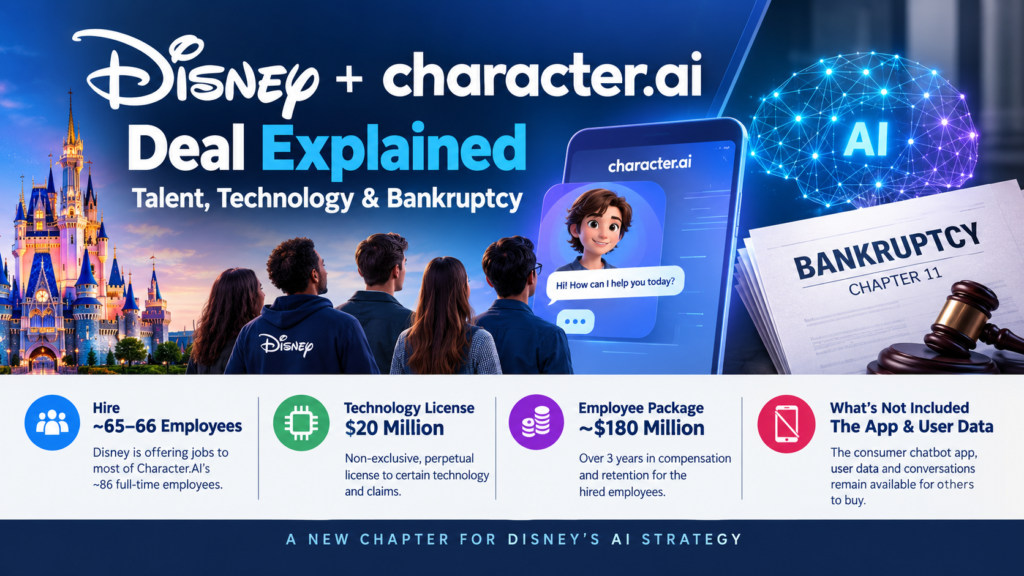
Short answer: Disney did not buy Character.AI. The Disney Character.AI deal is an acqui-hire. Disney offered jobs to 66 of Character.AI’s roughly 86 full-time employees, and Disney Worldwide Services is the stalking-horse bidder for a non-exclusive, perpetual license to certain technology and claims, priced at $20 million in cash. The consumer chatbot app is left to work through a bankruptcy sale. letsdatascienceletsdatascience
A chatbot startup that once let millions of people talk to cartoon heroes is now in bankruptcy court. The company that once sent it a legal threat is hiring most of its workforce. This guide covers who is going where, what the money buys, what is still up for grabs, and what the whole episode signals about the economics of consumer AI.
The Disney Character.AI Deal at a Glance
Here are the facts, based on reporting about the court filings:
- The buyer: Disney Worldwide Services, acting as the stalking-horse bidder. letsdatascience
- The workforce: 66 of roughly 86 full-time employees were offered jobs, including the company’s former CEO. letsdatascience
- The license price: $20 million in cash for a non-exclusive, perpetual license to certain technology and claims. letsdatascience
- The people budget: about $180 million over three years in compensation and retention for the roughly 65 employees Disney expects to hire. ppc
- The bankruptcy: TechCrunch and PPC Land reported that Character.AI filed for Chapter 11 in Delaware on October 12. letsdatascience
- The timeline: Character.AI expects the sale process to finish in late November or early December. Gizmodo
- What’s not included: the app, user data, and conversations remain available for others to buy. emarketer
What Is the Disney Character.AI Deal?
Definition: The Disney Character.AI deal is a two-part arrangement in which a media company hires a failing AI startup’s team and licenses a copy of its technology, without acquiring the company itself.
Expansion: The first part is about people. Disney is hiring most of the engineers, product staff, and executives who built the platform. The second part is about technology. Disney would receive a perpetual but non-exclusive license, so it can use the technology indefinitely while Character.AI keeps its own rights. The term sheet is explicit that the compensation money does not pass through Character.AI. Disney pays the employees directly and pays the bankrupt company separately for the license. ppc
This structure matters because it separates assets that are usually bundled. In a traditional acquisition, a buyer takes the brand, the users, the code, the contracts, and the liabilities together. Here, Disney takes the talent and a technology license. The consumer product, with its legal exposure and expensive compute bills, stays behind.
What is a stalking-horse bid?
Definition: A stalking-horse bid is an opening offer from a chosen buyer in a bankruptcy sale. It sets a price floor that other bidders must beat.
Expansion: The stalking horse usually gets protections in exchange for committing early. If another party wins, Disney gets its $2 million deposit back plus up to $700,000 in bid protections. This means the arrangement is not locked in. A rival could still outbid Disney for the license, though the reporting I found does not suggest one has emerged. ppc
How did we get here? A short timeline
- August 2024: Google paid $2.7 billion to license Character.AI’s models and rehire both founders. emarketer
- June 2025: Karandeep Anand joined Character.AI as CEO. Gizmodo
- September 2025: Disney was among the companies that sent Character.AI a cease-and-desist letter. avclub
- October 2025: Character.AI announced new age checks and a ban on open-ended chats for users under 18. Gizmodo
- Early 2026: Character.AI and Google agreed to settle multiple lawsuits from families who alleged psychological harm to their children. Gizmodo
- September 2026: Anand, then CEO, joined Disney as its first CTO. emarketer
- October 12, 2026: the Chapter 11 filing, followed by the term sheet detailing Disney’s offer.
How Many Character.AI Employees Is Disney Hiring?
Direct answer: Roughly 65 to 66 people, out of a workforce of about 86 full-time employees. That is the majority, which is the point of the TechCrunch headline.
Anyone tracking the Disney Character.AI deal will notice that outlets use different verbs. One report says Disney offered jobs to 66 of the roughly 86 full-time employees. Another says Disney hired roughly 65 employees. A third says Disney brought on 66 employees in September. These are not necessarily contradictory. Offers, acceptances, and start dates happen at different moments, and the filings describe a plan that was still being finalized. If you are citing a number, say “about 65 to 66” and attribute it to the filings. Disney Offers Jobs to 66 Character.AI Staff Amid Bankruptcy Sale +2
Who is in the group?
The most visible hire is Anand, who is now Disney’s first CTO. His time at Character.AI gives Disney experience in interactive fandom, moderation, and AI safety. The rest of the group is largely technical staff who built and ran the platform. emarketerruntimewire
There is also a legal wrinkle. At closing, Disney would buy any claims Character.AI still holds against former employees who joined Disney, known as the “Purchased Employee Claims.” In plain terms, Disney is cleaning up potential disputes over the people it is hiring. ppc
How Much Is Disney Paying?
Direct answer: The reported total is about $200 million over three years, split between a $20 million license price and roughly $180 million in pay and retention for the hired employees. The comparison below shows how the pieces break down.
The money in the Disney Character.AI deal flows in two directions: to the bankrupt company for rights, and to the employees for their work.
| Cost item | Reported amount | Who receives it | Notes |
|---|---|---|---|
| License bid | $20 million cash | Character.AI (bankruptcy estate) | Stalking-horse price; could be topped by another bidder |
| Employee pay and retention | About $180 million over three years | The ~65 hired employees | Per the binding term sheet, paid outside Character.AI |
| Annual pay (alternate framing) | About $60 million per year | The hired employees | Business Insider reported $60 million per year in total pay; this lines up with the three-year figure |
| Retention pool | $30 million “aggregate” | Employees who stay | Reported as an additional pool for staff who remain with Disney |
| Deposit and protections | $2 million deposit, up to $700,000 | Disney (if outbid) | Refunded if another party wins disney budgets 180m for character ai staff 20m for the bankrupt company +2 |
Averaged across about 65 people, a $180 million budget over three years works out to roughly $920,000 per person per year. That is a rough division, since the money almost certainly skews heavily toward senior hires and retention bonuses. It does show why this is an acqui-hire in the classic sense: Disney is paying much more for the team than for the technology license.
Compare that to Character.AI’s own financial picture. The company listed between $50 million and $100 million in estimated assets, with liabilities in the same range. A $20 million license fee is a meaningful share of that, while the payments to staff dwarf it. Gizmodo
What Does Disney Actually Get From the License?
Definition: A non-exclusive, perpetual license gives Disney the right to use specified technology forever, without ownership and without blocking others from using it.
Expansion: Under the Disney Character.AI deal, the filings describe several categories of rights:
- A copy of key systems. Disney would take a copy of those systems, while Character.AI would keep the original. ppc
- Patent rights. The Licensed Patents table lists nine entries, all owned by Character Technologies. ppc
- Certain claims. The license covers certain “claims” as well as technology, which includes those employee-related claims. letsdatascience
What Disney does not appear to get is the consumer product. The transaction is not a purchase of the consumer platform. Another outlet reading the same coverage concluded that nothing indicates Disney is buying Character.AI’s products or patents outright, though the filings as described by PPC Land do list licensed patents, so the safer phrasing is that Disney is licensing, not owning. letsdatasciencepasqualepillitteri
Acqui-Hire vs. Acquisition vs. Licensing Deal: Where This Fits
Definition: An AI acqui-hire is a transaction whose main purpose is to hire a startup’s team, often paired with a license to its technology rather than a purchase of the company.
Expansion: Big companies use acqui-hires to add AI talent quickly. Google’s 2024 arrangement with Character.AI was part of a pattern of hiring-and-licensing deals that Big Tech used to add AI talent while sidestepping antitrust scrutiny. The table shows where the Disney Character.AI deal sits on the spectrum. emarketer
| Dimension | Full acquisition | Acqui-hire + license (Disney, 2026) | License + founder rehire (Google, 2024) | Plain hiring |
|---|---|---|---|---|
| What the buyer gets | Whole company, product, users, liabilities | Most of the team plus a technology license | Models license plus key founders | Individual employees only |
| What’s left behind | Nothing | Consumer app, user base, legacy liabilities | The operating company | Everything but the people |
| Typical price signal | Equity valuation | $20M license + ~$180M people budget (reported) | $2.7B (reported) | Salaries and bonuses |
| Regulatory profile | Full merger review | Bankruptcy court approval | Scrutiny of structure | Minimal |
| Risk to buyer | Inherits lawsuits and costs | Limited; legacy exposure stays with the estate | Moderate | Low |
| Risk to remaining company | Ceases to exist as separate entity | Hollowed out; sale or wind-down | Hollowed out but funded | Talent drain |
The key insight from this table is risk transfer. Character.AI had faced lawsuits from families alleging harm to minors and, in the words of its new CEO, significant legal, regulatory, and operational headwinds. By hiring the team and licensing selected assets, Disney gets the capability without taking on the product’s legal baggage. Gizmodo
Why Is Disney Doing This? The Disney AI Strategy Behind the Move
Disney’s logic is easy to see from outside, though the company has not laid out a detailed roadmap in the coverage I reviewed. Three themes keep appearing.
Control over characters and IP
Disney’s relationship with character-based AI has been adversarial and then cooperative. It sent a legal threat in 2025, and Character.AI removed the characters, so the dispute never became a lawsuit. Since then, Disney struck a deal with OpenAI last year, which suggests it is fine with people interacting with its characters through AI as long as it keeps control. One analyst view is that bringing the technology in-house gives Disney full control over its IP and extends AI characters beyond theme parks. after threatening character ai with legal action disney puts its ceo in charge of tech 2000814225 +2
Talent with safety and moderation experience
The Karandeep Anand Disney CTO appointment is not only about engineering. The hardest problem in AI characters is not generating dialogue; it is managing emotionally engaging conversations safely. Anand’s tenure exposed him to the risk that conversations designed for emotional engagement can create serious problems, especially for younger users. For a company whose brand is built on families and children, that experience is an asset. It is also a reputational risk, which is why the hire surprised some observers. runtimewire
Theme parks, games, and new formats
Disney has already used AI to bring characters like Olaf to life for park guests in closely supervised interactions. The eMarketer analysis suggests Disney’s interest points toward in-house talent, theme parks, and gaming rather than a standalone chatbot app. In other words, the Disney AI strategy appears to be about embedding interactive characters into products Disney already owns, not competing in the companion-chatbot market. emarketeremarketer
The strategic logic of the Disney Character.AI deal is therefore simple: buy capability, avoid the consumer-app business, and keep the characters under Disney’s control.
Why Did Character.AI End Up in Bankruptcy?
Direct answer: A combination of high compute costs, legal and regulatory pressure, and expensive product expansions that did not earn enough revenue.
Understanding the Character.AI bankruptcy explains why the Disney Character.AI deal looks the way it does. Reporting from eMarketer describes unsustainable compute costs, with expansions into AI video and microdramas adding costs without meaningful revenue. That is a familiar pattern for consumer AI: usage grows, but every conversation costs money to serve, and advertising or subscriptions may not cover it. emarketer
The legal pressure compounded the problem. The company faced lawsuits from families who claimed teenagers were harmed after interacting with the chatbots. Character.AI responded by restricting younger users in late 2025, but restrictions can also shrink the audience that drives engagement. In its bankruptcy announcement, the company said it had taken steps over the past year to sustain and improve its business, and described the sale as the best path to maximize value for stakeholders. laughingplace
The eMarketer piece frames the broader story as five years that trace the ascent and collapse of consumer companion AI. Whether or not that is the final verdict on the category, the Character.AI bankruptcy is a data point investors will study. emarketer
What Happens to the Character.AI App and Its Users?
Direct answer: For now, the app keeps running. Its long-term owner is undecided.
Character.AI says its platform will continue operating without major disruptions during the process. The Disney Character.AI deal does not include the consumer app, so the app, user data, and conversation history remain assets that a different buyer could acquire. That raises a question every user should ask: what happens to my chats and personal information in a sale? The reporting I found does not say how user data would be handled, and the court process may produce more detail. Gizmodo
If you use the service, practical steps include:
- Check the company’s announcements for notices about data handling.
- Export or delete conversations you care about, if the product allows it.
- Avoid sharing sensitive personal details with any chatbot whose ownership is in flux.
What the Disney Character.AI Deal Means for AI Founders, Investors, and Creators
For AI founders
The lesson of the Disney Character.AI deal for founders is that talent and technology can be separated from the corporate shell. If a product is unprofitable or legally exposed, a strong team can still command a high price. The corollary is less comfortable: investors in the shell may recover little.
For investors
The terms of any competing bid for the remaining assets will show how investors value companion AI platforms that have real ad inventory but unsustainable compute costs. Watch the auction. emarketer
For employees
For the roughly 65 hired staff, the package looks generous on paper, with a multi-year pay and retention structure. For the roughly 20 who were not hired, the outcome is less clear from the reporting. The move also follows a Disney layoff that cut several hundred jobs, including in its tech divisions, which may color how the news lands inside Disney. laughingplace
For rights holders and creators
Character.AI’s model let users chat with versions of fictional and celebrity characters. Disney’s trajectory, from legal threat to hiring the CEO, shows one path for rights holders: pressure the platform, then absorb the capability. Other studios and brands will likely take note.
For parents and regulators
The safety history is not erased by the sale. Lawsuits, settlements, and restrictions on minors remain part of the record, and anyone deploying AI characters at scale, Disney included, will face the same questions.
Frequently Asked Questions
Did the Disney Character.AI deal close?
No. The Disney Character.AI deal is a proposed arrangement tied to a bankruptcy sale. Disney is the stalking-horse bidder, so another party could still submit a higher offer. The company expects the process to wrap up in late November or early December. Gizmodo
Did Disney buy Character.AI?
No. Disney is hiring most of the staff and licensing selected technology. It is not purchasing the consumer platform. letsdatascience
Is the Disney Character.AI deal the same as Google’s 2024 arrangement?
Similar in spirit, different in details. Google’s deal was a $2.7 billion licensing-and-rehire structure for a company that kept operating. Disney’s arrangement happens inside Chapter 11, involves far more of the workforce, and carries a much smaller license price.
Why would Disney hire people from a company it once threatened?
Because the interests changed. In 2025 Disney objected to unauthorized use of its characters. In 2026 it gets the team that understands interactive character AI, with its own IP and safety controls. Gizmodo’s reading is that Disney is not opposed to people using AI to interact with its characters, provided it has some control. Gizmodo
Will Disney launch its own AI chatbot?
Nothing in the coverage I reviewed confirms a product. The strategic signals point toward parks, gaming, and Disney-owned properties rather than a standalone chatbot.
Who is Karandeep Anand?
He was Character.AI’s CEO and is now Disney’s first CTO. Before Character.AI he served as president and chief product officer at fintech company Brex. Gizmodo
Key Takeaways
- The Disney Character.AI deal is an acqui-hire plus a technology license, not a company purchase.
- Roughly 65 to 66 of about 86 employees are moving to Disney, with a reported $180 million over three years for pay and retention.
- The $20 million license bid is a stalking-horse offer and can be topped.
- The consumer app, user data, and conversations remain for sale.
- Character.AI’s collapse reflects compute costs, legal pressure, and product expansions that did not pay off.
- Disney’s gain is capability, talent, and control; its risk is inheriting reputational questions about AI characters and minors.
The Bottom Line
The Disney Character.AI deal shows how modern AI transactions are increasingly built: take the people, license the technology, and leave the liabilities behind. It also shows where Disney’s priorities sit. The company is investing in the team that built interactive character AI, while keeping the characters, and the risks, under tight control. Expect the auction to reveal what the remaining assets are worth, and expect the Disney Character.AI deal to become a reference case for how far a bankrupt AI company’s value can be extracted without buying the company at all.