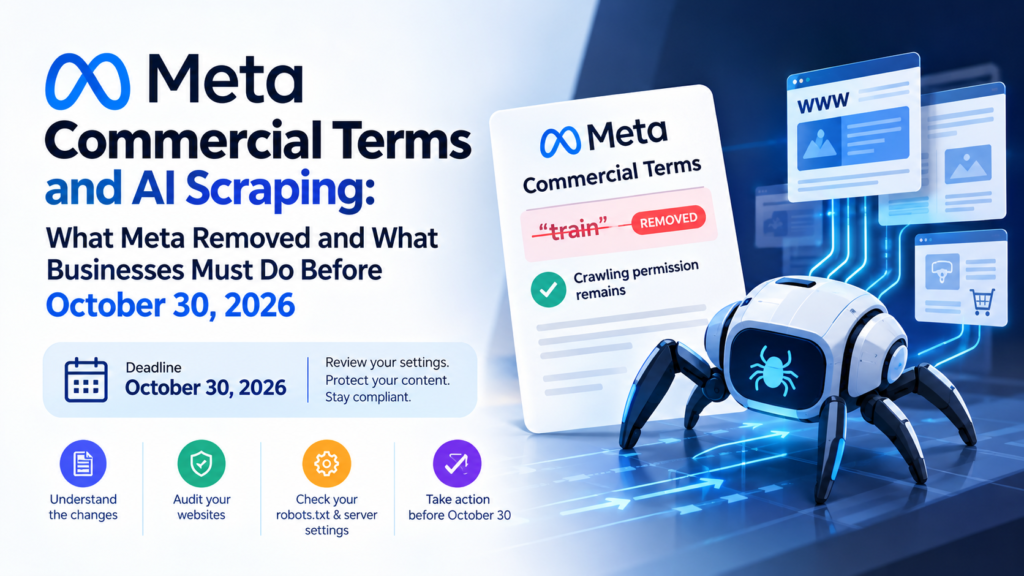
Meta deleted the sentence in its updated business agreement that appeared to let it use website content for AI training, but the revised Meta commercial terms still allow automated crawling of sites tied to business accounts. In short, the explicit “train” language is gone, the crawling permission remains, and the new agreement is scheduled to take effect on October 30, 2026.
That distinction matters because few contract updates jump from legal fine print to industry-wide controversy in a matter of days. This one did. Legal experts interviewed by Nieman Lab said the original wording could give Meta a path to scrape publisher websites and train AI models on the content. A Meta spokesperson insisted the update changed nothing about how the company crawls the web. Meta then pulled the provision anyway.
This guide explains what the agreement said, what was cut, what survives, and what to do about it. Each section stands on its own, so you can jump straight to the question you need answered.
The short version:
- What happened: Meta merged its crawling language into one commercial agreement, drew sharp criticism, and removed the sentence referencing “train” use on October 17, 2026.
- What remains: Permission for automated tools such as scrapers, bots, and crawlers to access websites linked to business accounts, according to reporting on the revised text.
- Deadline: October 30, 2026.
- Your first move: Read the live text for your region, audit the domains tied to your account, and document your robots.txt and server settings today.
What Are the Meta Commercial Terms?
The Meta commercial terms are the contract that businesses, advertisers, and publishers accept to use Meta’s business products across Facebook, Instagram, and WhatsApp. Acceptance is a condition of continued use. According to reporting, every business account that keeps using those platforms after October 30 consents to the document as written.
That makes the agreement unusual. Most terms of service govern what you do inside an app. This one reaches outward and governs how a platform may interact with your own website, a property you own and host elsewhere. For anyone with a Meta business account, the document is as much a data-access agreement as an advertising contract.
Why did Meta consolidate its crawling language?
A Meta spokesperson told Nieman Lab that language about crawling was previously scattered across several documents, including terms covering generative AI in ads, and that the update gathers it in one place. Meta’s stated goal was clarity: fewer overlapping agreements and a single reference point.
Why does consolidation raise legal questions?
Legal experts told Nieman Lab that folding the language into the main commercial agreement could let Meta argue the contract outranks other blocking instructions a site might use. A scattered set of narrow permissions is one thing. A single, mandatory, broadly worded agreement is another, because everyone using Meta’s business products has to accept it.
What Did the Original Meta Commercial Terms Say About Scraping?
The original Meta commercial terms authorized Meta, or anyone acting on its behalf, to use automated tools such as scrapers, bots, and crawlers on web pages and domains linked to a business’s products or services. The text also allowed Meta to use the collected content to provide, develop, improve, research, train, and maintain the integrity of its products and services.
The expansion is where the controversy lived. Local coverage summarizing Nieman Lab’s reporting said the language also let Meta create test credentials to get into sites and return periodically to pull updates. Read together, those pieces looked like a standing license to monitor and copy content from any website connected to a business account.
Why did the word “train” alarm legal experts?
The text never named AI directly. The word “train” did the work. Meta’s broader terms list AI at Meta among its products, so a permission to train products with website content could reach its AI models. Three legal experts told Nieman Lab that the language could be used to justify scraping for AI training, and TechCrunch reported that experts viewed it as a “remarkable provision.”
What was the commercial risk for publishers?
The core risk was licensing. Publishers and AI developers have been negotiating paid content deals, and coverage of the dispute noted that a contractual right to crawl and train could let a company sidestep that market and avoid fees that could run to many millions of dollars. Commentators also raised possible antitrust issues and the gradual erosion of the licensing market that content creators have been trying to build.
Cornell law professor James Grimmelmann warned that Meta could use scraped material in ways that compete with the publishers who produced it. Other experts compared the structure to tying: use the platform’s business tools, and the scraping rights come bundled in the same deal.
What Did Meta Remove, and What Stayed in Place?
Meta removed the provision on October 17, 2026. TechCrunch reported the change and credited The Verge with first reporting that the sentence was gone. Meta’s statement said the consolidated crawling terms applied only to its ads and business products, that it had made this explicit in the terms themselves, and that the update does not change how it uses web crawlers.
The removal was narrower than some headlines implied. Reports on the revised text say the agreement still lets Meta use scrapers, bots, and crawlers on websites associated with business accounts. What disappeared was the reference to using collected material to “train” Meta products. Meta’s communications chief, Andy Stone, has said the purpose is retrieving accurate product information for advertising and content recommendations. The removal narrowed the Meta commercial terms rather than rewriting them.
How do the earlier and revised versions compare?
The table below summarizes the differences as reported by the press. It is not a substitute for Meta’s full text.
| Element | Earlier version | Revised version (after Oct. 17) |
|---|---|---|
| Automated tools (scrapers, bots, crawlers) on business-linked sites | Authorized | Reportedly still authorized |
| Use of collected content to “train” Meta products | Stated explicitly | Reference removed |
| Stated scope of the crawling language | Broad, tied to domains linked to a business | Clarified as applying to ads and business products |
| Meta’s description of its crawler practices | No change | No change |
| Effective date | October 30, 2026 | Reportedly still October 30, 2026 |
What is the timeline of events?
The sequence below shows how quickly the story moved:
- Early October 2026: Meta notifies business customers of the update through a blog post and the Meta Business Suite.
- Mid-October 2026: Nieman Lab publishes legal experts’ concerns, and publishers and trade groups criticize the language.
- October 16, 2026: Andy Stone posts publicly that nothing has changed in how Meta uses web crawlers.
- October 17, 2026: The provision is removed, and The Verge and TechCrunch report the change.
- October 30, 2026: The updated agreement is scheduled to take effect.
Do the Revised Meta Commercial Terms Stop Meta From Crawling Business Websites?
No. The revised Meta commercial terms keep the permission to use automated tools on sites associated with business accounts. What changed is the stated purpose, not the access itself, and Meta maintains that its real-world crawler behavior never changed.
Two things can be true at once. Meta’s practices may be exactly what it says they are, and the contract may still document a broad permission that could be invoked later. Nothing in the public reporting shows that Meta used the disputed language to scrape or train on news content. One analysis of the episode stressed that the controversy does not establish actual large-scale scraping. The concern was optionality: rights that exist on paper can be relied on later, especially once the agreement is signed by millions of accounts.
Is Meta Training AI on Your Website Content?
Not on the public record. No report establishes that Meta used the removed language to train AI on content from business-account websites. The removal eliminates the most explicit contractual hook, but broader questions about Meta AI training remain unsettled.
Context helps here. In 2024, Meta acknowledged during an Australian parliamentary inquiry that it had used public Facebook and Instagram posts dating back to 2007 to train its generative AI. That concerns content posted on its own platforms, which is a different issue from crawling an independent website. The legal backdrop is also unsettled. TechCrunch noted that Meta defeated a high-profile copyright suit last year while other cases continue. Nieman Lab reported a class action filed in May by five large book publishers alleging Meta pirated books to train its Llama models. Legal experts told Nieman Lab that any attempt to train on content gathered under the new agreement would still turn on open questions about fair use.
Why Can a Contract Clause Matter More Than robots.txt?
A robots.txt file is a voluntary convention that tells compliant crawlers what to avoid, while a signed agreement is a binding commitment between two parties. When the two conflict, the contract may be the stronger document, which is why lawyers focused on it.
Expansion: robots.txt has no force of law on its own. It works because major crawlers choose to honor it. Meta had said content owners could keep managing access through such instructions, but legal experts questioned whether the revised language explicitly committed Meta to respecting them. That gap is the heart of the debate. If the Meta commercial terms say Meta may crawl linked domains, and your robots.txt says it may not, the question is which instruction wins. Experts said the new language gave Meta an opening to argue the contract does.
Who Is Affected by the Meta Commercial Terms?
Any organization whose domain is linked to a Meta business account is affected by the Meta commercial terms, because accepting the agreement is required to keep using the business tools. The groups with the most at stake are:
- News and media publishers whose original reporting has licensing value to AI developers.
- Ecommerce brands whose product pages, catalogs, and pricing are linked to ad accounts.
- Agencies managing multiple client accounts, each with its own domains and obligations.
- Creators and small businesses that rely on Meta advertising and rarely have legal teams to review contract changes.
- Multinational companies whose regional entities may be bound by different editions of the text.
Do the Meta Commercial Terms Differ by Region?
Possibly. One analysis that compared the preview editions on October 19 reported that the UK English edition still contained the “train” wording cut from the US edition. I could not verify that independently, so treat it as a prompt to check, not as a settled fact. If your business operates in several markets, read the Meta commercial terms for each region where you hold an account, and save a dated copy of each.
What Should Businesses Do Before October 30?
Businesses should take seven steps before the agreement takes effect. These steps reduce risk without requiring you to leave Meta’s platforms:
- Read the live Meta commercial terms for every region you operate in, and save dated copies. Press summaries are useful, but only the actual text governs.
- Inventory linked domains. List every site, subdomain, catalog, and pixel connected to your Meta business account, including those added by agencies.
- Review your robots.txt and server logs. Look for Meta’s documented crawler user agents, such as facebookexternalhit and meta-externalagent, and confirm the current names in Meta’s developer documentation.
- Keep dated records of your settings. If scraping later appears to exceed what your robots.txt allows, that record becomes the basis for any dispute.
- Limit exposure where practical. Consider whether every domain truly needs to stay linked to a business account.
- Ask for written clarification. Contact your Meta representative or agency partner and ask how the crawling language applies to your domains.
- Brief legal counsel and trade groups. Publishers have been vocal, and collective positions carry more weight than individual ones. This article is general information, not legal advice.
Which Controls Actually Limit AI Crawlers?
No single control is sufficient. The strongest approach layers technical blocking, clear site terms, and, where possible, negotiated agreements.
| Control | Binding? | Strength | Limitation |
|---|---|---|---|
| robots.txt | No (voluntary) | Easy to deploy; widely recognized | Depends on crawler cooperation |
| Site terms of service | Partly | States your position clearly | Enforceability varies by jurisdiction |
| Server or firewall blocking | Technical | Stops requests at the gate | Needs upkeep; may disrupt link previews or ad review |
| Negotiated licensing agreement | Yes | Can define permitted uses and payment | Smaller businesses have little leverage |
If you choose to block, test before you deploy. Blocking certain Meta user agents could affect link previews or ad review, so confirm the side effects first.
What Does This Mean for AI Visibility and Generative Engine Optimization?
It means you should separate two goals that often get blurred: being retrieved and cited by AI answer engines, and being used to train AI models. A brand can want the first and refuse the second.
Retrieval-focused systems pull passages to answer a live question and may cite the source. Training use ingests content to shape a model, usually without attribution or payment. Your crawler policy should reflect that difference. Allow the user-facing retrieval bots whose citations bring you traffic, and restrict training crawlers where your licensing strategy requires it. The Meta episode is a reminder to audit these policies regularly, because platform agreements can change the picture with a single sentence.
Frequently Asked Questions About the Meta Commercial Terms
Did Meta remove the AI training language from the Meta commercial terms?
Yes. Meta removed the sentence that referenced using collected website content to “train” its products, as reported on October 17, 2026. The crawling permission itself reportedly remains.
When do the Meta commercial terms take effect?
October 30, 2026, according to the reporting reviewed for this article. Business accounts that continue using Facebook, Instagram, or WhatsApp after that date are treated as accepting the agreement.
Can a business opt out of the Meta commercial terms?
None was reported. Coverage describes acceptance as a condition of continuing to use the business products. If you object to specific provisions, your options are to raise concerns with Meta, coordinate with trade groups, or reconsider how your domains are linked to your account.
Does the agreement replace robots.txt?
Not on its face, but experts worried it could be used to argue that the contract outranks blocking instructions. Keep your robots.txt current and keep dated records of it.
Is the text the same in every country?
Not necessarily. One analysis reported that a regional edition still carried the removed wording. Verify the version that applies to each market you operate in.
Bottom Line: Treat the Meta Commercial Terms as a Crawl-Access Contract
The lesson of this episode is bigger than one sentence in one document. The Meta commercial terms show how a platform agreement can quietly become a website-access agreement, and how quickly scrutiny from lawyers, journalists, and publishers can force a reversal.
Meta removed the language that raised the loudest alarm, and it says its crawling practices are unchanged. Both statements can be accurate, and your obligations stay the same: read the text, audit your domains, document your controls, and keep your options open. With the October 30 date approaching, the businesses that fare best will be the ones that treated the Meta commercial terms as a contract to understand rather than a pop-up to dismiss.