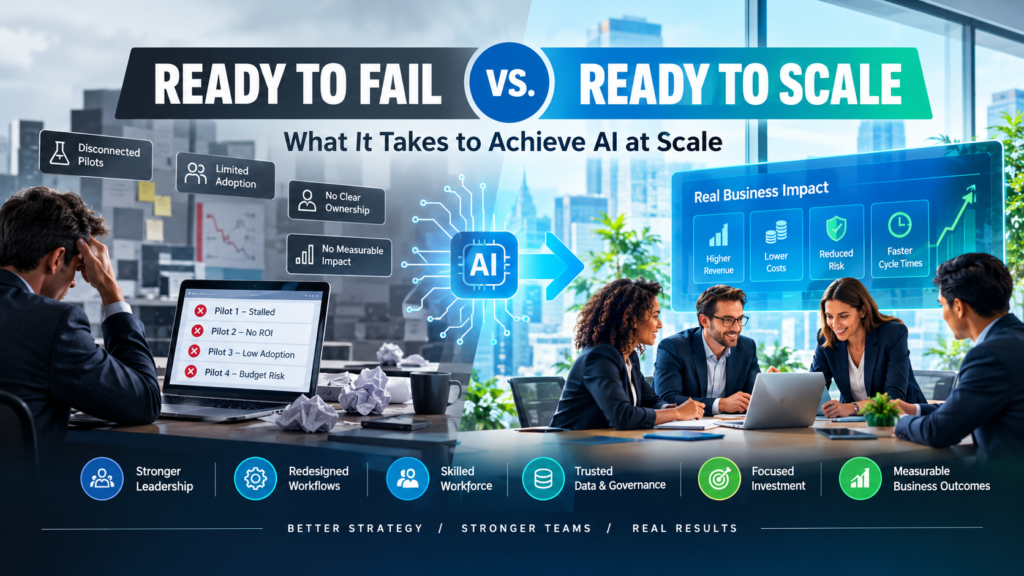
Organizations achieve AI at scale only when leaders change how the company operates, funds, and measures AI, not when they simply buy more tools or launch more pilots. Gartner’s research describes a stubborn pattern: heavy spending has not converted into everyday use, and everyday use has not converted into measurable financial value. This guide explains what separates organizations that are ready to fail from those that are ready to scale. It also gives CEOs, CFOs, CIOs, and CHROs a practical playbook they can start using this quarter. gartner
What you will learn in this guide:
- What AI at scale means and how it differs from a successful pilot
- Why access to AI does not guarantee adoption or business impact
- What leading CEOs and boards do differently
- How to align the CEO, CFO, and CHRO conversations into one C-suite AI strategy
- A readiness checklist, a measurement model, and a 90-day plan
What Is AI at Scale?
AI at scale is the stage at which artificial intelligence is embedded in multiple core business processes and produces measurable, repeatable value that the finance team can verify. It is a business outcome, not a technology milestone.
The definition has three parts:
- Breadth: AI supports many workflows across several functions, not one team’s experiment.
- Depth: AI changes how decisions are made and how work gets done, rather than sitting beside the real process as an optional extra.
- Durability: Results persist after the launch excitement fades, and they appear in financial reporting, not just in usage dashboards.
A simple test makes this concrete. If you switched an AI system off tomorrow, would a metric you report to the board change? If the honest answer is no, you have AI activity rather than AI at scale.
How Is AI at Scale Different From an AI Pilot?
A pilot shows that something can work under controlled conditions; AI at scale shows that it keeps working inside real processes, with real users, real data, real risk, and real accountability. Pilots usually have enthusiastic sponsors, curated data, and forgiving timelines. Production has none of those advantages. Many organizations discover the gap only after the pilot has been celebrated and the budget for the next phase has been requested.
Why Do Most AI Investments Fail to Deliver Business Impact?
Most AI investments disappoint because organizations fund technology but not the leadership, process, and behavior changes that turn technology into results. Gartner’s description of its C-suite session notes that large sums have gone into building and buying solutions and into funding pilots, deployments, and production initiatives, yet measurable business and financial value remains elusive. In earlier research, Gartner stated that more than half of generative AI projects fail. gartnergovevents
The root causes tend to cluster in three areas: unclear ownership, weak operating models, and metrics that measure activity instead of outcomes. The next two subsections unpack the gap and the strategic trap behind it.
What Is the Access, Adoption, and Impact Gap?
The access-adoption-impact gap is the distance between having AI tools available, employees actually using them in their work, and that use producing measurable financial results. Each step is a separate failure point:
- Access without adoption: Licenses are purchased and tools are deployed, but employees don’t know where AI fits in their daily work, or they don’t trust the output.
- Adoption without impact: People use AI regularly, but the time saved is spread thinly across many tasks, never redeployed, and never reflected in cost, revenue, or risk metrics.
- Impact without durability: A team produces a strong result once, but the workflow is never standardized, so the gain doesn’t repeat elsewhere.
Reaching AI at scale means closing all three gaps, not just the first. Most scorecards stop at access because access is the easiest thing to count.
Why Are Fast-Follower Strategies Becoming Obsolete?
Fast-follower strategies are failing because the advantage in AI comes from organizational learning, and learning cannot be copied after the fact. Gartner notes that traditional fast-follower approaches are becoming obsolete as AI investment accelerates. A competitor can license the same model you use within days. It cannot replicate your redesigned workflows, your trained workforce, your cleaned-up data, or the governance habits you built over two years. Waiting to see what others do doesn’t reduce risk. It delays your own learning curve while rivals move along theirs. gartner
Ready to Fail vs. Ready to Scale: A Side-by-Side Comparison
The clearest difference between the two postures is what leaders treat as the unit of success: a launched tool or a changed business outcome. The table below contrasts them across eight dimensions. It is an editorial synthesis built on the themes Gartner highlights: leadership, operating model, and organizational shifts.
| Dimension | Ready to Fail | Ready to Scale |
|---|---|---|
| Leadership ownership | Delegated to IT or an innovation lab | Owned by the CEO and board, with named executive accountability |
| Investment logic | Many disconnected pilots | A governed portfolio tied to value targets |
| Success metric | Licenses, logins, and prompts | Revenue, cost, risk, and cycle-time change |
| Operating model | AI layered on top of old processes | Processes, roles, and decision rights redesigned |
| Workforce approach | One-time training | Continuous skill building and role redesign |
| Data and risk | Handled project by project | Shared standards and guardrails |
| Time horizon | The next demo | Multi-year capability building |
| Competitive stance | Wait and copy | Learn by doing and build proprietary advantage |
Most organizations start in the left column, and that is normal. The practical goal is to identify which row costs you the most and fix it first. A scorecard that steadily moves from left to right is the most honest definition of preparing for AI at scale.
What Are Leading CEOs and Boards Doing Differently?
Leading chairpersons and CEOs treat AI as an enterprise transformation they personally own, not a technology program they sponsor from a distance. Gartner says its session draws on interviews with chairpersons and CEOs from organizations including IBM, Accenture, Tata Group, and PwC. The public session description doesn’t detail every finding, so the three patterns below combine Gartner’s stated themes with widely accepted management practice. gartner
They Make AI a Board-Level Business Question
Boards that get results ask business questions rather than technology questions. “Which P&L lines will move, by how much, and by when?” is more useful than “Which model are we using?” These leaders set a small number of enterprise outcomes, such as faster cycle times in a core process or a lower cost to serve, and hold named executives accountable for them. This keeps AI investment connected to strategy and stops every function from chasing its own favorite use case.
They Redesign the Operating Model, Not Just the Tool Stack
An AI operating model defines who decides, who builds, who funds, and who is accountable for AI outcomes across the company. Without one, every function renegotiates data access, risk review, and budget from scratch. Gartner’s work on AI leaders who exceed their CEOs’ expectations points to team structure, business trust, metrics, and portfolio management as the practices that set them apart. Those four areas make a useful diagnostic for any C-suite AI strategy. govevents
They Manage a Portfolio, Not a Pile of Pilots
A portfolio has stage gates, kill criteria, and shared infrastructure; a pile of pilots has enthusiasm. Leaders fund use cases in stages, stop the ones that miss their value targets, and reuse data pipelines, security reviews, and evaluation methods across initiatives. This discipline is the quiet engine of AI at scale, because it turns scattered experiments into compounding capability.
What Does an AI Operating Model Look Like in Practice?
A working AI operating model has four components: decision rights, funding, delivery, and risk governance. Each can be designed and improved on its own.
Decision Rights: Who Decides Which Use Cases Proceed?
A cross-functional AI council should decide, ideally chaired by a business executive rather than a technology leader. Its job is to rank use cases against enterprise priorities, resolve conflicts over shared data and talent, and decide what to stop. Without clear decision rights, the loudest sponsor wins instead of the highest-value idea.
Funding: How Is Money Released?
Release funding in stages tied to value milestones, not in one annual lump sum. An early stage might fund discovery and a baseline. A later stage funds production only after the pilot hits agreed targets. This approach limits losses on weak ideas and gives strong ideas a predictable path to production.
Delivery: Who Builds and Who Runs?
Most mature organizations use a hybrid. A central platform team provides shared capabilities such as data access, evaluation tools, and security patterns. Business-unit teams own the use case, the workflow redesign, and the results. The critical rule is that a named business owner, not the technology team, is accountable for AI adoption in their area.
Risk Governance: How Do You Move Fast Safely?
Tier your reviews by risk. A low-risk internal drafting assistant needs a lighter process than a customer-facing decision system. Pre-approved patterns, clear escalation paths, and post-launch monitoring let teams move quickly without skipping safeguards. Governance designed this way works as an accelerator, not a brake.
How Do You Align the CEO, CFO, and CHRO Conversations About AI?
Align them by giving each executive a distinct question and one shared scoreboard. Gartner has pointed out that several AI conversations run in parallel inside most enterprises, including the CEO conversation, the CFO conversation, and the CHRO conversation. When these run separately, the organization hears three different stories about what AI is for, and teams receive conflicting signals about priorities, funding, and job security. gartner
The CEO Conversation: Where Will AI Change Our Competitive Position?
The CEO defines where AI creates advantage and sets the pace of change. The key output is a short list of strategic bets with clear owners. The risk to avoid is a vague mandate to “use AI everywhere,” which produces activity with no direction.
The CFO Conversation: What Evidence of Value Will We Accept?
The CFO sets the evidence standard before money is spent. That means agreed baselines, defined benefit categories such as cost, revenue, risk, and working capital, and a clear rule for when projected savings count as real. The risk to avoid is approving funding on enthusiasm and reviewing it later with metrics nobody agreed to.
The CHRO Conversation: How Will Roles, Skills, and Incentives Change?
The CHRO prepares the workforce for changed work. AI adoption stalls when employees fear replacement or see no reason to change their habits. Effective CHROs link AI skills to career paths, redesign roles alongside workflows, and treat training as continuous rather than a one-time course.
What Is a Shared AI Scoreboard?
A shared AI scoreboard is a single set of outcome metrics that the CEO, CFO, CHRO, and CIO review together on a regular cadence. It might include value delivered per initiative, adoption inside redesigned workflows, workforce readiness, and risk incidents. When all four executives read the same numbers, a unified C-suite AI strategy becomes possible, and AI at scale stops being everyone’s priority and no one’s responsibility.
The Scale-Readiness Checklist: Seven Questions to Answer Before Investing More
Seven questions reveal whether an organization is ready to scale or ready to fail. Answer each one honestly. Any “no” marks a priority gap.
- Does every major AI initiative have a named business owner and a financial target?
- Is there an agreed baseline against which benefits will be measured?
- Are processes and roles being redesigned, or is AI simply layered on old workflows?
- Can the organization move a successful pilot into production within a defined timeline?
- Do shared standards for data quality, security, and responsible AI exist across functions?
- Is the workforce supported through continuous skill building rather than a single training event?
- Does the board review AI outcomes, not just AI activity, on a regular schedule?
As a rule of thumb, three or more “no” answers is a strong signal to pause new pilots and fix the foundations first.
How Do You Measure AI Business Impact?
Measure AI business impact on three layers (usage, operational change, and financial outcome) and report only the third to the board as proof of value. The first two layers help managers diagnose problems, but only the third shows whether the business actually changed.
| Layer | Example Metrics | Question It Answers |
|---|---|---|
| Usage | Active users, tasks completed with AI, adoption inside redesigned workflows | Are people using AI where it matters? |
| Operational change | Cycle time, error rates, throughput, first-contact resolution | Is the work actually different? |
| Financial outcome | Cost to serve, revenue per customer, risk losses avoided, working capital | Did the P&L move? |
Four practical rules keep the measurement honest:
- Set baselines before launch, not after.
- Use control groups or phased rollouts wherever possible to isolate AI’s contribution.
- Count time savings only when the freed capacity is redeployed or removed from the budget.
- Review results quarterly and retire metrics that nobody acts on.
Organizations that stop at the usage layer rarely reach AI at scale, because usage numbers feel like progress without proving it.
A 90-Day Plan to Move From Ready to Fail to Ready to Scale
Use 90 days to assign ownership, narrow the portfolio, and prove one or two value cases end to end. The plan is deliberately modest, because momentum matters more than ambition in the first quarter.
Days 1 to 30: Establish Ownership and Baselines
- Name an executive owner for each strategic AI bet
- Inventory every active pilot and deployment
- Capture baselines for the metrics each initiative claims to improve
- Hold a joint CEO, CFO, and CHRO session to agree on the shared scoreboard
Days 31 to 60: Narrow and Redesign
- Stop or pause initiatives with no owner or no financial target
- Choose two or three use cases with clear value and a realistic path to production
- Redesign the underlying workflow and roles, not just the tool
- Define stage gates and kill criteria for each use case
Days 61 to 90: Prove and Standardize
- Run the selected use cases in production with real users
- Measure against baselines using the three-layer model
- Document what worked as a repeatable playbook other teams can adopt
- Present results and next-quarter funding decisions to the board
Followed consistently, this sequence gives leaders their first credible proof point on the road to AI at scale.
Which Common Mistakes Keep Organizations Stuck in “Ready to Fail”?
The most common mistakes are counting usage as value, funding pilots with no path to production, and leaving the workforce out of the plan. Four more appear again and again:
- Treating governance as a brake instead of an enabler of speed
- Copying competitors’ tools without copying the operating changes behind them
- Delegating AI entirely to IT or an innovation lab
- Spreading investment evenly across too many use cases
Each mistake traces back to the same root cause: a technology mindset applied to an organizational problem.
Frequently Asked Questions
What Is AI at Scale in Simple Terms?
It means AI is embedded in core processes across the business and delivers measurable, repeatable value that shows up in financial results rather than only in usage statistics.
Why Does AI Adoption Not Automatically Create Business Impact?
Adoption measures whether people use AI, while impact measures whether the business changed. Employees can use AI heavily for tasks that don’t affect cost, revenue, or risk. Time saved that is never redeployed produces no financial result.
Who Should Own AI Strategy in a Company?
The CEO should own the outcome, with named accountability below. The CIO or a chief AI or data officer typically leads delivery, the CFO validates value, and the CHRO owns workforce readiness. Shared ownership without a single accountable executive is a common cause of stalled programs.
How Long Does It Take to Reach AI at Scale?
There is no universal timeline, because it depends on data quality, process complexity, and culture. Leaders can often prove first value within a quarter or two, as the 90-day plan shows. Embedding AI across multiple functions should be planned as a multi-year effort.
Is It Too Late to Start if Competitors Are Ahead?
No, but waiting is increasingly costly. Because the advantage comes from organizational learning, every quarter spent without a focused portfolio and clear ownership widens the gap. Starting with two or three well-governed use cases is better than waiting for a perfect strategy.
Conclusion: Treat AI at Scale as a Leadership Decision, Not a Software Purchase
The difference between ready to fail and ready to scale is leadership behavior, not technology access. Organizations that reach AI at scale assign executive ownership, redesign their operating models, manage a disciplined portfolio, and measure financial outcomes rather than activity. Those that don’t will keep funding pilots that never leave the lab.
To hear Gartner’s view directly, its live session, “C-Suite AI Conversations: Ready to Fail vs Ready to Scale,” runs on October 29, 2026, at 10:00 a.m. EDT and is hosted by Distinguished VP Analyst Frances Karamouzis. Whatever you decide after that, start now. Choose one initiative, name an owner, set a baseline, and measure what changes.