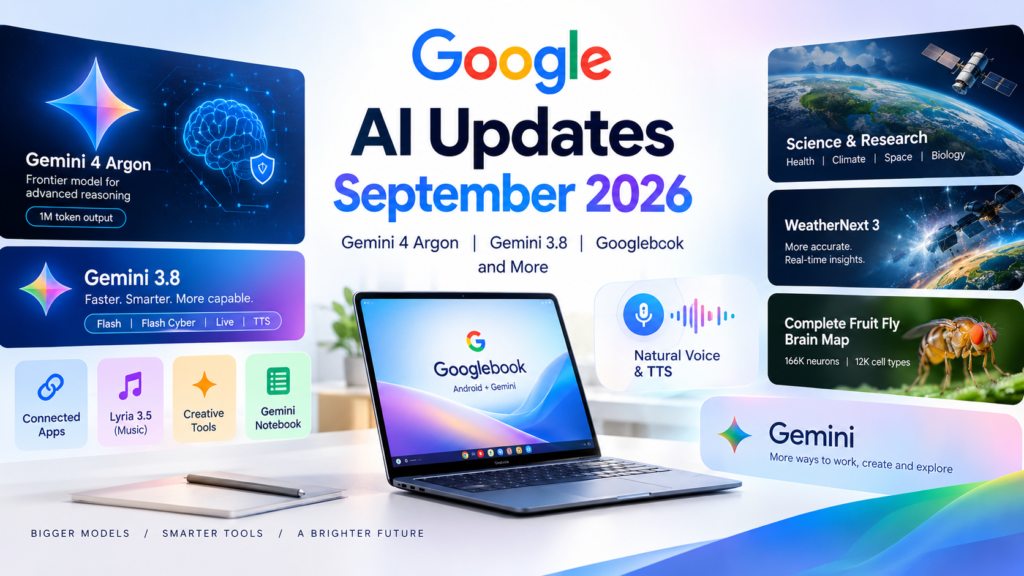
The Google AI updates September 2026 roundup is led by Gemini 4 Argon, a frontier model with a 1-million-token output limit that is rolling out first to trusted cyber defenders. Around it, Google shipped Gemini 3.8 Flash, expressive voice models, new Connected Apps, a Windows app for Gemini, Googlebook pre-orders, and a run of science results. Google published its official recap on October 2, 2026.
You don’t need to read every launch post to stay informed. You need to know what shipped, who can use it today, and what it changes for your work. This guide organizes the Google AI updates September 2026 into sections that each stand on their own, so you can jump straight to the part you need.
Quick Answer: The Biggest Announcements at a Glance
- Gemini 4 Argon: Google’s newest frontier model, built for advanced reasoning on hard problems. It is currently limited to trusted cyber defenders.
- Gemini 3.8 Flash and 3.8 Flash Cyber: Better reasoning and coding at the same speed and cost as 3.7 Flash. The Cyber variant is for vetted defenders.
- Gemini 3.8 Live and Live Extended Thinking: Two natural-sounding speech models, one for everyday conversation and one for multi-step reasoning by voice.
- Gemini 3.8 text-to-speech models: Flash and Flash-Lite versions that generate custom voices and scene dialogue from text prompts.
- Connected Apps in Gemini: New integrations including Airtable, Linear, monday.com, Adobe, Webflow, and Peloton.
- Lyria 3.5: Google’s most expressive music model, now in the Gemini app and several creative tools.
- Googlebook: An Android-based laptop with on-device Gemini features, open for pre-order.
- Science releases: AlphaGenome Atlas, MAPL-EMIT methane tracking, WeatherNext 3, and a complete adult male fruit fly brain map.
- Gemini app for Windows: Opens with Alt + Space over whatever you are working on.
What Are the Google AI Updates September 2026?
The Google AI updates September 2026 are the models, product features, hardware, and research results that Google announced during the month and collected in a single monthly recap. Google presents the roundup as a regular way to keep people posted on its progress across healthcare, crisis response, education, and everyday tools.
Think of the recap as a changelog with a narrative. It groups launches by what they help you do: reason through hard problems, talk to your devices, connect your apps, study, or understand the physical world. That grouping is a useful way to evaluate each launch, and this article follows it.
Why does Google publish a monthly AI roundup?
Google publishes the roundup because AI announcements now arrive faster than most people can track. A monthly digest gives developers, marketers, and enterprise teams one place to see what changed, and it gives Google a single page that links to every detailed launch post.
How should you read the recap?
Read it in three passes. Start with the models, because they set the ceiling for everything else. Then look at the products that put those models in front of users. Finally, scan the research items, which show where Google is investing for the longer term.
Gemini 4 Argon: The Headline Model
What is Gemini 4 Argon?
Gemini 4 Argon is the first model in Google’s new Gemini 4 family and the company’s newest frontier model. Google describes it as built for advanced reasoning on the hardest problems, with an industry-leading 1-million-token output limit. That output ceiling matters for long documents, large codebases, and extended research tasks, where shorter limits force you to split work into pieces.
Google names several workloads where Argon should excel:
- Coding
- Cybersecurity defense
- Financial research
- Legal drafting
- Autonomous cybersecurity patching
Why isn’t Gemini 4 Argon available to everyone yet?
Google is releasing it in phases. Argon is currently rolling out to trusted cyber defenders through the Fairwind Program, and Google says it is gathering feedback from early testers to improve guardrails before expanding to developers, enterprises, and consumers. Google’s stated reasoning is that releasing frontier capabilities at this level safely requires a phased approach.
This tells you something about the direction of the industry. The most capable models are increasingly reaching security professionals before the general public, especially when they can find and patch vulnerabilities autonomously.
Where does Gemini 4 Argon fit among the Google AI updates September 2026?
Argon is the only launch in the Google AI updates September 2026 that is deliberately gated, and it capped the month rather than opening it. Treat it as a preview of where Google’s models are heading. For production work today, the Gemini 3.8 family is the practical choice.
The Gemini 3.8 Family: Practical Models You Can Use Now
The Gemini 3.8 family is where the Google AI updates September 2026 become practical for everyday builders. It covers three areas: reasoning and coding, live voice, and speech generation.
Gemini 3.8 Flash and 3.8 Flash Cyber
Gemini 3.8 Flash delivers Google’s best reasoning and coding performance so far at the same speed and low cost as Gemini 3.7 Flash. Google highlights gains in long-horizon software engineering, multi-step problem solving, and agentic workflows. If you build agents or coding tools, that combination of better quality at unchanged price is the main reason to pay attention.
Gemini 3.8 Flash Cyber is the defender-focused sibling. It offers frontier-grade autonomous vulnerability discovery and automated code patching, and it is available to trusted organizations through the new Fairwind Program.
Availability details beyond Google’s recap are worth noting. Gemini 3.8 Flash became generally available and enabled by default in the Gemini Enterprise app in the global, US, and EU regions on September 23. google
Gemini 3.8 Live and Live Extended Thinking
Google launched two audio models built for natural conversation:
- Gemini 3.8 Live handles everyday spoken conversation.
- Gemini 3.8 Live Extended Thinking targets multi-step reasoning by voice. Google calls it the top-rated speech-to-speech model for that job, with less lag.
Both are available to developers in Google AI Studio and the Gemini API. Consumers can reach them through Search Live, Gemini Live, and Google Workspace, where voice commands work in Gmail, Docs, and Keep.
Gemini 3.8 text-to-speech models
The new Gemini 3.8 Flash TTS and Flash-Lite TTS models generate custom voices and direct scene dialogue from simple text prompts. Instead of picking from a fixed list of presets, you describe the voice you want. Google is rolling these out across products including Gemini Notebook and Google Vids.
What Changed in the Gemini App
Gemini Connected Apps
Gemini Connected Apps now cover more of the tools people already use. Google lists three groups:
- Productivity: Airtable, Linear, monday.com, and PandaDoc
- Creative: Adobe, Picsart, Squarespace, and Webflow
- Lifestyle: Peloton, SeatGeek, and Experian
To use them, open your Gemini settings and select the apps you want to link. The practical benefit is fewer tab switches: you can ask Gemini to act inside a connected tool without leaving the conversation.
Lyria 3.5 for music
Lyria 3.5 is Google’s most expressive music generation model yet. From text prompts or images, it produces richer arrangements and more coherent songs. It is available globally in Gemini and across Google AI Studio, Google Flow Music, and Google Vids.
Gemini Notebook study tools
Gemini Notebook added interactive coursework features: custom flashcards, versatile quiz formats, and 60-second Short Video Overviews in more than 80 languages. For back-to-school season, eligible college students can claim a free 12-month Google AI student plan with higher usage limits.
CC in Google Labs
Google Labs expanded CC from a personal agent into a group agent for household logistics and shared schedules. CC gets its own email address and can coordinate family calendars and track group to-dos, with built-in privacy controls. It is an experimental preview.
Gemini for Windows
The Gemini app now runs on Windows. Press Alt + Space to open it over your current work, whether you need to fact-check a document or brainstorm. In the dedicated workspace, you can delegate multi-step tasks to Gemini Spark, pull together files from Gmail and Drive, and generate images and videos.
Googlebook: Google’s Android Laptop
Googlebook is a laptop built on Android with desktop foundations from ChromeOS, and it is open for pre-order. Google designed it for Gemini Intelligence and for working with an Android phone out of the box.
Two on-device features stand out:
- Magic Pointer: Wiggle the cursor to point at anything on screen and ask Gemini about it.
- Rambler: Smart voice dictation that turns a verbal brain dump into organized, shareable notes.
Googlebook also offers no-code custom widgets and background task processing. If you live in the Android ecosystem, it is the clearest sign that Google wants Gemini built into the operating system, not just inside an app.
Science and Research Highlights
The September recap also covers research that has little to do with chat interfaces but shows where Google applies its models:
- AlphaGenome Atlas: A database predicting the effect of every possible single-nucleotide variant in the human genome, about 9 billion in total. It needs no coding skills and is already supporting rare disease and complex genetics research.
- MAPL-EMIT: A deep learning model built with NASA’s Jet Propulsion Laboratory to track methane leaks from space. Google reports it detects 50% more emissions than human experts and has found over 23,000 previously unmapped plumes. The data is open on Google Earth Engine.
- WeatherNext 3: Google’s most advanced AI weather model, now with real-time satellite data, hourly refreshes, higher resolution, and precipitation forecasting. It is integrated across Search, Gemini, Maps, and Cloud.
- Fruit fly brain map: The first complete brain map of an adult male fruit fly, charting over 166,000 neurons and nearly 12,000 cell types.
- Project Suncatcher: A first test satellite with Planet to see how Google TPUs perform in orbit, where satellites can access up to eight times more solar power.
- DeepMind Institute: A new forum for researchers and thinkers to discuss a world with AGI.
Google AI Updates September 2026 Compared: Availability and Best Use
| Update | What it is | Who can use it now | Best for |
|---|---|---|---|
| Gemini 4 Argon | Frontier reasoning model, 1M-token output | Trusted cyber defenders via Fairwind | Security teams, future planning |
| Gemini 3.8 Flash | Faster, cheaper reasoning and coding | Developers and enterprise users | Agents, software engineering |
| Gemini 3.8 Flash Cyber | Vulnerability discovery and patching | Trusted organizations | Defensive security |
| Gemini 3.8 Live | Natural speech-to-speech model | Developers and consumers | Voice assistants, Search Live |
| Gemini 3.8 TTS | Custom-voice text-to-speech | Rolling out across Google products | Audio and video production |
| Connected Apps | App integrations inside Gemini | Gemini users via settings | Task workflows |
| Lyria 3.5 | Music generation | Global, in Gemini and Google tools | Creators and marketers |
| Googlebook | Android-based laptop | Pre-order | Android-first users |
| WeatherNext 3 | Global weather AI model | Search, Gemini, Maps, Cloud | Forecasting and planning |
What the Google AI Updates September 2026 Mean for SEO and GEO
The Google AI updates September 2026 matter for search marketers because the same models now sit inside Google’s search experience. A new model option in AI Mode can behave like an algorithm update. Gemini 3.8 Flash became selectable in the AI Mode model dropdown for paid subscribers on September 2, and Marie Haynes’ tracker argues that better answers can mean fewer clicks to some sites. mariehaynes
Do model releases change how your content gets cited?
They can. When a stronger model resolves more of a question directly, it clicks through to fewer sources and picks those sources differently. That is why structure matters: modular headings, direct answers, and clearly defined terms give both people and retrieval systems something to extract and attribute.
What else happened in search that month?
Google began its September 2026 spam update on September 24, its fourth spam update of the year, and it said manipulating generative AI features in Search, including AI Overviews and AI Mode, falls under its existing spam policies. The practical lesson is to earn citations with useful, original content instead of trying to game AI answers. coalitiontechnologies
Practical steps for content teams
- Lead each page with the direct answer, then expand.
- Write sections that make sense when read alone.
- Name products, versions, and dates precisely.
- Link to primary sources, such as Google’s own launch posts.
- Refresh pages when a launch moves from preview to general availability.
How to Use the Google AI Updates September 2026 in Your Workflow
The best way to use the Google AI updates September 2026 is to match each launch to a job you already do, then test one at a time.
For developers: Try Gemini 3.8 Flash for agentic and coding work, and the Live models for voice features through Google AI Studio and the Gemini API.
For marketers and creators: Use Lyria 3.5 for music, the TTS models for voiceover, and Connected Apps to move work between Gemini and tools like Webflow or Adobe.
For students and educators: Explore Gemini Notebook’s flashcards, quizzes, and short video overviews.
For security teams: Watch the Fairwind Program, since Argon and Flash Cyber reach defenders first.
For everyday users: Install the Gemini app on Windows and try the Alt + Space shortcut for quick help.
Frequently Asked Questions
What is the biggest of the Google AI updates September 2026?
Gemini 4 Argon. It is the first Gemini 4 model, with advanced reasoning and a 1-million-token output limit, and Google calls it the headline of the month.
Can everyone use Gemini 4 Argon today?
No. It is rolling out to trusted cyber defenders through the Fairwind Program, and Google plans to expand to developers, enterprises, and consumers after gathering feedback on guardrails.
Which new model is best for everyday development?
Gemini 3.8 Flash. Google says it has its best reasoning and coding performance yet at the same speed and cost as 3.7 Flash.
Are the Google AI updates September 2026 available to everyone?
Availability varies by launch. Gemini 3.8 Live, Lyria 3.5, and Connected Apps reach regular users and developers. Argon and Flash Cyber are limited to trusted organizations, and Googlebook is open for pre-order.
Where can I read the original announcement?
Google’s official post, “The latest AI news we announced in September 2026,” is on the Google blog and links to each detailed launch article.
Conclusion
The Google AI updates September 2026 show a company moving on three fronts at once: more capable models, AI built into everyday tools and devices, and research aimed at science and climate. Argon shows where frontier capability is going, while Gemini 3.8 Flash, the Live models, and Connected Apps are what most people can use now.
For readers and builders, the takeaway from the Google AI updates September 2026 is simple. Match each launch to a real task, check who can access it today, and revisit as gated models like Argon widen their rollout. Bookmark Google’s official recap and each linked launch post, since details such as availability will keep changing.
What to do next
A short action plan keeps the news from turning into noise:
- This week: Pick one launch that fits work you already do, such as Gemini 3.8 Flash for coding or Connected Apps for task handoffs, and run a small test.
- This month: Compare the result with your current tools on speed, quality, and cost, and write down what changed.
- This quarter: Re-read Google’s next monthly roundup and check whether gated releases like Argon and Flash Cyber have moved beyond the Fairwind Program.
What to watch
Three signals will show where things go from here. First, whether Google widens Argon access to developers, enterprises, and consumers after its guardrail feedback. Second, how quickly Googlebook moves from pre-order to real-world use. Third, how Gemini models keep shaping Google Search, since each new model can change which sources get cited.
If you publish content about these topics, keep your pages current and precise. Name versions and dates, link to primary sources, and update posts when a preview becomes generally available. The Google AI updates September 2026 are a snapshot, and the people who track them closely will be best placed to use whatever Google ships next.