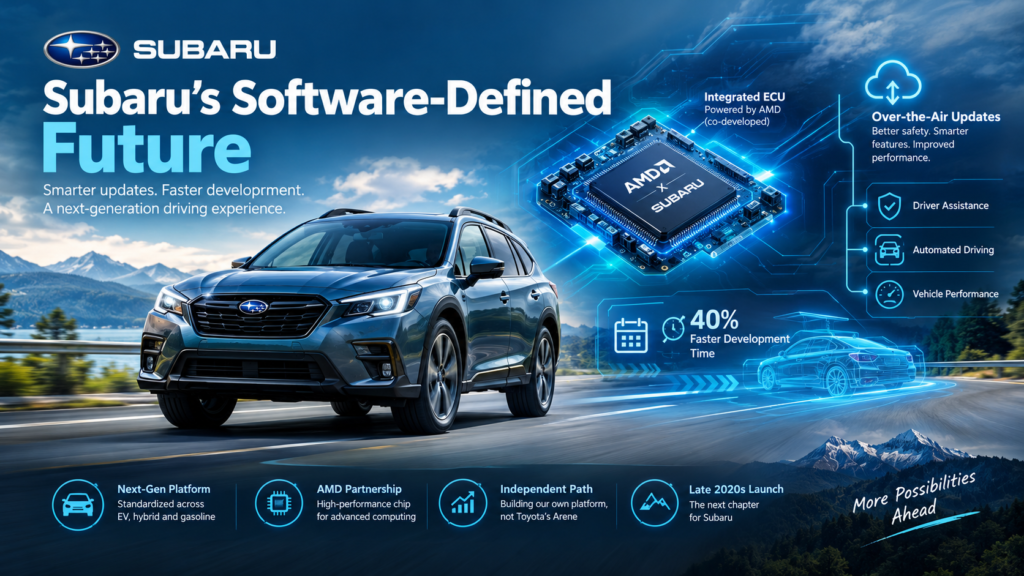
Subaru will launch its first software-defined vehicle in the second half of this decade, and it wants to build its cars about 40% faster to get there. The Japanese automaker announced the plan on Sunday at a strategy briefing at a research centre in Sano City, north of Tokyo. In plain terms, the Subaru software-defined vehicle roadmap means future Subarus will be upgradable by software after purchase, built on a new in-house electronic brain, and developed on a much shorter clock. Yahoo Finance
This is a bigger moment than a typical product-timeline update. Subaru is a smaller automaker, and it is choosing to build its own electronic foundation rather than plug into the platform of its largest shareholder. Here is what was announced, what it means, and what is still unknown.
Key Takeaways
- Timeline: Subaru plans to launch software-defined vehicles (SDVs) in the second half of this decade. thestar
- Speed: The company wants to cut vehicle development times by about 40%. thestar
- Hardware: A newly developed integrated electronic control unit (ECU) will be deployed gradually across the lineup. wtvbam
- Chip partner: Subaru jointly developed the chip at the core of the integrated ECU with US chipmaker Advanced Micro Devices. thestar
- Updates: Over-the-air updates are planned for driver-assistance, automated-driving and vehicle performance functions. wtvbam
- Toyota: Subaru has no plans at present to adopt Toyota’s Arene software platform, despite Toyota’s 21% stake. thestar
What Is the Subaru Software-Defined Vehicle Strategy?
A software-defined vehicle (SDV) is a car whose features, performance and behavior are controlled mainly by software rather than fixed hardware, so they can be improved after the car leaves the factory. The Subaru software-defined vehicle strategy applies that idea to Subaru’s lineup through a new electronic architecture, a faster development process and a standardized platform.
Definition: What a Software-Defined Vehicle Actually Is
Cars have run on software for decades. What is changing is that more capable and powerful ECUs running more comprehensive software are taking over tasks once handled by discrete, specialized components. The practical result is fewer, stronger computers in the car instead of dozens of small ones, each tied to a single job. jdpower
The consumer-facing benefit is that a car’s capabilities are no longer frozen at the dealership. A driver-assistance feature, a tuning parameter or a safety function can be refined through a download, much as a smartphone improves after purchase.
Expansion: What Subaru Specifically Announced
The Subaru software-defined vehicle plan has four moving parts:
- A new integrated ECU. It will be rolled out gradually across Subaru’s lineup. wtvbam
- A standardized electronic platform. Subaru plans to standardize electronic platforms across electric, hybrid and gasoline-powered vehicles. wtvbam
- Faster development. Digital simulations in prototyping, plus running design, testing and production preparation in parallel, are meant to shorten timelines. thestar
- Post-sale improvement. Over-the-air updates are intended to keep upgrading the car’s functions after delivery.
Nikkei Asia framed the shift the same way: software-defined vehicles that can be updated over the air later this decade, paired with more digital design and testing to cut development time for next-generation cars by 40%. nikkei
When Will the Subaru Software-Defined Vehicle Launch?
Short answer: In the second half of the 2020s, which Reuters and other outlets describe as the “late 2020s.”
Subaru has not, in the reporting reviewed, named a specific model, model year or launch date. The company described a half-decade window rather than a date. That is typical for an early strategy briefing, but readers should treat “late 2020s” as a target, not a commitment.
One detail is worth noting: because the integrated ECU will be deployed gradually across the lineup, the first Subaru software-defined vehicle is unlikely to be the only one. Expect a phased rollout in which the new architecture appears in some models first and spreads over time.
The Integrated ECU: The Brain Behind the Plan
Everything in the Subaru software-defined vehicle roadmap depends on one component: the integrated electronic control unit. This is the hardware that consolidates functions which used to be spread across many separate controllers.
The AMD Chip at the Core
Subaru said it developed the chip at the heart of the integrated ECU jointly with Advanced Micro Devices. Jiji Press added a cost angle: the automaker aims to keep costs down by optimizing the system’s functions. thestarnippon
A separate report said Subaru also picked Infineon’s AURIX TC4x microcontroller in March 2026 for the same integrated ECU, to handle real-time vehicle control. If accurate, that points to a division of labor: a high-performance AMD processor for heavy computing, and a dedicated microcontroller for time-critical control tasks. Subaru’s briefing materials would be the place to confirm that split. technology
Why Consolidating ECUs Matters
This is the broader logic of the SDV shift, and it explains why Subaru is investing in it:
- Simpler design. Fewer, more powerful ECUs vastly simplify a vehicle’s design and create what is called a zonal architecture. jdpower
- Less weight. Reduced wiring means less weight, which translates into more range for an electric vehicle or better fuel efficiency for a combustion car. jdpower
- Easier updates. Fewer, more capable computers give software teams a cleaner target for deploying improvements.
This is general industry context rather than a Subaru-specific claim, but it clarifies why the new ECU sits at the center of the Subaru software-defined vehicle strategy.
“Convenient, Not Overloaded”: Subaru’s Positioning
A Subaru executive, Eiji Shibata, signaled that the company is not chasing the most extreme feature set. According to Jiji Press, he said Subaru wants SDVs to be convenient and useful rather than packed with highly advanced features, and that it aims to broaden adoption through an affordable price. That fits Subaru’s brand: practical, safety-focused, and priced for mainstream buyers.
How Subaru Plans to Cut Development Time by 40%
Direct answer: By shifting more engineering work into digital simulation and by running design, testing and production preparation at the same time instead of one after another.
The Method: Simulation and Parallel Work
Traditional vehicle programs move in stages. Physical prototypes are built, tested, revised, and only then handed to production planners. Subaru aims to use digital simulations in prototyping and to run design, testing and production preparation in parallel. thestar
Digital prototyping lets engineers test ideas before metal is cut. Parallel workstreams remove the waiting between stages. Combined, they can compress the calendar significantly, which is exactly what a 40% target implies.
Why Standardization Makes Speed Possible
The plan to standardize electronic platforms across electric, hybrid and gasoline models is not a side detail. It is what makes the speed target plausible. When every powertrain shares the same electronic foundation, engineers stop rebuilding the electronics for each new model. Software and validation work can be reused instead.
Caveats on the 40% Figure
Treat the number with some care. It is a target, and “about 40%” was not accompanied, in the available reporting, by a baseline in months or years. Without knowing the starting point, readers cannot say how quickly a Subaru will actually go from concept to showroom. The first real test will be the first program built under the new process.
Over-the-Air Updates: What Drivers Could Expect
Direct answer: Subaru has said it plans over-the-air updates for three areas: driver assistance, automated driving, and vehicle performance.
The Subaru software-defined vehicle pitch is built on the idea that a car can get better with age. Those three categories are notable because they are core to Subaru’s identity, from its driver-assistance systems to the all-wheel-drive character that defines the brand.
A few practical questions remain open and are worth watching:
- Which features are updatable? Subaru named categories, not individual functions.
- Will updates be free? Pricing models for OTA features vary widely across the industry, and Subaru has not detailed its approach.
- How will safety-critical changes be validated? Updating automated-driving behavior carries more regulatory and safety weight than updating a navigation screen.
None of these are answered in the reporting reviewed. They are the questions a buyer should ask when specific models are announced.
Why Subaru Is Skipping Toyota’s Arene Platform
This is the most strategically interesting part of the announcement. Toyota owns a meaningful share of Subaru, so adopting Toyota’s software platform might have seemed natural.
Toyota’s Arene Ambitions
Toyota said on Friday that it expects Arene to be deployed in 10 million new vehicles annually by 2030 and expanded to alliance partners’ vehicles by 2035. Arene is Toyota’s first software-defined architecture. It includes a software development kit, data infrastructure and development tools, and was introduced with the RAV4. The SDK is designed to let developers build modular software components that can be reused across multiple applications and vehicle models. Subaru targets software-defined vehicle launch for late 2020s, plans to cut development times by 40% +2
Subaru’s In-House Route
Two days after Toyota’s announcement, Subaru made clear it is taking its own route, saying it has no plans at present to adopt Arene. technology
Note the careful wording: “at present.” This is not a permanent rejection. Toyota’s own timeline explicitly expects Arene to reach alliance partners by 2035, and the second half of the 2020s is Subaru’s launch window. The two roadmaps could converge later, but Subaru’s current plan is self-directed.
Analysis: Why Go Alone?
Subaru has not given a full explanation in the sources reviewed, so the following is interpretation, not reporting:
- Control over brand-defining features. Driver assistance and all-wheel-drive behavior are central to Subaru’s value proposition.
- Proven supplier relationships. Subaru already works with AMD and, according to one report, Infineon.
- Timing. Subaru’s launch window arrives before Arene’s stated expansion to partners.
- Flexibility. Keeping the architecture in-house preserves optionality, including a later decision to adopt Arene.
Comparison: Subaru vs. Toyota vs. Other Industry Approaches
| Factor | Subaru | Toyota (Arene) | Nissan and Honda | VW, BMW, Mercedes, Stellantis |
|---|---|---|---|---|
| Core approach | In-house integrated ECU and electronic platform | Software development kit and shared architecture | Joint work on software and components | Shared operating system |
| Stated timeline | Second half of this decade | 10 million vehicles a year by 2030; partners by 2035 | Collaboration agreement announced | Collaboration under way |
| Key partner | AMD (chip co-development) | Internal, with group suppliers | Each other | Each other |
| Main goal | Cut development time about 40% | Unified software lifecycle across models | Cut costs and speed development | Share costs and software |
| Powertrain scope | EV, hybrid and gasoline | Multiple models | Not specified | Not specified |
Sources: Reuters wire reporting on Subaru and Toyota; industry reporting on Nissan-Honda and European collaboration. Nissan and Honda’s agreement is aimed at cutting costs and speeding development, while European makers Volkswagen, BMW, Mercedes-Benz and Stellantis are working together to share the same operating system. ttnews
The table shows Subaru’s position clearly: where many rivals are pooling resources, Subaru is choosing a narrower path. That can mean faster decisions and tighter control, but it also means carrying more of the cost and risk itself.
Industry Context: Why Every Automaker Is Chasing SDVs
Subaru is not acting in isolation. The industry is converging on software as the main arena of competition. As one summary of the Nissan-Honda deal put it, sharing components and collaborating on research helps cut costs, speed development and add economies of scale once vehicles reach production. ttnews
For smaller manufacturers, the pressure is acute. Software talent is expensive, development cycles are lengthening as vehicles get more complex, and customers increasingly compare cars the way they compare phones. The Subaru software-defined vehicle program can be read as a response to all three pressures.
Subaru has also been building outside capacity. Subaru renewed a two-year corporate-level contract with FPT Automotive, covering software-defined vehicles, autonomous driving and next-generation safety systems, including an expert exchange program. That suggests the company is investing in people and process, not just silicon. automotiveworld
Risks and Open Questions
Strategy announcements are easy; execution is hard. Here are the main uncertainties around the Subaru software-defined vehicle plan:
- Scale economics. Toyota aims for 10 million Arene vehicles a year. Subaru is far smaller, so spreading platform costs across fewer cars is a genuine challenge.
- Software talent. Building and maintaining an in-house stack requires deep engineering capacity over many years.
- Cybersecurity and validation. Every OTA-capable vehicle expands the attack surface and raises validation demands.
- Execution risk on the 40% target. Parallel development can compress schedules, but it can also surface late-stage problems when stages overlap.
- Missing details. No model names, prices or exact launch year were provided in the reporting reviewed.
What It Means for Buyers, Dealers and Suppliers
For buyers: Expect cars that can improve over time, and possibly more frequent model refreshes if the speed target is met. Subaru’s emphasis on affordability suggests it wants SDV features to reach mainstream price points rather than remain premium extras.
For dealers: Software-led ownership changes the relationship. Updates, feature activations and diagnostics increasingly happen remotely, which can shift service patterns.
For suppliers: The announcement is a signal. Chipmakers like AMD and Infineon gain visibility, while traditional suppliers of single-purpose controllers may see demand consolidate.
For investors and analysts: The thing to watch is the first production vehicle on the new architecture. Until then, the Subaru software-defined vehicle strategy remains a credible plan rather than a proven result.
Frequently Asked Questions
What is the Subaru software-defined vehicle plan?
It is Subaru’s strategy to launch cars in the second half of this decade whose functions can be updated through software, built on a new integrated ECU and a development process designed to be about 40% faster.
Will the Subaru software-defined vehicle use Toyota’s software?
Not at present. Subaru said it has no plans at present to adopt Toyota’s Arene platform, even though Toyota holds a 21% stake. thestar
Which chipmaker is involved?
Subaru developed the chip at the core of its integrated ECU jointly with AMD. thestar
Will it apply only to electric cars?
No. The plan is to standardize electronics across electric, hybrid and gasoline-powered vehicles.
What can be updated over the air?
Subaru named driver-assistance, automated-driving and vehicle performance functions.
Bottom Line
The Subaru software-defined vehicle announcement tells us three things. Subaru believes software is now the main lever for competitiveness. It is betting on a self-built electronic foundation, co-developed with AMD, instead of Toyota’s shared platform. And it wants to move faster, with a 40% development-time cut as the headline goal.
Whether that bet pays off depends on execution: scale, talent, validation and the first real vehicle. For now, the Subaru software-defined vehicle roadmap is one of the clearest signals yet that even mid-sized automakers intend to compete on software, and that they are willing to choose their own path to do it.
The strategy is also a study in trade-offs. Going alone gives Subaru control over the features that define its brand, including driver assistance and all-wheel-drive behavior, and it keeps the door open to adopting Toyota’s Arene later, since the company said only that it has no plans “at present.” The cost is that Subaru must carry more of the engineering burden and spread platform expenses across a smaller sales base than Toyota can.
The details that matter most are still missing: model names, pricing, the exact launch year, and which functions will be updatable over the air. Subaru has set a destination and a direction, but not yet a finished route.
Over the next two to three years, watch for four signals:
- Named models: which vehicles get the integrated ECU first
- Update scope: how many functions Subaru opens to over-the-air updates
- Schedule proof: whether the 40% faster timeline shows up in a real program
- Toyota’s response: any change in how Subaru and Toyota’s software strategies relate
Until those pieces appear, treat the plan as ambitious and credible, but still unproven.