Published October 19, 2026. Based on Reuters, Wall Street Journal and CNBC reporting, and on Anthropic’s announcement.
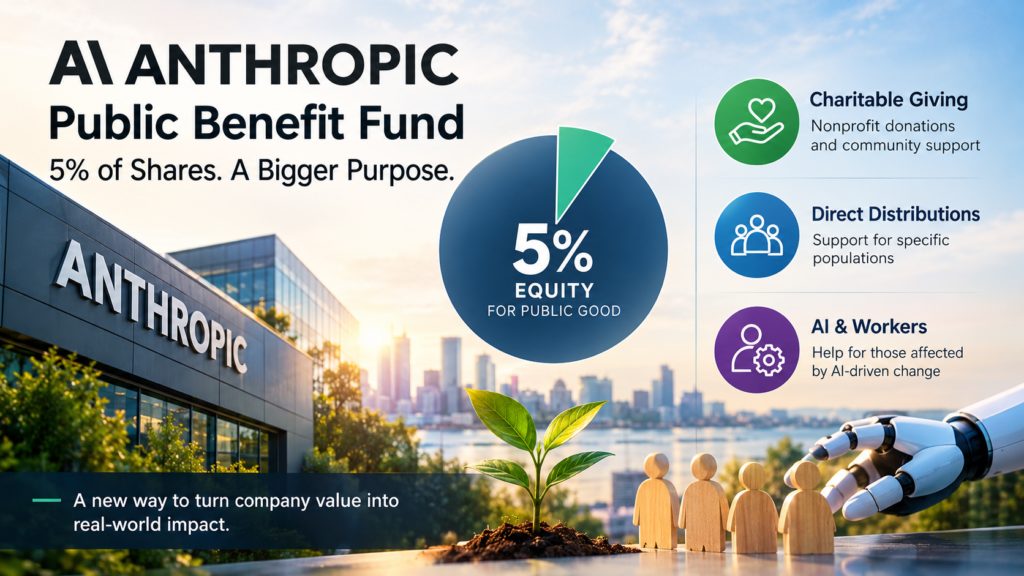
The Anthropic Public Benefit Fund is a new entity that will receive 5% of Anthropic’s shares, provided stockholders approve, and that stake can grow if the company’s valuation rises. Anthropic announced the plan on Sunday, October 18, 2026, while preparing what Reuters describes as one of the biggest IPOs in history.
It is unusual for a company to write a social promise into its ownership table before it ever lists on a public market. Anthropic is not pledging a slice of future profits. It is pledging a slice of the company itself. This article explains what was announced, how the structure works, what remains unknown, and why investors, policymakers and workers are watching closely.
Quick Summary: The Anthropic Public Benefit Fund in Seven Points
- Size: 5% of Anthropic’s shares, subject to stockholder approval.
- Growth: The stake can increase as valuation rises. Reuters reported that the board could add 2% of shares for each 50% increase in company value above a threshold that has not been disclosed.
- Structure: A wholly owned limited liability company (LLC), not a traditional nonprofit.
- Uses: Nonprofit donations, direct distributions to specific populations, and efforts to address AI’s effect on workers.
- Limits: None of the equity held by the fund will be used for lobbying or political contributions, in the US or abroad.
- Combined total: Roughly 20% of Anthropic’s shares are now earmarked for public purposes once earlier pledges are counted.
- Next steps: Anthropic says it will share more on governance, structure and valuation thresholds in the coming months, and will publish a public-benefit report.
What Is the Anthropic Public Benefit Fund?
Definition
The Anthropic Public Benefit Fund is a proposed vehicle created to hold a block of Anthropic equity and direct its value toward public-interest purposes. Put simply, it is a pool of company stock set aside for society rather than for private owners. The company says the arrangement gives it more flexibility and scale to make donations for the public good than it would otherwise have.
Expansion: How the Fund Is Built
According to reporting based on Anthropic’s announcement, the fund will sit inside a wholly owned LLC rather than a conventional 501(c)(3) charity. That detail matters. A 501(c)(3) comes with a well-known set of legal obligations and a familiar public-reporting regime. An LLC is a more flexible container, and the terms of that flexibility will depend on the governance documents Anthropic has not yet published.
The fund is also not a finished fact. The 5% commitment needs stockholder approval, and Anthropic has said the detailed rules will come later. For now, think of it as a announced design and a stated intention, not a fully operating foundation.
Anthropic Public Benefit Fund at a Glance: Key Facts
| Attribute | What Has Been Reported | Status |
|---|---|---|
| Announcement date | October 18, 2026 | Confirmed |
| Initial stake | 5% of Anthropic’s shares | Subject to stockholder approval |
| Legal form | Wholly owned LLC, not a traditional nonprofit | Reported |
| Possible expansion | Additional 2% of shares per 50% rise in value above a threshold, at the board’s discretion | Reported; threshold undisclosed |
| Permitted uses | Nonprofit donations, direct distributions, AI-and-workers initiatives | Announced; details pending |
| Prohibited uses | Lobbying and political contributions, US or abroad | Announced |
| Governance | Board, trustees or advisers not yet specified | Coming months |
| Accountability | Public-benefit report on progress toward the mission | Planned |
Questions Answered Directly
How much of Anthropic is going into the Anthropic Public Benefit Fund?
Direct answer: 5% of Anthropic’s shares. That is the initial commitment, and it applies to the company’s equity rather than to cash or annual revenue. Because the figure is a percentage, its dollar value moves with Anthropic’s valuation.
To see why that matters, consider an illustration. The Wall Street Journal reported that the coming IPO could value Anthropic at roughly $2 trillion. At that valuation, 5% would be worth about $100 billion. That is simple arithmetic for scale, not a company-confirmed figure, and the real number will depend on the valuation actually achieved.
Is the 5% commitment final?
Direct answer: No. Anthropic said the commitment is subject to stockholder approval. Until that vote happens, the plan is a proposal backed by the company’s leadership rather than a completed transfer of shares. Stockholders could in theory approve, amend or reject it, though Anthropic has not suggested it expects resistance.
Can the fund receive more than 5%?
Direct answer: Yes. Reuters reported that the stake could increase as Anthropic’s valuation grows. According to a summary of that reporting, the board could add another 2% of shares for every 50% increase in company value above a threshold. Anthropic has not disclosed the threshold, and the extra shares are at the board’s discretion rather than automatic.
What can the fund spend its resources on?
Direct answer: Anthropic named three broad categories: nonprofit donations, direct distributions to specific populations, and efforts to address AI’s impact on workers. The second category is the most distinctive. Most corporate philanthropy flows through intermediaries, so a mechanism that can send value directly to chosen groups of people would be a notable departure.
Can the fund be used for lobbying or political giving?
Direct answer: No. Anthropic said none of the equity held by the fund would be used for lobbying or political contributions anywhere in the world. This is a meaningful guardrail in an industry where policy influence is intensely debated, though how it will be enforced will depend on the governance terms still to come.
Is the Anthropic Public Benefit Fund a charity?
Direct answer: Not in the traditional legal sense. The fund is structured as a wholly owned LLC rather than a 501(c)(3). It is designed to serve public purposes, but its tax treatment, oversight and disclosure obligations have not been laid out. Readers should wait for the governance details before treating it as equivalent to a registered charity.
Why Is Anthropic Announcing This Now?
The timing points to the Anthropic IPO. Reuters noted that the company is planning one of the largest public offerings ever and intends to list as a public benefit corporation, a legal structure that requires management to weigh certain broader interests alongside returns for investors.
Several motives plausibly overlap, and it is worth separating what is reported from what is interpretation.
Reported: The fund was announced as the company prepares to go public, and it is subject to a stockholder vote. Anthropic framed it as a way to gain flexibility and scale for donations.
Interpretation: Settling the shape of a major public-purpose commitment before listing may give prospective investors clarity. Once shares trade publicly, changing a structure like this becomes harder, and a pledge made before the IPO is easier to bake into the company’s founding documents. A cynic would say the announcement also helps the company’s image ahead of intense scrutiny. A supporter would say a pledge is only credible if made before, not after, the money arrives. Both readings can be true at once.
The announcement also lands against the backdrop of the safety disclosures in Anthropic’s IPO prospectus. Reuters reported in September that the filing acknowledged its AI models could exhibit self-preserving behaviors. A company that is open about risks and also commits equity to public purposes is telling a consistent story: that it sees its technology as powerful enough to require both caution and redistribution.
How the Anthropic Public Benefit Fund Fits Anthropic’s Governance Structure
The new fund is the third layer in a set of mechanisms Anthropic has built to tie its commercial success to its stated mission.
Layer one: the public benefit corporation
Anthropic is a Delaware public benefit corporation. According to a Harvard Law School corporate governance analysis, this form lets directors balance stockholder financial interests against the public benefit named in the company’s charter, which is to responsibly develop and maintain advanced AI for the long-term benefit of humanity.
Layer two: the Long-Term Benefit Trust
On top of the PBC form, Anthropic created the Long-Term Benefit Trust. It holds a special class of shares, Class T common stock, that gives independent trustees the power to elect a growing share of the board over time, eventually a majority. The trust is a governance tool: it shapes who sits on the board and therefore how decisions are weighed.
Layer three: the new fund
The new fund is different in kind. It is an economic tool rather than a governance one. Where the trust influences how the company is run, the fund directs a portion of the company’s value to outside purposes.
| Mechanism | Type | What It Does | Status |
|---|---|---|---|
| Public benefit corporation | Legal form | Lets directors weigh public benefit alongside shareholder returns | In place |
| Long-Term Benefit Trust | Governance | Trustees holding Class T shares elect a rising share of the board | In place |
| Anthropic Public Benefit Fund | Economic | Holds 5% of shares, possibly more, for public purposes | Proposed; needs stockholder approval |
| Founder equity pledge | Personal giving | Co-founders pledged to donate 80% of their equity | Pledged |
| Employee donation matching | Workplace giving | Matches staff charitable donations | Existing program |
This layering is the real story. Each tool addresses a different failure mode. A legal form can be ignored in a bad year. Board control can be diluted. A pool of shares with an explicit purpose and a ban on political use adds a third, more tangible commitment.
The 20% Figure Explained
Reuters reported that, taken together with other commitments, roughly 20% of Anthropic’s shares would be dedicated to public purposes, excluding any extra shares the fund might receive if valuation milestones are reached.
Here is how that total is described across the reporting:
- The 5% from the Anthropic Public Benefit Fund.
- The co-founders’ pledge to donate 80% of their equity.
- An employee donation-matching program.
Two cautions apply. First, the 20% is a combined, approximate figure that mixes a corporate commitment (which needs stockholder approval) with personal pledges by individuals (which depend on those individuals following through). Second, pledged is not the same as delivered. Founder and employee pledges are promises about future giving, not shares already sitting in a dedicated entity. Readers who quote the 20% number should say “roughly” and “dedicated or pledged,” as the reporting does.
The Labor-Market Focus: Addressing AI-Driven Job Disruption
Anthropic singled out the effect of AI on workers as a priority area. Reuters noted that this builds on a previously announced $200 million commitment to study and address labor-market disruption. CNBC reported that the company says the fund is meant to help with potential job disruption linked to advances in AI.
This is notable because AI labor market disruption is among the most politically sensitive issues surrounding the industry. An AI developer funding its own mitigation work raises an obvious question: can a company credibly help manage a problem its products may help create? There are reasonable arguments on both sides.
The case for. Companies building the technology see its effects earliest and have data and resources that governments and charities lack. A large, dedicated pool of assets could fund retraining, research or direct support at a scale grants rarely reach.
The case for caution. Funding from the party most affected by the outcome invites questions about independence, about who decides which groups receive help, and about whether philanthropy can substitute for public policy. The ban on lobbying and political spending partly addresses the concern, but it does not settle who sets priorities.
The mention of direct distributions to specific populations is the detail to watch. If the fund can send value straight to people affected by job loss, it would resemble an experiment in private redistribution more than traditional charity. The design choices, such as eligibility, size of payments and independence of decision-makers, will determine whether that experiment is credible.
How Does It Compare With OpenAI’s Structure?
The Wall Street Journal’s coverage framed the announcement against the structure of rival OpenAI, whose nonprofit parent holds a 26% stake in its for-profit subsidiary.
The comparison shows two different philosophies. OpenAI’s approach keeps a nonprofit at the top of the corporate chain with a large ownership position. Anthropic’s approach keeps a public benefit corporation at the top and carves out a smaller, purpose-built vehicle underneath it, then layers on a governance trust. The headline percentages are not the whole picture, because control, voting rights and enforceability matter as much as ownership. A smaller stake with strong, well-drafted protections can matter more than a larger stake with weak ones, and the reverse is also true. Until Anthropic publishes the fund’s governance terms, a clean apples-to-apples comparison is not possible.
Reactions and Criticism
Reaction so far has been brief but telling. Elon Musk, who runs rival xAI, said on X that he would recommend giving the shares directly to the public. That suggestion reflects a real debate: should a pool of corporate equity be managed by a company-created vehicle, or should it go straight to citizens?
Beyond that comment, a few standard critiques are likely to follow, based on how earlier corporate-purpose pledges have been received:
- Control: A wholly owned LLC is controlled by its owner. Observers will ask how independent the fund’s decisions will really be.
- Impact washing: Earlier reporting on impact investors in Anthropic noted a risk that a mission-driven structure can lend a company a halo it must then earn. The same risk applies to any headline pledge.
- Timing and conditionality: The pledge depends on stockholder approval and on valuation thresholds that have not been published.
- Substitution: Some will argue that private giving cannot replace public programs for displaced workers.
None of these amount to evidence of bad faith. They are the questions a credible public-benefit commitment should be able to answer, which is why the promised governance disclosure is so important.
What We Still Don’t Know
Anthropic has said further detail is coming. Until then, these questions are open:
- Who will govern the fund, and how independent will they be from Anthropic’s management?
- What is the valuation threshold above which extra shares can be added, and how will the board decide?
- How will the fund turn shares into spendable resources, especially before the shares can be sold on a public market?
- What are the tax and disclosure implications of using an LLC rather than a 501(c)(3)?
- How will “direct distributions to specific populations” be designed and audited?
- What will the planned public-benefit report measure, and who will verify it?
- Will stockholders approve the plan as proposed?
What to Watch Next
Three milestones will show whether the pledge becomes a durable institution.
- The governance disclosure. Anthropic promised details in the coming months. The leadership, independence and decision rules of the fund will tell readers more than the headline percentage.
- The stockholder vote. Approval turns an intention into a commitment.
- The first public-benefit report. A report that sets measurable goals and names what has and hasn’t worked would be a strong signal of seriousness.
Alongside these, the IPO timeline matters. The final valuation will set the real dollar scale of the fund, and any valuation thresholds that trigger additional shares will define how large it can become.
Bottom Line
The Anthropic Public Benefit Fund is a proposed commitment of 5% of Anthropic’s shares, structured as a wholly owned LLC, aimed at donations, direct distributions and work on AI’s impact on workers, with a ban on lobbying and political spending. It is not yet final, and its most important details remain unpublished.
What makes the announcement significant is its design: a commitment of equity rather than profits, made before the IPO, layered on top of a public benefit corporation and a governance trust. Whether it becomes a landmark model or a well-publicized pledge will depend on the governance terms, the stockholder vote and the first public-benefit report. For readers tracking the Anthropic Public Benefit Fund, those three milestones are the ones that count.