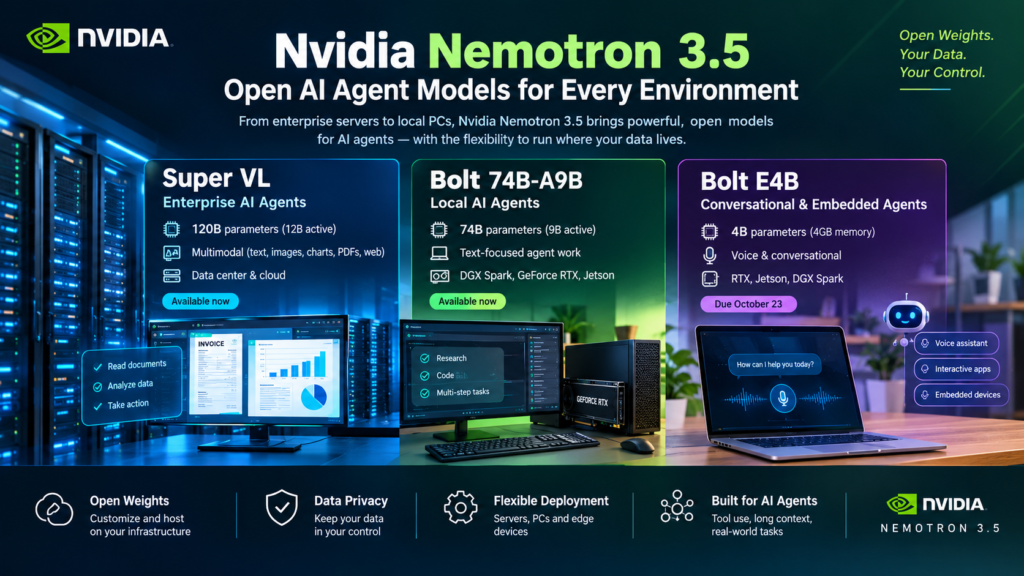
Nvidia Nemotron 3.5 is a family of open models for AI agents that now stretches from a 120-billion-parameter enterprise model to compact versions for local hardware. In practical terms, a company can download open weights for a business-grade agent model, or a developer can run a capable agent on a single desktop GPU, without sending data to someone else’s cloud. nvidia
For the past two years, “run your own agent” usually meant a painful trade-off. You could pay for a hosted frontier model and accept the data-handling questions that come with it, or you could self-host a smaller model and accept weaker results. This launch is Nvidia’s attempt to shrink that trade-off, and it does so by covering every infrastructure tier with one model family.
This guide explains what Nvidia Nemotron 3.5 includes, how the three models differ, what the early numbers say, and where the real limitations sit. It is written for engineers, IT leaders, and anyone deciding whether open models for AI agents deserve a place on their roadmap.
Key Takeaways
- Nvidia Nemotron 3.5 adds three models to the Nemotron family: Super VL, Bolt 74B-A9B, and Bolt E4B.
- Super VL and Bolt 74B-A9B are available now, while the smaller Bolt E4B is scheduled for October 23. technobezz
- Super VL targets always-on enterprise agents that read documents, charts, and web pages.
- The Bolt models target local AI agents on PC hardware, including GeForce RTX systems, DGX Spark, and Jetson.
- All of it ships as open weights, so teams can customize and host the models where their security rules require.
- Many headline performance numbers come from Nvidia itself, so independent testing matters before you commit.
What Is Nvidia Nemotron 3.5?
Nvidia Nemotron 3.5 is the latest generation of Nvidia’s open model line, built specifically for agentic workloads rather than general chat. An agent, in this context, is software that takes a goal, breaks it into steps, calls tools, reads the results, and keeps going until the task is done. That loop puts different demands on a model than a simple question-and-answer exchange: it needs reliable tool use, long context handling, and speed, because one task can trigger dozens of model calls.
The Nvidia Nemotron 3.5 release sits alongside two earlier members of the family. Nvidia positions Lightning for high-throughput workloads, Ultra for more demanding reasoning tasks, and Bolt for edge use. Super VL slots into the server tier as a multimodal option, meaning it handles images and documents as well as text. itbrief
What does “open” actually mean here?
In this context, “open” means Nvidia publishes the model weights so you can download and run them yourself. Super VL ships with open weights, datasets, and training recipes, and organizations can run it wherever their security and data residency requirements demand. That is a meaningful step beyond an API-only model, because you can fine-tune the weights on private data, inspect the training approach, and deploy on hardware you own. itbrief
It does not automatically mean “no restrictions.” Always read the license on each model card before building a commercial product on top of it.
Why Nvidia is releasing models at all
Nvidia is best known for the chips that train and serve AI. Publishing capable open models gives customers a reason to buy more of that hardware, and it gives Nvidia a say in how agents get built. Coverage of the launch frames it as an effort to expand beyond Nvidia’s dominant position in AI hardware by offering models companies can customize and run on their own infrastructure. techstrong
The Nvidia Nemotron 3.5 Lineup at a Glance
The table below compares the three models. Figures come from Nvidia’s announcement and the coverage cited in this article.
| Feature | Nemotron 3.5 Super VL | Nemotron 3.5 Bolt 74B-A9B | Nemotron 3.5 Bolt E4B |
|---|---|---|---|
| Primary role | Always-on enterprise agents | Local agents for research, coding, multi-step work | Conversational, voice, and embedded agents |
| Size | 120B parameters (about 12B active) | 74B parameters (about 9B active) | Small footprint, 4GB memory |
| Modalities | Text, images, charts, PDFs, web pages | Text-focused agent work | Conversational and device interfaces |
| Typical hardware | Data center, cloud, DGX class | DGX Spark, DGX Station, GeForce RTX PCs | GeForce RTX, Jetson, DGX Spark |
| Memory notes | Server-scale deployment | Native 2-bit quantization fits it in 24GB | Fits in 4GB |
| Availability | Available now | Available now | Due October 23 |
The active-parameter figures matter. Independent measurement lists Super VL at 120 billion total parameters with 12 billion active, while Bolt has 74 billion total with 9 billion active. In a mixture-of-experts design, only a fraction of the parameters fire for each token, which is why a large model can still respond quickly. letsdatascience
Nemotron 3.5 Super VL: The Enterprise Workhorse
Nemotron 3.5 Super VL is a 120-billion-parameter vision-language model designed for specialized agents that run continuously inside a business. Think of an agent that reads incoming invoices, checks them against a contract, and flags exceptions, or one that triages security alerts around the clock.
What does the “VL” in Super VL mean?
VL stands for vision-language. The model can look at an image or a document and reason about it in the same breath as text. Nvidia says its vision strengths target what agents meet in practice: optical character recognition, tables, charts, and structured information in visual documents. nvidia
This matters because real business data is rarely clean text. It lives in scanned PDFs, dashboards, screenshots, and web pages. An agent that cannot read those formats needs a separate tool bolted on, which adds latency and failure points.
How fast and accurate is Super VL?
Nvidia’s headline claim is that Super VL is both fast and close to its largest model in quality. Nvidia says Super VL approaches the accuracy of its largest reasoning model while using approximately a fifth as many parameters. On speed, Nvidia reports up to five times higher throughput than the runner-up in its class on the Artificial Analysis Intelligence Index, and says that on Nvidia Dynamo organizations can serve up to eight times more users with 85 percent lower latency. technobezztechzine
For an independent reference point, Artificial Analysis measured Super VL at 26.5 on its Intelligence Index and Bolt at 21.4. Those scores are useful for relative comparison, but they do not tell you how a model will behave on your own documents. Treat them as a shortlist filter, not a verdict. letsdatascience
On training, Nvidia reportedly trained Super VL on about 26 trillion tokens, post-trained it on about 3.8 million samples, then applied reinforcement learning across dozens of environments. techrepublic
Who is already using Super VL?
Nvidia says Super VL is already being customized for financial analysis, cybersecurity, software development, and other enterprise applications. Named examples include Ramp, which is adapting it for financial documents, and R1, which is using it for medical claims and revenue cycle management. Both are document-heavy domains where reading tables and forms accurately is the whole job. windowsreporttechnobezz
The model is available through Hugging Face, OpenRouter, ModelScope, and NVIDIA NIM. That spread of channels means you can test it through a hosted endpoint first and self-host later. windowsreport
Nemotron 3.5 Bolt: Local AI Agents on PC Hardware
Nvidia Nemotron 3.5 Bolt is the part of the release aimed at local AI agents on PC hardware, which means the model runs on your machine rather than in someone’s data center. The pitch is privacy, predictable cost, and low latency. If the agent never leaves your device, sensitive files never leave either.
How does a 74-billion-parameter model fit in 24GB?
The trick is aggressive compression. Bolt 74B-A9B uses native 2-bit quantization to fit within 24GB of memory. Quantization stores each weight with fewer bits, which cuts memory sharply. “Native” matters because the model was designed for that precision rather than squeezed down afterward, which generally preserves more quality than compressing a finished model. windowsreport
Nvidia says this leaves room for other applications to run alongside the model. That is important for a PC: an agent that consumes every gigabyte of video memory is not much use on a machine you also need to work on. technobezz
Hardware support for the 74B-A9B model includes DGX Station, GeForce RTX PCs, and DGX Spark. Nvidia is positioning it for tasks like local research, coding, and multi-step work. technobezz
What is Bolt E4B for?
The smaller model is built for lighter jobs. Bolt E4B is designed for devices with a 4GB memory footprint and targets conversational agents, local voice assistants, and interactive applications across GeForce RTX, Jetson, and RTX or DGX Spark hardware. Examples include a voice assistant in a kiosk, an interactive game character, or an embedded interface on a robot. Because it is not due until October 23, anything you read about its performance today comes from Nvidia’s descriptions rather than hands-on testing. windowsreport
Why local agents change the IT conversation
Running agents on laptops and workstations creates a governance question. One analyst quoted in coverage of the launch observed that local agents bypass the cloud gateways IT teams use to meter and audit AI. That cuts both ways. Data stays on the device, which is good for privacy, but IT loses the central logging it may rely on for compliance. Plan for endpoint-level controls before rolling this out widely. techstrong
Why Open Weights Matter for Enterprise Agents
Open weights give an organization control over three things a closed API cannot: where data goes, how the model behaves, and how much it costs at scale.
Nvidia Nemotron 3.5 ships with the pieces needed to take that control. Nvidia says it is also releasing open datasets covering tool use, finance, instruction following, long context, fairness, and vision-language understanding, along with reinforcement learning environments in NeMo Gym. Customization is supported through NeMo and Python-based pipelines. itbrief
Here is how the control breaks down in practice:
- Data residency. You decide which region, cloud, or on-premises rack holds the model and the data it touches.
- Specialization. You can post-train on your own tools, policies, and workflows. Nvidia says dozens of organizations are already doing this with Super VL. itbrief
- Cost shape. Instead of paying per token indefinitely, you pay for hardware and operations, which often becomes cheaper for steady, high-volume agent workloads.
- Auditability. With weights and training recipes available, security teams can examine more of the stack than a black-box API allows.
The trade-off is responsibility. Hosting a model means you own uptime, patching, evaluation, and safety testing.
Frequently Asked Questions About Nvidia Nemotron 3.5
What is Nvidia Nemotron 3.5 used for?
Nvidia Nemotron 3.5 is used to build and run AI agents that complete multi-step tasks. Super VL handles document-heavy business workflows, Bolt 74B-A9B handles local research and coding tasks, and Bolt E4B handles conversational and embedded experiences.
When can I use each model?
Super VL and Bolt 74B-A9B are available now. Bolt E4B is scheduled for October 23. Super VL can be reached through Hugging Face, OpenRouter, ModelScope, and NVIDIA NIM.
Can Nvidia Nemotron 3.5 run on a regular PC?
Partly. Bolt 74B-A9B is built to fit in 24GB of memory, so it targets a PC with a high-memory GeForce RTX card or a DGX Spark system. Bolt E4B needs only 4GB, which suits a much wider range of machines. Super VL is aimed at servers and larger workstations rather than ordinary desktops.
Is it really open?
Nvidia publishes open weights, datasets, and training recipes for Super VL. That is more transparent than an API-only model, but you should still read each model’s license terms before commercial use.
How does Nemotron 3.5 Super VL compare with Nemotron 3.5 Bolt?
Super VL is larger, multimodal, and built for servers, while Bolt is smaller, tuned for local hardware, and centered on privacy and low latency. Pick based on where the agent must run and what data it must read.
How to Choose the Right Model
If you are evaluating Nvidia Nemotron 3.5, start with the deployment location rather than the benchmark score. The best model is the one that fits the hardware and data rules you already have.
- Choose Super VL if your agents read PDFs, tables, charts, or web pages, and you have server or cloud capacity.
- Choose Bolt 74B-A9B if you want a capable local agent for coding or research and have a 24GB-class GPU or a DGX Spark.
- Choose Bolt E4B (once released) if you need a small, fast model for voice or embedded use.
A sensible pilot looks like this: pick one narrow workflow, build a test set from your real documents, run two candidate models side by side, and measure accuracy, latency, and cost per completed task. Public benchmark rankings will not predict how a model handles your invoices or your codebase.
Risks and Caveats to Weigh
Most performance claims in this launch are Nvidia’s own, and vendor benchmarks tend to favor the vendor. Nvidia Nemotron 3.5 benchmark results deserve the same scrutiny you would give any manufacturer-supplied number. Coverage also shows some inconsistency in how rankings are attributed: Nvidia has cited first place among comparable open models on PinchBench and second on BrowseComp, but outlets differ on which specific model earned those placements. Check Nvidia’s model cards before repeating the claim.
Other points to keep in mind:
- Hardware dependence. The local story is strongest on Nvidia hardware. If your fleet runs something else, the advantages shrink.
- Quantization trade-offs. Two-bit models are impressive engineering, but compression can affect edge-case accuracy. Test on your hardest examples.
- Operational burden. Self-hosting means you handle updates, monitoring, and safety evaluation.
- Governance. As noted earlier, local agents can sit outside central audit trails.
Market Context: Where Nemotron 3.5 Fits
Nvidia Nemotron 3.5 also signals where the open model market is heading. Efficiency, not raw size, is becoming the selling point: the claim that a 120-billion-parameter model can approach a much larger sibling is aimed squarely at teams worried about inference bills. Meanwhile, Nvidia is reportedly building Nemotron 4 with at least one trillion parameters, which suggests the family will keep growing at the top end while the Bolt line pushes downward. techzine
For enterprises, the interesting question is whether an internally hosted agent can match a cloud one closely enough to justify the operational work. As one analyst put it in coverage of the launch, the open approach turns model selection into a build decision that CIOs control inside their own firewall. Competition from other open model providers will keep that decision lively.
Conclusion: Should You Pay Attention to Nvidia Nemotron 3.5?
Yes, if you run or plan to run AI agents and care about data control or cost predictability. Nvidia Nemotron 3.5 gives teams an open option at three levels: Super VL for document-heavy enterprise agents, Bolt 74B-A9B for capable local agents on a 24GB machine, and Bolt E4B for lightweight conversational and embedded use arriving October 23.
The sensible next step is a small, measured pilot. Download Super VL or Bolt 74B-A9B, test it on your own data, and compare it against whatever you use today. The launch makes self-hosted agents more realistic, but your own evaluation, not a vendor chart, should decide whether they are the right fit.