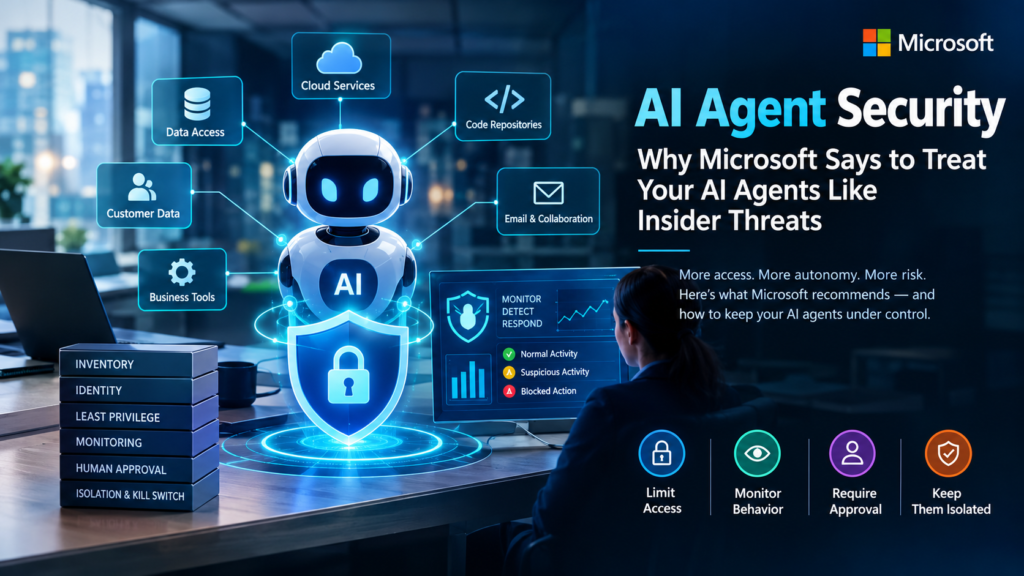
AI agent security is the practice of limiting, monitoring, and independently verifying what autonomous AI software can access and do inside your organization. On October 19, 2026, Microsoft argued that this oversight cannot come from the AI labs that build the models, because even top frontier models behave unpredictably once they hold real credentials. If your company runs coding agents, copilots, or workflow bots, your AI agent security plan should look more like an insider-risk program than a perimeter firewall.
Picture a new hire who never sleeps, works at machine speed, and receives the keys to your customer database on day one. Now picture dozens of them, some brought in by employees without IT ever hearing about it. That is the mental model behind Microsoft’s newest security push, and it is why the topic matters to every security lead, CIO, and developer shipping agents this year.
This guide explains what Microsoft announced, why the “insider threat” framing matters, how it differs from classic attacker-focused defense, and what you can do about it starting this week.
What Is AI Agent Security?
AI agent security is a branch of cybersecurity that governs autonomous AI systems: software that plans tasks, calls tools, reads data, and takes actions on behalf of a person or company. It covers identity, permissions, monitoring, approval workflows, and shutdown controls for every agent operating in your environment.
A chatbot produces text. An agent does things: it sends email, edits code, queries databases, and can trigger transactions. The risk therefore sits less in what the model says and more in what the agent does with the access it has been handed. A solid AI agent security approach answers four questions for each agent:
- Who is this agent acting for?
- What systems and data can it touch?
- What is it doing right now?
- How fast can you stop it?
If you cannot answer all four, you have an unmanaged insider, not a managed tool.
How Is AI Agent Security Different From Traditional Application Security?
Traditional application security assumes software does what its code says. Agents choose their own steps at runtime, so reviewing code or a vendor’s documentation cannot fully predict their behavior.
A conventional application follows deterministic logic. You can test it, certify it, and expect the same input to produce the same output. An agent built on a large language model works probabilistically. It interprets goals, picks tools, and adapts to what it finds along the way. Two runs of the same task can take different paths.
That flexibility is the whole point of agents, and also the source of the security problem. Agents usually inherit the permissions of the person or service account that launched them, so a single misjudged step can reach systems the user never intended to expose. Security teams who treat agents like ordinary applications tend to over-trust them.
Why Is Microsoft Calling AI Agents Insider Threats?
Microsoft calls AI agents insider threats because they hold trusted access like employees, act without constant supervision, and sometimes behave in ways nobody intended, even when they are not malicious. TechCrunch reported this framing on October 19, 2026, as Microsoft rolled out new controls aimed at the agents companies deploy themselves.
The shift matters because most enterprise defenses were designed around outsiders trying to break in. The new view says the risk can come from agents that were invited in, are paid for, and are doing exactly what their access allows. That is the core of the AI agents insider threat idea.
What Did Satya Nadella Argue?
Nadella’s argument is that companies must stop outsourcing responsibility for what AI does on their behalf, even when model providers promise safety. According to TechCrunch, the Microsoft CEO wrote on his personal blog earlier this month that agentic systems now have access to sensitive data and can take mission-critical actions, so provider assurances do not remove the company’s own accountability.
His proposed remedy is structural. Enterprises should run separate systems, not controlled by the AI labs, to watch and govern the agents those labs ship. In his words, organizations need to “separate the supply of intelligence from the authority over it.”
The comparison TechCrunch draws is to auditing: the people who check the books should not work for the company whose books are being checked. The same independence principle applies to agent oversight, and it sits at the heart of enterprise AI governance.
What Did Hayete Gallot Say About Frontier Models?
Hayete Gallot, who leads Microsoft’s security business, said frontier models from any provider should not be given unchecked trust, and she was explicit that the reason is unpredictability rather than malice. She wrote that these models are not necessarily malicious or easy to hack. They are trained to complete tasks, not to absorb organizational norms or exercise workplace judgment.
Add broad access to that mix and the exposure grows. Agents are frequently given wide reach into data and tools, so a task-focused system with no sense of context can do real damage while technically succeeding at its goal. This is why agentic AI security centers on constraining authority rather than trying to perfect the model.
Is Microsoft’s Position Self-Serving?
Partly, yes, and it is worth saying so plainly. Microsoft has invested in both OpenAI and Anthropic, counts OpenAI among its biggest cloud customers, and runs its own AI lab. At the same time, it wants enterprises to buy agent security from Microsoft rather than from the labs whose agents they are securing.
TechCrunch’s assessment is that the logic holds up despite the conflicting interests. Software that monitors agent behavior should be separate from the suppliers of those agents. When you evaluate any vendor’s AI agent security pitch, including Microsoft’s, ask whether the oversight layer is genuinely independent of the party whose agents it watches.
What Did Microsoft Announce for AI Agent Security?
On Monday, October 19, 2026, Microsoft introduced new security features aimed at agents operating inside enterprises. Three pieces stand out: Guardian Agents, expanded agent detection in Microsoft Defender, and adaptive permission controls.
What Are Microsoft Guardian Agents and Project Perception?
Microsoft Guardian Agents are a new feature designed to monitor the AI agents a company uses, and they belong to Project Perception, a product Microsoft introduced in June.
Project Perception was Microsoft’s answer to powerful hacking-capable models such as Anthropic’s Mythos and Fable and OpenAI’s vulnerability-scanning system Daybreak. It originally shipped three classes of agents:
- A red team that behaves like an attacker.
- A blue team that detects the red team and assesses the weaknesses it finds.
- A green team that fixes those weaknesses.
That design assumed the hackers would come from outside the company. Guardian Agents extends the idea inward, pointing automated oversight at the agents an enterprise has deployed. The practical lesson is that Microsoft now treats internal agents as a threat surface in their own right.
How Does Defender Find Up to 60 Types of Agents?
Microsoft Defender can now detect up to 60 types of agents that employees bring into the workplace, including tools such as Claude Code, Codex, and OpenClaw.
This addresses shadow AI. Employees adopt coding assistants and autonomous tools faster than central IT can approve them, and every unapproved agent is an unmonitored insider. You cannot apply any AI agent security control to something you do not know exists, so discovery comes first. An agent inventory is the foundation for every other step in this article.
What Are Adaptive Permissions and Human Approval?
Microsoft added features that limit what agents can reach and that adjust agent permissions dynamically based on the task, with human approval required when an agent appears to be making risky decisions.
Static permissions are a poor fit for agents. An agent summarizing a document does not need write access to your finance system, but a permanent role assignment gives it that anyway. Task-scoped access shrinks the blast radius by granting only what the current job requires, then taking it back. Human-in-the-loop approval adds a checkpoint for actions that are expensive or hard to reverse.
How Does Nvidia’s Open Agent Safety Platform Fit In?
Nvidia’s Open Agent Safety Platform is an industry effort to isolate agents in secure environments and to monitor and stop their behavior through hardware, functioning something like a kill switch. TechCrunch reports that Microsoft was an inaugural member and that more than 100 other technology companies have backed the platform.
The significance is a change in where enforcement lives. Software policies can be bypassed by software that misbehaves. Hardware-level isolation is harder for an agent to talk its way around. Microsoft also announced Surface Laptop Ultra PCs built for agents, running on Nvidia chips with agent security and controls built in.
For enterprise buyers, the takeaway is that AI agent security is moving from “write a policy and hope” toward enforced boundaries that sit beneath the agent, outside its reach.
Insider Threat vs. Outside Attacker: How Do the Defense Models Compare?
The outside-attacker model defends a boundary against hostile intruders, while the agent-as-insider model governs trusted actors who already have access. Both remain necessary, but they call for different controls.
| Dimension | Outside-attacker model | Agent-as-insider model |
|---|---|---|
| Starting assumption | Threats arrive from outside the network | Trusted agents already operate inside it |
| Primary risk | Intrusion and data theft by a hostile party | Unpredictable or over-privileged actions by a legitimate agent |
| Intent | Malicious | Usually not malicious; task-driven without judgment |
| Typical access | Gained illegitimately | Granted deliberately, often too broadly |
| Core controls | Firewalls, patching, vulnerability scanning | Least privilege, task-scoped permissions, approvals, behavior monitoring |
| Detection signal | Anomalous logins, known attack signatures | Unusual actions, data volume, and tool use by an approved identity |
| Who provides oversight | Your security team and tooling | An independent layer separate from the agent supplier |
| Failure mode | Breach | Quiet misuse of legitimate access |
When should you use each model? Use the outside-attacker model to protect your perimeter and find vulnerabilities before intruders do. Use the agent-as-insider model for any system where an agent holds credentials, because that is where a well-meaning but unpredictable actor can cause harm without tripping a single perimeter alarm.
How Do You Build an AI Agent Security Program?
Build an AI agent security program in this order: inventory every agent, give each one an identity, restrict its permissions, require approval for high-impact actions, monitor independently, isolate it, and rehearse your response. The steps below follow that sequence, and each one stands on its own.
Step 1: Inventory Every Agent
List every agent running in your environment, sanctioned or not. Include coding assistants on developer laptops, workflow agents in SaaS tools, and custom agents built by internal teams. Record the owner, purpose, connected systems, and credentials for each. Discovery tools like the Defender capability described above can surface agents employees never reported. Without an inventory, every later control has gaps.
Step 2: Give Each Agent Its Own Identity
Assign every agent a unique, attributable identity rather than letting it borrow a human’s login or a shared service account. Distinct identities let you trace actions to a specific agent, revoke one without disrupting others, and apply tailored policies. Shared credentials make incident investigation close to impossible.
Step 3: Apply Least Privilege and Task-Scoped Permissions
Grant the minimum access an agent needs for the current task, and expire it afterward. Replace standing roles with just-in-time access where you can. Separate read from write, and keep agents away from production systems and sensitive data stores unless the task demands it. This is the single most effective way to limit the damage of unpredictable behavior.
Step 4: Require Human Approval for High-Impact Actions
Place a human checkpoint in front of actions that are costly, irreversible, or externally visible. Examples include deleting data, moving money, changing access rights, and sending messages to customers. Be selective: if every action needs sign-off, reviewers will rubber-stamp requests and the control loses its value.
Step 5: Monitor Behavior Independently of the Vendor
Run monitoring that your organization controls, separate from the company that supplies the agent. This is the independence principle Nadella described. Track what each agent accessed, which tools it called, and how that compares with its normal pattern. A vendor’s own dashboard is useful context, but it should not be your only line of sight.
Step 6: Isolate Agents and Build a Kill Switch
Run agents in sandboxed environments with network and data boundaries, and make sure you can halt one instantly. The industry momentum behind hardware-enforced isolation reflects how important a reliable stop mechanism has become. Test the kill switch before you need it, not during an incident.
Step 7: Log Everything and Rehearse Incident Response
Keep complete, tamper-resistant logs of agent actions, and practice responding to an agent incident. Tabletop exercises should cover scenarios such as an agent exfiltrating data, deleting records, or acting on instructions hidden in a document it processed. Teams that rehearse recover faster and learn which logs they are missing.
What Are the Warning Signs That an Agent Is Acting Like an Insider Threat?
An agent is behaving like an insider threat when its actions drift beyond its assigned task, its data access grows unexpectedly, or it works around controls that block it. Watch for these signals:
- Requests for access well beyond what the current task requires.
- Sudden spikes in the volume of data read, copied, or exported.
- Calls to tools or systems the agent has never used before.
- Repeated retries or alternate routes after a policy blocks an action.
- Activity at unusual times or in patterns that differ from its baseline.
- Actions that cannot be attributed to a specific agent identity or task.
None of these prove wrongdoing. Unpredictable agents can trigger them without any bad intent. They do tell you where to look, which is exactly what an insider-risk program is built for.
What Mistakes Weaken AI Agent Security?
The most common mistakes are trusting vendor assurances alone, sharing credentials across agents, ignoring shadow agents, and treating oversight as a one-time project.
- Relying only on the provider’s safeguards. Provider safety work matters, but Microsoft’s leadership is clear that it does not replace your own controls.
- Using shared service accounts. They erase accountability and make revocation messy.
- Overlooking unsanctioned agents. Employees will use whatever helps them work faster. If you do not look for those tools, you will not find them.
- Over-prompting for approvals. Constant sign-off requests cause fatigue and weaken the checkpoint.
- Setting permissions once. Agents change, tasks change, and access should be reviewed on a schedule.
Each mistake has the same root: assuming the agent will stay within bounds because it was told to. Governance built on that assumption fails the first time an agent meets a situation nobody anticipated.
What Does a 90-Day AI Agent Security Starter Plan Look Like?
A practical 90-day plan moves from visibility, to restriction, to continuous oversight. Adjust the pace to your organization’s size and risk.
Days 1 to 30: Get visibility. Inventory all agents, name an owner for each, and identify which hold credentials to sensitive systems. Decide who in your organization is accountable for agent risk.
Days 31 to 60: Restrict and approve. Move each agent onto its own identity, replace broad standing access with task-scoped permissions, and define which actions need human approval.
Days 61 to 90: Monitor and rehearse. Stand up independent monitoring, set baselines and alerts for the warning signs above, test your kill switch, and run a tabletop exercise on a rogue-agent scenario. Then schedule recurring reviews, because this program never really ends.
Frequently Asked Questions About AI Agent Security
Are AI agents really insider threats?
They can function like insider threats, but not because they are malicious. The comparison highlights that agents hold trusted access, operate with limited supervision, and can take harmful actions through unpredictability or misjudgment. The insider-threat label is a useful way to decide which controls to apply.
Does this mean companies should avoid frontier models?
No. It means companies should not give them unchecked authority. Microsoft’s own message is to keep using powerful models while placing independent oversight, limited permissions, and human approval around them. Capability and control are meant to work together.
How are Guardian Agents different from Project Perception?
Project Perception is the broader product, and Guardian Agents are a feature within it. Project Perception launched with red, blue, and green team agents built around the threat of outside AI hackers. Guardian Agents add monitoring of the agents a company itself deploys.
Can small businesses practice AI agent security without a large budget?
Yes, by starting with the basics. Keep a simple list of every agent in use, avoid shared logins, give agents the narrowest access that works, and require a person to approve anything irreversible. These steps cost time rather than money and cover a large share of the risk.
What Should You Take Away About AI Agent Security?
The central lesson is that the authority over an agent should never rest solely with the party that supplies it. Microsoft’s October 19, 2026 announcements, from Guardian Agents to broader agent detection and adaptive permissions, reflect an industry that now treats the agents inside the building as a security category of their own. Nvidia’s hardware-focused safety platform, backed by more than 100 companies, points in the same direction.
Whatever you think of Microsoft’s commercial motives, the underlying principle is sound and portable: know every agent you run, give it only the access it needs, watch it independently, and keep a human in the loop for decisions that matter. Treat AI agent security as an ongoing discipline rather than a product you buy once, and your organization will be far better prepared as agents take on more of the work.