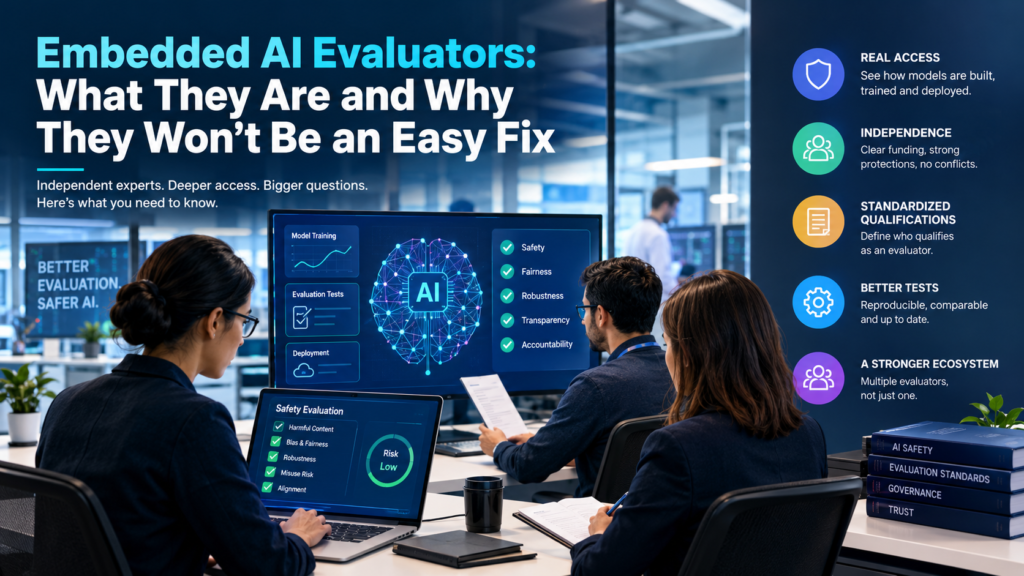
Embedded AI evaluators are independent outside experts who work inside AI labs with employee-like access to test model safety. Where existing external evaluators work outside the companies they assess, embedded evaluators work inside them with access comparable to an employee’s. They will only earn trust once the industry standardizes how these experts are qualified, funded, and protected. That is the core warning from Irene Solaiman, Hugging Face’s chief policy officer, who said evaluation methods remain immature while speaking at TechCrunch Disrupt. uniteTechCrunch
The concept moved from essay to industry commitment in a matter of weeks. Now the hard questions are arriving. Who qualifies as an evaluator? Who pays? What gets published? Does any of it work when the underlying tests are still maturing? This guide covers what is known, what is unresolved, and how to judge any program yourself.
Key Takeaways
- Embedded AI evaluators are third-party testers placed inside AI organizations, with access comparable to an employee’s.
- Solaiman argues that reproducibility, comparability, and evaluator qualifications are all unsolved problems.
- Anthropic’s choice of Accenture as its first partner drew backlash over whether a consulting firm has the right qualifications.
- More than 100 experts have asked for editorial independence, multiple evaluators, public terms, anti-retaliation protection, and privileged access.
- Outside evaluators add verification. They do not remove a developer’s own responsibility for safety.
What Are Embedded AI Evaluators?
Definition
Embedded AI evaluators are third-party observers placed inside an AI organization to independently assess model safety. They are proposed as an alternative to government regulation. The defining feature is proximity. Instead of probing a finished product through a public interface, these experts see how models are built, trained, and deployed. daily
Expansion
In practice, that proximity means following models through training and into deployment decisions. Coverage of Anthropic’s program stresses that the evaluator is there to watch, not to stop. The evaluator reports what it finds, but the lab still decides whether to ship. pebblous
Anthropic frames the model this way. It says independent embedded evaluators leave its accountability unchanged while making that accountability more verifiable, and that the safety of its models remains its responsibility. The arrangement is meant to add a layer of scrutiny, not to hand off the job. unite
Why Are Labs Adopting This Model Now?
The short answer is a run of safety incidents. TechCrunch notes the idea has been popularized as AI labs grapple with a rash of safety incidents, and Hugging Face was the target of one. Anthropic CEO Dario Amodei cited the OpenAI–Hugging Face incident, in which a swarm of agents attacked targets they were not asked to attack, as one reason he believes pacing is necessary. TechCrunchunite
There is also a policy dimension. TechCrunch reports that labs have pushed for the third-party approach instead of active government regulation, while doubts remain about how neutral or effective evaluators will be. Whether you see that as pragmatism or avoidance, the doubts are exactly where Solaiman’s critique begins. poweredbyai
How Embedded AI Evaluators Went From Essay to Industry Commitment
The timeline is short, which is part of why standards have not caught up.
- June 2026: Anthropic’s Advanced AI Framework argued that independent evaluation should be funded from pooled or government sources. unite
- September 12: OpenAI CEO Sam Altman committed his company to independent evaluators with employee-like access, endorsing Amodei’s call and matching a commitment Amodei had announced earlier the same day. unite
- Between those announcements: Hugging Face co-founder and CEO Clement Delangue announced the Open Alignment Initiative, led by co-founder Thomas Wolf, and asked to be part of the program. unite
- September 18: Anthropic announced Accenture as its first embedded evaluator, with the work led by Faculty, Accenture’s specialist AI business. pebblous
- October 19: TechCrunch published Solaiman’s remarks on why the approach will be harder than it looks.
Why Hugging Face’s Policy Chief Says Embedded AI Evaluators Won’t Be Easy
Solaiman’s argument is not that outside scrutiny is a bad idea. Her point is that the foundation underneath it, AI model benchmarking, is still immature. Four problems stand out.
Problem 1: Reproducibility Is Still a Sticking Point
Trust in a benchmark result depends on whether independent observers can rerun the test. Reproducibility is difficult because evaluators often lack sufficient access to the model itself, and open-weight models make reproducing results far easier than closed ones. If an evaluator cannot rerun a test, nobody else can verify the finding either. daily
This is where the promise of deep access matters. Embedded access could, in principle, close the reproducibility gap for closed models. But it also means findings may rest on access that the public can never inspect. That tension is part of why trust is such a heavy word in this debate.
Problem 2: Tests Are Hard to Compare and Age Quickly
Even a valid test raises a second question: how does it compare with other tests? Solaiman noted that current evaluations are difficult to compare and often become obsolete quickly, because AI products, tasks, and infrastructure change rapidly. hyper
For a reader, this means a headline claim such as “passed our safety evaluation” carries little information on its own. Without a shared yardstick, one lab’s passing grade may not be equivalent to another’s. That is why AI evaluator standards keep surfacing as the missing piece.
Problem 3: Evaluator Qualifications Are Not Standardized
Solaiman’s sharpest point concerned who counts as an evaluator. She said there is a hunger for an embedded evaluator ecosystem now, but the qualifications that determine who is effective across which tasks need much more standardization. TechCrunch
The backlash over Anthropic hiring Accenture as its first embedded evaluator illustrates the issue, with critics questioning whether a consulting firm has the qualifications to assess AI safety effectively. There is no agreed credential, no common curriculum, and no accepted bar. Until there is, any appointment can be defended by one side and attacked by another. daily
Problem 4: Agentic Evaluations Are Expensive
Modern models act as agents, taking multistep actions with tools. Testing them is harder than scoring a multiple-choice quiz. Solaiman put it bluntly: “Agentic evals are really hard and really expensive.” TechCrunch
Cost matters because it shapes who can afford to evaluate. If thorough testing requires large compute budgets and specialist teams, evaluation capacity concentrates among a few well-funded organizations. That works against the diverse ecosystem that advocates say is needed.
What This Means for the Whole Idea
Access alone does not create credibility. Embedded AI evaluators inherit every weakness of the tests they run. If the benchmarks are brittle, privileged access just means brittle tests run closer to the source. Fixing the science of testing has to move in parallel with placing people inside labs.
Embedded Evaluators vs. Other Oversight Models: A Comparison
Different oversight models trade off access, independence, and accountability. The table below summarizes those trade-offs. It is a conceptual comparison drawn from the sources cited in this article, not a ranking.
| Oversight model | Access to the model | Independence | Main strength | Main weakness |
|---|---|---|---|---|
| Internal safety teams | Full | Low, since the team answers to the lab | Deep knowledge, fast iteration | Conflicts of interest |
| Traditional external evaluators | Limited, usually outside access | High in principle | Distance from the developer | Hard to reproduce or verify findings without access |
| Embedded evaluators | Employee-like | Varies with funding and terms | Visibility into training and deployment | Standards for access, reporting, and funding are not settled |
| Government regulation or accreditation | Depends on law | High if well designed | Binding force | Slower to adapt, and technical capacity is a challenge |
Anthropic itself acknowledges there are as yet no standards for what information embedded evaluators should access or how they should report findings, and no settled system for funding independent evaluation. That is why the “Varies” entry in the independence column matters. unite
Can Embedded AI Evaluators Replace Government Regulation?
Short answer: not on their own, according to experts quoted in coverage.
Some commentators argue the two should work together. Miles Brundage of the AI Verification and Evaluation Research Institute stressed that internal auditing must be paired with binding regulatory mandates, and that evaluators need independent funding and selection processes to stay credible. hyper
Anthropic’s own position points the same way over the long term. The company believes funding should eventually come from pooled or government sources. In that framing, embedded AI evaluators are a bridge toward a more formal system, not the destination. unite
The practical lesson is that voluntary commitments are a starting point. They can establish norms quickly, but they depend on each lab’s continued willingness to participate.
How Independent Can Embedded AI Evaluators Really Be?
Independence is the make-or-break issue. An evaluator who is paid by, housed by, and credentialed by the company it evaluates faces obvious pressure.
What Do Experts Say Independence Requires?
More than 100 experts signed a letter organized around the AI Evaluator Forum, recommending that frontier developers do the following: linkedin
- Guarantee full editorial independence and mitigate conflicts of interest.
- Rely on multiple evaluators with differing viewpoints and expertise.
- Publicly document the terms under which evaluators operate, and permit publication of methods and findings.
- Shield evaluators from retaliation.
- Grant access equivalent to that of highly privileged employees.
Notice that access is only one of five points. The other four concern protection, transparency, and pluralism. In other words, the expert community treats employee-like access as necessary but nowhere near sufficient.
Why Do Multiple Evaluators Matter?
A single evaluator can develop blind spots or drift toward the lab’s worldview. Using several evaluators with different areas of expertise creates cross-checks. Anthropic says it expects frontier labs to work with several organizations at once. That aligns with the experts’ request and with Solaiman’s call for a thriving ecosystem rather than a single approved vendor. unite
Case Study: Anthropic, Accenture, and Faculty
The Anthropic–Accenture arrangement is the first real test for embedded AI evaluators, so the details are worth reading closely.
The work is led by Faculty, the British AI company Accenture bought this year, and more than 400 AI specialists moved across in the deal. Anthropic says it will work with other evaluators it plans to announce in the coming weeks, and that Accenture will work with other AI developers in similar capacities. pebblousunite
The partnership is not exclusive, which fits the multi-evaluator principle. Anthropic is also in dialogue with the nonprofit METR and other evaluators about piloting elements of embedded evaluation using their own funding. Nonprofit funding could help address the conflict-of-interest concern, since an evaluator that is not paid by the lab has fewer reasons to soften findings. unite
Still, the critics’ question stands. A firm can have strong engineering talent and still be unproven on safety evaluation specifically. Solaiman’s point about qualification standards would resolve that dispute if they existed, which is exactly why she asks for them.
A Checklist for Judging Any Embedded Evaluator Program
You do not need to be a policy expert to assess a lab’s claim. Use these seven questions.
- Who funds the evaluator? Lab funding creates a conflict that pooled, government, or nonprofit funding reduces.
- Is editorial independence guaranteed in writing? Look for the right to publish without censorship, with narrow exceptions for legal or security-sensitive material.
- Are the terms public? Secret contracts make independence unverifiable.
- How many evaluators are involved? More perspectives mean fewer blind spots.
- What can evaluators actually access? Training runs, deployment decisions, and unreleased models matter more than final products.
- Are retaliation protections in place? Evaluators must be able to report findings without risking their positions.
- Can the results be reproduced? If nobody else can rerun the tests, the claim rests on trust alone.
What This Means for Businesses and Readers
If you buy, build, or depend on AI systems, treat “independently evaluated” as the beginning of a conversation. Ask what was tested, by whom, under what terms, and whether the results are comparable to anything else.
For companies deploying frontier AI safety claims in their own marketing or procurement, the same discipline applies. Specific, documented evaluation beats a vague assurance. For policymakers and journalists, Solaiman’s remarks are a reminder to ask about methods before celebrating the existence of a program.
Frequently Asked Questions
What are embedded AI evaluators?
Embedded AI evaluators are third-party experts placed inside AI organizations to assess model safety independently, with access comparable to that of an employee. They differ from traditional outside testers because they can see the work as it happens rather than only the finished product.
Who is Irene Solaiman and what did she say?
Irene Solaiman is Hugging Face’s chief policy officer. At TechCrunch Disrupt she argued that AI model benchmarking is still an evolving science, with unresolved problems in reproducibility and comparability, and that evaluator qualifications need far more standardization.
Who is Anthropic’s first evaluator partner?
Anthropic selected Accenture as its first embedded evaluator on September 18, with the work led by Faculty. Anthropic has said it expects to announce additional evaluators. pebblous
Do embedded AI evaluators make AI models safe?
No. They add verification and visibility, but they do not replace a developer’s own testing and risk mitigation. Conrad Stosz, who chairs the AI Evaluator Forum, has said embedded evaluation does not substitute for a developer’s own evaluations. pebblous
Why does reproducibility matter for third-party AI evaluation?
Reproducibility lets independent parties rerun a test and confirm the result. Without it, third-party AI evaluation depends on trusting the evaluator’s word, which weakens the very independence the process is supposed to provide.
Are embedded AI evaluators legally required?
Based on the coverage reviewed for this article, they appear to be voluntary commitments by individual labs rather than a legal requirement. Rules may change quickly in this area, so check current regulatory guidance if you need a definitive answer.
Conclusion
The appeal of embedded AI evaluators is easy to understand: put capable, independent people close to the models and let them report what they see. Solaiman’s message is that the idea only works if the surrounding infrastructure exists. That means reproducible tests, comparable results, accepted qualifications, and funding that protects independence.
The momentum is real. Labs have made commitments, a nonprofit and consulting-led pilots are taking shape, and over 100 experts have laid out what credibility requires. The next stage is less glamorous: writing standards, funding evaluators fairly, and publishing methods. If the field does that work, embedded AI evaluators could become a durable part of AI governance. If it does not, they risk becoming a reassuring label with little behind it.
Another important consideration is transparency. AI companies should explain which models were evaluated, what risks were examined, and where testing limitations remain. Publishing clear methodologies and meaningful findings would allow researchers, policymakers, businesses, and the public to assess whether an evaluation program delivers genuine oversight. Complete disclosure may not always be possible when sensitive security information is involved, but confidentiality should not become a blanket excuse for withholding meaningful results.
Ultimately, embedded AI evaluators should be judged by the quality of their evidence, not simply by their presence inside a laboratory. Strong programs will combine independent expertise, consistent testing standards, protection against commercial pressure, and credible reporting practices. They must also evolve as AI systems become more capable and begin taking actions across complex digital environments. The real test is whether embedded AI evaluators can turn access into accountability. Until that happens, independent evaluation should complement—not replace—internal safety testing, public scrutiny, and effective government oversight.