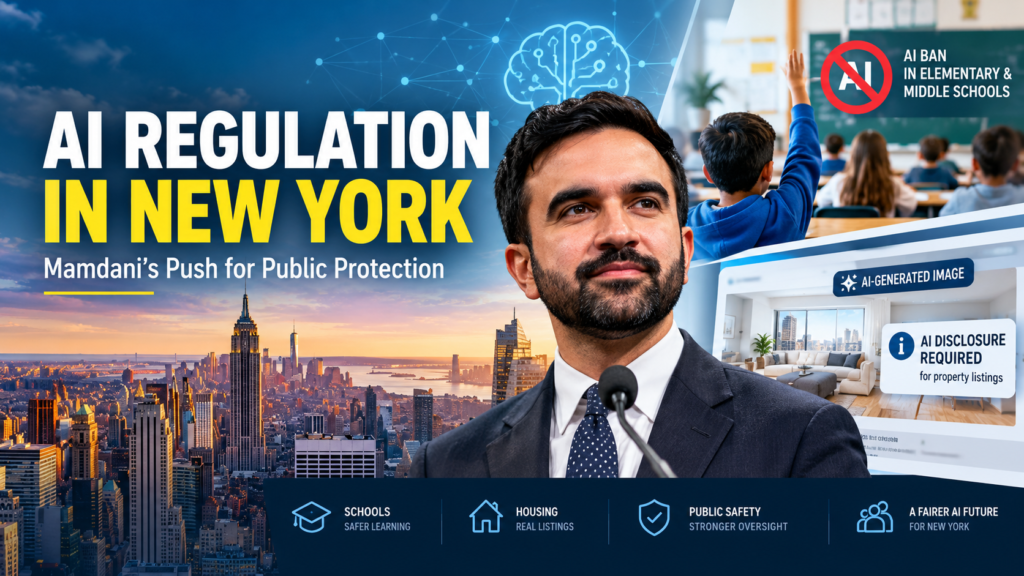
New York City Mayor Zohran Mamdani said on Monday, October 19, 2026, that Washington has abdicated its role on AI regulation, and he urged New Yorkers to demand protections at the local level instead of accepting AI’s rollout as inevitable. His argument is backed by two city actions already underway: a ban on AI use in elementary and middle schools, and a policy requiring disclosure when real estate listing photos or videos are made with AI.
That is the short version. The longer version matters more, because the fight over AI regulation is moving from Capitol Hill to city halls, classrooms, and rental markets, and the people who feel the consequences first are not lobbyists. They are parents, students, and tenants.
This guide explains what Mamdani said, what the city has actually done, what the federal government is (and is not) doing, and where the evidence points on whether city-level rules can work. Each section is written to stand on its own, so you can read start to finish or jump straight to the question you need answered.
Quick Facts: Mamdani’s AI Speech in Six Points
Here are the six facts that frame the story, in the order a reader needs them:
- Who: Mayor Zohran Mamdani of New York City.
- When and where: Monday evening, October 19, 2026, at Webster Hall in Manhattan.
- The event: The People’s AI Assembly, hosted by the AI Now Institute, with activist and “Broad City” star Ilana Glazer posing questions to the mayor.
- The core claim: The federal government has largely abandoned AI oversight, so cities and residents should not wait for Washington.
- The city’s record: A September order banning AI use in elementary and middle schools, and a summer policy on disclosing AI-made listing images.
- The federal backdrop: A new White House task force that, according to TechCrunch’s reporting, leans on companies to police themselves rather than creating new restrictions.
What Did Mayor Mamdani Say About AI Regulation?
Direct answer: Mamdani said the idea that AI will inevitably take over jobs, children’s minds, and public life is a narrative New Yorkers should reject, and he called for AI regulation that protects the public and puts power back in residents’ hands. He also criticized what he called a complete abdication of federal responsibility for the technology.
Where and when he said it
The remarks came at a public event in Manhattan on Monday night. The AI Now Institute, a think tank that studies the social implications of artificial intelligence, hosted the gathering. Glazer, who is also a parent, asked the questions and spoke candidly about her own unease with AI arriving in classrooms. She said it feels non-consensual and questioned why something that was not in schools two years ago suddenly has to be there now.
The central message: inevitability is a choice
Mamdani’s most repeated point was that AI’s expansion is a series of decisions, not a force of nature. “Nothing has to be,” he said in response to the idea that AI must be everywhere. He described a creeping, overwhelming dynamic that leaves people feeling they have no option, and he framed resistance as a civic act rather than a technophobic one.
That framing matters for anyone following the AI regulation debate. It shifts the question from “How do we adapt to AI?” to “Who decides the terms, and who is accountable when things go wrong?”
What Is Local AI Regulation?
Definition: Local AI regulation is the set of rules, executive orders, and procurement policies that a city or county government adopts to govern how AI is used inside its own institutions and marketplaces, without waiting for national legislation.
Expansion: Cities cannot write the rules for the whole technology industry, but they control more than most people assume. Typical levers include how public schools and city agencies use AI tools, what businesses operating in the city must disclose to customers, and what standards vendors must meet to win city contracts. Local AI regulation tends to be narrower than national law, but it can move faster and can target concrete, visible harms: a classroom tool, a misleading listing, a chatbot answering residents’ questions.
The value of this approach is speed and specificity. A federal statute may take years to negotiate. A mayor’s order can take effect on a timeline measured in weeks. The tradeoff is jurisdiction: a city’s rules stop at the city line, and they can be challenged or overridden if higher levels of government decide to act.
Mamdani AI Policy: What Has the City Actually Done?
The Mamdani AI policy record so far consists of two concrete moves, one in schools and one in housing. Both are narrow, both target a specific harm, and both were in place before Monday’s speech.
Banning AI in elementary and middle schools
Last month, Mamdani ordered a ban on AI use in elementary and middle schools. The AI in schools ban answers a worry that many parents share: that powerful tools are entering classrooms faster than anyone can evaluate their effects on young children’s learning and development.
The ban is notable for its scope. It applies to younger grades rather than all of K-12, and it targets the setting where children have the least say in what technology they use. That connects directly to Glazer’s point about consent. A student cannot opt out of a district’s software the way an adult can close an app.
Requiring disclosure of AI-made property listings
Over the summer, the mayor introduced a policy that would require landlords, brokers, and real estate platforms to clearly disclose when a property’s listing photos or videos were created with AI. The goal is to protect New Yorkers from being “house-phished,” a term for being lured by misleading listings that do not match the real apartment.
Disclosure is one of the oldest and least intrusive regulatory tools. It does not ban the technology. It labels the output so that a renter can make an informed decision before spending time, money, or a broker’s fee on a place that does not look like its pictures.
What the two policies have in common
TechCrunch notes that both moves challenge the assumption that schools and the public must simply accept AI as it arrives. Beyond that shared premise, the two policies follow a similar design logic:
- They are scoped to a defined setting. Schools and housing listings are places where the city already has a clear role.
- They target a visible harm. Neither regulates “AI” in the abstract.
- They preserve the technology’s use elsewhere. Neither is a general prohibition.
That pattern is worth watching, because it may be the template other cities reach for.
Why Does Mamdani Say Federal Oversight Has Failed?
Direct answer: Mamdani argues that Washington frames AI mainly as an arms race with China, which pushes human-centered concerns aside, and that treating AI as infallible lets developers avoid accountability. These are his characterizations, and they sit inside a live political disagreement.
The arms-race framing
At the national level, the mayor said, conversations about AI are so often cast as a competition with China that humanistic concerns get set aside in the name of national competitiveness. In his view, that framing leaves little room for questions about jobs, children, and dignity.
This is the exact point where Mamdani’s position and the administration’s diverge. The administration’s stated goal is to ensure America leads the world in the technology while protecting Americans’ interests. Mamdani’s counter is that leadership and public protection should not be treated as a tradeoff.
The infallibility argument and AI accountability
Mamdani also took aim at the way AI is discussed, as if it cannot be questioned and as if the only people qualified to regulate it are the ones building it. He compared the pattern to arguments Facebook made in 2008. His claim was that this posture is an attempt to escape AI accountability at every level, a goal he linked to protecting company valuations ahead of public offerings. TechCrunch notes that major AI developers are heading toward public markets.
Whether you agree with that characterization or not, it names a real structural tension. When the companies that build a technology also write the rules that govern it, the question of independent AI accountability becomes central: who checks the work, and what happens when the work is wrong?
The Iran school strike example
To illustrate what he called reckless adoption of technology without reckoning with its limits, Mamdani cited the U.S. military’s February strike on a school in Iran that killed more than 150 people, including at least 123 children. According to reporting by Bloomberg, officials involved in the Pentagon’s internal investigation said overreliance on AI in targeting was one contributing factor.
It is worth being precise here: the officials described AI overreliance as one factor among others, not the sole cause. Mamdani used the case to argue that systems treated as infallible can produce catastrophic errors when no one is positioned to question them.
What Is the Federal Government Doing About AI?
Direct answer: Mostly coordination and voluntary commitments rather than new binding rules. The administration has created a task force and secured industry pledges, but the reporting describes no new enforceable federal restrictions on AI developers.
Here is what is on the public record, according to TechCrunch, the Associated Press, and ABC News:
- A new task force. On Sunday, October 4, 2026, President Donald Trump announced what he calls the “Super Intelligence Force,” led by Director of National Intelligence Jay Clayton. Its members include Federal Trade Commission Chairman Andrew Ferguson, Pentagon chief technology officer Emil Michael, and Office of Personnel Management Director Scott Kupor. It reports to Trump and his chief of staff, Susie Wiles.
- A voluntary accord. The announcement followed a White House meeting with top AI executives, who signed a voluntary accord that would effectively have the industry police itself.
- A stated mission. Trump said the task force will coordinate engagement with consumers, public interest groups, religious organizations, critical infrastructure providers, and AI companies, with the aim of keeping America in the lead.
- A signal on process. Clayton said he expects mechanisms to be developed in dialogue with industry, as in other sectors, and that the group would examine current law and possible actions for Congress.
- An earlier framework. In March 2026, the White House released a National Policy Framework for AI urging Congress to preempt state AI laws considered unduly burdensome, while leaving room for certain generally applicable state laws and for state control over procurement and government use of AI.
TechCrunch characterizes the task force as largely focused on allowing powerful AI companies to self-regulate instead of creating new restrictions. That is the context for Mamdani’s “abdication” language. Supporters of the administration would describe the same facts differently: as a deliberate choice to protect innovation and keep the United States competitive.
Comparison: Three Ways to Govern AI
The disagreement is easier to follow when the three main approaches are placed side by side. The table below compares them on the criteria that matter most to residents and businesses.
| Approach | Who sets the rules | Speed | Main strength | Main limitation | Current example |
|---|---|---|---|---|---|
| Industry self-regulation | AI companies, through voluntary pledges | Fast | Flexible and keeps pace with the technology | No outside enforcement; companies grade themselves | The voluntary accord signed by AI executives at the White House |
| Local AI regulation | City government, mayors, and councils | Fast, within local authority | Targets concrete harms close to residents | Limited jurisdiction; may be challenged or preempted | NYC’s school AI ban and listing-disclosure policy |
| Binding national law | Congress and federal agencies | Slow | One uniform, enforceable standard nationwide | Politically difficult; could override stronger local rules | Under discussion; the March 2026 framework asks Congress to act |
The takeaway is that no single approach is strictly better. Self-regulation is quick but depends on goodwill. Local rules are responsive but fragmented. National law is uniform but slow. The real policy fight is over the mix.
The Case For and Against Local AI Regulation
Because this is a contested political question, it helps to hear the strongest version of each side.
The case for city-led action
- Harms are happening now. Supporters argue that waiting for a comprehensive federal statute means leaving children and tenants exposed in the meantime.
- Cities control the relevant settings. Schools, local markets, and city contracts are areas where municipal governments already hold authority.
- Experimentation produces evidence. Legal scholars have long debated whether states and localities serve as laboratories for new policy; a Federalist Society symposium in April 2026 staged exactly this debate over AI.
- Accountability is closer to voters. A mayor can be held responsible at the ballot box in a way a distant agency cannot.
The case against
- A patchwork raises compliance costs. The White House framework argues that fragmented state laws risk undermining innovation, competitiveness, and national policy coherence.
- Competition with rivals. The administration has favored voluntary frameworks in part to avoid hampering American developers against rivals such as China.
- Inconsistent rules confuse everyone. Critics argue that a company, school vendor, or landlord operating across multiple jurisdictions faces a maze of different obligations.
- Capacity concerns. Critics also commonly raise whether local governments have the technical expertise to write and enforce rules for a fast-moving technology.
Where this leaves the debate
The live question is not whether AI will be governed, but who writes the rules and how binding they are. Whether New York’s measures would survive a future federal preemption law is unsettled. The March framework would preserve some state authority over government use of AI, but legal analysts note it raises open questions about the scope of any preemption. Until Congress acts, city-level AI regulation operates in a gray zone that is both an opportunity and a risk.
What Should Schools, Businesses, and Residents Watch Next?
Five developments will show whether this push turns into durable AI regulation or fades as a single news cycle:
- How the school ban is implemented and enforced. The details of rollout will determine whether it is a model or a cautionary tale.
- Whether other cities copy the listing-disclosure approach. Replication is the clearest sign a policy design works.
- What the Super Intelligence Force produces. Clayton said the group would review current law and discuss options for Congress, so any proposals are worth reading closely.
- Whether Congress takes up preemption. A federal law that overrides local rules would change the entire landscape.
- Whether voluntary commitments get independent verification. Self-policing is only as credible as the checks behind it.
Practical takeaways by audience
This is general information, not legal advice.
- Parents and educators: Watch for guidance from your school or district on what the ban covers and how it applies to learning tools already in use.
- Landlords, brokers, and listing platforms: Review how your listings are produced and whether AI-generated or AI-altered images are labeled clearly.
- AI vendors selling to public institutions: Expect more scrutiny of products aimed at children and of how outputs are disclosed to the public.
- Residents: Public events like the People’s AI Assembly are one way local priorities get set, so attending hearings and contacting local representatives is a direct way to influence the outcome.
Frequently Asked Questions About AI Regulation in New York
Is a ban on AI in schools the same as banning AI?
No. The ban reported by TechCrunch covers AI use in elementary and middle schools, a specific setting. It is not described as a general prohibition on the technology in the city.
Can a city regulate AI without federal permission?
A city can act within the areas it has chosen to govern, such as its own schools and real estate listings, which is what New York has done so far. Whether a future federal law would limit those rules is unsettled, and the White House has asked Congress to consider preempting state laws it deems unduly burdensome.
What is AI accountability?
AI accountability is the principle that a person or organization can be identified, questioned, and held responsible when an AI system causes harm. In practice it includes requirements such as disclosure, independent review, and clear responsibility for errors. Mamdani’s argument is that AI accountability is weak when developers are the main authors of their own oversight.
Is Mamdani proposing a total ban on AI?
Based on the reporting, no. The actions described target particular contexts, and his message is about demanding rules and accountability rather than rejecting the technology outright.
What is the AI Now Institute?
The AI Now Institute is a think tank that explores the social implications of artificial intelligence. It hosted the People’s AI Assembly where Mamdani spoke.
What is the “Super Intelligence Force”?
It is the name President Trump gave to a federal AI task force announced on October 4, 2026. Director of National Intelligence Jay Clayton leads it, and its stated purpose is to coordinate the government’s engagement with consumers, civic groups, infrastructure providers, and AI companies while keeping the United States in the lead.
Why does federal oversight matter for local rules?
Federal law can set a nationwide floor or, if Congress chooses, override local rules entirely. That is why the debate over federal AI oversight directly affects what cities can and cannot do.
Bottom Line: Why This Moment Matters for AI Regulation
Mamdani’s speech did not introduce new law. What it did was put a clear argument in front of a large audience: AI’s spread is a set of choices, and residents have standing to make them. Whether that argument wins depends on whether other cities follow, whether Congress preempts or supports local action, and whether the voluntary commitments Washington favors prove credible.
For readers trying to make sense of the AI regulation debate, the practical lesson is to track three things at once: what cities are doing in schools and housing, what the federal task force produces, and what Congress decides about who gets to write the rules. The answer to all three will shape how AI shows up in classrooms, apartment listings, and public life for years.