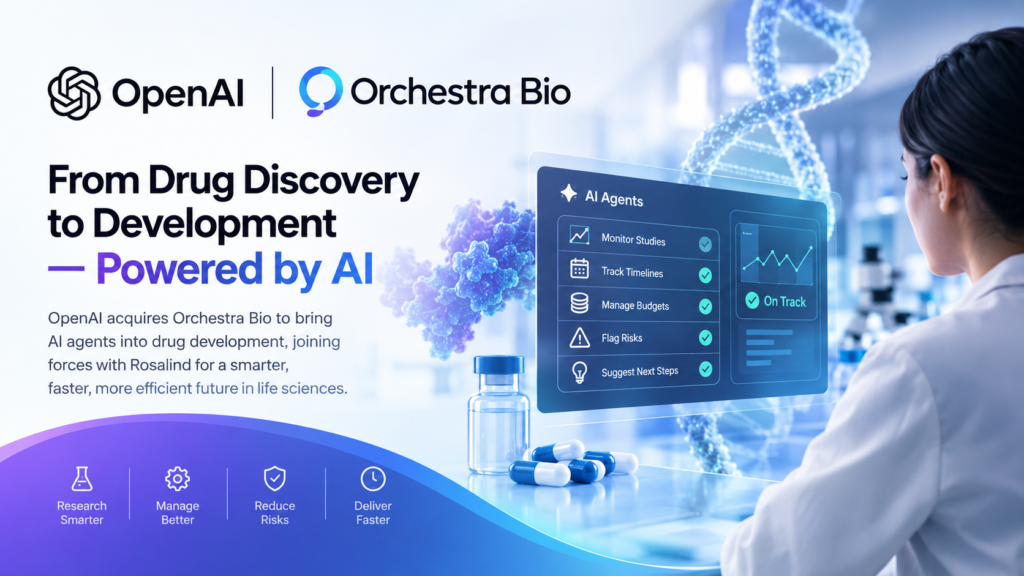
The Orchestra Bio acquisition is OpenAI’s purchase of a four-year-old AI startup whose software agents help drug companies manage development programs, announced on October 20, 2026. OpenAI is adding Orchestra’s team and technology to Rosalind, its AI model for life sciences research, and to the related Rosalind Workbench tool. Deal terms were not disclosed. TechCrunch
Most AI-in-biology news is about finding the next molecule. This deal is about a quieter problem: keeping a drug program that runs for a decade or more on schedule, on budget, and on the same page. This guide breaks the Orchestra Bio acquisition into short, self-contained sections, so you can read it in order or jump to the part you need.
Published October 21, 2026. Reported facts come from the sources listed at the bottom. Where I’m giving analysis rather than reporting, I say so.
Orchestra Bio Acquisition at a Glance
Here are the core facts, each tied to a reported source:
- Buyer: OpenAI, which announced the deal on its website on Tuesday, October 20, 2026. TechCrunch
- Target: Orchestra Bio, a San Francisco startup whose AI agents help drug companies keep sprawling development programs on schedule. Yahoo Finance
- Price: Not disclosed. TechCrunch
- Target’s funding: Reportedly around $20 million as of 2025. TechCrunch
- Destination inside OpenAI: Rosalind and Rosalind Workbench. TechCrunch
- Named Rosalind customers: Moderna and Novo Nordisk, according to OpenAI. TechCrunch
What Is the Orchestra Bio Acquisition?
Definition
The Orchestra Bio acquisition is a transaction in which OpenAI bought Orchestra Bio, a startup that builds AI agents for drug-development operations. Orchestra’s team and platform will be folded into Rosalind, OpenAI’s family of AI models and tools for biologists and chemists. Yahoo Finance
Expansion
Reports describe the assets as a team and a software platform, not a drug candidate, a laboratory, or a clinical dataset. That distinction matters. OpenAI is not buying a scientific result. It is buying a way to coordinate the work that surrounds scientific results: monitoring programs, tracking timelines, and flagging risks before they become delays.
Drug development involves far more than identifying a promising molecule. Pharmaceutical companies must coordinate research teams, clinical trials, regulatory milestones, financial resources, and operational decisions over several years. A delay in one area can affect the entire program, increasing costs and pushing important milestones further into the future. Orchestra Bio’s technology focuses on helping companies manage these interconnected activities through AI-powered software agents.
This makes the acquisition different from a conventional investment in drug discovery. Rather than purchasing a potential medicine or a laboratory with established research capabilities, OpenAI is acquiring technology designed to improve how development programs are managed. The strategic opportunity lies in connecting scientific work with the operational processes required to move potential treatments forward.
What Did OpenAI Announce?
OpenAI announced that it had acquired Orchestra Bio and would incorporate the startup’s team and technology into its Rosalind platform and Rosalind Workbench. The announcement, reported on October 20, 2026, represents a further step in OpenAI’s efforts to apply artificial intelligence to specialized scientific and pharmaceutical workflows.
Rosalind is designed to support life sciences research, including work involving biology, chemistry, and drug discovery. Rosalind Workbench provides an environment for researchers to plan experiments and analyze results. Orchestra Bio adds a complementary capability: helping manage the activities, schedules, and risks associated with drug-development programs.
The combination could allow AI systems to support a broader portion of the pharmaceutical research process. Researchers may use specialized AI tools to explore scientific questions, develop hypotheses, and interpret experimental findings. Meanwhile, operational agents could help teams monitor progress, identify emerging delays, and evaluate possible responses when plans change.
For example, a clinical trial may encounter a scheduling problem that affects a planned milestone. An AI agent could help identify the affected activities, gather relevant information, assess potential consequences, and present alternative responses to program leaders. The final decision would remain with the responsible human team. This example illustrates the type of operational support the technology is intended to provide; it does not establish that every capability is already available within Rosalind.
Why Is This Acquisition Significant?
The acquisition highlights a growing distinction between using AI to generate scientific insights and using AI to help execute the work that follows those insights. Discovering a promising therapeutic target is only one stage of a lengthy process. Turning that discovery into a medicine requires coordinated experiments, clinical studies, resource planning, and regulatory preparation.
Operational problems can undermine scientific progress even when the underlying research is promising. Missed deadlines, disconnected information, budget changes, and unexpected trial delays can create additional work for scientists and program managers. AI agents designed to monitor these activities could help teams identify problems earlier and make better-informed decisions.
For OpenAI, integrating Orchestra Bio into Rosalind could create a more connected offering for pharmaceutical and biotechnology organizations. Instead of supporting only selected research tasks, the platform could increasingly assist with the coordination surrounding those tasks. This is a potential strategic benefit rather than a proven outcome of the acquisition.
However, integration alone does not guarantee faster development or lower costs. The practical value will depend on how accurately the agents interpret program information, how well they work with existing systems, and whether research teams trust their recommendations. Pharmaceutical workflows also require careful oversight because operational mistakes can affect expensive studies and critical development milestones.
What Do We Know About the Deal Terms?
The financial terms of the Orchestra Bio acquisition have not been disclosed in the reports cited here. Orchestra Bio had reportedly raised approximately $20 million in funding by 2025, but that amount represents reported historical funding, not the acquisition price.
The available reporting also does not establish when the integration will be completed, whether Orchestra Bio’s platform will remain available as a standalone product, or which existing Orchestra customers may transition to Rosalind. These details will be important for biotechnology companies evaluating the long-term implications of the transaction.
For now, the clearest takeaway is that OpenAI is acquiring operational AI capabilities to complement its life sciences research tools. The longer-term significance will depend on how successfully the combined technology supports the complex, interconnected work required to develop new medicines.
How much did OpenAI pay for Orchestra Bio?
The price has not been made public. TechCrunch notes the startup had reportedly raised around $20 million as of 2025 from backers like Andreessen Horowitz, Atria, and 8VC. A separate report cites Caplight data and lists Andreessen Horowitz, Definition Capital, Insight Partners, and 8VC as seed investors. The two investor lists differ slightly, so treat the exact cap table as unconfirmed. TechCrunchYahoo Finance
Who Is Orchestra Bio?
Definition
Orchestra Bio is an AI biotech software startup. It creates AI agents that help biotech companies manage the minutiae of drug-discovery operations, from tracking finances to resolving scheduling issues with clinical trials. TechCrunch
What does Orchestra Bio’s software do?
It lets people hand routine program-management work to software agents. Scientists can delegate tasks like monitoring studies, tracking drug development timelines, and identifying potential delays. Yahoo Finance
The agents do more than report status. They work out which activities and deadlines take the hit, gather the relevant information, and compare ways to respond, while scientists and program leaders make the final call. An earlier company event listing described the product as agents that monitor progress, risks, and outcomes against scientific and financial plans. Yahoo Financeluma
That human-in-the-loop design is the core of AI agents for drug development. The software proposes and prepares, and a person decides.
Who founded and funded Orchestra Bio?
Orchestra was founded in the fall of 2022. One report names Ashoka Rajendra as the founder. The company came out of stealth in 2025 with $20 million in funding. OpenAI Buys Orchestra Bio to Put AI Agents in Charge of Drug Development Grunt Work +2
Is Orchestra Bio the same company as Orchestra BioMed?
No. The two are unrelated. Orchestra BioMed is a Nasdaq-listed medical device maker trading under the ticker OBIO. Search engines and AI systems can easily blur the names, so here is a side-by-side comparison: Yahoo Finance
| Attribute | Orchestra Bio | Orchestra BioMed |
|---|---|---|
| What it is | AI software startup for drug-program management | Publicly traded biomedical and medical-device company |
| Ticker | Private company | OBIO (Nasdaq) |
| Core products | AI agents that monitor and coordinate drug programs | Cardiovascular therapies such as AVIM therapy and the Virtue Sirolimus AngioInfusion Balloon |
| Involved in the OpenAI deal? | Yes, the acquired company | No |
Orchestra BioMed’s focus is cardiovascular disease, with products like AVIM therapy and the Virtue Sirolimus AngioInfusion Balloon. If you are researching the OpenAI deal, make sure you are reading about the right Orchestra. tipranks
What Is OpenAI Rosalind?
Definition
Rosalind is OpenAI’s AI model for life sciences research. OpenAI introduced its specialized GPT-Rosalind model in April to help researchers tackle complex problems in biology, chemistry, and drug discovery. Yahoo Finance
Expansion
OpenAI Rosalind is the scientific engine in this story. One report frames the division of labor this way: Rosalind helps scientists figure out what to test, while Orchestra is supposed to handle what comes after. That sentence is the clearest summary of why the two products fit together. Yahoo Finance
What is Rosalind Workbench?
Rosalind Workbench is a tool built around the Rosalind model. It is a harness that aims to help researchers plan experiments and analyze results. In plain terms, the Workbench is where a scientist’s day-to-day research work meets the model, and it is one of the two places Orchestra’s technology is headed. TechCrunch
Who uses OpenAI Rosalind today?
OpenAI says it has already won some big names as Rosalind customers, including Moderna and Novo Nordisk. OpenAI has also partnered with pharmaceutical giants, including those two, to bring AI into research and development workflows. TechCrunchYahoo Finance
How the Orchestra Bio Acquisition Fits Into OpenAI Rosalind
The Orchestra Bio acquisition gives Rosalind an operations layer. Rosalind addresses scientific questions, and Orchestra addresses the management of the program that answers them. Both companies aim to deploy agents that connect scientific findings with the decisions and next steps required to advance potential treatments. Yahoo Finance
The table below summarizes the division of labor, based on the reported descriptions:
| Dimension | OpenAI Rosalind (and Workbench) | Orchestra Bio |
|---|---|---|
| Core question | What should we test, and what do the results mean? | What happens to the program when something slips? |
| Stage of work | Experiment planning and analysis | Program monitoring, timelines, finances, trial scheduling |
| Typical output | Hypotheses, experiment plans, analyses | Risk flags, impact assessments, response options |
| Human role | Scientists direct the research | Scientists and program leaders make the final call |
| Known customers | Moderna, Novo Nordisk | Not named in the sources reviewed |
My analysis: The pairing is coherent because the two halves share a bottleneck. A good experiment plan still fails if the trial site is late or the budget is out of sync with the science. Connecting those layers is the stated ambition, though how well the integration works is unproven.
Why OpenAI Made the Deal: The Strategy Behind the Orchestra Bio Acquisition
Why does drug development need operational AI?
Because the process is slow and complicated. OpenAI says developing a new medicine typically takes 10 to 15 years, and it hopes AI can shorten that timeline. Much of that time is not discovery. It is coordination: aligning studies, sites, budgets, and decisions. That is the territory Orchestra worked in. Yahoo Finance
Why are AI labs building industry software?
Large AI labs are moving from general-purpose models into specific industries. TechCrunch calls the deal a classic example of how the biggest AI labs, namely OpenAI and Anthropic, are building ever more software for the biggest industries, like pharma. TechCrunch
The same report notes the tension this creates for startups. There is an ongoing fear that the labs will launch new features and become competitors, but in this case Orchestra is being absorbed rather than stomped out. TechCrunch
What does the deal say about OpenAI’s biotech strategy?
OpenAI’s biotech strategy appears to be moving up the stack, from a model that answers scientific questions toward a suite that also helps run the programs those questions belong to. That is an interpretation, not an OpenAI statement, but it fits the facts. A model, a workbench, named pharma partners, and now a program-management platform together form a more complete offering than any one piece.
Orchestra Bio Acquisition vs. Anthropic’s Coefficient Bio Deal
OpenAI is not alone in buying its way into biotech. Anthropic acquired the AI biotech startup Coefficient Bio for roughly $400 million in April, according to The Information. Axios frames both deals as the result of the same ambition: AI labs wanting to become useful inside pharmaceutical research and development. Yahoo Finance
Two cautions apply when comparing the deals:
- Prices are not comparable. The Coefficient Bio figure is a reported estimate. The Orchestra Bio acquisition has no disclosed price.
- The sources reviewed do not detail Coefficient Bio’s product. I won’t speculate on how its focus compares with Orchestra’s.
The safe takeaway is the pattern: more than one frontier lab is acquiring specialized biotech AI teams rather than building every capability from scratch.
What the Orchestra Bio Acquisition Means for Biotech Teams
Pharma and biotech leaders can read the Orchestra Bio acquisition as a signal. Here are the practical implications, labeled as my analysis rather than reported fact:
- Operational AI is now a lab priority. If a frontier lab buys a program-management startup, it suggests that scheduling, budgeting, and risk tracking are seen as valuable AI targets, not just discovery.
- Vendors may consolidate. Startups building adjacent tools face a choice between competing with the labs and being absorbed by them.
- Customers should ask about continuity. The sources reviewed do not say whether Orchestra’s product will remain available as a standalone offering. Existing users should ask directly.
- Governance still matters. The reported design keeps humans making the final decision. Teams adopting AI agents for drug development should define which decisions an agent may prepare and which a person must own.
- Integration with Rosalind may become the main upside. The strongest case for the deal is a single environment where scientific and operational context sit together.
Open Questions After the Orchestra Bio Acquisition
Several important points are not answered by the reporting I reviewed:
- Timing of integration. One analysis says the key thing to watch is how quickly OpenAI integrates Orchestra into Rosalind, and whether the promised specialized agents become products biopharma teams actually adopt. cryptobriefing
- Pricing and terms. The deal value is undisclosed.
- Standalone availability. It is unclear whether non-Rosalind customers can keep using Orchestra’s platform.
- Customer overlap. Orchestra’s customer list is not named in the sources reviewed, so overlap with Moderna and Novo Nordisk is unknown.
Treat any claim about these points as unconfirmed until OpenAI or Orchestra publishes details.
Frequently Asked Questions
What is the Orchestra Bio acquisition?
It is OpenAI’s purchase of Orchestra Bio, an AI startup whose agents help drug companies manage development programs. OpenAI announced it on October 20, 2026, and plans to fold Orchestra’s team and technology into Rosalind.
Who acquired Orchestra Bio?
OpenAI acquired Orchestra Bio. The ChatGPT maker shared the news exclusively with Axios. Yahoo Finance
How much did OpenAI pay?
The terms were not disclosed. The startup had reportedly raised about $20 million before the deal.
What does Orchestra Bio do?
It builds AI agents that watch over drug-development tasks, flag problems, and prepare response options, while humans make final decisions.
Is Orchestra Bio related to Orchestra BioMed?
No. Orchestra BioMed is an unrelated, publicly traded medical-device company.
What is Rosalind Workbench?
It is a tool that helps researchers plan experiments and analyze results, built to work with OpenAI’s Rosalind model.
Where is Orchestra Bio based?
It is a San Francisco startup. Yahoo Finance
Bottom Line
The Orchestra Bio acquisition is a small deal in headline terms, since no price was disclosed, but a revealing one. OpenAI is adding the operational side of drug development to a life sciences effort that already includes a specialized model, a researcher tool, and named pharma customers. Whether the combined product delivers faster programs is the real test. For now, the Orchestra Bio acquisition shows where frontier AI labs think the next value in pharma lies: in the daily work of running a program, not only in the discovery that starts it.