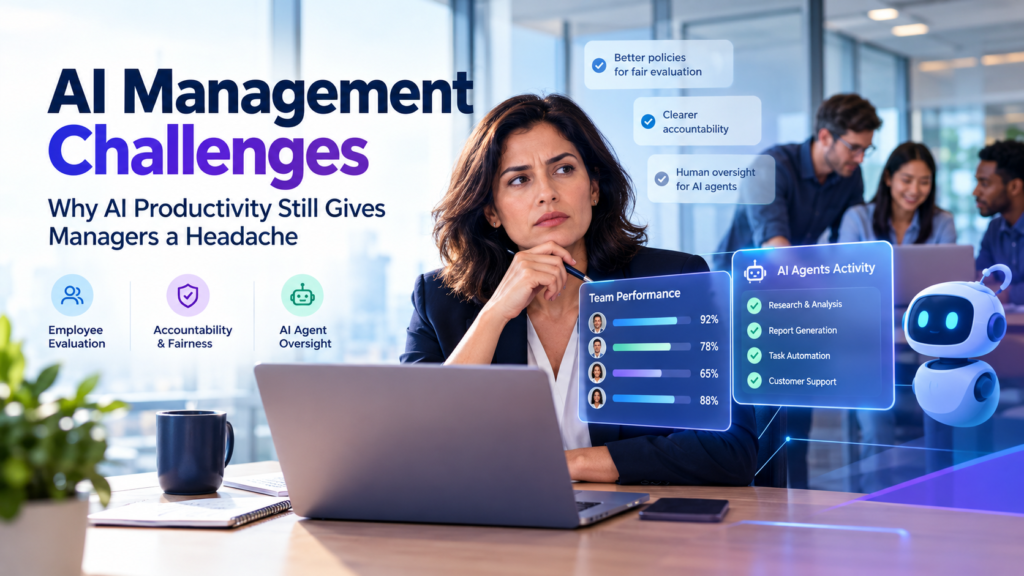
AI management challenges are the new problems leaders face once their teams adopt AI: harder performance evaluation, blurrier accountability, and oversight duties that didn’t exist two years ago. A Nielsen survey of 1,700 directors and senior managers across seven countries, commissioned by Monday.com, found that more than half of senior leaders say evaluating employees’ work has become harder since adopting AI. The fix is clearer evaluation criteria, human checkpoints and written AI policies, not more tools. TechCrunch
If you manage people in 2026, this probably sounds familiar. Your team ships faster, drafts look polished, and dashboards look healthy. Yet you feel less sure than ever about who did what, how well they did it, and whether anyone is really in control. This guide explains what the research says, why AI productivity gains don’t automatically make a manager’s job easier, and what you can do about it this quarter.
What Are AI Management Challenges?
AI management challenges are the operational, ethical, and people-related difficulties that managers face when AI tools and autonomous agents become part of how their teams work. They are different from technical adoption problems like choosing a vendor or running a pilot. They start after the rollout, when a manager has to lead people whose output is now partly produced by software.
These challenges tend to fall into three buckets:
- Measurement: It is harder to tell how much of a deliverable reflects human skill and how much reflects a model.
- Fairness: Reviews, promotions and feedback can be skewed when AI blurs individual contribution, or when AI helps write the review itself.
- Control: As companies deploy systems that act on their own, managers must decide who supervises those systems and who answers for their mistakes.
Each bucket maps to a finding in the new survey, covered next.
What the Latest Survey Reveals About AI Productivity and Managers
The Headline Numbers
The Nielsen survey, as reported by TechCrunch and syndicated coverage, points to a management layer under strain:
- 78% of respondents say they have changed how they evaluate employees since adopting AI. mezha
- 46% of managers use AI to help inform their decisions, and 39% of leaders use it to draft performance reviews. TechCrunch
- 58% of managers expect to oversee more AI agents than human employees within the next year, and 46% worry about losing control over what those agents do. TechCrunch
Taken together, these figures show where AI management challenges concentrate. They sit in the judgment-heavy parts of the job: assessing people, making decisions and supervising automation.
Managers Aren’t Anti-AI. The Role Itself Is Shifting
It would be a mistake to read the survey as managers rejecting AI. TechCrunch notes that managers are not unhappy about AI. The problem is that AI is developing faster than companies can adapt, and a tool that works well for a manager individually doesn’t solve the separate job of managing a team. TechCrunch
A manager can use AI to write faster, summarize meetings and analyze data. None of that tells them how to coach a team where everyone uses AI differently. That is the gap between personal AI productivity and team-level AI productivity.
Evaluating Work When AI Is in the Loop
Why Is It Harder to Evaluate Employees After Adopting AI?
Direct answer: Because the traditional signals of quality, such as speed, polish and volume, no longer reliably indicate skill. When AI can produce a clean first draft in seconds, a managerial eye can’t easily separate strong judgment from strong prompting.
This is the most immediate of the AI management challenges, and it is already reshaping behavior. Managers are putting more weight on employees’ ability to write prompts, decide which tasks to delegate to AI, and experiment with new ways of working. That shift may be reasonable, but it creates a new problem: those skills are rarely defined, taught or measured consistently. mezha
What Evaluating Employee Performance With AI Looks Like in Practice
Evaluating employee performance with AI works best when managers judge outcomes and decisions rather than raw output. A few practical shifts help:
- Ask for the reasoning, not just the result. A short note on what the employee asked the AI, what they rejected and why reveals more than the finished document.
- Evaluate verification. Catching an AI error is a skill. Reward people who check sources, test code and flag weak outputs.
- Separate throughput from impact. More deliverables per week is not the same as better results for customers or the business.
- Make expectations explicit. If prompt skill or delegation judgment counts in reviews, write it down before the review cycle, not during it.
One cautionary example comes from the way some workplaces measure AI use. Some people treat the number of AI tokens an employee consumes as a stand-in for productivity, yet higher token use can just mean higher costs, burnout and bloated, lower-quality output. Activity is not achievement. Wikipedia
When Managers Use AI to Judge People
A second layer of AI management challenges emerges when managers themselves rely on AI for people decisions. The survey suggests this is already common, with nearly half of managers using AI to inform decisions and a large share using it to draft performance reviews.
TechCrunch frames the resulting dilemma well. If managers can’t tell how much of an employee’s work came from AI, how fairly can that employee be judged? And what if the judge is also leaning on AI to produce the judgment? The article raises exactly this concern about fairness when AI sits on both sides of the evaluation. TechCrunch
Three Risks to Watch
- Hidden bias: A model’s suggested wording can carry assumptions about tone, seniority or communication style that a manager doesn’t notice.
- Loss of context: A drafted review may read well but miss the specific circumstances, such as a reorganization, a difficult client or a personal hardship.
- Accountability gaps: If a review is unfair, “the tool wrote it” is not an acceptable answer to the employee or to HR.
A reasonable rule: AI may help structure notes, but a human must own every conclusion in a performance review and be able to explain it unaided.
Managing AI Agents: The Next Wave of AI Management Challenges
The Scale Problem
Agents are not chatbots that wait for a prompt. They take actions, chain tasks and run in the background. The survey found 58% of managers expect to oversee more AI agents than human employees within a year. Managing AI agents therefore turns a manager into a supervisor of systems as well as people, often without training, job-description updates or extra capacity. TechCrunch
The Control Problem
Nearly half of managers (46%) worry about losing control over the actions of the agents they oversee. Managers say they want humans involved and consulted by AI on crucial tasks and decisions. That preference is a useful design principle: TechCrunchmezha
- Define which decisions an agent may make alone.
- Require human approval for anything irreversible, expensive or customer-facing.
- Log what agents did and why, so a manager can reconstruct events after a failure.
Managing AI agents well is less about technical skill than about clear delegation, the same discipline good managers already apply to people.
The AI Productivity Promise vs. Reality
The tension in the new survey is not new. Older research shows these AI management challenges have been building for a while. A 2024 Upwork Research Institute study found 96% of executives expected AI to boost productivity, yet only 26% had provided training and just 13% had a well-implemented AI strategy. The same research reported that nearly half (47%) of employees using AI had no idea how to achieve the productivity gains their employers expected, and 77% said the tools had decreased their productivity and added to their workload. peoplemattersgloballewissilkin
Newer reporting suggests the strain hasn’t gone away. Fortune cites 2026 data from Quantum Workplace showing that U.S. employees who use AI frequently report higher burnout than those who don’t. Some employers are responding by rethinking who benefits from efficiency gains: Bristol Myers Squibb, for example, is exploring a “well-being quotient” to decide how much productivity gained from automating tedious work should go back to employees. FortuneFortune
The lesson for managers: AI productivity is real in pockets, but it doesn’t flow automatically into team performance. It needs training, redesigned workflows and realistic expectations.
Why AI Management Challenges Are Really a Governance Problem
Definition: AI governance is the set of policies, roles and review processes that determine how an organization uses AI, who is accountable for it, and how its effects are monitored.
The survey’s central conclusion is that AI adoption is becoming a governance challenge as much as a chance to raise productivity. That reframing matters because it moves the conversation away from “which tool?” and toward “who decides, who checks, and who answers?” TechCrunchmezha
Treating AI management challenges as a governance issue means managers can’t solve them alone. They need:
- Policy from leadership on acceptable AI use in evaluation, hiring and reviews.
- Clear ownership for AI agents, including a named human for each one.
- Training that covers judgment and verification, not just button-clicking.
- Feedback loops so frontline managers can report where AI is causing friction.
Without those foundations, each manager improvises their own rules, and employees get inconsistent treatment depending on who they report to.
Traditional vs. AI-Era Management: A Comparison
The table below compares how AI management challenges change everyday management tasks.
| Management task | Traditional approach | AI-era approach | New risk to manage |
|---|---|---|---|
| Performance evaluation | Judge output quality and volume | Judge decisions, verification and AI-assisted judgment | Can’t tell human work from AI work |
| Feedback and reviews | Manager writes from direct observation | AI may draft; manager must validate and own | Generic or biased wording |
| Delegation | Assign work to people | Assign work to people and AI agents | Unclear accountability for agent actions |
| Skill development | Role-based training | Training on prompting, delegation and checking AI | Uneven AI skills across the team |
| Productivity tracking | Hours, tasks, deliverables | Outcomes and impact, not tool usage | Mistaking AI activity for results |
| Oversight | Direct supervision of staff | Monitoring staff plus automated systems | Loss of control over autonomous agents |
The pattern is consistent: the manager’s job moves from supervising effort to supervising judgment.
How to Solve AI Management Challenges: A Practical Framework
Start by naming which AI management challenges your team actually has. A team with unclear evaluation rules needs different fixes than a team deploying autonomous agents. Then work through these steps:
- Write an AI-use policy for your team. State what AI may be used for, what must be disclosed, and what always needs human review.
- Update evaluation criteria. Add observable behaviors such as verifying outputs, choosing what to delegate, and explaining decisions. Share them before the next review cycle.
- Keep humans accountable for people decisions. AI can organize notes, but promotions, ratings and discipline need a named human decision-maker.
- Assign an owner to every agent. Each autonomous system should have a responsible person, defined permissions and an approval step for high-stakes actions.
- Train managers first. Managers who don’t understand how teammates use AI can’t evaluate or coach them.
- Measure outcomes, not usage. Track customer results, quality and cycle time instead of prompts, logins or tokens.
- Review quarterly. Audit your AI management challenges every quarter, because tools and habits change faster than annual policies.
Quick Checklist for Managers
- Do my employees know how AI will factor into their reviews?
- Can I explain every conclusion in a review without referring to a tool?
- Does each AI agent on my team have a human owner?
- Am I rewarding verification and judgment, or only speed?
- Do I have a way to escalate AI problems to leadership?
Frequently Asked Questions
What are the biggest AI management challenges right now?
The most cited are evaluating employee work when AI contributes, keeping performance reviews fair when AI helps write them, and supervising autonomous agents. The Nielsen survey found more than half of senior leaders say evaluating work has gotten harder since adopting AI. TechCrunch
Does AI actually improve productivity for managers?
It can improve individual tasks like drafting and analysis, but team-level gains are less certain. AI may work well for managers as individuals, while their separate role as managers faces new complications. Gains depend on training, workflow redesign and realistic expectations. TechCrunch
Should managers use AI to write performance reviews?
AI can help organize notes and improve clarity, but managers should own every conclusion. Given the fairness and accountability risks above, a human should verify that each statement reflects the employee’s actual work and circumstances.
How can small teams reduce AI management challenges?
Small teams can start with a one-page AI policy, explicit review criteria and a named owner for any automation. These steps cost little and address the main sources of confusion: unclear expectations and unclear accountability.
Is this the same problem reported in earlier AI productivity studies?
It overlaps. Earlier research, such as the 2024 Upwork study, focused on employees feeling overloaded. The 2026 survey shifts attention to the manager’s side: evaluation, decision-making and oversight. Both point to the same cause, which is that technology is arriving faster than the systems around it.
Conclusion: Treat AI as a Management Redesign, Not Just a Tool Rollout
AI management challenges won’t disappear as models improve. Better tools may even sharpen them, because more capable systems blur individual contribution further and take on more autonomy. The organizations that handle this well will be the ones that treat AI adoption as a redesign of how work is assigned, judged and supervised.
For managers, the practical path is straightforward. Define how AI counts in evaluation, keep humans accountable for people decisions, assign owners to agents, and measure outcomes instead of activity. Do that, and AI productivity stops being a promise your team has to prove and starts becoming something you can actually manage.
Another important step is to make AI adoption a shared responsibility rather than leaving individual managers to figure everything out. Leadership teams should establish consistent policies, HR departments should update performance evaluation frameworks, and IT and security teams should help define appropriate access controls for AI tools and agents. When these groups work together, employees receive clearer expectations and managers can make decisions with greater confidence.
Organizations should also recognize that successful AI management requires continuous learning. A policy that works today may need revision as AI capabilities, employee workflows and business risks evolve. Regular reviews can help leaders identify where automation saves time, where it introduces errors, and where employees need additional training. Gathering feedback from frontline teams is especially valuable because those employees often discover practical problems before they appear in management reports.
Finally, managers should remember that productivity is not simply about completing more tasks in less time. Sustainable performance depends on work quality, customer satisfaction, employee well-being and the ability to make sound decisions. If AI increases output but also creates confusion, excessive monitoring or additional workloads, the organization may be measuring efficiency while overlooking its hidden costs.
The goal is not to eliminate human judgment from the workplace. It is to use AI where it adds value while preserving human responsibility where decisions matter most. Managers who establish transparent expectations, encourage verification and maintain meaningful oversight will be better positioned to turn AI adoption into lasting business improvements. Ultimately, the strongest organizations will not be those that deploy the most AI tools, but those that learn to manage the relationship between people, intelligent systems and measurable results.