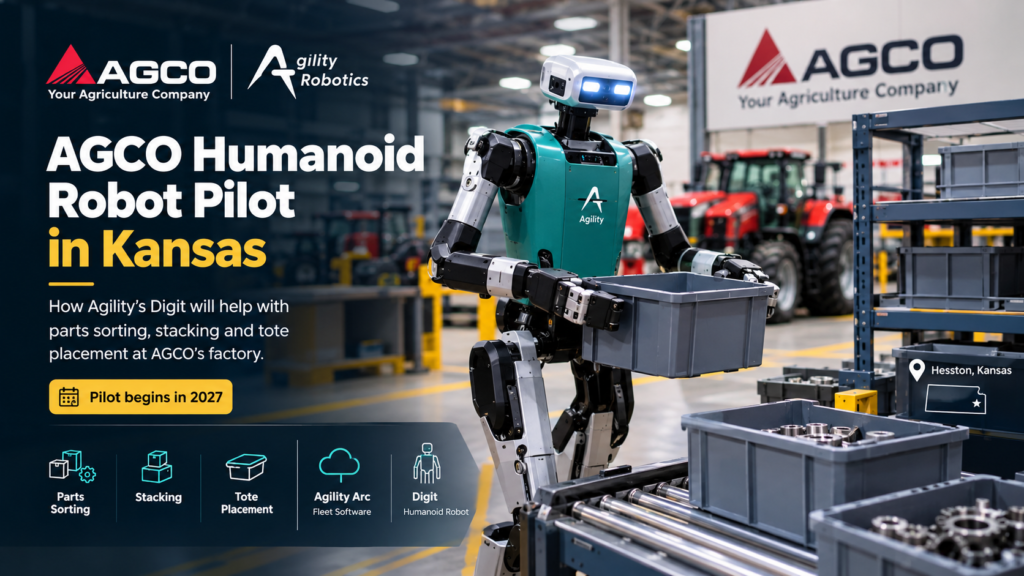
The AGCO humanoid robot pilot is a planned 2027 trial in which Agility Robotics’ Digit will help with parts sorting, stacking and storage-tote placement at AGCO’s production site in Hesston, Kansas. The two companies signed a commercial agreement on October 20, 2026, but no robots have started work yet, so this is a story about what is coming rather than what is running today. therobotreportinvesting
Farm equipment is built from a huge number of parts, and every one has to be moved, sorted and staged before it becomes a combine or a tractor. This guide explains what the AGCO humanoid robot pilot covers, why it matters for humanoid robots in manufacturing, and what to watch between now and 2027. Each section stands on its own, so you can jump straight to the question you care about.
What Is the AGCO Humanoid Robot Pilot?
The short definition
The AGCO humanoid robot pilot is a limited, real-world trial of a humanoid robot inside an active agricultural-equipment factory. In manufacturing, a pilot is a deliberately small deployment: a small number of robots, a narrow set of tasks, and clear measures of success that decide whether the project grows. That framing tells you what to expect in 2027: evidence gathering, not a factory full of walking robots.
What has actually been announced
Here is what is confirmed about the AGCO humanoid robot pilot so far. AGCO and Agility Robotics signed a commercial agreement to deploy Agility’s Digit humanoid in AGCO’s manufacturing operations, with the U.S. pilot expected to begin in 2027 at the Hesston, Kansas, site. therobotreportinvesting
AGCO’s director of manufacturing technology, Thomas Enghof, called humanoid robotics and AI essential teammates in building flexible, intelligent factories. He added that such robots can take on repetitive, strenuous or hazardous work and augment human capabilities, provided they are paired with strict safety governance. globenewswiretherobotreport
Key facts at a glance
- Companies: AGCO (NYSE: AGCO) and Agility Robotics investing
- Announced: October 20, 2026 agilityrobotics
- Location: AGCO’s Hesston, Kansas, manufacturing facility prnewswire
- Expected start: 2027 stocktitan
- First tasks: parts sorting and stacking, plus placement of totes for storage prnewswire
- Fleet software: Agility Arc, a cloud-based platform for deploying and managing robot fleets investing
- Robot: Digit, Agility’s general-purpose humanoid
Why Hesston, Kansas? The Factory Behind the Pilot
What AGCO builds in Hesston
AGCO’s manufacturing page identifies Hesston as the site that makes combines and hay and forage equipment for the Fendt and Massey Ferguson brands. AGCO’s other North American sites include Beloit, Kansas, where the Fendt Momentum planter is built, and Jackson, Minnesota, which focuses on high-horsepower tractors and application equipment. The company is headquartered in Duluth, Georgia, and its brands include Fendt, Massey Ferguson, PTx and Valtra. Agility Robotics Signs AGCO Deal to Pilot Digit Humanoid Robots +2
For the AGCO humanoid robot pilot, the Hesston Kansas factory offers a demanding test bed. This next point is my own reading, not something AGCO has said: combines and forage machines involve large, varied components, and variety is exactly where a flexible robot could prove more useful than a machine built for one repeated motion.
Why a production floor and not a warehouse?
Digit’s public track record began largely in logistics. Reports from 2024 described Digit working in a Spanx warehouse and running trials at Amazon facilities. Agility also listed GXO Logistics among the companies testing the robot. Bloombergagilityrobotics
The Hesston plan is different in one important way. Agility says Digit will support key assembly and production operations. That places the robot closer to the heart of a factory than a shipping dock, which is why industry watchers see the AGCO humanoid robot pilot as a meaningful test for humanoid robots in manufacturing. therobotreport
What Will Digit Do During the AGCO Humanoid Robot Pilot?
What tasks will Digit perform at AGCO? Digit will initially handle parts sorting and stacking and the placement of totes for storage. Neither company has published a step-by-step workflow, so the details below explain what these tasks generally involve rather than describing AGCO’s exact process. prnewswire
Parts sorting and stacking
Definition: Parts sorting means identifying components and directing them to the right place. Stacking means arranging them so they are stable, accessible and ready for the next step.
Expansion: These jobs are repetitive and physically demanding, which is the profile Agility and AGCO keep returning to. AGCO says it expects the robots to take on repetitive, physically demanding work so employees can focus on higher-value tasks. In a plant that builds heavy machinery, even small components add up to a lot of lifting over a shift. stocktitan
Intelligent tote placement
Totes are the standard bins that carry parts between stations and into storage. Moving them is the job Digit has been associated with since its early deployments. Agility’s own factory materials describe Digit moving, loading and unloading totes. The word “intelligent” in the announcement suggests Digit is expected to decide where totes belong rather than follow a fixed path. Agility says Digit uses AI to continuously learn and adapt to evolving workflows. newequipmenttherobotreport
Why start with simple tasks?
Starting small is a feature, not a limitation. A narrow task list keeps the AGCO humanoid robot pilot measurable: AGCO can compare throughput, ergonomics and reliability against a known baseline. It also lets the plant build confidence in safety procedures before the robot takes on anything more complex. That is typical of how new automation earns its place on a factory floor, though neither company has said what thresholds would trigger an expansion.
How Does Agility Robotics Digit Work?
Definition: What is Digit?
Digit is a general-purpose humanoid robot built to work in spaces designed for people. Agility describes it as the first multi-purpose, human-centric robot that is commercially deployed. Earlier reporting described a robot with two legs and two arms, designed to move through environments where steps or other structures can limit conventional robots. agilityroboticsmezha
The practical appeal of Agility Robotics Digit is simple. If a robot can use the same aisles, doorways and shelving as a person, a plant may not need to rebuild its layout around it.
Agility Arc: the software layer
A robot is only useful if someone can deploy and manage it. Agility says that when Digit is paired with Agility Arc, its cloud-based platform for deploying and managing robot fleets, companies can integrate automation into essential operations without extensive infrastructure changes or costly facility upgrades. That is Agility’s claim, and the AGCO pilot is a chance to test it in practice. globenewswire
Digit 5 and what it could change
Last month, Agility unveiled Digit 5, which includes new legs, upgraded batteries and a more comprehensive safety architecture. Agility has described the Digit 5 humanoid robot as its first model designed for cooperatively safe work at scale, meaning it can work close to people. The supporting ecosystem is growing too. Agility chose Nyobolt for ultra-fast charging on Digit 5, and it signed a memorandum of understanding with FORT Robotics to advance the safety infrastructure of the robot. AGCO to deploy Agility Digit humanoid in Kansas factory – The Robot Report +3
One caveat: the announcements I reviewed do not say which Digit version AGCO will use in 2027. Treat any claim that the Digit 5 humanoid robot is headed to Hesston as unconfirmed until AGCO or Agility says so.
AGCO Humanoid Robot Pilot vs. Traditional Automation
How does a humanoid compare with the conveyors and robot arms that factories already use? The table below summarizes general differences. The humanoid column reflects Agility’s stated positioning, not independently verified results.
| Factor | Traditional fixed automation | Humanoid robots like Digit |
|---|---|---|
| Layout needs | Usually built around a fixed cell or line | Designed to work in spaces built for people, per Agility |
| Task flexibility | Excellent at one repeated task | Aims to handle varied material-handling tasks and adapt through AI |
| Deployment approach | Typically requires custom engineering of the cell | Agility says fleet software lets companies avoid major facility upgrades |
| Track record | Decades of industrial use | Early commercial stage; pilots like AGCO’s build the evidence |
| Best fit | High-volume, stable, predictable processes | Variable, human-centric workflows with repetitive or strenuous tasks |
| Main open question | Cost and time to reconfigure | Reliability, speed and safety at production scale |
The takeaway is that humanoids are not replacing fixed automation across the board. They are aimed at the gaps between automated cells, where work still falls to people because it is too varied for a dedicated machine.
Who Else Deploys Agility Robotics Digit?
AGCO joins a growing group of companies deploying Agility’s humanoids, including Toyota, GXO Logistics and Schaeffler. That list helps explain why AGCO was willing to sign a commercial agreement rather than run an informal trial: Digit has customers in more than one industry, and each deployment adds operating experience. therobotreport
Still, no public source I found offers independent performance data from those sites, such as uptime or cost per task. Until that data appears, the AGCO humanoid robot pilot will be judged mostly on the plant’s own results.
What the AGCO Humanoid Robot Pilot Means for Workers and Safety
Will Digit replace workers at Hesston? Nothing in the announcements I reviewed mentions headcount changes. AGCO says the automation should improve ergonomic safety and free employees for higher-value work. Agility likewise says Digit will support employees in demanding tasks. stocktitanprnewswire
Those are the companies’ own framings, and they are plausible given the tasks involved, but it is reasonable for employees, unions and local officials to ask for specifics. The AGCO humanoid robot pilot will only earn lasting trust if the plant answers questions like these:
- Which tasks move to Digit, and which stay with people?
- How are robot and human work zones separated or shared?
- What safety certifications and procedures apply to a walking robot near employees?
- How will AGCO measure ergonomic benefits, and will results be shared?
- What retraining or role changes, if any, accompany the rollout?
Enghof’s emphasis on strict safety governance suggests AGCO knows these questions are coming. A pilot is the right place to answer them with data.
The Business Context: Agility’s Road to Going Public
The deal lands at a busy moment for Agility. The company is preparing to become public through a previously announced merger with Churchill Capital Corp XI, expected to close in the fourth quarter of 2026. After closing, the combined company is expected to operate as Agility Robotics and trade on Nasdaq under the ticker AGLT. The registration statement for the transaction was declared effective by the SEC on October 13, 2026. AGCO to deploy Agility Digit humanoid in Kansas factory – The Robot Report +2
Agility has also confirmed that it is exploring wheeled robots for its customers. The signal for buyers is that Agility is willing to adapt its hardware to the job, not just sell one form factor. therobotreport
For AGCO, the timing means the AGCO humanoid robot pilot is a commercial relationship with a company that expects to be publicly traded. For readers, this is context rather than investment advice, and the transaction is not complete until it closes.
Open Questions About the AGCO Humanoid Robot Pilot
The announcement answers the what, where and when. Several important details remain unpublished in the sources I reviewed:
- Fleet size: How many Digit units will join the pilot?
- Robot version: Will AGCO receive Digit 5 or an earlier generation?
- Success metrics: What throughput, safety or ergonomic targets define a successful trial?
- Scale-up path: The wording says the effort begins at Hesston, but no sites beyond it have been named.
- Integration: How will Digit connect to AGCO’s existing material-flow and inventory systems?
Watching how these get answered over 2027 will reveal more about the state of humanoid robots in manufacturing than the original announcement does.
What to Watch as the AGCO Humanoid Robot Pilot Approaches
The AGCO humanoid robot pilot will be worth watching for more than the number of tasks Digit can complete. Its real value will depend on whether the robot can perform reliably in a working factory, operate safely around employees, and fit into existing production processes without creating new bottlenecks.
Productivity and reliability: Parts sorting, stacking, and tote placement may appear straightforward, but manufacturing environments demand consistent performance over long shifts. Observers will want to know how frequently Digit completes tasks successfully, how often it requires human intervention, and whether it can keep pace with the factory’s material-handling requirements.
Worker safety and collaboration: A humanoid robot working in an active manufacturing facility must operate predictably around people, equipment, and moving materials. Clear operating procedures, defined work zones, emergency stops, and appropriate safety measures will be important as AGCO evaluates the deployment. The pilot could also help identify where human supervision remains necessary.
Integration with existing systems: Digit’s performance will depend on more than its physical capabilities. The robot must fit into AGCO’s established workflows for moving components between storage areas and production stations. Agility Arc is intended to help manage robot fleets, but the actual integration process and any infrastructure requirements at Hesston have not yet been publicly detailed.
The economics of humanoid automation: Businesses considering similar robots will need evidence that the technology delivers value beyond an impressive demonstration. Relevant measures include operating costs, maintenance requirements, uptime, task completion rates, and the amount of manual work reduced. Neither company has publicly disclosed the financial or performance thresholds that will define success for this pilot.
These questions will become easier to answer as the planned 2027 trial progresses. Until then, the AGCO agreement should be viewed as an important commercial step rather than proof that humanoid robots are already ready for every manufacturing task.
Conclusion
The AGCO humanoid robot pilot represents a practical test of whether humanoid robotics can move beyond warehouse operations and contribute to agricultural equipment manufacturing. By starting with parts sorting, stacking, and tote placement, AGCO and Agility Robotics are focusing on specific tasks that can potentially be evaluated against measurable operational goals.
For manufacturers, the most important question is not whether a robot looks or moves like a person. It is whether the robot can complete useful work safely, reliably, and economically within the constraints of an existing facility. The Hesston deployment could provide valuable evidence on all three fronts.
However, important details remain unknown, including the number of robots involved, the exact Digit model selected, and the criteria AGCO will use to assess the pilot. The planned 2027 start also means readers should distinguish between the announced agreement and results that have yet to be demonstrated.
If the trial succeeds, it could encourage other manufacturers to investigate humanoid robots for repetitive material-handling tasks. If it exposes limitations in reliability, safety, or cost, those findings could be equally valuable for the industry.
For now, the AGCO humanoid robot pilot is best understood as a closely watched experiment in industrial automation. Its lasting significance will depend on the evidence produced on the factory floor, not simply on the announcement itself.