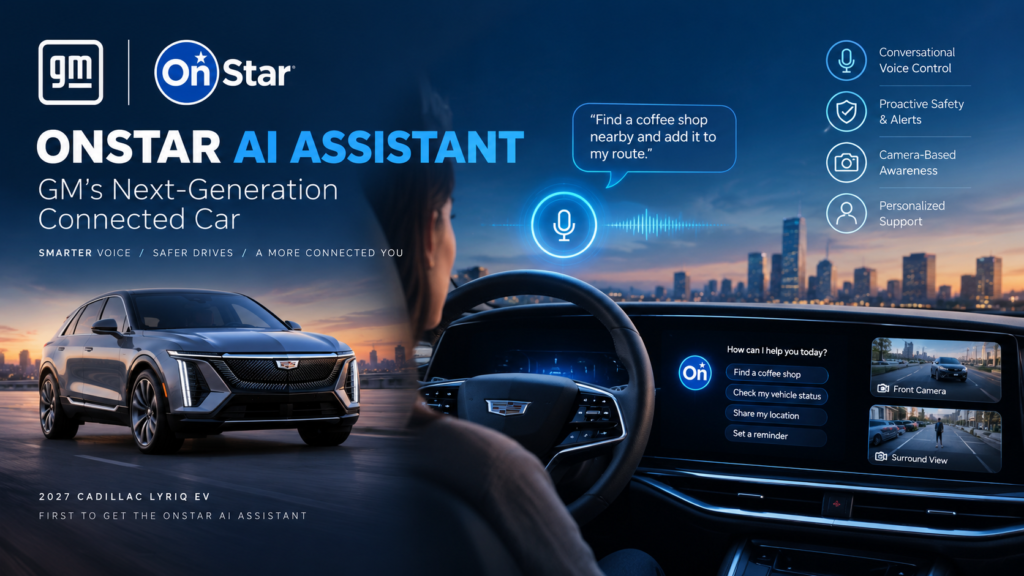
Quick answer: The OnStar AI Assistant is General Motors’ new in-house personal AI helper for drivers and passengers. It debuts in the 2027 Cadillac Lyriq EV in the coming months, with more GM vehicles to follow. It also marks the biggest rethink of OnStar in its 30-year history: a shift from a call-center safety service to what GM calls a connected intelligence platform.
GM announced the change on Wednesday, October 21, 2026, at its GM Forward event in New York, as reported by TechCrunch. The OnStar AI Assistant is the centerpiece of a broader GM OnStar AI makeover. That makeover also includes a new OnStar mobile app arriving in 2027, camera-based safety features, and fresh commitments on data privacy. This guide explains what was announced, how the pieces fit together, how the new OnStar compares with the old one, and which questions remain open.
What Is the OnStar AI Assistant?
Definition: The OnStar AI Assistant is a conversational, in-vehicle AI that GM built in-house to give drivers and passengers an interactive, customized experience inside the car.
Expansion: The key word is personal. GM’s stated aim is for the assistant to become more embedded in people’s daily lives rather than sit in the dashboard as a menu of voice commands. It is also described as agentic AI in cars, and the term is worth unpacking. In general usage, agentic AI refers to software that works toward a goal on a user’s behalf, anticipating needs and taking actions, rather than only answering one-off questions. For GM, that means moving OnStar from reacting when you press a button to interpreting what is happening around the vehicle and offering support before you ask.
Put simply, the OnStar AI Assistant is not a bolt-on voice feature. GM’s chief product officer, Sterling Anderson, told TechCrunch that OnStar is becoming a connected intelligence platform: a mechanism for interpreting, understanding, and providing predictive, proactive support to owners, not just the call center it was historically known as.
Just as important is who built it. For years, GM relied on Google to supply the generative AI experience inside its vehicles. This assistant is an internal effort, which gives GM direct control over how the product evolves.
Key Facts at a Glance
Here is the announcement distilled into the details most readers need:
- What it is: The OnStar AI Assistant, a personal AI assistant added to the OnStar subscription service
- First vehicle: The 2027 Cadillac Lyriq EV, arriving in the coming months, with more GM vehicles to follow
- Announced: October 21, 2026, at GM Forward in New York
- Built by: GM, as an in-house effort
- Companion product: A new OnStar mobile app launching in 2027
- What the app replaces: The OnStar Guardian app (launched in 2020) and the separate Buick, Cadillac, Chevrolet, and GMC brand apps
- Privacy stance: Customers decide what data is shared; recordings have time limits and are encrypted; GM says neither it nor OnStar can access Connected Camera recordings
- Not yet disclosed in the reporting: Pricing, the complete list of future vehicles, and exact launch dates beyond “coming months” and “2027”
Why Did GM Rebuild OnStar Around AI?
Direct answer: GM is rebuilding OnStar around AI because software and AI are now central to how vehicles compete, and because OnStar is the vehicle for GM’s subscription ambitions. The announcement coincides with a wider industry push to keep pace with Chinese automakers, with technology that is central to the vehicle rather than a bolted-on gimmick.
A 30-year product under pressure
OnStar began three decades ago as a subscription safety and roadside assistance service. Over the past five years, GM has updated it repeatedly as tech-forward competitors like Tesla raised expectations for in-car software. GM’s longer-term plan, first stated in 2021, is to build a $25 billion subscription business by 2030. A smarter, stickier OnStar is a natural anchor for that goal.
Achieving it has required GM to change how it builds vehicles. According to the reporting, the company has had to alter its software development approach, adopt AI tools, and design a new electrical and centralized compute architecture.
From Dialogflow to Gemini to in-house AI
The path to this assistant was gradual. A condensed timeline:
- 2020: GM launches the OnStar Guardian app
- 2021: Guardian expands to anyone with a compatible phone, even non-GM owners, offering crash detection, emergency assistance, and location sharing
- 2022: GM begins using Google Cloud’s conversational AI, Dialogflow, to recognize specific spoken requests
- 2023: The service expands to answer common queries such as routing and navigation help
- 2025: GM says Google Gemini will roll out in vehicles in 2026
- 2026: GM unveils its in-house OnStar AI Assistant alongside the new OnStar app
Seen this way, the OnStar AI Assistant is the logical next step: from recognizing commands, to answering questions with Google’s help, to a GM-owned assistant designed to be proactive. The reporting does not explain how this in-house effort will coexist with the Gemini-powered experience GM announced last year, so that remains an open question.
What Can the OnStar AI Assistant Do?
Short answer: Based on what GM has shared, the assistant handles voice control of certain vehicle functions, answers questions about vehicle features, and works with connected cameras to capture and share events. GM has also signaled broader predictive and proactive support.
Voice control and vehicle Q&A
With the OnStar AI Assistant, occupants will be able to use their voice to control certain functions on the vehicle, including climate. They can also ask questions about specific vehicle features. Anyone who has dug through a manual or touchscreen menu to find a setting will see the appeal of simply asking.
GM has not published a full command list, so the exact scope of controllable functions is still unclear.
Connected cameras and automatic event capture
The most concrete new capability is camera integration. Cameras on the vehicle connect to the software to offer live views as well as crash and safety recordings. Owners can set the cameras to turn on automatically if the vehicle senses an impending event, such as an aggressive horn honk. The system captures the moment and uploads it to the OnStar app.
For drivers, the practical benefits are clear: evidence after an incident, a way to check on the vehicle remotely, and a record of safety events. The same capability is also why the privacy details covered below matter.
How proactive will it be?
Anderson’s description points to predictive, proactive support, but the announcement details one concrete example: camera-triggered recording. How far the OnStar AI Assistant goes beyond that, such as anticipating maintenance needs, suggesting routes, or flagging safety risks, is not specified in the reporting. Treat broader proactive features as the stated direction rather than a confirmed feature list.
How Does the New OnStar Mobile App Fit In?
Direct answer: The new OnStar mobile app is the phone-side companion to the in-car experience, and it consolidates several existing apps into one.
Launching in 2027, the new OnStar mobile app will complement and sync with the in-car software, where the OnStar AI Assistant lives. It will replace the current OnStar Guardian app as well as the individual apps for Buick, Cadillac, Chevrolet, and GMC. That is a significant simplification. Owners of different GM brands currently juggle separate apps, while the new OnStar mobile app aims to be a single home for vehicle features, safety services, and camera recordings.
The reporting does not say whether the assistant itself will be available inside the phone app or only in the vehicle. Check GM’s rollout details as they emerge.
OnStar Before and After the AI Makeover
The table below compares OnStar before this announcement with the direction GM has now described.
| Dimension | OnStar before the AI makeover | OnStar with the AI makeover |
|---|---|---|
| Positioning | Safety and roadside assistance service, known as a call center | Connected intelligence platform |
| AI source | Google’s conversational AI (Dialogflow) and Google-provided generative experiences | In-house assistant built by GM |
| Interaction style | Recognizes specific spoken requests; answers common queries like routing | Interactive, customized assistant; voice control; questions about vehicle features |
| Support model | Largely request-driven | Predictive and proactive (stated goal) |
| Cameras | Not part of the announced experience | Live views, crash and safety recordings, automatic event capture |
| Apps | OnStar Guardian plus separate Buick, Cadillac, Chevrolet, and GMC apps | One new OnStar mobile app in 2027 |
| First vehicle | Broad GM lineup | 2027 Cadillac Lyriq, then more GM vehicles |
Is the OnStar AI Assistant Safe for Privacy?
Direct answer: GM says customers will control what data is shared, but the company’s track record means the claims deserve scrutiny.
The announcement arrives after GM was criticized, and even fined, for sharing driver data with third parties. In response, GM made several commitments for the new system:
- Customers can decide what data is shared
- Connected Camera recordings have time limits
- Recordings are encrypted
- GM and OnStar cannot access Connected Camera recordings
Those are meaningful design choices, especially “cannot access,” which is a stronger statement than “will not.” Still, the reporting offers no technical detail on how the safeguards are enforced or audited. For any owner, the practical advice is to review data-sharing settings as soon as the OnStar AI Assistant and the new app are available, and to check what the camera features record by default.
Why the OnStar AI Assistant Matters Beyond GM
Definition: Embedded AI in a vehicle is an assistant that has context about the car, its sensors, and its owner, rather than a general chatbot reached through a phone.
Expansion: GM’s move is one example of a broader shift. Automakers are racing to make software central to the vehicle, and that is forcing structural change: centralized compute, AI-assisted development, and subscription revenue models. The OnStar AI Assistant is notable because GM chose to build it rather than rent it. Owning the assistant means owning the customer relationship, the data flows, and the pace of improvement. It also means GM carries the responsibility if the product disappoints.
For readers outside the auto industry, the lesson is transferable. Established products with decades of brand equity, like OnStar, can be rebuilt around AI, but only when the underlying architecture changes too.
Frequently Asked Questions
When will the OnStar AI Assistant launch?
It debuts in the 2027 Cadillac Lyriq EV “in the coming months,” according to GM’s announcement. More GM vehicles will follow, and the new OnStar mobile app arrives in 2027. GM has not given a specific date.
Which vehicles will get it first?
The 2027 Cadillac Lyriq EV is the first confirmed vehicle. GM says additional vehicles will follow but has not published a list in the reporting.
Is the OnStar AI Assistant available in India?
The reporting covers GM’s announcement from the U.S. and does not mention availability outside the U.S. If you are in India, treat it as a development to watch rather than a product you can use today.
Is the OnStar AI Assistant built on Google Gemini?
The reporting describes it as an in-house GM effort. GM separately announced last year that Google Gemini would roll out in its vehicles in 2026, but the article does not explain how the two relate.
What is the new OnStar mobile app?
It is a 2027 app that syncs with the in-car software and replaces the OnStar Guardian app and the Buick, Cadillac, Chevrolet, and GMC brand apps.
Can GM see my camera footage?
GM says neither it nor OnStar can access Connected Camera recordings, that recordings are encrypted and time-limited, and that customers choose what data is shared.
How much will it cost?
Pricing was not included in the reporting. OnStar is a subscription service, so expect details to arrive closer to launch.
Final Takeaway: Why the OnStar AI Assistant Could Transform Connected Cars
The OnStar AI Assistant is GM’s bet that a 30-year-old safety service can become a proactive, AI-driven platform. Its first home is the 2027 Cadillac Lyriq, and its companion new OnStar mobile app arrives in 2027. The strongest concrete features announced so far are voice control, vehicle Q&A, and camera-triggered event capture, with proactive support as the declared direction. The biggest open questions are pricing, the full vehicle rollout, how it coexists with Google Gemini, and how well the privacy promises hold up.
If you cover cars, AI, or connected technology, this is a story to track through the Lyriq launch. Judge the OnStar AI Assistant by what it does in real vehicles, not simply by what the keynote promised.
The Bigger Opportunity: Making Cars Easier to Use
One of the most important opportunities for the OnStar AI Assistant is reducing the friction between drivers and vehicle technology. Modern cars increasingly contain complex infotainment systems, touchscreen menus, connected services, and driver-assistance features. Although these technologies can improve convenience, finding the right setting or understanding a particular function can sometimes require unnecessary effort.
A conversational assistant could make these interactions more natural. Instead of searching through menus, drivers could ask questions about vehicle features or use voice commands to control supported functions, including climate settings. This approach could make connected-car technology more approachable for people who do not want to learn every menu or memorize specific commands.
However, convenience must not come at the expense of road safety. Voice interaction should help drivers keep their attention on driving rather than encourage lengthy conversations or distracting activities behind the wheel. The quality of the user experience will depend on how accurately the assistant understands requests, how quickly it responds, and how effectively it handles situations where a command is unclear.
GM will need to demonstrate that its assistant works reliably in real driving conditions, including noisy cabins and situations where drivers need immediate, straightforward responses. These practical details will matter more to customers than impressive demonstrations alone.
Why Building Its Own AI Matters for GM
GM’s decision to develop the OnStar AI Assistant in-house is also strategically significant. Automakers increasingly compete through software, connected services, and the digital experiences they provide after a vehicle leaves the showroom. An internally developed assistant gives GM greater control over its product direction, how features are integrated, and how the experience evolves over time.
This strategy could also strengthen the relationship between GM and its customers. Rather than treating OnStar primarily as an emergency assistance subscription, the company is positioning it as a service that can support owners throughout their daily driving experience. If customers find the assistant genuinely useful, it could give them more reasons to remain engaged with GM’s connected services.
Nevertheless, developing an in-house assistant introduces its own challenges. GM must maintain the underlying software, improve its conversational capabilities, address errors, and support the system across different vehicles. The company must also clarify how its new assistant relates to the Google Gemini experience previously announced for its vehicles. Customers will benefit from a clear explanation of which assistant handles particular tasks and whether the experiences will work together.
Privacy Will Be a Critical Test
The connected-camera features make privacy one of the most important issues surrounding the OnStar AI Assistant. Vehicle cameras can provide useful information after an incident, help owners view their vehicles remotely, and capture safety-related events. Automatic recording triggered by a detected event could be particularly valuable when a driver needs evidence of what happened.
At the same time, camera-based services raise reasonable questions about recording, storage, access, and control. Drivers need to understand when recording begins, how long footage remains available, how it is transmitted, and what happens when they change their data-sharing preferences.
GM has stated that customers control what data is shared, recordings are encrypted and time-limited, and neither GM nor OnStar can access Connected Camera recordings. These commitments are important, but customers will need clear explanations of how the protections work in practice. Accessible privacy settings and transparent documentation can help turn those promises into meaningful safeguards.
The company’s handling of these concerns could influence how readily customers accept more intelligent and connected vehicles. Trust will be particularly important as automotive AI becomes more integrated into everyday activities.
What Drivers Should Watch Before Buying
For consumers considering a future GM vehicle, the announcement is a reason to watch the rollout rather than assume every advertised capability will be available immediately. The 2027 Cadillac Lyriq is the first confirmed vehicle, with additional GM models expected to follow. Exact launch dates, subscription pricing, and the complete list of supported vehicles have not been established in the reporting.
Before making a purchasing decision, prospective buyers should look for confirmation of which functions are available at launch, whether particular features require an OnStar subscription, and whether capabilities differ by model. They should also review the assistant’s supported commands, camera controls, data-sharing options, and compatibility with existing connected services.
For now, the OnStar AI Assistant represents a meaningful change in GM’s vision for the connected car. Its long-term success will depend on delivering reliable assistance, useful safety features, understandable privacy controls, and a consistent experience across the vehicle lineup.
Ultimately, the real test begins when the technology reaches customers. If GM can turn its announcement into a dependable everyday experience, the OnStar AI Assistant could help redefine what drivers expect from an automotive subscription. If the features prove limited, confusing, or difficult to trust, the promise of a connected intelligence platform may be harder to deliver. The Lyriq launch and the subsequent rollout will reveal whether GM can make that transition successfully.