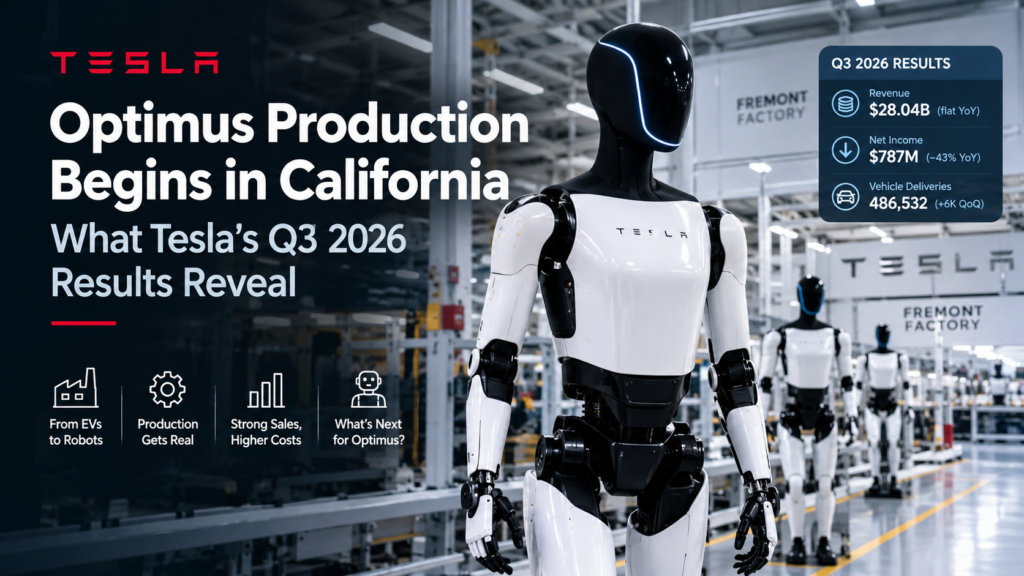
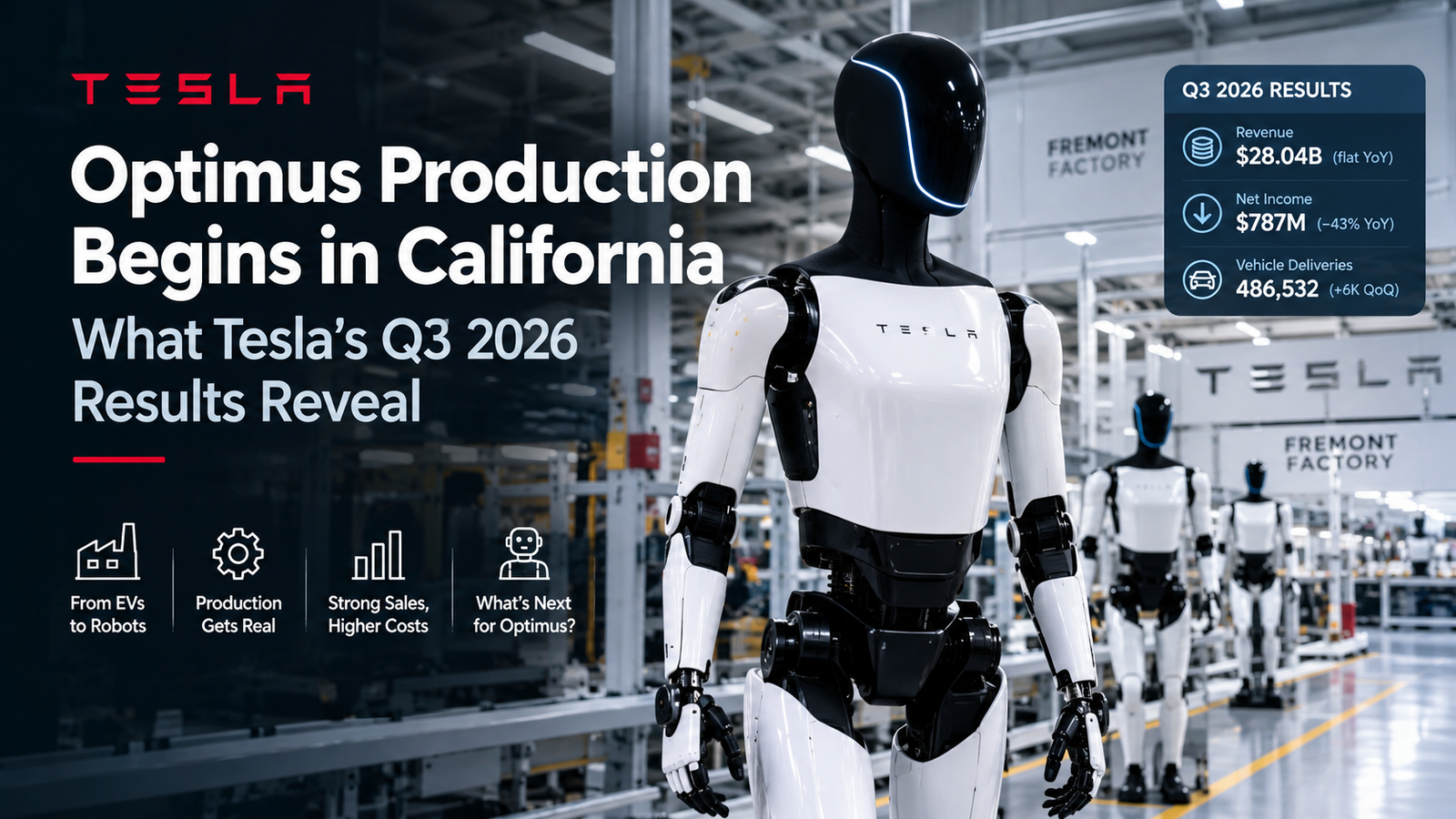
Tesla Optimus production has officially started at the company’s Fremont, California factory, but it has not yet turned Optimus into a profit engine. Tesla announced the milestone on October 21, 2026, alongside third-quarter results in which revenue stayed flat and net income fell 43% to USD 787 million, as heavy spending on AI, autonomous driving and robots outweighed steady electric vehicle sales.
For anyone who has watched humanoid robot demos for years, this is the moment the story moves from stage shows to factory floors. A line that once built Tesla’s flagship sedans and SUVs is now turning out robots, and the financial bill for that pivot is arriving at the same time as the first units. This guide explains exactly what happened, what the numbers say, how Tesla compares with rivals, and what to watch next.
Key Facts at a Glance
- What happened: Tesla began Optimus humanoid robot production at its Fremont, California factory, announced October 21, 2026, according to TechCrunch.
- Where: The same Fremont manufacturing space once dedicated to making electric vehicles.
- Q3 2026 revenue: USD 28.04 billion, essentially flat versus USD 28.09 billion in Q3 2025.
- Q3 2026 net income: USD 787 million, down 43% from USD 1.37 billion a year earlier.
- Vehicle deliveries: 486,532 in the quarter, up about 6,000 from Q2 but below the same period last year.
- Bright spot: Services and other revenue grew 33% year over year to USD 4.6 billion.
- Tesla’s claim: The current manufacturing process for Optimus is suitable for a commercial product.
What Is Tesla Optimus Production, and Why Does It Matter?
Tesla Optimus production is the manufacturing of Tesla’s general-purpose humanoid robot on a dedicated assembly line, as opposed to building prototypes by hand in a lab. The distinction matters because a robot that can only be built one at a time cannot become a product. A line that can repeatedly produce units to a consistent standard is the first requirement for selling, deploying and improving robots at scale.
Definition and expansion: the Optimus humanoid robot
The Optimus humanoid robot is a bipedal machine with two arms and hands, designed to perform tasks that people currently do, starting with repetitive and physically demanding factory work. Tesla’s pitch is that it can reuse technology it already builds for cars, including AI chips, battery systems, electric motors and the vision-based software stack developed for driver assistance. In other words, the company sees its automotive manufacturing experience as a head start in humanoid robot manufacturing.
Why this milestone is bigger than a press release
Humanoid robots have a famous gap between demonstrations and deployments. A video of a robot folding laundry proves a capability; a production line proves a process. Tesla Optimus production matters because it tests whether the process can be engineered, repeated and eventually scaled to volumes that justify the investment. It also matters because Tesla has repeatedly described Optimus as central to its long-term value, so investors are now watching for evidence rather than promises.
Did Tesla Optimus Production Really Start at Fremont?
Yes. Tesla stated in its third-quarter shareholder letter that robots are now coming off a production line at Fremont. Tesla described them as the first production-quality bots that it has manufactured, and said it had shown the current process is suitable for a commercial product. Tesla also said it will keep iterating on both the hardware and the manufacturing process.
That wording is worth reading carefully. “Production-quality” and “commercial product” signal readiness of the process, not a volume milestone. Tesla did not, in the reporting available at the time of writing, publish a unit count for Optimus.
The timeline from Model S and X shutdown to first robots
The path to this announcement was not smooth, and the timeline helps put the news in context:
- January 2026: Tesla said on its Q4 2025 earnings call that it would end Model S and Model X production to free the Fremont space for Optimus, according to reporting at the time.
- April 22, 2026: On the Q1 call, Elon Musk said Optimus production would begin around late July or August, while warning that early output would be slow because the robot has more than 10,000 unique parts.
- May 2026: The last Model S and Model X vehicles were built, and Tesla’s manufacturing account later said the legacy line was decommissioned in 46 days.
- July 22, 2026: The Q2 shareholder letter described the first-generation Optimus line at Fremont as being installed, with production “anticipated later this year” rather than the late-July or August window given earlier. Reporting on that deck said the first builds would go to an internal “Optimus Academy” for training data collection and further functionality development.
- October 21, 2026: Tesla confirmed production-quality robots were coming off the Fremont line.
So production did start, but later than the first guidance suggested. That is common in hardware, and it is the reason experienced observers treat any robotics schedule as a range rather than a date.
What “production-quality” means, and what it does not
“Production-quality” means the units are built using a repeatable process rather than as one-off prototypes. It does not mean any of the following:
- That Tesla is shipping robots to paying customers at scale.
- That the factory is running at its design capacity.
- That the robots are doing useful commercial work at the same level as human workers.
- That Optimus is already profitable.
Keeping those four points apart is the most useful habit when reading any humanoid robot headline.
How Did Tesla’s Q3 2026 Earnings Look?
Tesla’s Q3 2026 earnings showed flat revenue, a 43% drop in net income and rapidly rising expenses tied to AI, autonomous driving and Optimus. Revenue was USD 28.04 billion, slightly below the USD 28.09 billion reported a year earlier and about USD 200 million below the previous quarter’s USD 28.23 billion. Electric vehicle revenue was flat year over year at about USD 20 billion.
Tesla Q3 2026 earnings compared with last year
| Metric | Q3 2026 | Comparison point |
|---|---|---|
| Total revenue | USD 28.04 billion | USD 28.09 billion in Q3 2025; USD 28.23 billion in Q2 2026 |
| Net income | USD 787 million | USD 1.37 billion in Q3 2025 (down 43%) |
| EV revenue | About USD 20 billion | Flat year over year |
| Vehicle deliveries | 486,532 | About 6,000 more than Q2; fewer than Q3 2025 |
| Solar and energy storage revenue | USD 2.8 billion | Down 16% year over year |
| Services and other revenue | USD 4.6 billion | Up 33% year over year |
| Services and other gross profit | USD 734 million | Record for the segment |
Figures are from TechCrunch’s report on Tesla’s Q3 2026 results published October 21, 2026.
Why profit fell 43%
The simplest explanation is that Tesla is spending ahead of revenue. Reporting on the results says costs surged as the company pushed harder on Optimus, AI and autonomous driving, and that lower regulatory credit sales added further pressure. When revenue is flat and expenses jump, profit falls quickly. The 43% decline is therefore as much a statement about investment intensity as about the car business.
The solar and energy storage line also dragged, falling 16% year over year to USD 2.8 billion, which Tesla attributed to tariff-related customer refunds.
The services bright spot
Services and other was the standout. Revenue rose 33% to USD 4.6 billion, a category that includes customer subscriptions to Tesla’s Full Self-Driving driver-assistance software. The segment produced a record USD 734 million in gross profit, which is a large reason Tesla stayed profitable at all. Put differently, high-margin software and services revenue is currently helping fund the robot factory.
Is Tesla Optimus Production Hurting Tesla’s Profits?
Partly, yes: Tesla Optimus production is one of several heavy spending areas that pushed Q3 profit down, but it is not the only cause. TechCrunch reported that spending on AI projects and Optimus took a big bite out of profits, while weaker regulatory credit sales also reduced earnings. Tesla did not, in the coverage reviewed, publish a clean breakout of Optimus spending, so it is impossible to say what share of the decline is attributable to the robot alone.
This lack of detail is itself a signal. Commentators following the story have said that the number worth waiting for is any disclosed Optimus unit count, capital expenditure or headcount figure. Until Tesla discloses these, analysts are left reasoning from totals.
How to think about the trade-off
A useful way to frame the situation is as a bet with a visible cost and an invisible payoff:
- The visible cost: Lower profit today, because capital and engineering talent are going into a product with no meaningful revenue yet.
- The invisible payoff: The possibility that humanoid robots become a very large market, which Tesla’s leadership has argued for years.
- The core uncertainty: Whether the robots can perform useful work reliably and cheaply enough to find real buyers.
How Big Can Tesla Optimus Production Get?
Tesla has said the Fremont line is designed for a capacity of up to one million robots per year, but design capacity is not the same as actual output. Reports on Tesla’s ramp, including coverage that tracked the company’s own statements, consistently stress that early production will be a small fraction of that ceiling. Musk himself said earlier in 2026 that the initial pace would be quite slow and hard to predict.
Why the ramp is slow
Humanoid robot manufacturing is harder to scale than car manufacturing in several ways:
- Parts count and novelty: Musk said the robot has more than 10,000 unique parts, and a ramp is limited by the slowest of them.
- Supply chain: There is no mature, large-scale humanoid supply chain, so Tesla has to build much of it from scratch, including components such as hands and forearms.
- Process learning: Assembling a humanoid is not like assembling a car, and Musk acknowledged as much after walking the Fremont line.
- Software readiness: Hardware volume only matters if the robot can do useful tasks, which depends on training data and AI performance.
The second factory
Tesla has also described a second, higher-volume Optimus factory at Giga Texas, with meaningful production reported as targeted for around mid-2027. Long-term capacity figures for that site have been described as aspirational. For planning purposes, treat Fremont as the proving ground and Texas as the scale story, and note that both depend on how well Tesla Optimus production performs in its first year.
How Does Tesla Compare With Other Humanoid Robot Makers?
Tesla is a late but heavily funded entrant in a crowded field, and rivals currently have stronger documented deployments. An industry review published in July 2026 concluded that Figure AI and Agility Robotics had clearer operating records than Optimus at that point, while Chinese makers such as Unitree and AgiBot were leading on unit volume.
Humanoid robot manufacturing: who is where
| Company | Base | Status signal (per reports) | What to watch |
|---|---|---|---|
| Tesla | California, USA | Production-quality robots off the Fremont line (Oct 2026) | First disclosed unit counts; external customers |
| Figure AI | California, USA | Completed an 11-month BMW pilot with more than 1,250 operating hours, per a November 2025 report | Scale of BMW and other deployments |
| Agility Robotics | Oregon, USA | Operates a dedicated humanoid factory, described as the first in the US | Commercial warehouse deployments |
| Boston Dynamics | Massachusetts, USA | Electric Atlas; Hyundai reportedly targeting up to 30,000 units annually for industrial use | Actual production numbers |
| Unitree | Hangzhou, China | Targeting 10,000 to 20,000 humanoids in 2026 | Delivery volumes and profitability |
Status descriptions come from third-party reports and company statements and may change quickly. The wider market shipped roughly 13,000 to 16,000 humanoids in 2025, according to one industry estimate.
Where Tesla’s advantage might come from
Tesla’s argument is vertical integration. It designs its own AI chips, builds motors and batteries, and has decades of mass manufacturing experience. If any company can turn a humanoid robot into a repeatable product with a falling cost curve, the case for Tesla is that it already knows how to run that playbook for cars. The counterargument is that cars and humanoids are different products, and that the real bottleneck is useful, reliable robot intelligence rather than assembly lines.
What Are the Biggest Risks to Tesla Optimus Production?
The main risks are schedule slippage, unproven commercial demand, rising costs and competition from faster-moving rivals. The Fremont timeline has already moved once, from the late-July or August guidance to a vaguer “later this year” language in July before the October confirmation.
- Execution risk: Ramping a new product with more than 10,000 unique parts is operationally complex and prone to delays.
- Demand risk: Tesla has not, in the sources reviewed, named external commercial customers with delivery dates.
- Financial risk: With revenue flat, continued heavy spending could keep pressure on profit.
- Competitive risk: Chinese manufacturers are shipping volume today, and US rivals have operating records with named industrial customers.
- Credibility risk: Long-standing optimism in Tesla’s public targets means observers discount unverified timelines.
What Should You Watch Next?
The most useful signals are hard numbers rather than announcements. If you follow Tesla Optimus production, these are the milestones that would genuinely change the picture:
- Any Optimus unit count in a Tesla quarterly production or delivery report.
- A named external customer with a firm delivery date rather than a letter of intent.
- Tesla breaking out Optimus capital spending, headcount or per-unit cost in a shareholder deck.
- Evidence of Optimus robots performing paid or productive work inside Tesla’s own factories.
- Progress on the Giga Texas Optimus factory.
- Public demonstrations of the production version of the robot.
What Does Tesla Optimus Production Mean for India?
For India, Tesla Optimus production is a signal that physical AI is becoming a manufacturing and careers topic, not only a software one. Humanoid robots depend on a stack that includes computer vision, reinforcement learning, embedded systems, sensors, actuators and large-scale data pipelines. Indian students and early-career engineers with skills in those areas are well placed to take part in the global robotics supply chain, both through engineering services and through AI model work that can be done remotely.
There are also practical angles for Indian founders and educators:
- Skills demand: Robotics, edge AI and simulation engineering are likely to become more visible in hiring conversations as more companies announce humanoid programs.
- Manufacturing: As global firms look for resilient supply chains for components, Indian electronics and precision manufacturing could find new opportunities, though no specific Optimus supplier relationship in India has been announced.
- Education: Universities and training providers have an opening to build practical curricula around robotics software, simulation and data collection.
The honest caveat is that humanoid robots remain early. Anyone building a career or business plan around them should track real deployments, not just launch events.
Frequently Asked Questions
When did Tesla Optimus production start?
Tesla announced on October 21, 2026 that Optimus robots are being built on a production line at its Fremont, California factory. Earlier guidance had pointed to late July or August, so the start came later than first indicated.
Where is Tesla Optimus production happening?
It is happening at the Fremont factory in California, in space previously used to build Tesla’s Model S and Model X. A second, larger Optimus factory has been described for Giga Texas, with meaningful output targeted for around mid-2027.
How many Optimus robots has Tesla built?
Tesla has not published a unit count in the coverage reviewed. It has said the robots coming off the line are its first production-quality units, and has described the line’s design capacity as up to one million robots per year, which is not an output figure.
Did Tesla Optimus production cause profit to fall 43%?
It contributed, but it was not the only factor. Tesla’s Q3 2026 net income fell to USD 787 million from USD 1.37 billion because spending on AI, autonomous driving and Optimus rose while revenue was flat and regulatory credit sales declined.
Who are Tesla’s main humanoid robot competitors?
The main names include Figure AI, Agility Robotics, Boston Dynamics, Unitree and AgiBot, along with more than a hundred other companies globally according to industry trackers. Several have clearer deployment records than Tesla today.
Conclusion: A Real Milestone With an Unfinished Story
Tesla Optimus production has crossed an important threshold: robots are being built on a proper line rather than in a lab. At the same time, the third-quarter numbers show how expensive the transition is, with flat revenue, a 43% profit decline and a business leaning on high-margin software to stay comfortably in the black. The next chapters will be written in unit counts, customer contracts and cost curves, not in launch events.
Want to understand physical AI, agentic workflows and the skills behind the next wave of robotics and AI jobs? Explore the AI learning resources and workshops on Kalinga.ai to build practical skills that employers are starting to ask for.