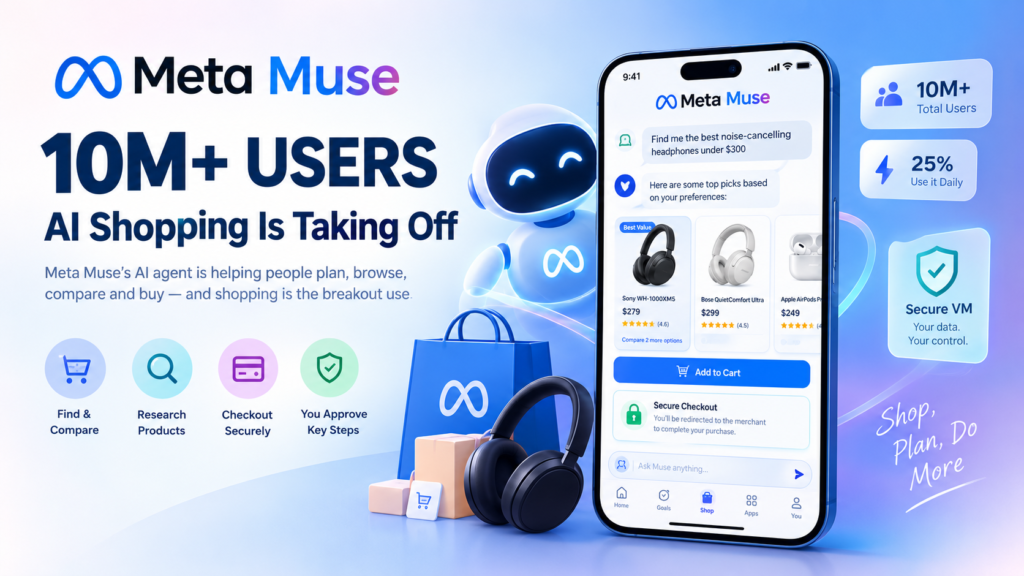
Meta Muse now has more than 10 million users, and shopping is one of the things they do with it most. Meta confirmed the milestone on its third-quarter earnings call on October 21, 2026, adding that roughly one in four people who set up the app now use it daily. For anyone building products, content, or marketing around AI, it is the clearest sign yet that people will let an AI agent spend their money.
Until recently, most AI assistants answered questions and stopped there. Muse is built to run errands: it plans, browses websites, fills in forms, and checks out on a user’s behalf, with a person approving the sensitive steps. This article explains what Muse is, how fast it grew, why shopping leads, how its security model works, how Meta plans to earn money from it, and what it means for merchants, marketers, and publishers.
Key Takeaways
- Scale: Meta Muse passed 10 million users, according to Meta’s Q3 2026 earnings call.
- Retention: About 25% of people who set up Muse now use it daily, per Mark Zuckerberg.
- Spending: Over a quarter of engaged users who shop through Muse average purchases above 200 dollars.
- Security: Muse runs inside the Muse Secure VM, an isolated virtual computer that holds the agent and the data a user connects.
- Business model: Free for most people, with Meta keeping a percentage of commerce and charging power users for heavier usage.
- Limits: Availability is restricted, Amazon has blocked Muse from its site, and early testing exposed reliability glitches.
What Is Meta Muse?
Meta Muse is a personal AI agent that carries out multi-step tasks for a user, including shopping, booking travel, and sending email. A chatbot answers a question and stops. An agent takes a goal, builds a plan, and keeps working after the user closes the app, coming back when it needs approval. Meta launched Muse in the United States on September 8, 2026, powered by its Muse Spark model, which the company describes as its most capable to date.
What Is a Personal AI Agent?
A personal AI agent is software that acts on your behalf across the apps and accounts you connect to it. It differs from a chatbot in three ways: it takes actions rather than only producing text, it works over time rather than in a single exchange, and it needs permissions to do its job. Muse follows that pattern. Users give it a goal, such as planning a trip or organizing a dinner, and it develops a plan and tracks progress in a Goals tab.
How Muse Works Under the Hood
Muse runs on what Meta calls the Muse Secure VM, a dedicated virtual machine that Zuckerberg described as an isolated Linux computer with its own browser, processor, memory, and storage. The agent and the credentials and data a user chooses to connect live inside it. That design is what lets Muse open a browser, fill out forms, and keep working in the background.
Several controls sit on top of that foundation:
- Users choose which apps Muse can connect to and can revoke access at any time.
- Sensitive actions, such as sending an email or completing a purchase, require approval.
- An audit trail shows what the agent has done and what it plans to do.
- Users can opt out of having their conversations used to train Meta’s AI models.
Launch connectors reported by reviewers include Gmail, Google Calendar, OpenTable, Facebook, Instagram, Peloton, Spotify, and Plaid for finances. Travel booking is reportedly powered by the UK company Duffel.
Where Can You Use Muse, and What Does It Cost?
Muse is available through iOS and Android apps, the muse.ai website, and chats inside WhatsApp, with a Mac app also reported. Launch coverage describes the service as limited to adults aged 18 and over in the United States, and some reports add Canada. Support for Meta’s AI glasses is planned.
On pricing, the free tier reportedly allows up to 100 million tokens per week. Heavier users can pay for subscription tiers, which one report put at 20 or 100 dollars per month. One launch report noted that signing up requires a payment card.
How Fast Did Meta Muse Grow?
Meta Muse grew faster than any major AI assistant that Sensor Tower compared it with, reaching an estimated 5 million US downloads in about 22 days. That pace, combined with Meta’s confirmation of more than 10 million users, makes it one of the quickest consumer AI launches on record, though the comparison comes with caveats covered below.
Timeline: From Launch to 10 Million
- September 8, 2026: Meta launches Muse in the US.
- First five days: Sensor Tower estimates roughly 730,000 downloads.
- About September 18: Muse overtakes ChatGPT as the top free app on the US App Store, according to Sensor Tower and Apptopia.
- September 30: Sensor Tower projects Muse crossed 5 million US downloads, about 22 days after launch.
- October 20: TechCrunch reports Sensor Tower estimates of 10 million US downloads in 40 days, a milestone it says only 11 other apps have reached.
- October 21: Meta tells investors Muse has more than 10 million users.
Comparison: How Quickly Did AI Apps Reach 5 Million US Downloads?
| App | Days to 5 million US downloads | Context from Sensor Tower |
|---|---|---|
| Meta Muse | About 22 | Launched on iOS and Android at once, with a heavy Meta ad push |
| ChatGPT | 56 | Early days were largely on a single platform |
| Grok | 103 | iOS-only during its first five days |
| Claude | 492 | iOS-only during its first five days |
Sensor Tower added that only 23 apps have ever passed 5 million US downloads within 22 days of release, and about 85% of them were mobile games. The non-game exceptions it listed were Disney+, HBO Max, and Threads.
Why the Numbers Need Context
Three details keep the headline in proportion:
- Marketing helped. Sensor Tower says Meta raised Muse ad spending on September 16, when daily downloads jumped 73%, and that Muse took up to half of Meta’s own house-ad impressions across Facebook and WhatsApp for two weeks.
- The comparison is not perfectly like for like. Platform timing differed across apps, as the table notes.
- Downloads are not users. A download is an install. A user is someone who set the app up. A daily user is someone who comes back. Meta’s 25% daily figure is the number that speaks to retention.
An earlier report from The Information, which TNW said it could not independently verify, put weekly prompters at more than 3 million about three weeks after launch. Meta’s own 10 million figure supersedes that snapshot.
Why Is Shopping the Top Activity on Meta Muse?
Shopping leads because it is a goal with clear steps, a clear finish line, and an obvious payoff: the agent researches, compares, and completes the purchase so the user does not have to. The evidence for how far that has gone comes from Meta itself, and it is surprising even to payments insiders.
What Meta Said About Shopping
On the earnings call, Zuckerberg said more than a quarter of engaged users who shop through the agent had an average purchase size above 200 dollars. He also said that Plaid, the financial technology company whose connector supports Muse’s agentic shopping, told Meta it had not seen activity like this on any other service.
That figure is directional rather than precise. Meta has not published how many users it counts as engaged shoppers or how purchase sizes are distributed, so the number shows intent and willingness to spend, not total sales volume.
The Payment Rails Behind Agentic Commerce
Agentic commerce is the practice of AI agents discovering products and completing purchases on a person’s behalf. For it to work, the agent needs a safe way to pay. Muse relies on several pieces:
- Link by Stripe: Reviewers describe it as Muse’s initial one-click checkout path, supported by thousands of merchants.
- Shop Pay: Meta and Shopify announced a partnership to bring Shopify’s checkout to Muse, letting users discover products from Shopify-powered retailers and buy inside the assistant.
- Plaid: A connector that links users’ bank accounts. One report said it reaches more than 12,000 US financial institutions with read-only access to balances, transactions, and holdings.
Meta’s own materials say shopping interactions could indirectly influence the ads a person sees, although it says conversations and virtual-machine data are not shared directly with its advertising systems.
The Amazon Roadblock
Not every merchant is on board. Multiple reports say Amazon has blocked Muse from shopping on its platform, citing security and user-experience concerns. That matters because it shows a technical ability to browse a site does not equal permission to transact there. An AI shopping agent is only as useful as the number of stores that let it in.
What the 200-Dollar Average Signals
A purchase size above 200 dollars suggests people are not using Muse only for small convenience buys. They are handing over considered purchases, such as electronics, travel, or household items. If that pattern holds, it points to deep trust in the approval step and the Secure VM, and it gives Meta a commission-style revenue stream that does not depend on advertising alone.
What Else Do People Use Muse For?
Beyond shopping, the other popular uses are personal productivity tasks, such as connecting Muse to email and calendars. Zuckerberg argued that this behavior shows users trust the security setup, since email and calendars are among the most sensitive accounts a person owns.
Reviewers have tested a range of everyday jobs:
- Triage an inbox and draft replies.
- Book restaurant reservations through OpenTable.
- Plan and book travel, with flights powered by Duffel.
- Track long-running goals and report back when something changes.
Results are mixed. A PCWorld reviewer found shopping to be where the agent shone and called Muse an unlikely hit, while basic tasks such as a commute check were less impressive. A Slate reviewer reportedly watched Muse place a calendar event in the past, a reminder that agents fail in ways chatbots do not.
Is Meta Muse Safe?
Meta Muse is designed around isolation and approval, but it is a young product handling highly sensitive accounts, so caution is reasonable. Safety here has three parts: what Meta has built, what it has promised next, and what remains unresolved.
The Current Security Design
The Muse Secure VM keeps the agent and the user’s data in a dedicated environment instead of scattering them across Meta’s systems. Approval prompts gate high-impact actions, the audit trail makes behavior inspectable, and permissions can be withdrawn. Meta delayed the launch from its original April target to work through security concerns, according to Vishal Shah, Meta’s vice president of AI products.
The Coming Muse Confidential VM
On the earnings call, Zuckerberg mentioned a forthcoming Muse Confidential VM that would prevent even Meta from seeing a user’s content. That is a notable promise because, according to one launch explainer, the current version does not stop Meta from accessing data when necessary to operate, support, or secure the service. Until the confidential version ships, that gap is worth knowing about.
Open Concerns to Watch
- Reliability: Launch coverage said internal testing found problems, including the agent disconnecting mid-task without explanation.
- Prompt and action errors: Agents can misread instructions and take the wrong action, which is why approvals matter.
- Privacy trade-offs: Connecting email, calendar, and bank data is a big ask, even with opt-outs.
- Merchant friction: Blocked sites mean some tasks simply will not complete.
How Will Meta Make Money From Muse?
Meta plans to keep Muse free for most users, take a percentage of commerce that happens on the platform, and charge power users who want advanced models or more tokens. Zuckerberg said Meta expects Muse to eventually earn more revenue per user than its family of apps does today. He described that current figure as several hundred dollars per user annually across Facebook, Instagram, WhatsApp, and Messenger.
The obstacle is cost. Zuckerberg said Muse is very compute-intensive to run right now, but Meta expects to improve its cost efficiency by more than 10 times over the next year, which he said would make Muse profitable once revenue reaches scale. Meta is also building capacity to serve more than a billion people over the next few years.
Muse will play a central role in Meta’s smart glasses strategy as well. Reality Labs, the division behind glasses, VR, and the metaverse, is still losing billions, with losses expected to improve from 19.1 billion dollars in 2025 to about 15 billion dollars this year.
Meta Muse vs a Traditional Chatbot
The core difference is that a chatbot produces answers while Muse produces outcomes. This table summarizes how the two models of AI assistance compare, based on Meta’s published descriptions and launch reporting.
| Feature | Traditional chatbot | Meta Muse |
|---|---|---|
| Core job | Answer questions and generate text | Complete tasks toward a goal |
| Persistence | Works within a single conversation | Keeps working after the app is closed |
| Where it runs | The provider’s chat interface | A dedicated Muse Secure VM with a browser |
| Account access | Usually none | Connected apps such as email, calendar, and payments |
| Purchases | Recommends products | Can check out with user approval |
| Safety controls | Content filters | Approval prompts, audit trail, revocable access |
| Revenue model | Subscriptions, ads, or API fees | Free tier, commerce share, paid power tiers |
What Does Meta Muse Mean for Merchants, Marketers, and Publishers?
It means the buyer’s first contact with a brand may soon be an agent, not a person. That changes what it takes to be chosen.
For Merchants
Agent-friendly checkout is becoming a competitive advantage. Shop Pay and Link by Stripe integrations give stores a route into Muse, while blocking agents, as Amazon has done, protects a retailer’s own experience at the cost of that traffic. Clean product data, clear pricing, and reliable checkout flows help agents complete purchases without errors.
For Marketers
Attribution is unsettled. One industry report noted that Meta has not announced how affiliate links, publisher influence, or product-source attribution will work when an agent researches and buys. Marketers should expect fewer visible clicks and plan for measurement that depends on platform-reported data.
For Publishers and Content Creators
Agents that research products rely on structured, specific, trustworthy content. That makes answer-first writing, clear comparison tables, and current statistics more valuable, the same principles behind Generative Engine Optimization. Content that gives a direct answer in the first sentence and backs it with named sources is easier for both people and AI systems to quote.
For Readers Outside the United States
At the time of writing, coverage describes Muse as available in the US, with Canada also mentioned in some reports. Readers elsewhere, including India, should watch Meta’s announcements for expansion rather than assume access.
Frequently Asked Questions About Meta Muse
How many users does Meta Muse have?
More than 10 million, according to Meta’s third-quarter 2026 earnings call. About 25% of people who set up the app use it daily.
Is Meta Muse free?
Mostly. Meta plans to keep it free for most users, with paid tiers for people who want advanced models or more usage. The free tier reportedly includes up to 100 million tokens per week.
What can Muse buy?
It can research products and complete purchases at participating merchants using payment options such as Link by Stripe, with Shop Pay support announced. It cannot shop on Amazon, which has blocked it, and sensitive actions require your approval.
Is Meta Muse available in India?
Launch coverage describes availability in the US, with Canada mentioned in some reports. Check Meta’s official announcements for any rollout beyond those markets.
Can Meta see my Muse data?
Meta says conversations and virtual-machine data are not shared directly with its ad systems, and users can opt out of AI training. One explainer notes the launch version does not stop Meta from accessing data when needed to operate, support, or secure the service. The planned Muse Confidential VM is meant to close that gap.
Will Muse be profitable?
Meta says it expects Muse to be profitable once revenue is at scale, helped by an expected 10 times improvement in cost efficiency within a year. That is a forecast, not a result.
Bottom Line
Meta Muse has shown that consumers will adopt an AI agent quickly when it is easy to start, lives inside apps they already use, and does something concrete like shopping. The numbers that matter most are not the downloads but the 25% daily usage and the 200-dollar average purchases among engaged shoppers. The open questions are equally clear: whether security promises hold up, whether merchants like Amazon open their doors, and whether Meta can bring compute costs down fast enough. For marketers and publishers, the practical response is to make content and checkout flows legible to agents now.