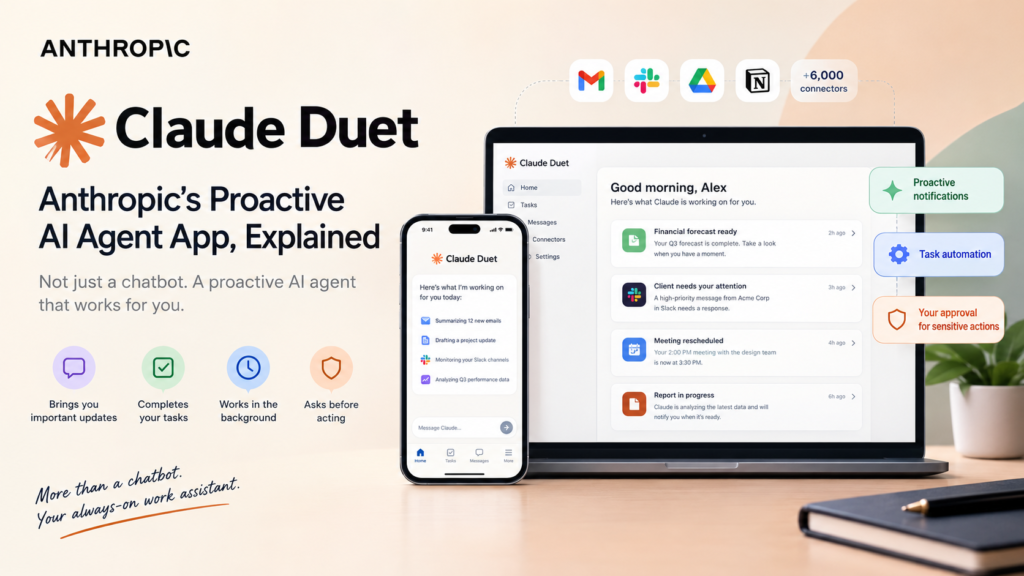
Claude Duet is Anthropic’s new standalone app where Claude works as a proactive AI agent. It comes to you with what needs your attention, completes tasks you ask of it, keeps working when you step away, and checks with you before it acts on your behalf. Anthropic opened it as a research preview on October 21, 2026, and access currently runs through a waitlist for Pro and Max subscribers in the United States.
Most AI assistants behave like a sharp colleague who only speaks when spoken to. You open a chat, type a request, get an answer, and leave. Nobody warns you about the invoice that slipped, the meeting that moved, or the customer thread heating up in Slack. This guide explains how Claude Duet changes that pattern, what it can and can’t do, how it compares with OpenAI’s dots and Meta’s Muse, and who should bother joining the waitlist.
Quick Facts at a Glance
- Maker: Anthropic
- Model: Built around Claude Opus 5.5 MacRumors
- Platforms: Standalone iOS and Android apps, plus the web at claude.ai 9to5Mac
- Status: Research preview with waitlist access
- Eligibility: Pro and Max subscribers in the US MacRumors
- Extra cost: None; it uses your existing Claude plan limits MacRumors
What Is Claude Duet?
Claude Duet is a standalone Anthropic app in which Claude acts as an always-available, proactive agent instead of a chat window you have to open yourself. You message it the way you’d message a person. The difference is that it also messages you first when something deserves your attention.
Definition: What Is a Proactive AI Agent?
A proactive AI agent is software that watches your connected tools, decides what matters, and either acts or alerts you without waiting for a fresh prompt each time. A reactive chatbot answers questions. A proactive agent notices things.
That distinction is the whole point of this product. Anthropic says Claude Opus 5.5 gives the app the judgment to decide what needs you, what can wait, and when to check with you first. The core skill is triage, not just task execution. An agent that interrupts you about everything is useless, and one that interrupts you about nothing is just a slower chatbot. Everything about the design hinges on getting that balance right. x
Who Is Claude Duet For?
Anthropic built Claude Duet for a specific audience. The company says it targets professionals and small business owners with too much to track, because those are the people most likely to find a proactive assistant useful. MacRumors
It is not positioned as a personal errand-runner. Anthropic distinguishes it from personal agents such as Instinct, noting that it isn’t good at handling errands or booking tickets. Think of it as a chief-of-staff-style assistant for work, not a concierge for your weekend. TechCrunch
How Claude Duet Works
Four design choices explain most of how this AI agent app behaves day to day: a single thread, a cloud computer, carried-over setup, and approval gates.
One Main Thread Instead of Many Chats
Claude Duet keeps a single main conversation going. That thread stays in one place, so the agent picks up where you left off. Traditional chat apps scatter your work across dozens of separate conversations, and you end up re-explaining context. Here, the agent posts updates to the main conversation when a task is finished or needs a decision. 9to5Mac9to5Mac
The practical effect is that the app feels less like a tool you consult and more like a teammate you keep in contact with. You check one thread, see what changed, and respond.
A Cloud Computer That Keeps Working
Claude Duet runs on its own computer in the cloud. That lets it keep working even after you close the app. Like other agents, it completes tasks in the background through its own virtual machine while you handle other things, then comes back to you if it needs approval. 9to5MacTechCrunch
Here is why that matters. If you ask for a financial forecast and then walk into a meeting, nothing stalls while your phone is in your pocket. The work continues, and the result is waiting when you return. The same architecture also supports monitoring: the agent can watch ongoing tasks and surface recommendations as things change.
Your Existing Claude, Carried Over
Because Claude Duet reuses your Claude account’s setup, there’s very little to configure. It uses the same memories, skills, and connectors as regular Claude, and can search past conversations so you don’t have to repeat yourself. 9to5Mac
The connector library is large. Duet integrates with more than 6,000 connectors in the Claude Marketplace, including Gmail and Slack. If you’ve already set up Claude with your tools, much of that work follows you into the new app. U.S. News & World Report
Approval Before Consequential Actions
Autonomy without guardrails is a liability, so Duet pauses before anything with real consequences. The app asks for your approval before sending messages, paying for anything, or deleting data. Anthropic says it requires user approval for sensitive actions. beebomU.S. News & World Report
That means the agent can draft, prepare, and queue work on its own, but the final click on high-stakes steps stays with you.
What Can Claude Duet Do?
In practice, Claude Duet covers a mix of monitoring, creation, and coordination work. Based on Anthropic’s announcement and press coverage, the headline capabilities are:
- Daily briefings. It can build a daily briefing for its users. TechCrunch
- Dashboards and suggested actions. It can create dashboards or suggest actions based on your data. TechCrunch
- Scheduling. Anthropic says it handles tasks from scheduling meetings to building financial forecasts and web apps. kelo
- Background task execution. It works through its cloud computer and returns when it needs a decision.
- Proactive recommendations. It delivers recommendations proactively as it monitors ongoing tasks. TechCrunch
- Approved purchases. It can make purchases through Stripe’s Link digital wallet and Shopify’s Shop Pay, with the approval gates described above. U.S. News & World Report
A Hypothetical Day With a Proactive Agent
To make this concrete, imagine a freelance consultant who runs a small agency. This is an illustration of the product category, not a documented case study.
In the morning, the agent posts a briefing: two client emails need replies, a meeting moved to the afternoon, and a proposal draft is due. The consultant asks it to turn last quarter’s numbers into a simple dashboard. They leave for a call. By the time they’re back, the dashboard is built and a draft reply is waiting for approval. Nothing was sent without sign-off.
The value isn’t any single task. It’s that the consultant never had to remember to ask.
What Claude Duet Can’t Do
Knowing the limits matters as much as knowing the features. Anthropic has been fairly candid about them:
- Personal errands. It isn’t good at errands or booking tickets. Anthropic also acknowledges it remains less effective at personal tasks. TechCrunchU.S. News & World Report
- Live browser view. It can’t show you its browser use as it happens. TechCrunch
- Moving money or trading. It won’t trade securities or move money between accounts. TechCrunch
- Perfect urgency judgment. Anthropic says it can still misjudge what’s urgent, and the company plans to keep tuning it from early-user feedback. x
That last limit deserves attention. Urgency is exactly the skill a proactive agent sells. A research preview that sometimes over-notifies or under-notifies is normal for early software, but it’s the first thing to test if you get access.
Claude Duet vs the Standard Claude App
Both products run on your Claude account, so the confusion is understandable. The question to ask is who starts the conversation. In the regular Claude app you begin every chat, whereas in Duet, Claude comes to you when something needs your attention. beebom
| Feature | Standard Claude App | Claude Duet |
|---|---|---|
| Who starts the conversation | You open a chat | Claude reaches out when something needs you |
| Conversation structure | Separate chats | One main thread |
| Memory, skills, connectors | From your Claude account | Same ones, carried over |
| Background work | You stay in the conversation | Works on its own cloud computer |
| Target audience | Broad | Professionals and small-business owners |
| Availability | Wide | Waitlist; US Pro and Max only |
| Extra cost | Per your plan | None; shares your plan limits |
The two aren’t rivals. Think of the standard app as the place you go to think things through, and Duet as the assistant that handles follow-through and watches the inbox while you do other things.
Claude Duet vs OpenAI dots and Meta Muse
Anthropic isn’t alone here. Its new app is aimed at rivaling Meta Muse, OpenAI Dots, Hark, Instinct, Grok Bot, and Fo. Two competitors get the most attention. TechCrunch
| Claude Duet | OpenAI dots | Meta Muse | |
|---|---|---|---|
| Maker | Anthropic | OpenAI | Meta |
| Positioning | Proactive agent for professionals and small businesses | Always-on goal-pursuing agents | Personal AI assistant, plus a small-business version |
| Where it works | Connected apps via Claude Marketplace connectors | Apps such as Slack and Microsoft Teams | Connections to other apps |
| Notable detail | Runs on Claude Opus 5.5; approval before sensitive actions | Launched last month | Drew millions of downloads |
The table summarizes reporting, not hands-on testing, so treat the rows as positioning rather than benchmarks. OpenAI launched its always-on “dots” agents last month, pursuing user goals across apps such as Slack and Microsoft Teams, while Meta’s Muse drew millions of downloads and fueled investor interest. Meta also released a version of Muse for small businesses with connections to other apps. keloTechCrunch
What distinguishes Anthropic’s entry is its emphasis on restraint. The company foregrounds approval steps, blocked actions, and a dedicated leak-prevention classifier. Whether buyers value that caution over raw autonomy is the open market question.
Is Claude Duet Safe?
Safety is the obvious worry with any agent that has access to your email, calendar, and payments. Anthropic’s answer has several layers.
Does it see my passwords? No. Anthropic says it never directly sees your passwords. It doesn’t see passwords or logins when given access to accounts. xMacRumors
What stops sensitive data from leaking? A dedicated classifier and safety system prompt check each message and guard against sensitive information leaks. MacRumors
Who makes the big decisions? You do. Anthropic says the important decisions stay with the user. Combined with approval gates for sending, paying, and deleting, this keeps a human in the loop for anything hard to undo. x
What’s still unproven? Plenty. Anthropic says it will share more about its safety approach soon, which means the full picture isn’t public yet. Early adopters should start with low-stakes tasks and review what the agent does before widening its access. x
Who Can Use Claude Duet, and What Does It Cost?
Availability. It’s an early research preview, available through a waitlist on Pro and Max plans in the US. Access is rolling out gradually to people who receive an invitation. If you’re outside the US, there’s no announced timeline in the coverage I reviewed. x9to5Mac
Pricing. Anthropic isn’t charging anything extra; the app draws on the same usage quota as your Claude plan. There’s a catch worth knowing. Its background checks count toward your plan limits. An agent that monitors things all day can consume usage even when you’re not chatting, so heavy users should watch their limits. beebomMacRumors
Devices. Duet comes as standalone iOS and Android apps, and on a computer it opens at claude.ai.
If you’re weighing whether a Claude Pro and Max subscription is worth it for this alone, hold off until you’ve seen how the agent performs for your workload. The waitlist and preview status mean the experience will change.
Who Should Join the Waitlist?
Good Fit
Claude Duet is a strong match if you:
- Juggle many inboxes, channels, and deadlines
- Run a small business without a dedicated operations hire
- Already use Claude with connected apps like Gmail and Slack
- Want recurring briefings and dashboards without building them yourself
Wait and Watch
You may want to hold off if you:
- Mainly want help with personal errands or travel booking
- Need to watch every browser action as it happens
- Aren’t a Pro or Max subscriber in the US
- Handle highly regulated data and need full safety documentation first
Frequently Asked Questions
What is Claude Duet?
Claude Duet is Anthropic’s proactive agent app, opened as a research preview on October 21, 2026. It reaches out about what needs your attention, takes tasks by message, and checks with you before acting.
Is the app free?
There’s no separate charge, but you need a Claude Pro or Max plan. It shares your plan’s usage limits, including for background checks.
Which AI model powers it?
It runs on Claude Opus 5.5, which Anthropic credits for its judgment about what needs you and what can wait.
Can it spend my money?
Only with approval. It can make purchases through Stripe’s Link and Shopify’s Shop Pay, but it asks first, and it won’t trade securities or move money between accounts.
How do I get access?
Join the waitlist if you’re a US-based Pro or Max subscriber. Access is being granted gradually.
Does it replace the regular Claude app?
No. It’s a separate app built around a proactive, single-thread experience, and it shares your account’s memory, skills, and connectors.
The Bottom Line
Claude Duet is Anthropic’s bet that the next stage of AI assistance is an agent that comes to you rather than waiting to be asked. Its strengths are a judgment-focused model, a shared setup with your existing Claude account, a cloud computer for background work, and approval gates on consequential actions. Its weaknesses are just as clear: it’s invite-only, US-only, weak at personal errands, and still learning what counts as urgent.
If you run a busy professional life and already live inside Claude, join the waitlist and start with small, reversible tasks. If you want a general-purpose personal assistant, watch how the preview matures before committing.
Ultimately, Claude Duet’s value will depend on how reliably it identifies important information, prioritizes tasks, and completes work without creating unnecessary interruptions. A proactive assistant should reduce mental overhead, not add another stream of notifications to manage. Its ability to understand context across connected tools could make it particularly useful for professionals balancing client communication, meetings, reports, and ongoing projects.
However, autonomy alone does not guarantee productivity. Users should evaluate whether Duet saves meaningful time, produces accurate results, and asks for approval at the right moments. It is also worth monitoring usage limits, since background activity draws on the existing Claude plan rather than operating as an unlimited service.
For now, the most sensible approach is to treat Claude Duet as an emerging productivity tool rather than a complete replacement for your existing workflow. Begin with low-risk tasks, review its recommendations carefully, and expand its responsibilities only when you are comfortable with its performance.
As Anthropic gathers feedback and improves the research preview, Claude Duet could become an important step toward AI assistants that actively help manage the working day. Whether it delivers on that promise will depend on the balance between useful initiative, dependable execution, and user control.