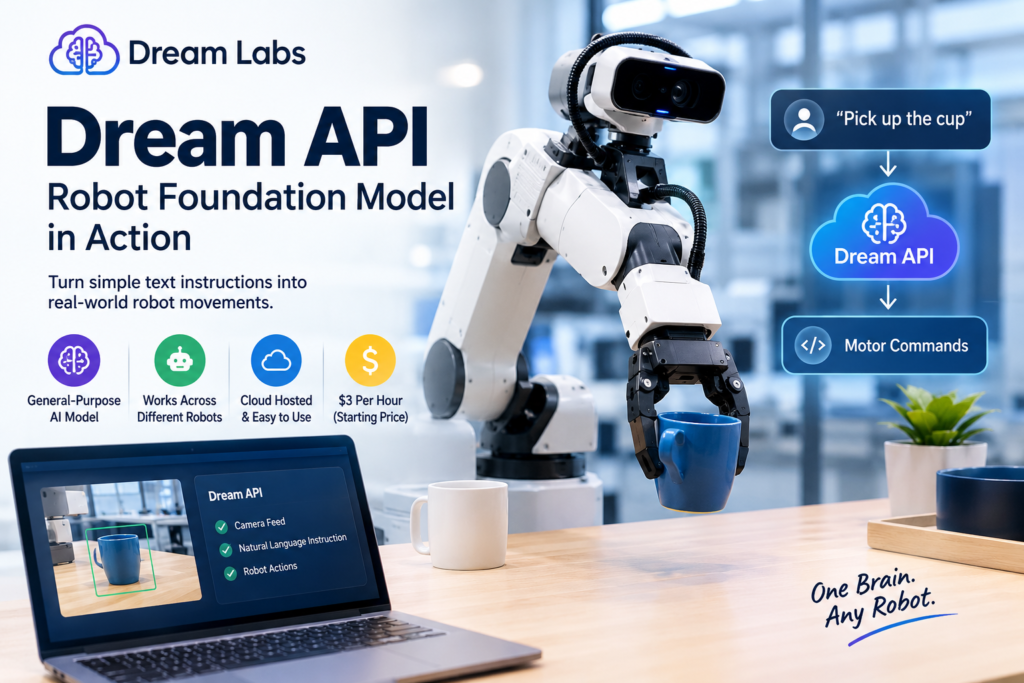
The Dream API is a hosted developer interface that takes a robot’s camera feed and a plain-English instruction and returns the motor commands needed to perform the task. Dream Labs announced it on October 19 alongside a $90 million seed round led by B Capital and Kindred Ventures. Access starts at $3 an hour, and the company says the API went live for everyone on launch day. letsdatasciencedigg
Picture typing “fold the towel” into a browser and watching a real robot respond. Until recently, that kind of behavior took months of custom engineering for each machine. The Dream API proposes a different model: one general-purpose “brain” that many robots can share. This guide explains what it is, how it works, what it costs, how it performed in published tests, and where it still falls short.
What Is the Dream API?
Definition
The Dream API is the public developer interface to Dream-1, a robot foundation model built by Dream Labs. A developer connects a supported robot, provides a camera feed and a natural-language instruction, and Dream Labs’ cloud-hosted model generates the motor commands to carry out the task. theaiinsider
A robot foundation model is a large, general-purpose AI model trained on broad data so it can control many robots and tasks, rather than a single machine doing a single job.
Expansion
The easiest way to understand the Dream API is as a separation of “brain” and “body.” Traditionally, a robot maker trains a control policy for one specific machine. With a shared model, the intelligence lives in the cloud, and the hardware only has to send images and receive actions.
Dream Labs calls it the first publicly available API for a robot foundation model, and says it works even for robots the model has never seen before. That claim is the heart of the pitch, and it is also the part developers should test most carefully. morningstar
Key Facts at a Glance
- Company: Dream Labs, based in San Francisco
- Launch date: October 19, 2026
- Funding: $90 million seed round
- Lead investors: B Capital and Kindred Ventures
- Model: Dream-1, a robot foundation model
- Product: the Dream API, plus a fine-tuning service and a browser-based Robot Playground
- Starting price: $3 per hour
- Status: research beta, not validated for safety-critical use
Who Is Behind Dream Labs?
Dream Labs was founded in 2026 by former NVIDIA robotics researchers. The co-founders are Joel Jang and You Liang Tan, who argue that robot makers can buy a general-purpose control layer instead of building a separate policy for every machine. The company describes its team as the researchers who created DreamZero and World Action Models. Dream Labs Raises $90 Million Seed Round and Launches Robot Foundation-Model API +2
That pedigree matters for credibility, but it is not a guarantee of performance. The real test for any physical AI company is whether its software works on other people’s robots, in other people’s environments.
Jang summed up the thesis by saying what has been missing is a brain any robot can use. The funding is meant to widen how many robots and tasks that brain can handle. morningstar
How Does the Dream API Work?
How does the Dream API turn words into movement?
The Dream API converts an image stream and a text instruction into robot actions in three steps. The robot sends what its camera sees. The developer sends an instruction such as “pick up the cup.” The hosted model returns motor commands that the robot executes. Because the model runs on Dream Labs’ infrastructure, developers do not need to build or operate a robotics foundation model themselves. unite
What is a World Action Model?
A World Action Model is a model designed to connect what a robot sees with what it should do next. Dream Labs labels Dream-1 a World Action Model, and the distinction matters because robot bodies differ. unite
Different robots have different arm lengths, joints, grippers, and camera positions. A model that only memorizes one body’s movements will fail on another. Dream Labs’ approach is to learn the underlying task structure instead. Dream-1 learns from video of people performing everyday tasks. dealroom
Why does hosting the model in the cloud matter?
Because the Dream API is hosted, small teams can try advanced robot intelligence without training anything. That lowers the barrier to entry and moves the cost from large up-front research to metered usage. The trade-off is dependence on a third party’s service for real-time control, which is worth weighing for any production deployment.
How Much Does the Dream API Cost?
The Dream API costs $3 per hour of use. Dream Labs offers it through a metered public API at that rate. That makes it easy to estimate budgets: a one-hour experiment costs about as much as a coffee, and a continuous eight-hour shift would run about $24 at the advertised rate. runtimewire
Two caveats apply. First, that price covers the general model, not the extra work required for custom hardware. Second, for its 20+ hardware partners, Dream Labs goes further by refining the model for each robot so it performs at its best. Teams with unusual hardware should expect the best results to involve additional tuning. morningstar
The Three Products Launched Alongside the Dream API
Dream Labs launched three things together: the API, a browser-accessible Robot Playground, and a fine-tuning service for hardware or capabilities that need more examples. letsdatascience
Dream API
The core product. It exposes Dream-1 to developers so they can send camera frames and instructions and receive actions. This is the robot control API at the center of the launch.
Fine-Tuning Service
Fine-tuning-as-a-Service gives developers another option when the general model falls short, and Dream Labs acknowledges that adapted models still outperform zero-shot operation. In practice, this means the zero-shot promise is a starting point, not a ceiling. unite
Robot Playground
Anyone with a browser can type commands to a robot in Dream Labs’ San Francisco office and watch it respond live and unedited, with no robot purchase required. For evaluators, this may be the most useful feature. You can see how the model behaves, including where it stumbles, before committing any hardware or budget. morningstar
Comparison Table: Dream API vs. Traditional Robot Programming
| Factor | Dream API | Traditional per-robot policy |
|---|---|---|
| Setup approach | Connect a supported robot and send camera plus text | Collect data and train a policy for each machine |
| Typical time to first task | Minutes, according to Dream Labs | Often months |
| Hardware coverage | Aims to span robots from different makers | One machine at a time |
| Instruction style | Natural language | Task-specific code or demonstrations |
| Cost model | $3 per hour, metered | Engineering and data-collection costs |
| Customization | Fine-tuning service available | Fully custom by default |
| Maturity | Research beta | Established, validated workflows |
| Safety validation | Not validated for safety-critical use | Can be certified per deployment |
The table shows the core trade-off. The Dream API wins on speed and breadth, while traditional policies still win on maturity and certifiability. Dream Labs says a new robot can do useful work in minutes, not months. That is a company claim, and results will vary by hardware and task. morningstar
What Can Dream-1 Do Today?
Dream-1 handles tabletop tasks such as picking, placing, and folding laundry today, with wheeled robots and dexterous hands to follow. It is also reported to control any robot with grippers out of the box, zero-shot. dealroom
The company says it can control unfamiliar bimanual (two-armed) robots without robot-specific training. runtimewire
In short, the current sweet spot is tabletop manipulation with gripper-equipped arms. Mobile robots, humanoid hands, and complex dexterous work are on the roadmap rather than in the product.
How Well Does the Dream API Perform?
The published evidence is encouraging but early. Dream Labs’ evaluation tested 27 unseen robot embodiments in simulation, using 300 rollouts per embodiment, with results reported relative to YAM, the robot on which Dream-1 was trained. unite
Independent reporting adds one more data point. Robocurve reports a 59.3% mean score across 120 benchmark runs. A mean near 60% suggests real capability but also real failure rates, which is why the Robot Playground and hands-on testing matter. digg
Two cautions help interpret these numbers:
- Simulation results do not automatically transfer to physical robots.
- Scores relative to a training robot are not the same as success rates on your own task.
A public API lets robot makers and smaller teams evaluate behavior directly, including where it fails, instead of relying only on selected demonstrations. That openness is arguably as important as any single benchmark number. unite
Limitations: Where the Dream API Falls Short
Every serious evaluation of the Dream API should start with its limits:
- Research beta. The cofounders themselves say it will make mistakes. digg
- Not for safety-critical work. Dream Labs states that Dream-1 has not been validated for safety-critical use. unite
- Hardware requirements. The strongest zero-shot claims apply to robots with grippers.
- Narrow task range. Today’s strength is tabletop manipulation.
- Zero-shot gap. Adapted models outperform zero-shot ones, so expect to invest in tuning for demanding work.
- Real-world proof pending. The test will be whether the API holds up outside demos and in real-world settings. dealroom
None of these are unusual for a first release. They simply define where to deploy it now and where to wait.
Why Investors Backed Dream Labs
Participants in the round included A.Capital, Unusual Ventures, SV Angel, Wing VC, Scribble VC, and Adrian Aoun, among others. Dealroom notes the round sits in the top 1% of US seed rounds in enterprise software by size. vcnewsdailydealroom
The investment logic is a cost argument. B Capital’s Daisy Cai framed it this way: capable robot arms have fallen from luxury-car prices to high-end-laptop prices. Cheap hardware shifts the bottleneck to software. If arms are affordable but hard to program, whoever supplies the general control layer captures real value. dealroom
Dream Labs says the funding will primarily support compute as it expands model capabilities and capacity. That fits the economics of foundation models, where training and serving costs dominate. unite
Who Should Use the Dream API?
The Dream API suits teams that want to explore general-purpose robot control quickly. It is a good fit for:
- Robotics startups that want to prototype tasks without building a policy from scratch
- Hardware makers evaluating whether a shared model can reduce software effort
- Researchers and educators who want a live, low-cost testbed through the Playground
- Developers curious about physical AI who have a supported gripper-equipped arm
It is a poor fit, today, for factory lines with strict uptime or safety requirements. Those users should treat the API as an experiment, not a dependency.
A Practical Checklist for Evaluating the Dream API
- Start in the Robot Playground. Watch live, unedited behavior before spending anything.
- Define one narrow task. Pick something tabletop-scale, such as pick-and-place.
- Run many trials. A single success proves little when mean scores are near 60%.
- Test on your own hardware. Confirm that your gripper type is supported.
- Compare zero-shot to fine-tuned results. Measure the gain before budgeting for tuning.
- Keep humans in the loop. Do not use it for safety-critical operation.
Frequently Asked Questions
Is the Dream API free?
No. The Dream API starts at $3 per hour. The Robot Playground, however, lets anyone control a demo robot from a browser without buying hardware, which makes it the closest thing to a free trial.
Does the Dream API work with any robot?
Not yet in every case. Dream Labs says Dream-1 works across manufacturers and on unseen robots, and it is reported to handle grippers zero-shot. Wheeled robots and dexterous hands are planned, so check compatibility before building around it.
Is the Dream API safe for industrial use?
Dream Labs says Dream-1 is a research beta that has not been validated for safety-critical use. Treat it as an experimental tool until independent validation exists.
Who founded Dream Labs?
Joel Jang (co-founder and CEO) and You Liang Tan, both former NVIDIA robotics researchers.
Conclusion
The Dream API is best understood as a bet that robot intelligence can be rented by the hour instead of rebuilt for every machine. The funding, the founders’ background, and the open Playground give it more credibility than a typical launch. The beta status, hardware requirements, and mid-range benchmark scores keep expectations grounded.
For now, the smart move is to test it on a small, low-risk task and judge the results yourself. If the Dream API holds up outside the demo, it could make general-purpose robots far easier to build.
Beyond its initial capabilities, the Dream API represents a broader shift in how developers may approach robotics. Traditionally, building an intelligent robot requires specialized engineering, task-specific programming, and extensive testing. A general-purpose robot foundation model could reduce some of this complexity by allowing developers to give instructions in natural language and let the model translate them into physical actions. For startups, researchers, and hardware manufacturers, this approach could make experimenting with new robotic applications faster and more accessible.
Another important advantage is the potential to reuse AI capabilities across different robot platforms. Instead of developing an entirely new control system for every machine, developers may be able to start with a shared model and adapt it to their hardware and requirements. However, this flexibility should not be confused with universal compatibility. Differences in robotic arms, grippers, sensors, camera placement, and movement capabilities can affect performance. Developers should verify hardware support and evaluate whether additional fine-tuning is necessary before committing to a deployment.
Cost is another factor worth considering. At the advertised starting price of $3 per hour, the Dream API offers an accessible entry point for early experimentation compared with the resources required to build and train a robotics foundation model independently. Nevertheless, the API fee is only one part of the overall budget. Hardware acquisition, integration, testing, network connectivity, customization, and ongoing monitoring may also contribute to the total cost. Businesses should estimate these expenses alongside the time saved through faster development.
Performance evaluation will ultimately determine whether the platform delivers on its promise. Developers should test realistic tasks repeatedly, measure completion rates, record failure modes, and compare zero-shot performance with fine-tuned results. They should also examine how consistently the model handles different objects, lighting conditions, camera angles, and unexpected situations. Successful demonstrations are useful starting points, but reliable performance across repeated trials is a much stronger indicator of practical value.
Safety must remain a priority throughout this process. Because the Dream API is described as a research beta that has not been validated for safety-critical use, it should not be trusted with hazardous or unsupervised operations. Human oversight, emergency-stop mechanisms, physical safeguards, and controlled testing environments are essential when evaluating any AI system that directly influences physical movement.
Ultimately, the Dream API is worth watching because it addresses one of robotics’ persistent challenges: making capable machines easier to program and more adaptable to different tasks. Its long-term value will depend on how well it performs beyond controlled demonstrations, how effectively it supports different hardware, and whether its reliability improves as the technology develops.
For developers interested in physical AI, the best next step is straightforward: explore the Robot Playground, choose a clearly defined task, and test the system against measurable expectations. The Dream API is not yet a replacement for every traditional robotics solution, but it offers an intriguing direction for the future. If its early promise translates into dependable real-world performance, renting robotic intelligence could become an increasingly practical alternative to building every robot’s brain from scratch.