ଟେକ୍ କମ୍ପାନୀର ସିଇଓ (CEO) ଏବଂ AI: ଯେଉଁ ଉପକରଣଗୁଡ଼ିକ ମୁଖ୍ୟ ଅଧିକାରୀଙ୍କୁ ସାହାଯ୍ୟ କରେ, ସେଗୁଡ଼ିକ ଅନ୍ୟ ସମସ୍ତଙ୍କ ପାଇଁ ସବୁବେଳେ ସହାୟକ ହୁଏ ନାହିଁ କାହିଁକି?
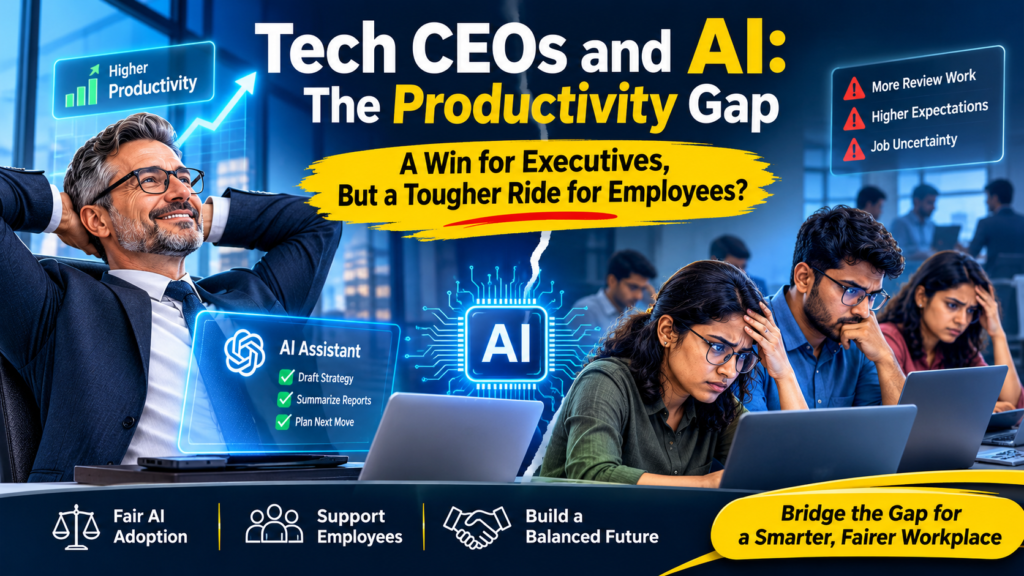
Tech CEOs and AI are a natural fit for personal productivity, but the gains rarely spread evenly through a company. Executives usually meet AI as a fast assistant that shines in a demo, while employees inherit the slower job of checking, fixing, and supervising what the tools produce.
That tension is the question a TechCrunch article published on November 1, 2026 raises in its headline: AI can make tech CEOs’ lives easier, but what about everyone else? This guide unpacks the debate in plain language, grounds it in the data and examples reported so far, and finishes with practical steps for both leaders and employees.
What Is the Gap Between Tech CEOs and AI in Everyday Work?
Definition. The executive AI gap is the difference between how AI feels to a chief executive and how it performs for the people who do the detailed work.
Expansion. For a CEO, AI is usually a drafting partner, a summarizer, and a quick way to prototype an idea. In those roles a rough first pass is valuable, and mistakes are cheap because the executive can spot them and move on. For an engineer, support agent, or analyst, the same tools must produce work that is correct, secure, compliant, and ready to ship. The distance between “looks right” and “is right” is where most of the hidden cost lives.
The relationship between tech CEOs and AI therefore plays out at the top of the work, where a good-enough draft helps. Everyone else meets AI at the bottom of the work, where good enough can break a product, a contract, or a customer relationship.
Why Does AI Work So Well for Tech CEOs?
Short answer: Much of an executive’s job is delegation, synthesis, and communication, and those are tasks where an imperfect first draft still saves real time.
Work That Is Shaped Like a First Draft
Emails, memos, strategy outlines, board narratives, and meeting summaries all begin as rough drafts that a human refines. Generative AI is strong at producing exactly that kind of output. When tech CEOs and AI collaborate on these tasks, the results feel impressive because the bar for “useful” is low and the executive is the one judging quality.
Distance From the Consequences
An executive who tries a tool on a simple test case sees it succeed. What the executive rarely sees is the long tail: the edge cases, the failed integrations, the compliance review, the customer escalation. Those details sit with the people closer to the work, which is exactly the blind spot the next section describes.AI productivity in the workplace
AI adoption in tech companies
AI agents and employee productivity
AI-driven layoffs
What Does “AI Psychosis” Mean in the Debate Over Tech CEOs and AI?
Definition. In this debate, “AI psychosis” is a provocative label for unrealistic beliefs about what AI can do. It is not a medical diagnosis.
Expansion. Box CEO Aaron Levie wrote on X that CEOs are “uniquely prone to AI psychosis.” His argument, as summarized in coverage of the post, is that leaders can try an AI tool, watch it succeed in a simple test, and then assume it can do an entire job from start to finish. The hosts of TechCrunch’s Equity podcast stressed that Levie is not rejecting AI tools and was criticizing unrealistic expectations.
His proposed remedy is practical rather than pessimistic: leaders should use AI heavily so they can judge it realistically. In other words, the problem is not too much AI use at the top. It is shallow use that produces deep confidence.
The Last-Mile Problem: Why Demos Are Not Deployments
Definition. The “last mile” is the detailed, unglamorous work that makes an AI result safe, correct, and fit for real use. Levie’s point is that CEOs tend to sit far from this work.
Expansion. Commentators echoing the argument describe a familiar pattern. A chief executive hands an agentic coding tool a task, and it produces something that works. The executive then wonders why a large team is needed at all. Critics respond that leaders have no visibility into areas such as security, legal compliance, and accessibility.
Typical last-mile tasks include:
- Security review: confirming the output does not introduce vulnerabilities.
- Legal and compliance checks: making sure the result meets contractual and regulatory obligations.
- Accessibility and quality assurance: testing with real users, devices, and edge cases.
- Integration and maintenance: keeping the result working as systems around it change.
- Accountability: deciding who is responsible when the output is wrong.
None of these tasks make for an exciting demo. All of them decide whether a demo becomes a dependable product.
What Does the ClickUp Case Show About Tech CEOs and AI Agents?
Definition. AI agents are software helpers that can take actions on their own, much like a junior assistant following instructions, rather than only answering questions.
The case. According to TechCrunch’s reporting, ClickUp’s CEO said the company cut 22% of its staff after rolling out about 3,000 AI agents, and the remaining workers are expected to manage and review the agents’ work.
What it means. The work did not vanish. It changed shape, from producing output to supervising it. That shift can be positive when people are trained, resourced, and credited for the oversight. It becomes a burden when the supervision is unpaid, invisible, or assumed to be effortless. One company is also a single data point, not proof of a universal pattern, so treat it as an illustration rather than a rule.
Are AI Layoffs Following the Hype?
Short answer: Layoffs are rising alongside AI adoption, but the data does not prove that AI caused them.
TechCrunch cites Layoffs.fyi figures showing that 115,430 people were laid off from 152 tech companies in the first five months of 2026, close to the 124,636 recorded for all of 2025. Those numbers count job cuts, not their causes. Companies lay people off for many reasons, including over-hiring corrections, cost pressure, and shifting strategy.
Still, the timing explains why the topic feels charged. When executives are confident that AI can replace large parts of a role, and employees are watching headcount fall, trust becomes the central issue. Leaders who announce AI-driven restructuring before testing the tools on real workflows risk cutting capability they later need. That is one reason AI layoffs have become a flashpoint in the wider conversation about tech CEOs and AI.
How the Executive and Employee Experience of AI Compare
The table below summarizes how tech CEOs and AI interact differently from how employees and AI interact. It is an analytical framework, not a statistical finding, and individual experiences will vary.
| Dimension | Tech CEO’s Experience | Frontline Employee’s Experience |
|---|---|---|
| Typical use | Drafting, summarizing, brainstorming | Producing finished, verified work products |
| Cost of an error | Low; caught and discarded in review | Higher; errors reach customers, code, or contracts |
| Main task with AI | Delegating and reviewing outputs | Checking, correcting, and supervising agents |
| Visibility of last-mile work | Often limited | Direct and daily |
| Exposure to AI-driven job cuts | Decision-maker | Affected party |
| What success looks like | Faster decisions and communication | Reliable results with less rework |
| Biggest risk | Overconfidence from simple tests | Unrecognized extra workload |
Could AI Replace the CEO Instead?
Short answer: Some prominent executives say it is possible someday, which adds irony to the debate.
Alphabet CEO Sundar Pichai has said that the job of a CEO may be one of the easier things for AI to do one day, while adding that AI will eliminate some roles and transform others, so people will need to adapt. Whether or not that prediction holds, it reframes the conversation. If leaders believe automation can reach the corner office, they have a reason to examine how automation actually performs on the work they already understand.
AI Doubles and the “Everywhere at Once” Idea
WIRED reported in April 2026 that CEOs see AI as a way to be omnipresent, and that AI doubles raise governance questions about accountability and employee oversight. The same reporting suggested that company heads are thinking about which routine responsibilities they could delegate to simulations of themselves.
This is the clearest example of AI making a leader’s life easier. It also raises a question worth asking out loud: if executives can multiply themselves, who reviews the copies, and who is accountable when a double gets something wrong? For employees, that question is not abstract. It determines whom they report to and whose judgment they are actually getting.
Top-Down Mandates vs. Bottom-Up Adoption
Definition. A top-down mandate is an instruction from leadership that everyone must use AI tools. Bottom-up adoption happens when employees choose tools because they help.
Expansion. The TechCrunch Equity hosts raised an open question about whether companies will adopt AI from the top down or because employees find it useful in daily work. Technologist Anil Dash has argued that the “AI-first” push among tech CEOs resembles the return-to-office fad, pointing to groupthink and signaling as drivers. Those are opinions, but they highlight a real design choice.
| Factor | Top-Down Mandate | Bottom-Up Adoption |
|---|---|---|
| Who decides | Leadership | Individual teams and employees |
| Speed of rollout | Fast and uniform | Gradual and uneven |
| Fit with real workflows | Often untested | Usually tested by the people using it |
| Employee trust | Can erode if tied to layoffs | Tends to build through demonstrated value |
| Main risk | Compliance without real benefit | Inconsistent practices and security gaps |
| Best use | Clear, well-tested standards | Discovering what actually works |
Public sentiment adds pressure. The Equity hosts pointed to students booing when AI comes up at graduation ceremonies, a sign that enthusiasm at the top is not matched everywhere.
What Does the Research Say About AI Productivity Gains?
Short answer: The evidence is mixed. TechCrunch’s reporting notes that several studies suggest measured productivity gains can lag behind the promises.
That does not mean AI productivity gains are imaginary. Many individuals report real time savings on drafting, research, and coding assistance. It means that individual wins do not automatically add up to organization-wide results. Gains can be eaten by review time, rework, and coordination overhead.
To measure AI productivity gains honestly, teams can compare three things before and after a rollout:
- Cycle time: how long it takes to complete a defined piece of work.
- Error and rework rates: how often output must be corrected.
- Oversight hours: how much human time goes into checking the AI.
If the first number falls but the other two rise sharply, the net benefit may be smaller than the demo suggested.
A Practical Playbook for Leaders
Executives who want the benefits of AI without the blind spot can take these steps:
- Test in real workflows. Run pilots on actual work, not clean examples, before reorganizing teams. This is the point reporting on the debate stresses: watch whether leaders spend time testing AI in real workflows before restructuring.
- Ask the last-mile question. For every proposed automation, name who verifies security, compliance, and quality.
- Fund the oversight. If employees will supervise agents, count that time, train for it, and recognize it.
- Separate tool adoption from headcount decisions. Prove value first, then discuss staffing.
- Use the tools deeply yourself. Sustained, hands-on use gives a more accurate picture than occasional demos.
- Invite dissent. Make it safe for people closest to the work to report where AI falls short.
A Practical Playbook for Employees
Employees can also shape how tech CEOs and AI strategies land at work:
- Document the hidden work. Track time spent verifying, correcting, and integrating AI output so the effort is visible.
- Share concrete wins. Specific examples of AI helping persuade better than general enthusiasm or skepticism.
- Raise risks early. Flag security, privacy, or quality concerns with evidence and suggested fixes.
- Build adjacent skills. Learn to evaluate, prompt, and supervise AI systems; that oversight skill is increasingly valuable.
- Propose pilots. Offer to test a tool on a bounded task and report the results.
How Should Companies Respond to the Tech CEOs and AI Overconfidence Problem?
Short answer: Treat executive enthusiasm as a starting point, then verify it with evidence from the people doing the work.
Healthy governance of tech CEOs and AI adoption looks less like a mandate and more like a feedback loop. Leaders set direction, teams test it on real tasks, and results flow back up before any large decision is made. Three habits make that loop work:
- Publish the scorecard. Share cycle time, error rates, and oversight hours openly so claims about AI can be checked.
- Create a review channel. Give employees a simple way to report where tools fail, without fear that honesty will be read as resistance.
- Pause before restructuring. Require a short evidence review before any AI-linked staffing change, so decisions rest on measured results rather than a promising demo.
Organizations that adopt this loop tend to avoid the worst version of the tech CEOs and AI story: confident decisions made on thin evidence. Boards can reinforce it by asking management a simple question each quarter, namely what the AI program has measurably improved and what it has quietly added to someone’s workload.
Frequently Asked Questions
Are tech CEOs overestimating AI?
Some critics think so. Levie, who is himself an AI believer, argues that executives can mistake a successful simple test for proof that AI can handle an entire role. Others counter that experimentation by leaders is exactly how adoption accelerates. The honest answer is that it varies by leader and by use case.
Is AI the main cause of tech layoffs?
The available data counts layoffs but does not assign causes. AI may be a factor at some companies, as the ClickUp example suggests, but cost pressure and corrections after earlier hiring also play roles.
What is the “last mile” in AI work?
It is the detailed verification, integration, and compliance work that turns an AI output into something safe and reliable. Executives are often the furthest from it.
Why does the debate about tech CEOs and AI matter to employees?
Because executive beliefs shape staffing, tooling, and expectations. If leaders assume AI can do more than it can, employees absorb the gap through extra review work or reduced headcount.
Will AI replace CEOs?
Some leaders, including Alphabet’s Sundar Pichai, have suggested the role could be among the easier ones for AI to take on someday. No one knows how that will play out, and it remains a prediction rather than a fact.
How can a company get real value from AI?
Start with pilots on real workflows, measure cycle time, error rates, and oversight hours, fund the supervision work, and expand only where the net benefit is clear.
Key Takeaways
- Tech CEOs and AI interact mainly at the drafting and decision layer, where imperfect output is still useful.
- Employees interact with AI at the verification layer, where errors have real costs.
- Levie’s “AI psychosis” critique targets overconfidence from simple tests, not AI itself.
- The ClickUp example shows work shifting from producing to supervising, not disappearing.
- Layoff figures and AI adoption are rising together, but the data does not prove causation.
- Research on AI productivity gains is mixed, so organizations should measure their own results.
- The best path combines leadership hands-on use, funded oversight, and bottom-up feedback.
Conclusion
The conversation about tech CEOs and AI is ultimately a conversation about perspective. AI genuinely can make an executive’s day easier, and many of those benefits are real. The risk arises when the view from the top is treated as the view from everywhere. Leaders who test tools in real workflows, respect the last mile, and bring employees into the design of AI adoption are far more likely to turn individual convenience into shared productivity.
ଟେକ୍ କମ୍ପାନୀର ସିଇଓ (CEO) ଏବଂ AI: ଯେଉଁ ଉପକରଣଗୁଡ଼ିକ ମୁଖ୍ୟ ଅଧିକାରୀଙ୍କୁ ସାହାଯ୍ୟ କରେ, ସେଗୁଡ଼ିକ ଅନ୍ୟ ସମସ୍ତଙ୍କ ପାଇଁ ସବୁବେଳେ ସହାୟକ ହୁଏ ନାହିଁ କାହିଁକି?
ବ୍ୟକ୍ତିଗତ କାର୍ଯ୍ୟଦକ୍ଷତା ବୃଦ୍ଧି କ୍ଷେତ୍ରରେ ଟେକ୍ କମ୍ପାନୀର ସିଇଓ ଏବଂ AI (କୃତ୍ରିମ ବୁଦ୍ଧିମତ୍ତା) ଏକ ଉପଯୁକ୍ତ ଯୋଡ଼ି ଭଳି ମନେହୁଏ, କିନ୍ତୁ ଏଥିରୁ ମିଳୁଥିବା ଲାଭ କମ୍ପାନୀର ସମସ୍ତ କର୍ମଚାରୀଙ୍କ ମଧ୍ୟରେ ସମାନ ଭାବରେ ବଣ୍ଟିତ ହୁଏ ନାହିଁ। ଉଚ୍ଚ ପଦସ୍ଥ ଅଧିକାରୀମାନଙ୍କ ପାଇଁ AI ଏକ ଦ୍ରୁତ ସହାୟକ ଭାବରେ କାମ କରେ, ଯାହା ଡେମୋ (ପ୍ରଦର୍ଶନ) ସମୟରେ ବେଶ୍ ପ୍ରଭାବଶାଳୀ ମନେହୁଏ। ଅନ୍ୟପକ୍ଷରେ, କର୍ମଚାରୀମାନଙ୍କୁ AI ଦ୍ୱାରା ପ୍ରସ୍ତୁତ କାର୍ଯ୍ୟକୁ ଯାଞ୍ଚ କରିବା, ସୁଧାରିବା ଏବଂ ତଦାରଖ କରିବା ଭଳି ଅଧିକ ସମୟ ସାପେକ୍ଷ କାମ କରିବାକୁ ପଡ଼ିଥାଏ।
ଏହି ପାର୍ଥକ୍ୟ ବା ଟଣାଓଟରାକୁ ନେଇ ୧ ନଭେମ୍ବର, ୨୦୨୬ରେ ‘ଟେକ୍କ୍ରଞ୍ଚ’ (TechCrunch) ରେ ପ୍ରକାଶିତ ଏକ ଲେଖାର ଶୀର୍ଷକରେ ପ୍ରଶ୍ନ ଉଠାଯାଇଛି: AI ଟେକ୍ କମ୍ପାନୀର ସିଇଓମାନଙ୍କ ଜୀବନକୁ ସହଜ କରିପାରେ, କିନ୍ତୁ ଅନ୍ୟ କର୍ମଚାରୀମାନଙ୍କ ପାଇଁ ଏହାର ଭୂମିକା କ’ଣ? ଏହି ଲେଖାଟି ସେହି ବିତର୍କକୁ ସରଳ ଭାଷାରେ ବୁଝାଇଥାଏ, ଏହାକୁ ତଥ୍ୟ ଓ ଉଦାହରଣ ମାଧ୍ୟମରେ ଉପସ୍ଥାପନ କରେ ଏବଂ ଶେଷରେ ନେତୃବୃନ୍ଦ ତଥା କର୍ମଚାରୀମାନଙ୍କ ପାଇଁ କିଛି ବ୍ୟାବହାରିକ ପରାମର୍ଶ ଦେଇଥାଏ।
ଦୈନନ୍ଦିନ କାର୍ଯ୍ୟରେ ଟେକ୍ ସିଇଓ ଏବଂ AI ମଧ୍ୟରେ ଥିବା ପାର୍ଥକ୍ୟ କ’ଣ?
ସଂଜ୍ଞା: ଉଚ୍ଚ ପଦସ୍ଥ ଅଧିକାରୀ ଏବଂ AI ମଧ୍ୟରେ ଥିବା ଏହି ପାର୍ଥକ୍ୟ ହେଉଛି—ଜଣେ ସିଇଓ AI କୁ ଯେପରି ଦେଖନ୍ତି ଏବଂ ଯେଉଁ କର୍ମଚାରୀମାନେ ପ୍ରକୃତରେ ବିସ୍ତୃତ କାର୍ଯ୍ୟ କରନ୍ତି, ସେମାନଙ୍କ ପାଇଁ AI ଯେପରି କାମ କରେ, ସେହି ଦୁଇଟି ମଧ୍ୟରେ ଥିବା ଅନ୍ତର।
ବିସ୍ତୃତ ବ୍ୟାଖ୍ୟା: ଜଣେ ସିଇଓଙ୍କ ପାଇଁ AI ସାଧାରଣତଃ ଏକ ଡ୍ରାଫ୍ଟ (ଖସଡ଼ା) ପ୍ରସ୍ତୁତକାରୀ ସହଯୋଗୀ, ବିଷୟବସ୍ତୁର ସାରାଂଶ ପ୍ରସ୍ତୁତକାରୀ ଏବଂ କୌଣସି ଧାରଣାର ପ୍ରାରମ୍ଭିକ ରୂପରେଖ (prototype) ତିଆରି କରିବାର ଏକ ଦ୍ରୁତ ମାଧ୍ୟମ ହୋଇଥାଏ। ଏହି କ୍ଷେତ୍ରରେ, ଏକ ପ୍ରାରମ୍ଭିକ ଖସଡ଼ା ଯଥେଷ୍ଟ ମୂଲ୍ୟବାନ ହୋଇଥା ଯେତେବେଳେ ଟେକ୍ କମ୍ପାନୀଗୁଡ଼ିକର ସିଇଓ (CEO) ମାନେ ଏହି କାର୍ଯ୍ୟଗୁଡ଼ିକ ପାଇଁ AI (କୃତ୍ରିମ ବୁଦ୍ଧିମତ୍ତା) ସହିତ ମିଶି କାମ କରନ୍ତି, ସେତେବେଳେ ଫଳାଫଳଗୁଡ଼ିକ ବହୁତ ଭଲ ଲାଗେ। ଏହାର କାରଣ ହେଉଛି, ଏଠାରେ “ଉପଯୋଗୀ” ହେବାର ମାନଦଣ୍ଡ ବହୁତ କମ୍ ଥାଏ ଏବଂ କାର୍ଯ୍ୟର ଗୁଣବତ୍ତା ବିଷୟରେ ନିଷ୍ପତ୍ତି ନେବା ବ୍ୟକ୍ତି ଜଣକ ହେଉଛନ୍ତି ସେହି ସିଇଓ।
ପରିଣାମଠାରୁ ଦୂରତା
ଜଣେ ସିଇଓ ଯେତେବେଳେ ଏକ ସରଳ ପରୀକ୍ଷଣରେ କୌଣସି AI ଟୁଲ୍ ବ୍ୟବହାର କରନ୍ତି, ସେତେବେଳେ ତାହା ସଫଳ ହେବାର ଦେଖନ୍ତି। କିନ୍ତୁ ସେ ଯାହା ଦେଖିପାରନ୍ତି ନାହିଁ, ତାହା ହେଉଛି ଏହାର ଦୀର୍ଘମିଆଦୀ ପ୍ରଭାବ ବା ଅନ୍ୟାନ୍ୟ ଜଟିଳ ଦିଗଗୁଡ଼ିକ; ଯେପରିକି ବିଶେଷ ପରିସ୍ଥିତି (edge cases), ବିଫଳ ସମନ୍ୱୟ (failed integrations), ନିୟମାବଳୀ ପାଳନ ସମ୍ବନ୍ଧୀୟ ସମୀକ୍ଷା (compliance review) ଏବଂ ଗ୍ରାହକଙ୍କ ପକ୍ଷରୁ ଆସୁଥିବା ଗୁରୁତର ଅଭିଯୋଗ। ଏହି ସବୁ ବିଷୟ ସେହି କର୍ମଚାରୀମାନଙ୍କ ଦ୍ୱାରା ପରିଚାଳିତ ହୁଏ ଯେଉଁମାନେ ପ୍ରକୃତ କାର୍ଯ୍ୟ ସହିତ ଅଧିକ ନିକଟତର ଥାଆନ୍ତି। ଏହି ଦିଗଟି ସିଇଓମାନଙ୍କ ଦୃଷ୍ଟିସୀମାରୁ ବାଦ୍ ପଡ଼ିଯାଏ, ଯାହା ବିଷୟରେ ପରବର୍ତ୍ତୀ ଅଂଶରେ ବର୍ଣ୍ଣନା କରାଯାଇଛି।
ଟେକ୍ ସିଇଓ ଏବଂ AI କୁ ନେଇ ଚାଲିଥିବା ଆଲୋଚନାରେ “AI ସାଇକୋସିସ୍” (AI Psychosis) ର ଅର୍ଥ କ’ଣ?
ସଂଜ୍ଞା: ଏହି ଆଲୋଚନାରେ, “AI ସାଇକୋସିସ୍” ହେଉଛି ଏକ ଉତ୍ତେଜକ ଶବ୍ଦ, ଯାହା AI କ’ଣ କରିପାରିବ ସେ ବିଷୟରେ ରହିଥିବା ଅବାସ୍ତବ ଧାରଣାକୁ ବୁଝାଏ। ଏହା କୌଣସି ଚିକିତ୍ସା ବିଜ୍ଞାନ ସମ୍ବନ୍ଧୀୟ ରୋଗ ନୁହେଁ।
ବିସ୍ତୃତ ବ୍ୟାଖ୍ୟା: ‘Box’ କମ୍ପାନୀର ସିଇଓ ଆରୋନ୍ ଲେଭି (Aaron Levie) ‘X’ (ପୂର୍ବରୁ ଟ୍ୱିଟର) ରେ ଲେଖିଛନ୍ତି ଯେ ସିଇଓମାନଙ୍କ ମଧ୍ୟରେ “AI ସାଇକୋସିସ୍” ଦେଖାଯିବାର ସମ୍ଭାବନା ଅଧିକ ଥାଏ। ତାଙ୍କ ଯୁକ୍ତି ଅନୁଯାୟୀ, ନେତାମାନେ (ସିଇଓମାନେ) ଏକ AI ଟୁଲ୍ ବ୍ୟବହାର କରି ଏହାକୁ ଏକ ସରଳ ପରୀକ୍ଷଣରେ ସଫଳ ହେବାର ଦେଖନ୍ତି ଏବଂ ତା’ପରେ ଭାବିନିଅନ୍ତି ଯେ ଏହା ଏକ ସମ୍ପୂର୍ଣ୍ଣ କାର୍ଯ୍ୟକୁ ଆରମ୍ଭରୁ ଶେଷ ପର୍ଯ୍ୟନ୍ତ ଏକାକୀ କରିପାରିବ। ‘TechCrunch’ ର ‘Equity’ ପଡକାଷ୍ଟର ଉପସ୍ଥାପକମାନେ ସ୍ପଷ୍ଟ କରିଛନ୍ତି ଯେ ଲେଭି ଆଇନଗତ ଏବଂ ଅନୁପାଳନ ଯାଞ୍ଚ: ଫଳାଫଳ ଚୁକ୍ତିନାମା ଏବଂ ନିୟାମକ ଦାୟିତ୍ୱ ପୂରଣ କରୁଛି କି ନାହିଁ ତାହା ନିଶ୍ଚିତ କରିବା।
ପ୍ରବେଶଯୋଗ୍ୟତା ଏବଂ ଗୁଣବତ୍ତା ନିଶ୍ଚିତତା: ପ୍ରକୃତ ବ୍ୟବହାରକାରୀ, ଡିଭାଇସ୍ ଏବଂ ଧାର ମାମଲା ସହିତ ପରୀକ୍ଷଣ।
ସମନ୍ୱୟ ଏବଂ ରକ୍ଷଣାବେକ୍ଷଣ: ଫଳାଫଳକୁ କାର୍ଯ୍ୟକ୍ଷମ ରଖିବା ଯେପରି ଏହାର ଚାରିପାଖରେ ଥିବା ସିଷ୍ଟମଗୁଡ଼ିକ ପରିବର୍ତ୍ତନ ହୁଏ।
ଦାୟିତ୍ୱ: ଆଉଟପୁଟ୍ ଭୁଲ ହେଲେ କିଏ ଦାୟୀ ତାହା ନିଷ୍ପତ୍ତି ନେବା।
ଏହି କାର୍ଯ୍ୟଗୁଡ଼ିକ ମଧ୍ୟରୁ କୌଣସିଟି ଏକ ରୋମାଞ୍ଚକର ଡେମୋ ପାଇଁ ପ୍ରସ୍ତୁତ କରେ ନାହିଁ। ସେମାନେ ସମସ୍ତେ ନିଷ୍ପତ୍ତି ନିଅନ୍ତି ଯେ ଏକ ଡେମୋ ଏକ ନିର୍ଭରଯୋଗ୍ୟ ଉତ୍ପାଦ ହୋଇଯାଏ କି ନାହିଁ।
କ୍ଲିକଅପ୍ ମାମଲା ଟେକ୍ ସିଇଓ ଏବଂ ଏଆଇ ଏଜେଣ୍ଟମାନଙ୍କ ବିଷୟରେ କ’ଣ ଦେଖାଏ?
ପରିଭାଷା। ଏଆଇ ଏଜେଣ୍ଟମାନେ ସଫ୍ଟୱେର୍ ସହାୟକ ଅଟନ୍ତି ଯେଉଁମାନେ କେବଳ ପ୍ରଶ୍ନର ଉତ୍ତର ଦେବା ପରିବର୍ତ୍ତେ ନିର୍ଦ୍ଦେଶାବଳୀ ଅନୁସରଣ କରୁଥିବା ଜଣେ ଜୁନିଅର୍ ସହାୟକ ପରି ନିଜେ କାର୍ଯ୍ୟ କରିପାରିବେ।
ମାମଲା। ଟେକ୍ କ୍ରଞ୍ଚର ରିପୋର୍ଟିଂ ଅନୁଯାୟୀ, କ୍ଲିକଅପ୍ ର ସିଇଓ କହିଛନ୍ତି ଯେ କମ୍ପାନୀ ପ୍ରାୟ 3,000 ଏଆଇ ଏଜେଣ୍ଟଙ୍କୁ ରୋଲ୍ କରିବା ପରେ ଏହାର 22% କର୍ମଚାରୀଙ୍କୁ କାଟି ଦେଇଛି, ଏବଂ ଅବଶିଷ୍ଟ କର୍ମଚାରୀମାନଙ୍କୁ ପରିଚାଳନା ଏବଂ କର୍ମଚାରୀମାନଙ୍କ କାର୍ଯ୍ୟର ସମୀକ୍ଷା କରିବା।
ଏହାର ଅର୍ଥ କ’ଣ? କାମ କେଉଁଆଡ଼େ ଉଭେଇ ଯାଇନାହିଁ। ଏହାର ରୂପ ବଦଳି ଯାଇଛି—କାମ ସିଧାସଳଖ କରିବା ବଦଳରେ, ବର୍ତ୍ତମାନ ତାହାର ତଦାରଖ କରିବାକୁ ପଡ଼ୁଛି। ଯେତେବେଳେ କର୍ମଚାରୀମାନଙ୍କୁ ଉପଯୁକ୍ତ ପ୍ରଶିକ୍ଷଣ ଓ ସମ୍ବଳ ଦିଆଯାଏ ଏବଂ ଏହି ତଦାରଖ ଦାୟିତ୍ୱ ପାଇଁ ସେମାନଙ୍କୁ ସ୍ୱୀକୃତି ମିଳେ, ସେତେବେଳେ ଏହି ପରିବର୍ତ୍ତନ ସକାରାତ୍ମକ ହୋଇପାରେ। କିନ୍ତୁ ଯେତେବେଳେ ଏହି ତଦାରଖ କାର୍ଯ୍ୟ ପାଇଁ କୌଣସି ପାରିଶ୍ରମିକ ମିଳେ ନାହିଁ, ଏହା ଅଦୃଶ୍ୟ ରହିଯାଏ କିମ୍ବା ଏହାକୁ ଏକ ସହଜ କାମ ବୋଲି ଧରି ନିଆଯାଏ, ସେତେବେଳେ ଏହା ଏକ ବୋଝ ପାଲଟିଯାଏ। ଗୋଟିଏ କମ୍ପାନୀର ଉଦାହରଣ କେବଳ ଗୋଟିଏ ତଥ୍ୟ (data point) ଅଟେ; ଏହା କୌଣସି ସାର୍ବଜନୀନ ଧାରାର ପ୍ରମାଣ ନୁହେଁ। ତେଣୁ, ଏହାକୁ ଏକ ନିୟମ ଭାବରେ ନୁହେଁ, ବରଂ ଏକ ଉଦାହରଣ ଭାବରେ ବିଚାର କରନ୍ତୁ।
AI (କୃତ୍ରିମ ବୁଦ୍ଧିମତ୍ତା) କୁ ନେଇ ସୃଷ୍ଟି ହୋଇଥିବା ଉତ୍ସାହ ଓ ଚର୍ଚ୍ଚା ସହିତ କ’ଣ କର୍ମଚାରୀ ଛଟେଇର ସମ୍ପର୍କ ଅଛି?
ସଂକ୍ଷିପତ୍ତ ଉତ୍ତର: AI ର ବ୍ୟବହାର ବଢ଼ିବା ସହିତ କର୍ମଚାରୀ ଛଟେଇ ମଧ୍ୟ ବଢ଼ୁଛି, କିନ୍ତୁ AI ହିଁ ଏହାର କାରଣ ବୋଲି ତଥ୍ୟରୁ ପ୍ରମାଣିତ ହୁଏ ନାହିଁ।
‘TechCrunch’ ଅନୁଯାୟୀ, ‘Layoffs.fyi’ ର ତଥ୍ୟ ଦର୍ଶାଉଛି ଯେ ୨୦୨୬ ମସିହାର ପ୍ରଥମ ପାଞ୍ଚ ମାସରେ ୧୫୨ଟି ଟେକ୍ କମ୍ପାନୀରୁ ୧,୧୫,୪୩୦ ଜଣ କର୍ମଚାରୀଙ୍କୁ ଛଟେଇ କରାଯାଇଛି। ଏହି ସଂଖ୍ୟା ୨୦୨୫ ମସିହାର ମୋଟ ଛଟେଇ ସଂଖ୍ୟା (୧,୨୪,୬୩୬) ର ବେଶ୍ ନିକଟତର ଅଟେ। ଏହି ସଂଖ୍ୟାଗୁଡ଼ିକ କେବଳ କର୍ମଚାରୀ ଛଟେଇକୁ ଦର୍ଶାଏ, କିନ୍ତୁ ଏହାର କାରଣକୁ ନୁହେଁ। କମ୍ପାନୀଗୁଡ଼ିକ ବିଭିନ୍ନ କାରଣରୁ କର୍ମଚାରୀଙ୍କୁ ଛଟେଇ କରିଥାନ୍ତି; ଯେପରିକି ଅତ୍ୟଧିକ ନିଯୁକ୍ତିର ସଂଶୋଧନ, ଖର୍ଚ୍ଚ କମାଇବାର ଚାପ ଏବଂ କାର୍ଯ୍ୟରଣନୀତିରେ ପରିବର୍ତ୍ତନ।
ତଥାପି, ଯେଉଁ ସମୟରେ ଏହି ଘଟଣାଗୁଡ଼ିକ ଘଟୁଛି, ତାହା ଏହି ବିଷୟକୁ ଅଧିକ ସମ୍ବେଦନଶୀଳ କରିଦେଉଛି। ଯେତେବେଳେ କମ୍ପାନୀର ଉଚ୍ଚ ପଦସ୍ଥ ଅଧିକାରୀମାନେ ବିଶ୍ୱାସ କରନ୍ତି ଯେ AI କର୍ମଚାରୀଙ୍କ ତ୍ରୁଟିଗୁଡ଼ିକ ଗ୍ରାହକଙ୍କ ପାଖରେ ପହଞ୍ଚିପାରେ, କିମ୍ବା କୋଡ୍ (code) ଓ ଚୁକ୍ତିନାମା ଉପରେ ପ୍ରଭାବ ପକାଇପାରେ।
AI ସହିତ ମୁଖ୍ୟ କାର୍ଯ୍ୟ: କାର୍ଯ୍ୟଭାର ଅନ୍ୟକୁ ଦେବା (delegating) ଏବଂ ଫଳାଫଳର ସମୀକ୍ଷା କରିବା | ଏଜେଣ୍ଟମାନଙ୍କ (AI ସିଷ୍ଟମ୍) କାର୍ଯ୍ୟ ଯାଞ୍ଚ କରିବା, ସୁଧାରିବା ଏବଂ ତଦାରଖ କରିବା।
ଶେଷ ପର୍ଯ୍ୟାୟ କାର୍ଯ୍ୟ (last-mile work) ଉପରେ ଦୃଶ୍ୟମାନତା: ପ୍ରାୟତଃ ସୀମିତ | ପ୍ରତ୍ୟକ୍ଷ ଏବଂ ଦୈନନ୍ଦିନ।
AI ଯୋଗୁଁ ଚାକିରି ହରାଇବାର ଆଶଙ୍କା: ନିଷ୍ପତ୍ତି ନେଉଥିବା ବ୍ୟକ୍ତି (ନିଜେ ସୁରକ୍ଷିତ ଥାଇପାରନ୍ତି) | ପ୍ରଭାବିତ ହେଉଥିବା ପକ୍ଷ।
ସଫଳତାର ଅର୍ଥ: ଦ୍ରୁତ ନିଷ୍ପତ୍ତି ଏବଂ ଯୋଗାଯୋଗ | କମ୍ ପୁନଃ କାର୍ଯ୍ୟ (rework) ସହିତ ନିର୍ଭରଯୋଗ୍ୟ ଫଳାଫଳ।
ସବୁଠାରୁ ବଡ଼ ବିପଦ: ସରଳ ପରୀକ୍ଷଣରୁ ସୃଷ୍ଟି ହେଉଥିବା ଅତ୍ୟଧିକ ଆତ୍ମବିଶ୍ୱାସ | ଅଦେଖା ରହିଯାଉଥିବା ଅତିରିକ୍ତ କାର୍ଯ୍ୟଭାର।
କ’ଣ AI, CEO (ମୁଖ୍ୟ କାର୍ଯ୍ୟନିର୍ବାହୀ ଅଧିକାରୀ) ଙ୍କ ସ୍ଥାନ ନେଇପାରେ?
ସଂକ୍ଷିପତ୍ତ ଉତ୍ତର: କିଛି ପ୍ରମୁଖ କାର୍ଯ୍ୟନିର୍ବାହୀ ଅଧିକାରୀଙ୍କ ମତରେ ଭବିଷ୍ୟତରେ ଏହା ସମ୍ଭବ ହୋଇପାରେ, ଯାହା ଏହି ଆଲୋଚନାକୁ ଏକ ବିଡ଼ମ୍ବନାପୂର୍ଣ୍ଣ ମୋଡ଼ ଦେଇଥାଏ।
Alphabet (ଆଲଫାବେଟ୍) ର CEO ସୁନ୍ଦର ପିଚାଇ କହିଛନ୍ତି ଯେ, ଭବିଷ୍ୟତରେ AI ପାଇଁ CEO ର କାର୍ଯ୍ୟ ସମ୍ପାଦନ କରିବା ସବୁଠାରୁ ସହଜ କାମ ହୋଇପାରେ। ସେ ଆହୁରି ମଧ୍ୟ କହିଛନ୍ତି ଯେ AI କିଛି ଭୂମିକାକୁ ସମ୍ପୂର୍ଣ୍ଣ ହଟାଇ ଦେବ ଏବଂ ଅନ୍ୟ କିଛି ଭୂମିକାର ରୂପ ବଦଳାଇ ଦେବ, ତେଣୁ ଲୋକମାନଙ୍କୁ ନିଜକୁ ପରିସ୍ଥିତି ଅନୁଯାୟୀ ଢାଳିବାକୁ ପଡ଼ିବ। ଏହି ପୂର୍ବାନୁମାନ ସତ ହେଉ ବା ନ ହେଉ, ଏହା ସମଗ୍ର ଆଲୋଚନାର ଦୃଷ୍ଟିକୋଣକୁ ବଦଳାଇ ଦେଇଛି। ଯଦି ନେତୃବୃନ୍ଦ ବିଶ୍ୱାସ କରନ୍ତି ଯେ ‘ଅଟୋମେସନ୍’ (ସ୍ୱୟଂଚାଳିତ ବ୍ୟବସ୍ଥା) ସର୍ବୋଚ୍ଚ ପଦବୀ ପର୍ଯ୍ୟନ୍ତ ପହଞ୍ଚିପାରେ, ତେବେ ସେମାନଙ୍କ ପାଖରେ ଏହା ଯାଞ୍ଚ କରିବାର କାରଣ ରହିଛି ଯେ, ସେମାନେ ପୂର୍ବରୁ ବୁଝିଥିବା କାର୍ଯ୍ୟଗୁଡ଼ିକ ଉପରେ ଏହି ଅଟୋମେସନ୍ ପ୍ରକୃତରେ କିପରି କାମ କରୁଛି।
AI ପ୍ରତିରୂପ (AI Doubles) ଏବଂ “ଏକା ସମୟରେ ସବୁଠାରେ ଉପସ୍ଥିତ ରହିବା”ର ଧାରଣା
ଏପ୍ରିଲ୍ ୨୦୨୬ ରେ WIRED ଟେକ୍ନୋଲୋଜିଷ୍ଟ ଅନିଲ ଦାଶ ଯୁକ୍ତି ଦେଇଛନ୍ତି ଯେ ଟେକ୍ ସିଇଓମାନଙ୍କ ମଧ୍ୟରେ “ଏଆଇ-ପ୍ରଥମ” ଚାପ ଅଫିସକୁ ଫେରିବା ଫ୍ୟାଡ୍ ସହିତ ସମାନ, ଗୋଷ୍ଠୀଚିହ୍ନ ଏବଂ ଚାଳକ ଭାବରେ ସଙ୍କେତକୁ ଇଙ୍ଗିତ କରୁଛି। ସେଗୁଡ଼ିକ ମତାମତ, କିନ୍ତୁ ସେମାନେ ଏକ ପ୍ରକୃତ ଡିଜାଇନ୍ ପସନ୍ଦକୁ ଉଜ୍ଜ୍ୱଳ କରନ୍ତି।
କାରକ ଉପର-ନିମ୍ନ ନିର୍ଦ୍ଦେଶ ତଳ-ଉପର ଗ୍ରହଣ ନେତୃତ୍ୱ କିଏ ନିଷ୍ପତ୍ତି ନିଏ ବ୍ୟକ୍ତିଗତ ଦଳ ଏବଂ କର୍ମଚାରୀ ରୋଲଆଉଟର ଗତି ଦ୍ରୁତ ଏବଂ ସମାନ କ୍ରମିକ ଏବଂ ଅସମାନ ପ୍ରକୃତ କାର୍ଯ୍ୟପ୍ରବାହ ସହିତ ଫିଟ୍ ପ୍ରାୟତଃ ଅପରୀକ୍ଷିତ ସାଧାରଣତଃ ଏହାକୁ ବ୍ୟବହାର କରୁଥିବା ଲୋକଙ୍କ ଦ୍ୱାରା ପରୀକ୍ଷିତ ଛାଡ଼ିବା ସହିତ ବାନ୍ଧି ହେଲେ କର୍ମଚାରୀ ବିଶ୍ୱାସ କ୍ଷୟ ହୋଇପାରେ ପ୍ରଦର୍ଶିତ ମୂଲ୍ୟ ମାଧ୍ୟମରେ ନିର୍ମାଣ କରିବାକୁ ପ୍ରବୃତ୍ତ ପ୍ରକୃତ ଲାଭ ବିନା
ମୁଖ୍ୟ ବିପଦ ଅନୁପାଳନ ଅସଙ୍ଗତ ଅଭ୍ୟାସ ଏବଂ ସୁରକ୍ଷା ବ୍ୟବଧାନ ସର୍ବୋତ୍ତମ ବ୍ୟବହାର ସ୍ପଷ୍ଟ, ଭଲ ଭାବରେ ପରୀକ୍ଷିତ ମାନକ ପ୍ରକୃତରେ କ’ଣ କାମ କରେ ତାହା ଆବିଷ୍କାର ଜନସାଧାରଣ ଭାବନା ଚାପ ଯୋଗ କରେ। ଇକ୍ୱିଟି ହୋଷ୍ଟ ସ୍ନାତକ ସମାରୋହରେ AI ଆସିଲେ ଛାତ୍ରମାନଙ୍କୁ ବ୍ୟୁ କରିବା ପ୍ରତି ଇଙ୍ଗିତ କରିଛି, ଏହା ଏକ ସଙ୍କେତ ଯେ ଶୀର୍ଷରେ ଉତ୍ସାହ ସବୁଠି ମେଳ ଖାଉ ନାହିଁ।
ଗବେଷଣା AI ଉତ୍ପାଦକତା ଲାଭ ବିଷୟରେ କ’ଣ କହେ?
ସଂକ୍ଷିପ୍ତ ଉତ୍ତର: ପ୍ରମାଣ ମିଶ୍ରିତ। ଟେକକ୍ରଞ୍ଚର ରିପୋର୍ଟିଂ ଉଲ୍ଲେଖ କରେ ଯେ ଅନେକ ଅଧ୍ୟୟନ ମାପି ଉତ୍ପାଦକତା ସୂଚାଇଥାଏ y ଲାଭ ପ୍ରତିଶ୍ରୁତି ଅପେକ୍ଷା ପଛରେ ରହିପାରେ।
ଏହାର ଅର୍ଥ ନୁହେଁ ଯେ AI ଉତ୍ପାଦକତା ଲାଭ କାଳ୍ପନିକ। ଅନେକ ବ୍ୟକ୍ତି ଡ୍ରାଫ୍ଟିଂ, ଗବେଷଣା ଏବଂ କୋଡିଂ ସହାୟତାରେ ପ୍ରକୃତ ସମୟ ସଞ୍ଚୟ ରିପୋର୍ଟ କରନ୍ତି। ଏହାର ଅର୍ଥ ହେଉଛି ବ୍ୟକ୍ତିଗତ ବିଜୟ ସ୍ୱୟଂଚାଳିତ ଭାବରେ ସଂଗଠନ-ବ୍ୟାପୀ ଫଳାଫଳରେ ଯୋଡି ହୁଏ ନାହିଁ। ସମୀକ୍ଷା ସମୟ, ପୁନଃକାର୍ଯ୍ୟ ଏବଂ ସମନ୍ୱୟ ଓଭରହେଡ୍ ଦ୍ୱାରା ଲାଭ ଖାଇଯାଇପାରେ।
AI ଉତ୍ପାଦକତା ଲାଭକୁ ସଚ୍ଚୋଟ ଭାବରେ ମାପିବା ପାଇଁ, ଦଳଗୁଡ଼ିକ ଏକ ରୋଲଆଉଟ୍ ପୂର୍ବରୁ ଏବଂ ପରେ ତିନୋଟି ଜିନିଷ ତୁଳନା କରିପାରିବେ:
ଚକ୍ର ସମୟ: ଏକ ନିର୍ଦ୍ଦିଷ୍ଟ କାର୍ଯ୍ୟ ସମ୍ପୂର୍ଣ୍ଣ କରିବାକୁ କେତେ ସମୟ ଲାଗେ।
ତ୍ରୁଟି ଏବଂ ପୁନଃକାର୍ଯ୍ୟ ହାର: କେତେ ଥର ଆଉଟପୁଟ୍ ସଂଶୋଧନ କରାଯିବା ଆବଶ୍ୟକ।
ତଦାରଖ ଘଣ୍ଟା: AI ଯାଞ୍ଚ କରିବାରେ ମାନବ ସମୟ କେତେ ସମୟ ଲାଗେ।
ଯଦି ପ୍ରଥମ ସଂଖ୍ୟା ଖସିଯାଏ କିନ୍ତୁ ଅନ୍ୟ ଦୁଇଟି ଦ୍ରୁତ ଗତିରେ ବୃଦ୍ଧି ପାଏ, ତେବେ ନିଟ୍ ଲାଭ ପ୍ରସ୍ତାବିତ ଡେମୋ ଅପେକ୍ଷା କମ୍ ହୋଇପାରେ।
ନେତାମାନଙ୍କ ପାଇଁ ଏକ ବ୍ୟବହାରିକ ପ୍ଲେବୁକ୍
ଯେଉଁମାନେ ଅନ୍ଧ ସ୍ଥାନ ବିନା AI ର ଲାଭ ଚାହାଁନ୍ତି ସେମାନେ ଏହି ପଦକ୍ଷେପଗୁଡ଼ିକ ନେଇପାରିବେ:
ପ୍ରକୃତ କାର୍ଯ୍ୟପ୍ରବାହରେ ପରୀକ୍ଷା। ଦଳଗୁଡ଼ିକୁ ପୁନଃସଂଗଠିତ କରିବା ପୂର୍ବରୁ ପରିଷ୍କାର ଉଦାହରଣ ନୁହେଁ, ପ୍ରକୃତ କାର୍ଯ୍ୟରେ ପାଇଲଟ୍ ଚଲାନ୍ତୁ। ଏହି ବିତର୍କ ଉପରେ ରିପୋର୍ଟିଂ କରୁଥିବା ବିନ୍ଦୁଟି ହେଉଛି ଗୁରୁତ୍ୱାରୋପ: ପୁନଃଗଠନ ପୂର୍ବରୁ ନେତାମାନେ ପ୍ରକୃତ କାର୍ଯ୍ୟପ୍ରବାହରେ AI ପରୀକ୍ଷା କରିବାରେ ସମୟ ବିତାଉଛନ୍ତି କି ନାହିଁ ଦେଖନ୍ତୁ।
ଶେଷ-ମାଇଲ ପ୍ରଶ୍ନ ପଚାରନ୍ତୁ। ପ୍ରତ୍ୟେକ ପ୍ରସ୍ତାବିତ ସ୍ୱୟଂଚାଳିତକରଣ ପାଇଁ, ସୁରକ୍ଷା, ଅନୁପାଳନ ଏବଂ ଗୁଣବତ୍ତା ଯାଞ୍ଚ କରୁଥିବା ବ୍ୟକ୍ତିଙ୍କ ନାମ ଦିଅନ୍ତୁ।
ତଦାରଖ ପାଇଁ ପାଣ୍ଠି ଯୋଗାଇ ଦିଅନ୍ତୁ। ଯଦି କର୍ମଚାରୀମାନେ ଏଜେଣ୍ଟମାନଙ୍କୁ ତଦାରଖ କରିବେ, ତେବେ ସେହି ସମୟକୁ ଗଣନା କରନ୍ତୁ, ଏଥିପାଇଁ ତାଲିମ ଦିଅନ୍ତୁ ଏବଂ ଏହାକୁ ଚିହ୍ନନ୍ତୁ।
ହେଡ୍କାଉଣ୍ଟ ନିଷ୍ପତ୍ତିରୁ ଉପକରଣ ଗ୍ରହଣକୁ ପୃଥକ କରନ୍ତୁ। ପ୍ରଥମେ ମୂଲ୍ୟ ପ୍ରମାଣ କରନ୍ତୁ, ତାପରେ କର୍ମଚାରୀଙ୍କ ବିଷୟରେ ଆଲୋଚନା କରନ୍ତୁ।
ନିରନ୍ତର, ହାତ ବ୍ୟବହାର ବେଳେବେଳେ ଡେମୋ ଅପେକ୍ଷା ଅଧିକ ସଠିକ୍ ଚିତ୍ର ପ୍ରଦାନ କରେ।
ଅସନ୍ତୋଷକୁ ଆମନ୍ତ୍ରଣ କରନ୍ତୁ। କାର୍ଯ୍ୟର ନିକଟତମ ଲୋକଙ୍କ ପାଇଁ AI କେଉଁଠାରେ କମ୍ ପଡ଼ିଥାଏ ତାହା ରିପୋର୍ଟ କରିବା ସୁରକ୍ଷିତ କରନ୍ତୁ।
କର୍ମଚାରୀମାନଙ୍କ ପାଇଁ ଏକ ବ୍ୟବହାରିକ ପ୍ଲେବୁକ୍
କର୍ମଚାରୀମାନେ ମଧ୍ୟ କାର୍ଯ୍ୟସ୍ଥଳରେ ଟେକ୍ ସିଇଓ ଏବଂ AI ରଣନୀତି କିପରି ପଡ଼ିଥାଏ ତାହା ଆକାର ଦେଇପାରିବେ:
ଲୁଚି ରହିଥିବା କାର୍ଯ୍ୟକୁ ଡକ୍ୟୁମେଣ୍ଟ କରନ୍ତୁ। AI ଆଉଟପୁଟ୍ ଯାଞ୍ଚ କରିବା, ସଂଶୋଧନ କରିବା ଏବଂ ସଂହତ କରିବାରେ ବିତାଇଥିବା ସମୟକୁ ଟ୍ରାକ୍ କରନ୍ତୁ ଯାହା ଦ୍ଵାରା ପ୍ରୟାସ ଦୃଶ୍ୟମାନ ହେବ।
କଂକ୍ରିଟ୍ ବିଜୟ ସେୟାର କରନ୍ତୁ। ସାଧାରଣ ଉତ୍ସାହ କିମ୍ବା ସନ୍ଦେହବାଦ ଅପେକ୍ଷା ଭଲ ଭାବରେ ପ୍ରେରଣା ଦେବାରେ AI ସାହାଯ୍ୟ କରୁଥିବା ନିର୍ଦ୍ଦିଷ୍ଟ ଉଦାହରଣ।
ପ୍ରାରମ୍ଭିକ ଭାବରେ ବିପଦ ବୃଦ୍ଧି କରନ୍ତୁ। ପ୍ରମାଣ ଏବଂ ପ୍ରସ୍ତାବିତ ସମାଧାନ ସହିତ ସୁରକ୍ଷା, ଗୋପନୀୟତା କିମ୍ବା ଗୁଣବତ୍ତା ଚିନ୍ତାକୁ ଫ୍ଲାଗ୍ କରନ୍ତୁ।
ନିକଟବର୍ତ୍ତୀ ଦକ୍ଷତା ନିର୍ମାଣ କରନ୍ତୁ। AI ସିଷ୍ଟମଗୁଡ଼ିକୁ ମୂଲ୍ୟାଙ୍କନ, ପ୍ରେରଣା ଏବଂ ତଦାରଖ କରିବା ଶିଖନ୍ତୁ; ସେହି ତଦାରଖ ଦକ୍ଷତା କ୍ରମଶଃ ମୂଲ୍ୟବାନ ହେଉଛି।
ପାଇଲଟ୍ ପ୍ରସ୍ତାବ ଦିଅନ୍ତୁ। ଏକ ସୀମିତ କାର୍ଯ୍ୟରେ ଏକ ଉପକରଣ ପରୀକ୍ଷା କରିବାକୁ ଏବଂ ଫଳାଫଳ ରିପୋର୍ଟ କରିବାକୁ ପ୍ରସ୍ତାବ ଦିଅନ୍ତୁ।
କମ୍ପାନୀଗୁଡ଼ିକ ଟେକ୍ ସିଇଓ ଏବଂ AI ଅତ୍ୟଧିକ ଆତ୍ମବିଶ୍ୱାସ ସମସ୍ୟାକୁ କିପରି ପ୍ରତିକ୍ରିୟା ଦେବା ଉଚିତ?
ସଂକ୍ଷିପ୍ତ ଉତ୍ତର: କାର୍ଯ୍ୟନିର୍ବାହୀ ଉତ୍ସାହକୁ ଏକ ଆରମ୍ଭ ବିନ୍ଦୁ ଭାବରେ ବ୍ୟବହାର କରନ୍ତୁ, ତାପରେ କାର୍ଯ୍ୟ କରୁଥିବା ଲୋକଙ୍କ ପ୍ରମାଣ ସହିତ ଏହାକୁ ଯାଞ୍ଚ କରନ୍ତୁ।
ଟେକ୍ ସିଇଓ ଏବଂ AI ଗ୍ରହଣର ସୁସ୍ଥ ଶାସନ ଏକ ନିର୍ଦ୍ଦେଶ ପରି କମ୍ ଏବଂ ଏକ ମତାମତ ଲୁପ୍ ପରି ଦେଖାଯାଏ। ନେତାମାନେ ଦିଗନିର୍ଦ୍ଦେଶ ସ୍ଥିର କରନ୍ତି, ଦଳଗୁଡ଼ିକ ଏହାକୁ ପ୍ରକୃତ କାର୍ଯ୍ୟରେ ପରୀକ୍ଷା କରନ୍ତି, ଏବଂ କୌଣସି ବଡ଼ ନିଷ୍ପତ୍ତି ନେବା ପୂର୍ବରୁ ଫଳାଫଳ ପୁନର୍ବାର ପ୍ରବାହିତ ହୁଏ। ତିନୋଟି ଅଭ୍ୟାସ ସେହି ଲୁପ୍ କୁ କାର୍ଯ୍ୟ କରିଥାଏ:
ସ୍କୋରକାର୍ଡ ପ୍ରକାଶ କରନ୍ତୁ। ଚକ୍ର ସମୟ, ତ୍ରୁଟି ହାର ଏବଂ ତଦାରଖ ଘଣ୍ଟା ଖୋଲାଖୋଲି ଭାବରେ ସେୟାର କରନ୍ତୁ ଯାହା ଦ୍ୱାରା AI ବିଷୟରେ ଦାବି ଯାଞ୍ଚ କରାଯାଇପାରିବ।
ଏକ ସମୀକ୍ଷା ଚ୍ୟାନେଲ୍ ସୃଷ୍ଟି କରନ୍ତୁ। କର୍ମଚାରୀମାନଙ୍କୁ ଯେଉଁଠାରେ ଉପକରଣ ବିଫଳ ହୁଏ ତାହା ରିପୋର୍ଟ କରିବାର ଏକ ସରଳ ଉପାୟ ଦିଅନ୍ତୁ, ଭୟ ନକରି ଯେ ସଚ୍ଚୋଟତାକୁ ପ୍ରତିରୋଧ ଭାବରେ ପଢ଼ାଯିବ।
ପୁନର୍ଗଠନ ପୂର୍ବରୁ ବିରତି ନିଅନ୍ତୁ। କୌଣସି AI-ଲିଙ୍କ୍ଡ୍ କର୍ମଚାରୀ ପରିବର୍ତ୍ତନ ପୂର୍ବରୁ ଏକ ସଂକ୍ଷିପ୍ତ ପ୍ରମାଣ ସମୀକ୍ଷା ଆବଶ୍ୟକ କରନ୍ତୁ, ତେଣୁ ନିଷ୍ପତ୍ତିଗୁଡ଼ିକ ଏକ ପ୍ରତିଶ୍ରୁତିପୂର୍ଣ୍ଣ ଡେମୋ ପରିବର୍ତ୍ତେ ମାପ ଫଳାଫଳ ଉପରେ ନିର୍ଭର କରେ।
ଏହି ଲୁପ୍ ଗ୍ରହଣ କରୁଥିବା ସଂଗଠନଗୁଡ଼ିକ ଟେକ୍ ସିଇଓ ଏବଂ ଏଆଇ କାହାଣୀର ସବୁଠାରୁ ଖରାପ ସଂସ୍କରଣକୁ ଏଡାଇବାକୁ ଚେଷ୍ଟା କରନ୍ତି: ପତଳା ପ୍ରମାଣ ଉପରେ ଆତ୍ମବିଶ୍ୱାସୀ ନିଷ୍ପତ୍ତି। ବୋର୍ଡଗୁଡ଼ିକ ପ୍ରତି ତ୍ରୟମାସରେ ପରିଚାଳନାକୁ ଏକ ସରଳ ପ୍ରଶ୍ନ ପଚାରି ଏହାକୁ ସୁଦୃଢ଼ କରିପାରିବେ, ଯଥା ଏଆଇ କାର୍ଯ୍ୟକ୍ରମ କ’ଣ ମାପଯୋଗ୍ୟ ଭାବରେ ଉନ୍ନତ ହୋଇଛି ଏବଂ ଏହା କାହା କାର୍ଯ୍ୟଭାରରେ ଚୁପଚାପ୍ କ’ଣ ଯୋଡିଛି।
ପ୍ରାୟତଃ ପଚରାଯାଉଥିବା ପ୍ରଶ୍ନ
କ’ଣ ଟେକ୍ ସିଇଓମାନେ ଏଆଇକୁ ଅଧିକ ଆକଳନ କରୁଛନ୍ତି?
କିଛି ସମାଲୋଚକ ଏପରି ଭାବନ୍ତି। ଲେଭି, ଯିଏ ନିଜେ ଏଆଇ ବିଶ୍ୱାସୀ, ଯୁକ୍ତି ଦିଅନ୍ତି ଯେ କାର୍ଯ୍ୟନିର୍ବାହୀମାନେ ଏକ ସଫଳ ସରଳ ପରୀକ୍ଷାକୁ ପ୍ରମାଣ ପାଇଁ ଭୁଲ କରିପାରନ୍ତି ଯେ ଏଆଇ ଏକ ସମ୍ପୂର୍ଣ୍ଣ ଭୂମିକା ପରିଚାଳନା କରିପାରିବ। ଅନ୍ୟମାନେ ବିରୋଧ କରନ୍ତି ଯେ ନେତାମାନଙ୍କ ଦ୍ୱାରା ପରୀକ୍ଷଣ ଠିକ୍ କିପରି ଗ୍ରହଣକୁ ତ୍ୱରାନ୍ୱିତ କରେ। ସଚ୍ଚୋଟ ଉତ୍ତର ହେଉଛି ଯେ ଏହା ନେତା ଏବଂ ବ୍ୟବହାର କେସ୍ ଅନୁସାରେ ଭିନ୍ନ ହୁଏ।
ଏଆଇ କ’ଣ ଟେକ୍ ଛଟେଇର ମୁଖ୍ୟ କାରଣ?
ଉପଲବ୍ଧ ତଥ୍ୟ ଛଟେଇ ଗଣନା କରେ କିନ୍ତୁ କାରଣ ନିର୍ଣ୍ଣୟ କରେ ନାହିଁ। କ୍ଲିକଅପ୍ ଉଦାହରଣ ସୂଚାଇ ଦେଇଥିବା ପରି କିଛି କମ୍ପାନୀରେ ଏଆଇ ଏକ କାରଣ ହୋଇପାରେ, କିନ୍ତୁ ପୂର୍ବରୁ ନିଯୁକ୍ତି ପରେ ଖର୍ଚ୍ଚ ଚାପ ଏବଂ ସଂଶୋଧନ ମଧ୍ୟ ଭୂମିକା ଗ୍ରହଣ କରେ।
ଏଆଇ କାର୍ଯ୍ୟରେ “ଶେଷ ମାଇଲ୍” କ’ଣ?
ଏହା ବିସ୍ତୃତ ଯାଞ୍ଚ, ସମନ୍ୱୟ ଏବଂ ଅନୁପାଳନ କାର୍ଯ୍ୟ ଯାହା ଏକ AI ଆଉଟପୁଟ୍ କୁ କିଛି ନିରାପଦ ଏବଂ ନିର୍ଭରଯୋଗ୍ୟ ଜିନିଷରେ ପରିଣତ କରେ। କାର୍ଯ୍ୟନିର୍ବାହୀମାନେ ପ୍ରାୟତଃ ଏଥିରୁ ସବୁଠାରୁ ଦୂରରେ ଥାଆନ୍ତି।
କାହିଁକି ଟେକ୍ ସିଇଓ ଏବଂ AI ବିଷୟରେ ବିତର୍କ କର୍ମଚାରୀମାନଙ୍କ ପାଇଁ ଗୁରୁତ୍ୱପୂର୍ଣ୍ଣ?
କାରଣ କାର୍ଯ୍ୟନିର୍ବାହୀ ବିଶ୍ୱାସ କର୍ମଚାରୀ, ଟୁଲିଂ ଏବଂ ଆଶାକୁ ଆକାର ଦିଏ। ଯଦି ନେତାମାନେ ଭାବନ୍ତି ଯେ AI ଏହାଠାରୁ ଅଧିକ କରିପାରିବ, ତେବେ କର୍ମଚାରୀମାନେ ଅତିରିକ୍ତ ସମୀକ୍ଷା କାର୍ଯ୍ୟ କିମ୍ବା କମ ହେଡକାଉଣ୍ଟ ମାଧ୍ୟମରେ ଏହି ବ୍ୟବଧାନକୁ ଗ୍ରହଣ କରିବେ।
କ’ଣ AI CEOମାନଙ୍କୁ ବଦଳାଇବେ?
ଆଲଫାବେଟର ସୁନ୍ଦର ପିଚାଇ ସମେତ କିଛି ନେତା ପରାମର୍ଶ ଦେଇଛନ୍ତି ଯେ ଏହି ଭୂମିକା କୌଣସି ଦିନ AI ପାଇଁ ଗ୍ରହଣ କରିବା ସହଜ ହୋଇପାରେ। କେହି ଜାଣନ୍ତି ନାହିଁ ଯେ ଏହା କିପରି ହେବ, ଏବଂ ଏହା ଏକ ସତ୍ୟ ନୁହେଁ ବରଂ ଏକ ଭବିଷ୍ୟବାଣୀ ହୋଇ ରହିଛି।
ଏକ କମ୍ପାନୀ AI ରୁ ପ୍ରକୃତ ମୂଲ୍ୟ କିପରି ପାଇଲଟ୍ ପାଇଲଟ୍ ସହିତ ଆରମ୍ଭ କରିପାରିବ?
ପ୍ରକୃତ କାର୍ଯ୍ୟପ୍ରବାହ ଉପରେ ପାଇଲଟ୍ ସହିତ ଆରମ୍ଭ କରନ୍ତୁ, ଚକ୍ର ସମୟ, ତ୍ରୁଟି ହାର ଏବଂ ତଦାରଖ ଘଣ୍ଟା ମାପ କରନ୍ତୁ, ତଦାରଖ କାର୍ଯ୍ୟ ପାଇଁ ପାଣ୍ଠି ଯୋଗାଇ ଦିଅନ୍ତୁ, ଏବଂ କେବଳ ଯେଉଁଠାରେ ନିଟ୍ ଲାଭ ସ୍ପଷ୍ଟ ଅଛି ସେଠାରେ ବିସ୍ତାର କରନ୍ତୁ।
ପ୍ରମୁଖ ପ୍ରସଙ୍ଗ
ଟେକ୍ ସିଇଓ ଏବଂ ଏ.ମୁଁ ମୁଖ୍ୟତଃ ଡ୍ରାଫ୍ଟିଂ ଏବଂ ନିଷ୍ପତ୍ତି ସ୍ତରରେ ଆଲୋଚନା କରେ, ଯେଉଁଠାରେ ଅସମ୍ପୂର୍ଣ୍ଣ ଆଉଟପୁଟ୍ ଏପର୍ଯ୍ୟନ୍ତ ଉପଯୋଗୀ।
କର୍ମଚାରୀମାନେ ଯାଞ୍ଚ ସ୍ତରରେ AI ସହିତ ଆଲୋଚନା କରନ୍ତି, ଯେଉଁଠାରେ ତ୍ରୁଟିର ପ୍ରକୃତ ମୂଲ୍ୟ ଥାଏ।
ଲେଭିଙ୍କ “AI ସାଇକୋସିସ୍” ସମାଲୋଚନା AI ନୁହେଁ, ସରଳ ପରୀକ୍ଷାରୁ ଅତ୍ୟଧିକ ଆତ୍ମବିଶ୍ୱାସକୁ ଟାର୍ଗେଟ କରେ।
ClickUp ଉଦାହରଣ ଦେଖାଏ ଯେ କାମ ଉତ୍ପାଦନରୁ ତଦାରଖକୁ ସ୍ଥାନାନ୍ତରିତ ହେଉଛି, ଅଦୃଶ୍ୟ ନୁହେଁ।
ଛାଡ଼ି ସଂଖ୍ୟା ଏବଂ AI ଗ୍ରହଣ ଏକାଠି ବଢ଼ୁଛି, କିନ୍ତୁ ତଥ୍ୟ କାରଣ ପ୍ରମାଣିତ କରେ ନାହିଁ।
AI ଉତ୍ପାଦକତା ଲାଭ ଉପରେ ଗବେଷଣା ମିଶ୍ରିତ, ତେଣୁ ସଂଗଠନଗୁଡ଼ିକ ସେମାନଙ୍କର ନିଜସ୍ୱ ଫଳାଫଳ ମାପ କରିବା ଉଚିତ।
ସର୍ବୋତ୍ତମ ପଥ ନେତୃତ୍ୱ ହାତ-ଅନ୍ ବ୍ୟବହାର, ପାଣ୍ଠିଯୁକ୍ତ ତଦାରଖ ଏବଂ ତଳ-ଉପର ମତାମତକୁ ମିଶ୍ରଣ କରେ।
ନିଷ୍କର୍ଷ
ଟେକ୍ ସିଇଓ ଏବଂ AI ବିଷୟରେ ଆଲୋଚନା ଶେଷରେ ଦୃଷ୍ଟିକୋଣ ବିଷୟରେ ଆଲୋଚନା। AI ପ୍ରକୃତରେ ଜଣେ କାର୍ଯ୍ୟନିର୍ବାହୀଙ୍କ ଦିନକୁ ସହଜ କରିପାରେ, ଏବଂ ସେଥିରୁ ଅନେକ ଲାଭ ପ୍ରକୃତ। ବିପଦ ସୃଷ୍ଟି ହୁଏ ଯେତେବେଳେ ଉପରୁ ଦୃଷ୍ଟିକୋଣକୁ ସବୁଠି ଦୃଷ୍ଟିକୋଣ ଭାବରେ ବିବେଚନା କରାଯାଏ। ଯେଉଁମାନେ ପ୍ରକୃତ କାର୍ଯ୍ୟପ୍ରବାହରେ ଉପକରଣଗୁଡ଼ିକୁ ପରୀକ୍ଷା କରନ୍ତି, ଶେଷ ମାଇଲକୁ ସମ୍ମାନ କରନ୍ତି ଏବଂ କର୍ମଚାରୀମାନଙ୍କୁ AI ଗ୍ରହଣର ଡିଜାଇନରେ ଆଣନ୍ତି, ସେମାନେ ବ୍ୟକ୍ତିଗତ ସୁବିଧାକୁ ଅଂଶୀଦାର ଉତ୍ପାଦକତାରେ ପରିଣତ କରିବାର ସମ୍ଭାବନା ବହୁତ ଅଧିକ।