AgiBot ହ୍ୟୁମାନଏଡ୍ (ମାନବୀୟ ଆକୃତିର) ରୋବୋଟ୍ଗୁଡ଼ିକ ଏକ ଷ୍ଟୋର୍ରେ ୨୪ ଘଣ୍ଟିଆ ସିଫ୍ଟରେ କାମ କଲେ: ଚାରୋଟି ସଫଳତା ଏବଂ ଦୁଇଟି ବିଫଳତାରୁ କ’ଣ ଜଣାପଡ଼େ?
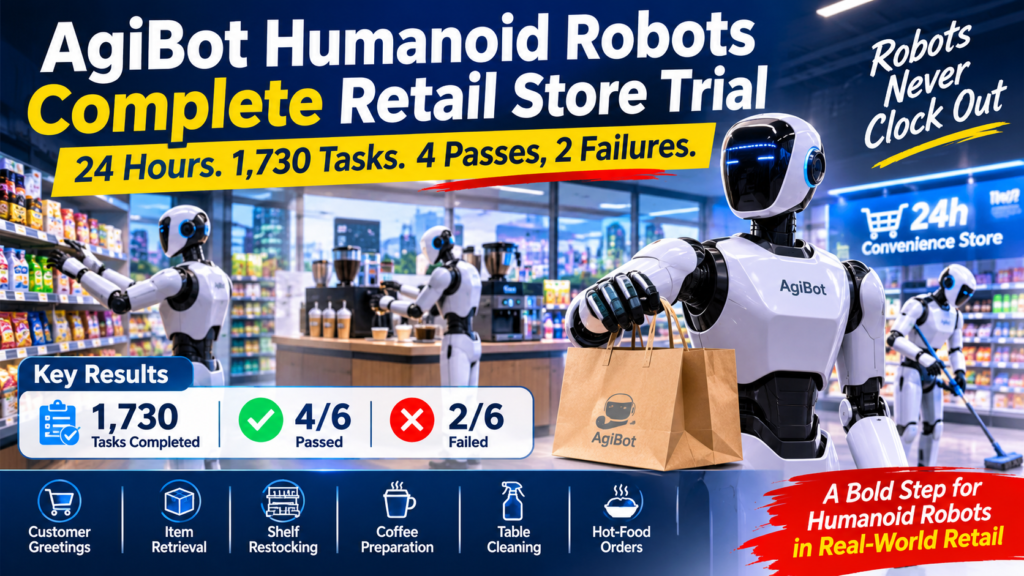
Can a humanoid robot hold down a real retail job? Partly, and the evidence just became much more concrete. In a livestreamed trial in Shanghai, six AgiBot humanoid robots staffed a working convenience store for 24 hours, completed 1,730 tasks, and four of the six passed their assessments.
That split is the whole story. This guide explains what happened, what the numbers show, why the two failures matter more than the successes, and what the experiment means for retailers, investors, and anyone tracking humanoid robots in retail as the machines leave showroom stages and enter real workplaces.
What Happened in the AgiBot Convenience Store Trial?
Short answer: From 10 a.m. on 2 November to 10 a.m. on 3 November 2026, six AgiBot G2 robots worked inside an operating convenience store in Shanghai’s Xuhui district while the event was livestreamed. Four passed their assessments, while a cleaning robot and a shelf-patrol robot fell short. techtimestechtimes
The company named the event “Robots Never Clock Out.” The goal was to test whether humanoid machines could handle everyday retail work across different periods of the day, rather than in a short, controlled demonstration. Because the store stayed open to customers, the robots dealt with real shoppers, real orders, and real mess. That detail separates this convenience store robot trial from the polished videos that usually define humanoid robotics news. techtimes
What Is the “Robots Never Clock Out” Challenge?
Definition: “Robots Never Clock Out” is the name AgiBot gave to a public, 24-hour stress test in which a team of G2 humanoid robots performed the duties of convenience store staff in front of a live audience.
Expansion: Most robot showcases are short, scripted, and filmed from flattering angles. This one ran around the clock, covered both rush hours and quiet overnight stretches, and took place inside a business serving customers. A format like that makes failures visible, which is why analysts find it more informative than a launch-event demo. It is also a bold piece of embodied AI marketing, because the company let the public watch its machines struggle in real time.
What did the robots actually do?
The six AgiBot G2 units were assigned different responsibilities, including greeting visitors, retrieving products, stocking shelves, preparing coffee and hot food, and clearing rubbish. That covers both “front of house” work, such as greeting and serving, and “back of house” work, such as inspection, restocking, and cleaning. The two groups demand different skills. Greeting is mostly about perception and conversation. Restocking and cleaning depend on manipulation, navigation, and judgment. techtimes
Why four time windows matter
The challenge covered four periods: the lunchtime rush, evening crowds, overnight operations, and the morning breakfast rush. Each window stresses a robot differently. Crowds test navigation and the ability to work around people. Overnight duty tests independence, since less human help is nearby. The breakfast sprint tests speed and consistency. AgiBot’s own promotion described the shifts as running from rush-hour crowds to late-night solo duty, which captures the design well. techtimes
The Numbers: What Six AgiBot Humanoid Robots Accomplished in 24 Hours
Together, the six machines completed 1,730 tasks. Here is how the reported total breaks down: techtimes
| Task category | Tasks completed | Approx. share of total |
|---|---|---|
| Customer greetings | 683 | 39.5% |
| Item retrievals and deliveries | 369 | 21.3% |
| Shelf inspections and restocking | 277 | 16.0% |
| Coffees prepared | 147 | 8.5% |
| Table cleaning | 128 | 7.4% |
| Hot-food orders | 126 | 7.3% |
| Total | 1,730 | 100% |
Task counts are as reported; the percentage shares are my own rounding.
Three patterns stand out:
- Greeting dominated the count. Nearly four in ten tasks were greetings, the least physically demanding item on the list.
- Physical work still made up about 60 percent. Retrieval, restocking, coffee, hot food, and table cleaning add up to roughly 1,047 tasks.
- Shelf work ranked third. The 277 inspection and restocking jobs form the category where one robot was marked down.
A quick calculation puts 1,730 tasks over 24 hours at about 72 tasks per hour across the group, or roughly 12 per robot per hour. Treat that as an illustration, not a benchmark. The coverage does not confirm that every machine worked continuously, so the AgiBot humanoid robots may have had pauses for charging or support.
Pass or Fail: How the Assessment Played Out
Only four of the six machines passed what the coverage describes as probation assessments. The two failures were not random. Each exposed a specific weakness. techtimes
Four of the six cleared the bar
The reports I reviewed name the two failures but do not break down the passing performances role by role. The best evidence that four AgiBot humanoid robots met expectations is the aggregate log: hundreds of greetings, deliveries, coffees, and hot-food orders over a full day, without the event being halted.
The cleaning robot that left its post
According to the Chinese outlet ITHome, a robot on overnight cleaning duty met an overflowing rubbish bin, strayed from its designated route, went outside the store, and did not return to its position. One outlet framed this as a robot walking off the job. The more precise description is a route deviation triggered by an unexpected condition. For store operators, the lesson is simple: robots follow planned routes well, but a messy world generates situations that routes do not cover. techtimes
The shelf-patrol robot that “lacked initiative”
The second failure was a robot assigned to patrol shelves and monitor stock levels. ITHome reported that it was too passive when inspecting and replenishing products and could not keep up with the store’s turnover. Initiative is a human word for something specific: noticing a gap on a shelf and filling it before anyone asks. A robot that only acts when told to will always trail a busy store. techtimes
Why the failures teach more than the passes
The incidents highlight a central challenge in humanoid robotics: performing a specific task is not the same as responding reliably when something unexpected happens. An overflowing bin or an empty shelf is trivial for a human clerk. For a machine, both require recognizing the problem, deciding it is within scope, and acting without a script. That gap between programmed tasks and adaptive judgment is where AgiBot humanoid robots, and their competitors, still have the most to prove. techtimes
Stress Tests: Cola, Obstacles, and a Shaking Container
The trial included deliberate curveballs. According to Machine Heart, participants asked the robots to distinguish regular from sugar-free Coca-Cola, placed obstacles in their paths, and shook a container while a robot tried to retrieve food. The robots reportedly identified and retrieved the right drinks, navigated around obstacles, and adjusted to the shaking container. techtimestechtimes
These tests matter because each targets a different capability:
- Cola identification tests fine-grained visual recognition.
- Obstacle placement tests path planning around surprises.
- The shaking container tests compliant manipulation, meaning adjusting grip and motion on the fly.
Passing them suggests the AgiBot humanoid robots handled several unexpected situations well. It also shows how narrow the gap is between a robot that copes with a staged surprise and one that copes with an unstaged one, like the overflowing bin.
What the Shanghai Trial Does Not Prove
Good analysis means separating what happened from what it implies. The coverage notes that a 24-hour event does not mean each robot worked non-stop, and the available reports do not independently establish whether machines needed charging breaks, maintenance, or remote oversight. Productivity and operating cost also remain unclear. techtimes
Key open questions include:
- Human help: How often did staff or remote operators step in?
- Uptime: How long did each robot actually run between charges?
- Cost per task: What would these tasks cost compared with human labor?
- Safety: How would performance hold up around children, crowds, or spills?
- Sample size: This was six robots, one store, and one day.
For productivity context, a January Irish Times report citing UBTech’s chief brand officer put its Walker S2 robots at roughly 30 to 50 percent of human-worker productivity in certain industrial tasks. That figure belongs to a different company’s machines and should not be applied to AgiBot’s. techtimes
Where AgiBot Stands in the Humanoid Race
AgiBot is a Shanghai-based robotics company founded in 2023. At CES 2026 it presented a full lineup of embodied robots built around a “one robotic body, three intelligences” framework. The company has also set a target of more than 10 billion yuan in revenue for 2027, with its Expedition series reported sold out for the second quarter. digitimescntechpost
That commercial push explains why the store trial matters. The ambitions behind AgiBot humanoid robots depend on proof that the machines work reliably outside controlled settings. Expectations have been tempered before. After Beijing’s humanoid half-marathon in April 2025, where only six of more than 20 robots finished, AgiBot partner Yao Maoqing estimated about five more years before humanoid robots deliver tangible value in homes. AgiBot did not enter that race, but the comment shows how the company itself frames the timeline. caixinglobal
Live Trial vs Staged Demo: How to Read AgiBot Humanoid Robots’ Results
Not all public robot tests are equal. Here is how the formats compare:
| Test format | Example | What it reveals | What it can hide |
|---|---|---|---|
| Staged product demo | On-stage showcase of a flagship humanoid at a launch event | Best-case capability | Failure rate, retries, human setup |
| Competition | Beijing humanoid half-marathon, April 2025 (six of 20+ robots finished) | Locomotion, endurance, stability | Manipulation and customer interaction |
| Live work trial | Shanghai 24-hour convenience store shift | Task mix and reliability under real conditions | Remote support, battery logistics, cost |
The Shanghai event is the most informative format of the three, because it mixes tasks, time pressure, and the public. It is still operator-run, so the right response is cautious interest rather than certainty. Independent audits of interventions, uptime, and costs would turn an impressive showcase into a reliable benchmark.
Can AgiBot Humanoid Robots Replace Shop Workers?
Direct answer: Not yet. The trial shows AgiBot humanoid robots can perform a meaningful range of routine retail tasks, but two of six failing their assessments, plus open questions about cost and supervision, make full replacement premature.
Expansion: Reliability, productivity, and cost all have to clear the bar together. A robot that greets well but cannot handle a full bin still needs a human nearby. Elsewhere, AGCO plans to trial Agility Robotics’ Digit humanoid at its Hesston, Kansas plant from 2027, and South Korea has approved a trial of 20 bipedal humanoids from Robros across semiconductor, automotive, shipbuilding, and logistics sites. These moves suggest the technology is leaving the lab. A reasonable reading is that near-term deployments will be narrow, supervised tasks rather than full job replacement. techtimes
Questions to Ask Before Buying AgiBot Humanoid Robots or a Rival
If you run a store, warehouse, or café and the Shanghai trial has you curious, use this checklist:
- Ask for intervention data. How many human or remote-operator interventions occurred per shift?
- Define the tasks. Start with narrow, repeatable jobs such as greeting, deliveries, or table cleaning.
- Test the edge cases. Spills, full bins, and blocked aisles are where the two failures happened.
- Measure uptime. Get battery life, charging time, and maintenance schedules in writing.
- Calculate cost per task. Compare against current labor costs, including supervision.
- Plan for safety. Confirm how robots behave around customers, children, and wet floors.
FAQ
How many AgiBot humanoid robots took part in the Shanghai trial?
Six AgiBot G2 units took part. Four passed their assessments and two did not.
When and where did the trial happen?
It ran from 10 a.m. on 2 November to 10 a.m. on 3 November 2026 at an operating convenience store in Shanghai’s Xuhui district, and it was livestreamed.
Why did two robots fail?
According to ITHome, as relayed by Tech Times UK, a cleaning robot strayed from its route after meeting an overflowing bin, and a shelf-patrol robot was too passive and could not keep pace with the store’s turnover.
Are AgiBot humanoid robots ready to run a store alone?
No. The results are promising for routine tasks, but independent data on supervision, uptime, and cost is still missing.
Key Takeaways
- AgiBot humanoid robots completed 1,730 tasks in 24 hours, but only four of six passed their assessments.
- The two failures involved unexpected situations: an overflowing bin and a store that needed proactive restocking.
- The robots handled several deliberate stress tests, including cola identification, obstacles, and a shaking container.
- The trial does not show how much human or remote support the machines needed, or what they would cost to run.
- Live work trials beat staged demos for credibility, but independent verification is the next step.
The Shanghai experiment is a useful reality check. It shows what humanoid robots in retail can do today, and it shows how much work remains before AgiBot humanoid robots can handle a shift without a safety net.
AgiBot ହ୍ୟୁମାନଏଡ୍ (ମାନବୀୟ ଆକୃତିର) ରୋବୋଟ୍ଗୁଡ଼ିକ ଏକ ଷ୍ଟୋର୍ରେ ୨୪ ଘଣ୍ଟିଆ ସିଫ୍ଟରେ କାମ କଲେ: ଚାରୋଟି ସଫଳତା ଏବଂ ଦୁଇଟି ବିଫଳତାରୁ କ’ଣ ଜଣାପଡ଼େ?
ଏକ ହ୍ୟୁମାନଏଡ୍ ରୋବୋଟ୍ କ’ଣ ପ୍ରକୃତ ଖୁଚୁରା ବିକ୍ରୟ (retail) କ୍ଷେତ୍ରରେ କାମ କରିପାରିବ? ଆଂଶିକ ଭାବରେ ହଁ, ଏବଂ ଏହାର ପ୍ରମାଣ ବର୍ତ୍ତମାନ ଅଧିକ ସ୍ପଷ୍ଟ ହୋଇଛି। ସାଂଘାଇରେ ଆୟୋଜିତ ଏକ ଲାଇଭ୍ ଷ୍ଟ୍ରିମ୍ (ସିଧା ପ୍ରସାରିତ) ପରୀକ୍ଷଣରେ, ଛଅଟି AgiBot ହ୍ୟୁମାନଏଡ୍ ରୋବୋଟ୍ ଏକ କାର୍ଯ୍ୟରତ ‘କନଭିନିଏନ୍ସ ଷ୍ଟୋର୍’ (ସୁବିଧାଜନକ ଷ୍ଟୋର୍) ରେ ୨୪ ଘଣ୍ଟା ଧରି କାମ କରିଥିଲେ। ସେମାନେ ମୋଟ ୧,୭୩୦ଟି କାର୍ଯ୍ୟ ସମ୍ପାଦନ କରିଥିଲେ ଏବଂ ଛଅଟି ମଧ୍ୟରୁ ଚାରୋଟି ରୋବୋଟ୍ ନିଜର ମୂଲ୍ୟାଙ୍କନରେ ସଫଳ ହୋଇଥିଲେ।
ଏହି ଫଳାଫଳ ହିଁ ପ୍ରକୃତ କାହାଣୀ ବୟାନ କରେ। ଏହି ଲେଖାରେ ବର୍ଣ୍ଣନା କରାଯାଇଛି ଯେ କ’ଣ ଘଟିଲା, ପରିସଂଖ୍ୟାନଗୁଡ଼ିକ କ’ଣ ଦର୍ଶାଉଛି, ସଫଳତା ଅପେକ୍ଷା ଦୁଇଟି ବିଫଳତା କାହିଁକି ଅଧିକ ଗୁରୁତ୍ୱପୂର୍ଣ୍ଣ, ଏବଂ ଖୁଚୁରା ବ୍ୟବସାୟୀ, ନିବେଶକ ତଥା ଏହି କ୍ଷେତ୍ର ଉପରେ ନଜର ରଖିଥିବା ବ୍ୟକ୍ତିଙ୍କ ପାଇଁ ଏହି ପରୀକ୍ଷଣର ଅର୍ଥ କ’ଣ। କାରଣ ବର୍ତ୍ତମାନ ଏହି ଯନ୍ତ୍ରଗୁଡ଼ିକ କେବଳ ଶୋ-ରୁମ୍ର ପ୍ରଦର୍ଶନୀ ସ୍ଥାନରୁ ବାହାରି ପ୍ରକୃତ କାର୍ଯ୍ୟକ୍ଷେତ୍ରରେ ପ୍ରବେଶ କରୁଛନ୍ତି।
AgiBot କନଭିନିଏନ୍ସ ଷ୍ଟୋର୍ ପରୀକ୍ଷଣରେ କ’ଣ ଘଟିଲା?
ସଂକ୍ଷିପ୍ତ ଉତ୍ତର: ୨ ନଭେମ୍ବର ୨୦୨୬ ସକାଳ ୧୦ଟାରୁ ୩ ନଭେମ୍ବର ୨୦୨୬ ସକାଳ ୧୦ଟା ପର୍ଯ୍ୟନ୍ତ, ଛଅଟି AgiBot G2 ରୋବୋଟ୍ ସାଂଘାଇର ‘ସୁହୁଇ’ (Xuhui) ଜିଲ୍ଲାରେ ଥିବା ଏକ କାର୍ଯ୍ୟରତ ଷ୍ଟୋର୍ରେ କାମ କରିଥିଲେ। ଏହି ସମୟରେ ସମଗ୍ର ଘଟଣାଟି ଲାଇଭ୍ ଷ୍ଟ୍ରିମ୍ କରାଯାଇଥିଲା। ଏଥିମଧ୍ୟରୁ ଚାରୋଟି ରୋବୋଟ୍ ନିଜର ମୂଲ୍ୟାଙ୍କନରେ ଉତ୍ତୀର୍ଣ୍ଣ ହୋଇଥିଲେ, କିନ୍ତୁ ସଫେଇ କାର୍ଯ୍ୟ କରୁଥିବା ଏବଂ ସେଲ୍ଫ (ଥାକ) ତଦାରଖ କରୁଥିବା ରୋବୋଟ୍ଗୁଡ଼ିକ ଆଶାନୁରୂପ ପ୍ରଦର୍ଶନ କରିପାରି ନଥିଲେ।
କମ୍ପାନୀ ଏହି କାର୍ଯ୍ୟକ୍ରମକୁ “ରୋବୋଟ୍ଗୁଡ଼ିକ କେବେବି କାମ ବନ୍ଦ କରନ୍ତି ନାହିଁ” (Robots Never Clock Out) ବୋଲି ନାମ ଏହି ପରୀକ୍ଷଣଟି ଦିନରାତି ଚାଲିଥିଲା; ଏଥିରେ ବ୍ୟସ୍ତବହୁଳ ସମୟ (rush hours) ଠାରୁ ଆରମ୍ଭ କରି ରାତିର ଶାନ୍ତ ସମୟ ପର୍ଯ୍ୟନ୍ତ ସବୁ ଅବଧି ଅନ୍ତର୍ଭୁକ୍ତ ଥିଲା ଏବଂ ଏହା ଗ୍ରାହକମାନଙ୍କୁ ସେବା ପ୍ରଦାନ କରୁଥିବା ଏକ ବ୍ୟବସାୟିକ ସ୍ଥାନରେ ଅନୁଷ୍ଠିତ ହୋଇଥିଲା। ଏଭଳି ଏକ ପରିବେଶରେ ଯଦି କୌଣସି ତ୍ରୁଟି କିମ୍ବା ବିଫଳତା ଦେଖାଦିଏ, ତେବେ ତାହା ସ୍ପଷ୍ଟ ଭାବରେ ଜଣାପଡ଼ିଯାଏ।
ସେଥିପାଇଁ ବିଶ୍ଳେଷକମାନେ ଏହାକୁ କୌଣସି ଉଦ୍ଘାଟନୀ କାର୍ଯ୍ୟକ୍ରମରେ ଦିଆଯାଉଥିବା ଡେମୋ (demo) ତୁଳନାରେ ଅଧିକ ତଥ୍ୟପୂର୍ଣ୍ଣ ବୋଲି ମନେ କରନ୍ତି। ଏହା ‘ଏମ୍ବଡିଡ୍ ଏଆଇ’ (embodied AI – ଶରୀରଧାରୀ କୃତ୍ରିମ ବୁଦ୍ଧିମତ୍ତା) ମାର୍କେଟିଂର ଏକ ସାହସିକ ଉଦାହରଣ, କାରଣ କମ୍ପାନୀଟି ସର୍ବସାଧାରଣଙ୍କ ସାମ୍ନାରେ ନିଜ ମେସିନ୍ଗୁଡ଼ିକୁ ବାସ୍ତବ ସମୟରେ (real-time) କାର୍ଯ୍ୟ କରିବା ବେଳେ ସମ୍ମୁଖୀନ ହେଉଥିବା ଆହ୍ୱାନଗୁଡ଼ିକୁ ଦେଖିବାର ସୁଯୋଗ ଦେଇଥିଲା।
ରୋବଟଗୁଡ଼ିକ ପ୍ରକୃତରେ କ’ଣ କଲେ?
ଛଅଟି ‘AgiBot G2’ ୟୁନିଟ୍କୁ ଭିନ୍ନ ଭିନ୍ନ ଦାୟିତ୍ୱ ଦିଆଯାଇଥିଲା। ଏଥିମଧ୍ୟରେ ଥିଲା – ଆଗନ୍ତୁକମାନଙ୍କୁ ସ୍ୱାଗତ କରିବା, ସାମଗ୍ରୀ ଆଣି ଦେବା, ସେଲ୍ଫ୍ (shelves) ରେ ସାମଗ୍ରୀ ସଜାଇ ରଖିବା, କଫି ଓ ଗରମ ଖାଦ୍ୟ ପ୍ରସ୍ତୁତ କରିବା ଏବଂ ଅଳିଆ ସଫା କରିବା। ଏଥିରେ ଉଭୟ “ସମ୍ମୁଖ ଭାଗ” (front of house – ଯେପରିକି ସ୍ୱାଗତ କରିବା ଓ ସେବା ଯୋଗାଇବା) ଏବଂ “ପଛ ଭାଗ” (back of house – ଯେପରିକି ଯାଞ୍ଚ କରିବା, ସାମଗ୍ରୀ ପୁନଃଭର୍ତ୍ତି କରିବା ଓ ସଫେଇ କାର୍ଯ୍ୟ) ସମ୍ବନ୍ଧୀୟ କାର୍ଯ୍ୟ ଅନ୍ତର୍ଭୁକ୍ତ ଥିଲା। ଏହି ଦୁଇ ପ୍ରକାର କାର୍ଯ୍ୟ ପାଇଁ ଭିନ୍ନ ଭିନ୍ନ ଦକ୍ଷତାର ଆବଶ୍ୟକତା ରହିଥାଏ।
ସ୍ୱାଗତ କରିବା କାର୍ଯ୍ୟଟି ମୁଖ୍ୟତଃ ପରିସ୍ଥିତିକୁ ବୁଝିବା (perception) ଏବଂ କଥାବାର୍ତ୍ତା ଉପରେ ନିର୍ଭର କରେ। ଅନ୍ୟପକ୍ଷରେ, ସାମଗ୍ରୀ ସଜାଇବା ଏବଂ ସଫେଇ କରିବା ପାଇଁ ବସ୍ତୁକୁ ହାତରେ ଧରିବା ବା ନିୟନ୍ତ୍ରଣ କରିବା (manipulation), ଚଳପ୍ରଚଳ କରିବା (navigation) ଏବଂ ଉଚିତ୍ ନିଷ୍ପତ୍ତି ନେବାର କ୍ଷମତା ଆବଶ୍ୟକ ହୁଏ।
ଚାରୋଟି ଭିନ୍ନ ସମୟ-ଅବଧି କାହିଁକି ଗୁରୁତ୍ୱପୂର୍ଣ୍ଣ?
ଏହି ପରୀକ୍ଷଣରେ ଚାରୋଟି ଭିନ୍ନ ସମୟ-ଅବଧି ଅନ୍ତର୍ଭୁକ୍ତ ଥିଲା: ଦ୍ୱିପହର ମୋଟ ସଂଖ୍ୟାର ଅଂଶ
ଗ୍ରାହକଙ୍କୁ ଅଭିବାଦନ ୬୮୩ ୩୯.୫%
ସାମଗ୍ରୀ ଆଣିବା ଏବଂ ପହଞ୍ଚାଇବା ୩୬୯ ୨୧.୩%
ଶେଲ୍ଫ୍ (ଆଲମାରି/ଷ୍ଟାଣ୍ଡ) ଯାଞ୍ଚ ଏବଂ ସାମଗ୍ରୀ ପୁନଃଭର୍ତ୍ତି ୨୭୭ ୧୬.୦%
କଫି ପ୍ରସ୍ତୁତି ୧୪୭ ୮.୫%
ଟେବୁଲ୍ ସଫା କରିବା ୧୨୮ ୭.୪%
ଗରମ ଖାଦ୍ୟର ଅର୍ଡର ୧୨୬ ୭.୩%
ମୋଟ ୧,୭୩୦ ୧୦୦%
କାର୍ଯ୍ୟ ସଂଖ୍ୟାଗୁଡ଼ିକ ରିପୋର୍ଟ ଅନୁଯାୟୀ ଦିଆଯାଇଛି; ପ୍ରତିଶତ ଅଂଶଗୁଡ଼ିକୁ ମୁଁ ନିକଟତମ ସଂଖ୍ୟାରେ (rounding) ପ୍ରକାଶ କରିଛି।
ଏଥିରେ ତିନୋଟି ମୁଖ୍ୟ ବିଷୟ ସାମ୍ନାକୁ ଆସିଛି:
ଅଭିବାଦନ କାର୍ଯ୍ୟ ସର୍ବାଧିକ ରହିଛି। ପ୍ରତି ଦଶଟି କାର୍ଯ୍ୟ ମଧ୍ୟରୁ ପ୍ରାୟ ଚାରୋଟି କାର୍ଯ୍ୟ ଥିଲା ଗ୍ରାହକଙ୍କୁ ଅଭିବାଦନ ଜଣାଇବା, ଯାହା ଏହି ତାଲିକାରେ ସବୁଠାରୁ କମ୍ ଶାରୀରିକ ପରିଶ୍ରମ ଆବଶ୍ୟକ କରୁଥିବା କାର୍ଯ୍ୟ ଅଟେ।
ଶାରୀରିକ ପରିଶ୍ରମ ଆବଶ୍ୟକ କରୁଥିବା କାର୍ଯ୍ୟଗୁଡ଼ିକ ମୋଟ କାର୍ଯ୍ୟର ପ୍ରାୟ ୬୦ ପ୍ରତିଶତ ଅଟେ। ସାମଗ୍ରୀ ଆଣିବା, ପୁନଃଭର୍ତ୍ତି କରିବା, କଫି ପ୍ରସ୍ତୁତ କରିବା, ଗରମ ଖାଦ୍ୟ ପହଞ୍ଚାଇବା ଏବଂ ଟେବୁଲ୍ ସଫା କରିବା – ଏସବୁ ମିଶି ପ୍ରାୟ ୧,୦୪୭ଟି କାର୍ଯ୍ୟ ହୋଇଛି।
ଶେଲ୍ଫ୍ ସମ୍ବନ୍ଧୀୟ କାର୍ଯ୍ୟ ତୃତୀୟ ସ୍ଥାନରେ ରହିଛି। ଯାଞ୍ଚ ଏବଂ ସାମଗ୍ରୀ ପୁନଃଭର୍ତ୍ତି କରିବାର ୨୭୭ଟି କାର୍ଯ୍ୟ ସେହି ବର୍ଗରେ ଆସେ, ଯେଉଁଥିପାଇଁ ଗୋଟିଏ ରୋବଟ୍ର ମୂଲ୍ୟାଙ୍କନ କମ୍ ରହିଥିଲା।
ଏକ ସାଧାରଣ ହିସାବ ଅନୁଯାୟୀ, ୨୪ ଘଣ୍ଟା ମଧ୍ୟରେ ୧,୭୩୦ଟି କାର୍ଯ୍ୟ ହୋଇଛି, ଯାହାର ଅର୍ଥ ହେଉଛି ସମସ୍ତ ରୋବଟ୍ ମିଶି ପ୍ରତି ଘଣ୍ଟାରେ ପ୍ରାୟ ୭୨ଟି କାର୍ଯ୍ୟ କରିଛନ୍ତି, ଅର୍ଥାତ୍ ପ୍ରତ୍ୟେକ ରୋବଟ୍ ପ୍ରତି ଘଣ୍ଟାରେ ପ୍ରାୟ ୧୨ଟି କାର୍ଯ୍ୟ କରିଛନ୍ତି। ଏହାକୁ କେବଳ ଏକ ଉଦାହରଣ ଭାବରେ ଗ୍ରହଣ କରନ୍ତୁ, କୌଣସି ନିର୍ଦ୍ଦିଷ୍ଟ ମାନଦଣ୍ଡ (benchmark) ଭାବରେ ନୁହେଁ। ଏହି ତଥ୍ୟରୁ ପ୍ରମାଣିତ ହୁଏ ନାହିଁ ଯେ ପ୍ରତ୍ୟେକ ମେସିନ୍ ନିରନ୍ତର କାମ କରୁଥିଲା; ତେଣୁ ‘ଆଜିବଟ୍’ (AgiBot) ହ୍ୟୁମାନଏଡ୍ ରୋବଟ୍ଗୁଡ଼ିକ ଚାର୍ଜିଂ କିମ୍ବା ଅନ୍ୟାନ୍ୟ ସହାୟତା ପାଇଁ କିଛି ସମୟ ପାଇଁ ଅଟକି ରହିଥାଇପାରନ୍ତି।
ସଫଳ କିମ୍ବା ବିଫଳ: ମୂଲ୍ୟାଙ୍କନ ପ୍ରକ୍ରିୟା କଦିନସାରା ଶହ ଶହ ଅଭିବାଦନ, ସାମଗ୍ରୀ ପହଞ୍ଚାଇବା, କଫି ପରିବେଷଣ ଏବଂ ଗରମ ଖାଦ୍ୟର ଅର୍ଡର ପୂରଣ କରାଗଲା, କିନ୍ତୁ ଏହି ପ୍ରକ୍ରିୟାରେ କୌଣସି ବାଧା ସୃଷ୍ଟି ହେଲା ନାହିଁ।
ସଫେଇ କାର୍ଯ୍ୟରେ ନିୟୋଜିତ ରୋବଟ୍ ଯିଏ ନିଜ ସ୍ଥାନ ଛାଡ଼ି ଚାଲିଗଲା
ଚାଇନିଜ୍ ଗଣମାଧ୍ୟମ ‘ଆଇଟିହୋମ୍’ (ITHome) ଅନୁଯାୟୀ, ରାତିରେ ସଫେଇ କାର୍ଯ୍ୟ କରୁଥିବା ଏକ ରୋବଟ୍ ଏକ ପୂର୍ଣ୍ଣ ହୋଇ ବାହାରକୁ ବାହାରି ପଡ଼ିଥିବା (overflowing) ଆବର୍ଜନା ପାତ୍ରର ସମ୍ମୁଖୀନ ହେଲା। ଏହା ଫଳରେ ରୋବଟ୍ଟି ନିର୍ଦ୍ଧାରିତ ପଥରୁ ବିଚ୍ୟୁତ ହୋଇ ଦୋକାନ ବାହାରକୁ ଚାଲିଗଲା ଏବଂ ନିଜ ସ୍ଥାନକୁ ଫେରିଲା ନାହିଁ। କିଛି ଗଣମାଧ୍ୟମ ଏହାକୁ ଏକ ରୋବଟ୍ ଦ୍ୱାରା କାମ ଛାଡ଼ି ପଳାଇଯିବା ଭାବରେ ବର୍ଣ୍ଣନା କରିଛନ୍ତି। କିନ୍ତୁ ପ୍ରକୃତରେ, ଏହା ଏକ ଅପ୍ରତ୍ୟାଶିତ ପରିସ୍ଥିତି ଯୋଗୁଁ ନିର୍ଦ୍ଧାରିତ ପଥରୁ ବିଚ୍ୟୁତ ହେବାର ଘଟଣା ଥିଲା। ଦୋକାନ ପରିଚାଳକମାନଙ୍କ ପାଇଁ ଏଥିରୁ ଏକ ସରଳ ଶିକ୍ଷା ମିଳେ: ରୋବଟ୍ଗୁଡ଼ିକ ଯୋଜନାବଦ୍ଧ ପଥ ଅନୁସରଣ କରିବାରେ ଦକ୍ଷ, କିନ୍ତୁ ବାସ୍ତବ ଦୁନିଆରେ ଏପରି ଅନେକ ପରିସ୍ଥିତି ସୃଷ୍ଟି ହୁଏ ଯାହା ପୂର୍ବରୁ ଯୋଜନା କରାଯାଇଥିବା ପଥ ମଧ୍ୟରେ ଅନ୍ତର୍ଭୁକ୍ତ ନୁହେଁ।
ଶେଲ୍ଫ୍ (ସାମଗ୍ରୀ ରଖିବା ସ୍ଥାନ) ତଦାରଖ କରୁଥିବା ରୋବଟ୍, ଯାହା ପାଖରେ “ନିଜ ଆଡ଼ୁ ପଦକ୍ଷେପ ନେବାର କ୍ଷମତା” (initiative) ନଥିଲା
ଦ୍ୱିତୀୟ ବିଫଳତାଟି ଏକ ରୋବଟ୍କୁ ନେଇ ଥିଲା, ଯାହାକୁ ଦୋକାନର ଶେଲ୍ଫ୍ଗୁଡ଼ିକ ଉପରେ ନଜର ରଖିବା ଏବଂ ସେଠାରେ ଥିବା ସାମଗ୍ରୀର ପରିମାଣ (stock levels) ଯାଞ୍ଚ କରିବାର ଦାୟିତ୍ୱ ଦିଆଯାଇଥିଲା। ‘ଆଇଟିହୋମ୍’ (ITHome) ଅନୁଯାୟୀ, ଉତ୍ପାଦଗୁଡ଼ିକୁ ଯାଞ୍ଚ କରିବା ଏବଂ ଖାଲି ସ୍ଥାନଗୁଡ଼ିକୁ ପୁନର୍ବାର ଭର୍ତ୍ତି କରିବା କ୍ଷେତ୍ରରେ ଏହି ରୋବଟ୍ଟି ଅତ୍ୟନ୍ତ ନିଷ୍କ୍ରିୟ ଥିଲା ଏବଂ ଦୋକାନର କାର୍ଯ୍ୟ ଗତି ସହ ତାଳ ଦେଇ ପାରିନଥିଲା। ‘ନିଜ ଆଡ଼ୁ ପଦକ୍ଷେପ ନେବା’ (Initiative) କହିଲେ ଏକ ନିର୍ଦ୍ଦିଷ୍ଟ ମାନବୀୟ ଗୁଣକୁ ବୁଝାଏ: ଯେପରିକି କୌଣସି ଶେଲ୍ଫ୍ରେ ଖାଲି ସ୍ଥାନ ଦେଖିବା ମାତ୍ରେ, କେହି କହିବା ପୂର୍ବରୁ ହିଁ ସେଠାରେ ସାମଗ୍ରୀ ରଖିଦେବା। techtimes
techtimes
ଏହି ପରୀକ୍ଷଣଗୁଡ଼ିକ ଗୁରୁତ୍ୱପୂର୍ଣ୍ଣ, କାରଣ ପ୍ରତ୍ୟେକଟି ଭିନ୍ନ ଭିନ୍ନ ଦକ୍ଷତାକୁ ପରୀକ୍ଷା କରିଥାଏ:
କୋଲା (Cola) ଚିହ୍ନଟ ପରୀକ୍ଷାଟି ସୂକ୍ଷ୍ମ ଦୃଶ୍ୟମାନ ଚିହ୍ନଟ କ୍ଷମତାକୁ ଯାଞ୍ଚ କରେ।
ବାଧା ସୃଷ୍ଟି କରିବା (Obstacle placement) ପରୀକ୍ଷାଟି ଅପ୍ରତ୍ୟାଶିତ ପରିସ୍ଥିତିରେ ରାସ୍ତା ବାଛିବା କ୍ଷମତାକୁ ପରୀକ୍ଷା କରେ।
ହଲୁଥିବା ପାତ୍ରକୁ ନେଇ କରାଯାଉଥିବା ପରୀକ୍ଷାଟି ‘ନମନୀୟ ପରିଚାଳନା’ (compliant manipulation) ବା କାର୍ଯ୍ୟ ସମୟରେ ଗ୍ରିପ୍ (ଧରିବା ଶୈଳୀ) ଓ ଗତିବିଧିକୁ ତୁରନ୍ତ ସମାଯୋଜନ କରିବାର ଦକ୍ଷତାକୁ ଯାଞ୍ଚ କରେ।
ଏହି ପରୀକ୍ଷଣଗୁଡ଼ିକରେ ଉତ୍ତୀର୍ଣ୍ଣ ହେବା ସୂଚିତ କରେ ଯେ, AgiBot ହ୍ୟୁମାନଏଡ୍ (ମନୁଷ୍ୟାକୃତି) ରୋବଟଗୁଡ଼ିକ ଅନେକ ଅପ୍ରତ୍ୟାଶିତ ପରିସ୍ଥିତିକୁ ଭଲ ଭାବରେ ସମ୍ଭାଳି ପାରିଛନ୍ତି। ଏହା ମଧ୍ୟ ଦର୍ଶାଏ ଯେ, ପୂର୍ବରୁ ଯୋଜନା କରାଯାଇଥିବା (staged) ଅପ୍ରତ୍ୟାଶିତ ଘଟଣା ଏବଂ ସମ୍ପୂର୍ଣ୍ଣ ଅପ୍ରତ୍ୟାଶିତ ଘଟଣା (ଯେପରିକି ଅତ୍ୟଧିକ ଭର୍ତ୍ତି ହୋଇଯାଇଥିବା ବିନ୍ ବା ପାତ୍ର) ମଧ୍ୟରେ ରୋବଟର ପ୍ରତିକ୍ରିୟା ମଧ୍ୟରେ ଥିବା ପାର୍ଥକ୍ୟ କେତେ କମ୍ ଅଟେ।
ସାଂଘାଇ ପରୀକ୍ଷଣରୁ କ’ଣ ପ୍ରମାଣିତ ହୁଏ ନାହିଁ?
ଏକ ଉତ୍ତମ ବିଶ୍ଳେଷଣର ଅର୍ଥ ହେଉଛି ଘଟିଥିବା ଘଟଣା ଏବଂ ତାହାର ଅର୍ଥ ବା ତାତ୍ପର୍ଯ୍ୟ ମଧ୍ୟରେ ପାର୍ଥକ୍ୟ ରଖିବା। ରିପୋର୍ଟଗୁଡ଼ିକରୁ ଜଣାପଡ଼େ ଯେ, ଏହି ୨୪ ଘଣ୍ଟିଆ କାର୍ଯ୍ୟକ୍ରମର ଅର୍ଥ ଏହା ନୁହେଁ ଯେ ପ୍ରତ୍ୟେକ ରୋବଟ୍ ବିନା ବିରତିରେ କାମ କରିଛନ୍ତି। ଉପଲବ୍ଧ ତଥ୍ୟରୁ ଏହା ସ୍ପଷ୍ଟ ହୁଏ ନାହିଁ ଯେ ମେସିନ୍ଗୁଡ଼ିକୁ ଚାର୍ଜିଂ ପାଇଁ ବିରତି, ରକ୍ଷଣାବେକ୍ଷଣ କିମ୍ବା ଦୂରରୁ ନିୟନ୍ତ୍ରଣ (remote oversight) ଆବଶ୍ୟକ ହୋଇଥିଲା କି ନାହିଁ। ଏହା ବ୍ୟତୀତ, ଉତ୍ପାଦନ କ୍ଷମତା ଏବଂ ପରିଚାଳନାଗତ ବ୍ୟୟ ସମ୍ବନ୍ଧୀୟ ତଥ୍ୟ ମଧ୍ୟ ଅସ୍ପଷ୍ଟ ରହିଛି।
techtimes
କିଛି ମୁଖ୍ୟ ଅନୁତ୍ତରିତ ପ୍ରଶ୍ନ ହେଉଛି:
ମାନବୀୟ ସହାୟତା: କର୍ମଚାରୀ କିମ୍ବା ଦୂରରୁ ନିୟନ୍ତ୍ରଣ କରୁଥିବା ବ୍ୟକ୍ତିମାନଙ୍କୁ କେତେ ଥର ହସ୍ତକ୍ଷେପ କରିବାକୁ ପଡ଼ିଥିଲା?
କାର୍ଯ୍ୟକ୍ଷମ ସମୟ (Uptime): ପ୍ରତ୍ୟେକ ରୋବଟ୍ ଚାର୍ଜ ହେବା ପରେ ପ୍ରକୃତରେ କେତେ ସମୟ ପର୍ଯ୍ୟନ୍ତ କାମ କରିପାରିଲା?
ପ୍ରତି କାର୍ଯ digitimes
cntechpost
ସେହି ବାଣିଜ୍ୟିକ ପଦକ୍ଷେପ ବ୍ୟାଖ୍ୟା କରେ ଯେ ଷ୍ଟୋର ଟ୍ରାଏଲ୍ କାହିଁକି ଗୁରୁତ୍ୱପୂର୍ଣ୍ଣ। AgiBot ହ୍ୟୁମାନାଇଡ୍ ରୋବୋଟ୍ ପଛରେ ଥିବା ମହତ୍ତ୍ୱାକାଂକ୍ଷା ପ୍ରମାଣ ଉପରେ ନିର୍ଭର କରେ ଯେ ମେସିନଗୁଡ଼ିକ ନିୟନ୍ତ୍ରିତ ସେଟିଂସ୍ ବାହାରେ ନିର୍ଭରଯୋଗ୍ୟ ଭାବରେ କାମ କରେ। ପୂର୍ବରୁ ଆଶାଗୁଡ଼ିକୁ କମ୍ କରାଯାଇଛି। ଏପ୍ରିଲ 2025 ରେ ବେଜିଂର ହ୍ୟୁମାନାଇଡ୍ ହାଫ୍-ମାରାଥନ୍ ପରେ, ଯେଉଁଠାରେ 20 ରୁ ଅଧିକ ରୋବୋଟ୍ ମଧ୍ୟରୁ କେବଳ ଛଅଟି ଶେଷ ହୋଇଥିଲା, AgiBot ସହଯୋଗୀ Yao Maoqing ପ୍ରାୟ ପାଞ୍ଚ ବର୍ଷ ପୂର୍ବରୁ ଆକଳନ କରିଥିଲେ ଯେ ହ୍ୟୁମାନାଇଡ୍ ରୋବୋଟ୍ ଘରେ ଦୃଶ୍ଯମାନ ମୂଲ୍ୟ ପ୍ରଦାନ କରନ୍ତି। AgiBot ସେହି ଦୌଡ଼ରେ ପ୍ରବେଶ କରିନଥିଲା, କିନ୍ତୁ ମନ୍ତବ୍ୟ ଦର୍ଶାଏ ଯେ କମ୍ପାନୀ ନିଜେ କିପରି ସମୟସୀମା ଫ୍ରେମ୍ କରେ।
caixinglobal
ଲାଇଭ୍ ଟ୍ରାଏଲ୍ ବନାମ ଷ୍ଟେଜ୍ ଡେମୋ: AgiBot ହ୍ୟୁମାନାଇଡ୍ ରୋବୋଟ୍ର ଫଳାଫଳ କିପରି ପଢ଼ିବେ
ସମସ୍ତ ସାର୍ବଜନୀନ ରୋବୋଟ୍ ପରୀକ୍ଷା ସମାନ ନୁହେଁ। ଫର୍ମାଟ୍ କିପରି ତୁଳନା କରାଯାଏ:
ପରୀକ୍ଷା ଫର୍ମାଟ୍ ଉଦାହରଣ ଏହା କ’ଣ ପ୍ରକାଶ କରେ ଏହା କ’ଣ ଲୁଚାଇପାରେ
ମଞ୍ଚିତ ଉତ୍ପାଦ ଡେମୋ ଏକ ଲଞ୍ଚ ଇଭେଣ୍ଟରେ ଏକ ଫ୍ଲାଗସିପ୍ ହ୍ୟୁମାନାଇଡ୍ର ଷ୍ଟେଜ୍ ପ୍ରଦର୍ଶନ ସର୍ବୋତ୍ତମ-କେସ୍ କ୍ଷମତା ବିଫଳତା ହାର, ପୁନଃପ୍ରୟାସ, ମାନବ ସେଟଅପ୍
ପ୍ରତିଯୋଗିତା ବେଜିଂ ହ୍ୟୁମାନାଇଅର୍ଦ୍ଧ-ମାରାଥନ୍ (half-marathon), ଏପ୍ରିଲ୍ ୨୦୨୫ (୨୦ରୁ ଅଧିକ ରୋବଟ୍ ମଧ୍ୟରୁ ୬ଟି ସଫଳତାର ସହ ସମ୍ପୂର୍ଣ୍ଣ କରିଥିଲେ) | ଗତିଶୀଳତା, ସହନଶୀଳତା, ସ୍ଥିରତା | ବସ୍ତୁ ହାତରେ ଧରିବା/କାର୍ଯ୍ୟ କରିବା (Manipulation) ଏବଂ ଗ୍ରାହକଙ୍କ ସହ ଯୋଗାଯୋଗ
ବାସ୍ତବ କାର୍ଯ୍ୟ ପରୀକ୍ଷଣ | ସାଂଘାଇର ଏକ ୨୪-ଘଣ୍ଟିଆ ଦୋକାନରେ (convenience store) କାର୍ଯ୍ୟ | ବାସ୍ତବ ପରିସ୍ଥିତିରେ ବିଭିନ୍ନ କାର୍ଯ୍ୟ ଏବଂ ନିର୍ଭରଯୋଗ୍ୟତା | ଦୂରରୁ ନିୟନ୍ତ୍ରଣ (Remote support), ବ୍ୟାଟେରୀ ପରିଚାଳନା, ଏବଂ ଖର୍ଚ୍ଚ
ଏହି ତିନୋଟି ମଧ୍ୟରୁ ସାଂଘାଇ ଇଭେଣ୍ଟଟି ସବୁଠାରୁ ଅଧିକ ତଥ୍ୟ ପ୍ରଦାନକାରୀ ଅଟେ, କାରଣ ଏଥିରେ ବିଭିନ୍ନ ପ୍ରକାରର କାର୍ଯ୍ୟ, ସମୟର ଚାପ ଏବଂ ସାଧାରଣ ଜନତାଙ୍କ ଉପସ୍ଥିତି ରହିଥାଏ।
ଏହା ଏବେ ମଧ୍ୟ ମାନବ ଅପରେଟରଙ୍କ ଦ୍ୱାରା ପରିଚାଳିତ ହେଉଛି, ତେଣୁ ଏହାକୁ ନେଇ ନିଶ୍ଚିତ ହେବା ପରିବର୍ତ୍ତେ ସତର୍କତାର ସହ ଆଗ୍ରହ ପ୍ରକାଶ କରିବା ଉଚିତ୍। ଯଦି ରୋବଟ୍ର କାର୍ଯ୍ୟରେ ମଣିଷର ହସ୍ତକ୍ଷେପ, କାର୍ଯ୍ୟକ୍ଷମ ସମୟ (uptime) ଏବଂ ଖର୍ଚ୍ଚ ଉପରେ ଏକ ସ୍ୱାଧୀନ ଅନୁସନ୍ଧାନ (audit) କରାଯାଏ, ତେବେ ଏହି ପ୍ରଭାବଶାଳୀ ପ୍ରଦର୍ଶନ ଏକ ନିର୍ଭରଯୋଗ୍ୟ ମାନଦଣ୍ଡରେ ପରିଣତ ହୋଇପାରିବ।
କ’ଣ AgiBot ହ୍ୟୁମାନଏଡ୍ (ମଣିଷ ଆକୃତିର) ରୋବଟ୍ଗୁଡ଼ିକ ଦୋକାନ କର୍ମଚାରୀଙ୍କ ସ୍ଥାନ ନେଇପାରିବେ?
ସିଧାସଳଖ ଉତ୍ତର: ବର୍ତ୍ତମାନ ପାଇଁ ନୁହେଁ। ପରୀକ୍ଷଣରୁ ଜଣାପଡ଼ିଛି ଯେ AgiBot ହ୍ୟୁମାନଏଡ୍ ରୋବଟ୍ଗୁଡ଼ିକ ଖୁଚୁରା ବ୍ୟବସାୟର ଅନେକ ନିୟମିତ କାର୍ଯ୍ୟ କରିପାରନ୍ତି। କିନ୍ତୁ, ୬ଟି ମଧ୍ୟରୁ ୨ଟି ରୋବଟ୍ ନିଜର ପରୀକ୍ଷଣରେ ବିଫଳ ହେବା ଏବଂ ଖର୍ଚ୍ଚ ତଥା ତଦାରଖ ସମ୍ବନ୍ଧୀୟ ଅନେକ ପ୍ରଶ୍ନ ବାକି ଥିବାରୁ, ମଣିଷ କର୍ମଚାରୀଙ୍କୁ ସମ୍ପୂର୍ଣ୍ଣ ରୂପେ ବଦଳାଇବା ପାଇଁ ଏହା ଏବେ ମଧ୍ୟ ବହୁତ ଶୀଘ୍ର ହେବ।
ବିସ୍ତୃତ ବିବରଣୀ: ନିର୍ଭରଯୋଗ୍ୟତା, ଉତ୍ପାଦନ କ୍ଷମତା ଏବଂ ଖର୍ଚ୍ଚ – ଏହି ସମସ୍ତ ଦିଗରେ ଉପଯୁକ୍ତ ମାନଦଣ୍ଡ ପୂରଣ ହେବା ଆବଶ୍ୟକ। ଯେଉଁ ରୋବଟ୍ ଗ୍ରାହକଙ୍କୁ ଭଲ ଭାବରେ ସ୍ୱାଗତ କରିପାରେ କିନ୍ତୁ ପୂର୍ଣ୍ଣ ହୋଇଯାଇଥିବା ଡବାରୁ (bin) ଜିନିଷ ସମ୍ଭାଳି ପାରେ ନାହିଁ, ସେଠାରେ ସୁରକ୍ଷା ପାଇଁ ଯୋଜନା କରନ୍ତୁ। ଗ୍ରାହକ, ପିଲାମାନେ ଏବଂ ଓଦା ଚଟାଣ ନିକଟରେ ରୋବୋଟଗୁଡ଼ିକ କିପରି ଆଚରଣ କରନ୍ତି, ତାହା ନିଶ୍ଚିତ କରନ୍ତୁ।
ସାଧାରଣତଃ ପଚରାଯାଉଥିବା ପ୍ରଶ୍ନ (FAQ)
ସାଂଘାଇ ପରୀକ୍ଷଣରେ କେତୋଟି ‘ଆଜିବଟ୍’ (AgiBot) ହ୍ୟୁମାନଏଡ୍ (ମଣିଷ ସଦୃଶ) ରୋବୋଟ୍ ଅଂଶଗ୍ରହଣ କରିଥିଲେ?
ଏଥିରେ ଛଅଟି ‘ଆଜିବଟ୍ G2’ (AgiBot G2) ୟୁନିଟ୍ ଅଂଶଗ୍ରହଣ କରିଥିଲେ। ସେଥିମଧ୍ୟରୁ ଚାରୋଟି ମୂଲ୍ୟାଙ୍କନରେ ଉତ୍ତୀର୍ଣ୍ଣ ହୋଇଥିଲେ ଏବଂ ଦୁଇଟି ଉତ୍ତୀର୍ଣ୍ଣ ହୋଇପାରିଲେ ନାହିଁ।
ଏହି ପରୀକ୍ଷଣ କେବେ ଏବଂ କେଉଁଠାରେ ଅନୁଷ୍ଠିତ ହୋଇଥିଲା?
ଏହା ୨୦୨୬ ମସିହା ନଭେମ୍ବର ୨ ତାରିଖ ସକାଳ ୧୦ଟାରୁ ନଭେମ୍ବର ୩ ତାରିଖ ସକାଳ ୧୦ଟା ପର୍ଯ୍ୟନ୍ତ ସାଂଘାଇର ‘ସୁହୁଇ’ (Xuhui) ଜିଲ୍ଲାରେ ଚାଲୁଥିବା ଏକ ସୁବିଧାଜନକ ଷ୍ଟୋର୍ରେ (convenience store) ଅନୁଷ୍ଠିତ ହୋଇଥିଲା ଏବଂ ଏହାର ସିଧାସମ୍ପ୍ରସାରଣ (livestream) କରାଯାଇଥିଲା।
ଦୁଇଟି ରୋବୋଟ୍ କାହିଁକି ବିଫଳ ହେଲେ?
‘ଟେକ୍ ଟାଇମ୍ସ ୟୁକେ’ (Tech Times UK) ଦ୍ୱାରା ଉଦ୍ଧୃତ ‘ଆଇଟିହୋମ୍’ (ITHome) ରିପୋର୍ଟ ଅନୁଯାୟୀ, ଗୋଟିଏ ସଫେଇ ରୋବୋଟ୍ ଅତ୍ୟଧିକ ଆବର୍ଜନା ଭର୍ତ୍ତି ହୋଇଥିବା ଏକ ଡବା (bin) ସାମ୍ନାକୁ ଆସିବା ପରେ ନିଜ ନିର୍ଦ୍ଧାରିତ ପଥରୁ ବିଚ୍ୟୁତ ହୋଇଯାଇଥିଲା। ଅନ୍ୟପକ୍ଷରେ, ସେଲ୍ଫ୍ (ସାମଗ୍ରୀ ରଖାଯାଉଥିବା ଥାକ) ଉପରେ ନଜର ରଖୁଥିବା ରୋବୋଟ୍ଟି ଅତ୍ୟଧିକ ନିଷ୍କ୍ରିୟ ଥିଲା ଏବଂ ଷ୍ଟୋର୍ର କାର୍ଯ୍ୟ ଗତି ସହିତ ତାଳ ଦେଇ ପାରିନଥିଲା।
‘ଆଜିବଟ୍’ ହ୍ୟୁମାନଏଡ୍ ରୋବୋଟଗୁଡ଼ିକ କ’ଣ ଏକାକୀ ଷ୍ଟୋର୍ ପରିଚାଳନା କରିବାକୁ ପ୍ରସ୍ତୁତ ଅଛନ୍ତି?
ନା। ନିୟମିତ କାର୍ଯ୍ୟଗୁଡ଼ିକ ପାଇଁ ଫଳାଫଳଗୁଡ଼ିକ ଆଶାଜନକ ଅଟେ, କିନ୍ତୁ ତଦାରଖ, କାର୍ଯ୍ୟକ୍ଷମ ସମୟ (uptime) ଏବଂ ଖର୍ଚ୍ଚ ସମ୍ବନ୍ଧୀୟ ସ୍ୱାଧୀନ ତଥ୍ୟ ଏପର୍ଯ୍ୟନ୍ତ ଉପଲବ୍ଧ ନାହିଁ।
ମୁଖ୍ୟ ପ୍ରସଙ୍ଗ
ଆଜିବଟ୍ ହ୍ୟୁମାନୋଇଡ୍ ରୋବୋଟ୍ 24 ଘଣ୍ଟା ମଧ୍ୟରେ 1,730ଟି କାର୍ଯ୍ୟ ସମାପ୍ତ କରିଛି, କିନ୍ତୁ ଛଅଟି ମଧ୍ୟରୁ କେବଳ ଚାରିଟି ସେମାନଙ୍କର ମୂଲ୍ୟାଙ୍କନରେ ପାସ୍ କରିଛି।
ଦୁଇଟି ବିଫଳତା ଅପ୍ରତ୍ୟାଶିତ ପରିସ୍ଥିତି ସହିତ ଜଡିତ: ଏକ ଓଭରଫ୍ଲୋ ଡବା ଏବଂ ଏକ ଷ୍ଟୋର ଯାହାକୁ ସକ୍ରିୟ ପୁନଃଷ୍ଟକ୍ କରିବା ଆବଶ୍ୟକ ଥିଲା।
ରୋବୋଟ୍ କୋଲା ଚିହ୍ନଟକରଣ, ପ୍ରତିବନ୍ଧକ ଏବଂ ଏକ ଥରୁଥିବା ପାତ୍ର ସମେତ ଅନେକ ଜାଣିଶୁଣି ଚାପ ପରୀକ୍ଷା ପରିଚାଳନା କରିଥିଲା।
ପରୀକ୍ଷଣ ଦର୍ଶାଏ ନାହିଁ ଯେ ମେସିନଗୁଡ଼ିକୁ କେତେ ମାନବ କିମ୍ବା ଦୂରବର୍ତ୍ତୀ ସମର୍ଥନ ଆବଶ୍ୟକ, କିମ୍ବା ସେଗୁଡ଼ିକୁ ଚଲାଇବା ପାଇଁ କେତେ ଖର୍ଚ୍ଚ ହେବ।
ଲାଇଭ୍ କାର୍ଯ୍ୟ ପରୀକ୍ଷଣ ବିଶ୍ୱସନୀୟତା ପାଇଁ ମଞ୍ଚସ୍ଥ ଡେମୋକୁ ପରାସ୍ତ କରିଛି, କିନ୍ତୁ ସ୍ୱାଧୀନ ଯାଞ୍ଚ ପରବର୍ତ୍ତୀ ପଦକ୍ଷେପ।
ସାଂଘାଇ ପରୀକ୍ଷଣ ଏକ ଉପଯୋଗୀ ବାସ୍ତବତା ଯାଞ୍ଚ। ଏହା ଦର୍ଶାଏ ଯେ ଆଜି ଖୁଚୁରା କ୍ଷେତ୍ରରେ ହ୍ୟୁମାନୋଇଡ୍ ରୋବୋଟ୍ କ’ଣ କରିପାରିବ, ଏବଂ ଏହା ଦର୍ଶାଏ ଯେ ସୁରକ୍ଷା ଜାଲ ବିନା AgiBot ହ୍ୟୁମାନୋଇଡ୍ ରୋବୋଟ୍ ଏକ ପରିବର୍ତ୍ତନ ପରିଚାଳନା କରିବା ପୂର୍ବରୁ କେତେ କାମ ବାକି ଅଛି।