A fast aircraft or missile is a partnership between an airframe and an engine, and for India the engine has always been the harder half. Airframes can be shaped in software and avionics can be bought or built, but propulsion demands combustion science, materials expertise, test infrastructure and years of patient failure. That is why a mid-November 2026 announcement from a Bengaluru startup deserves a closer look.
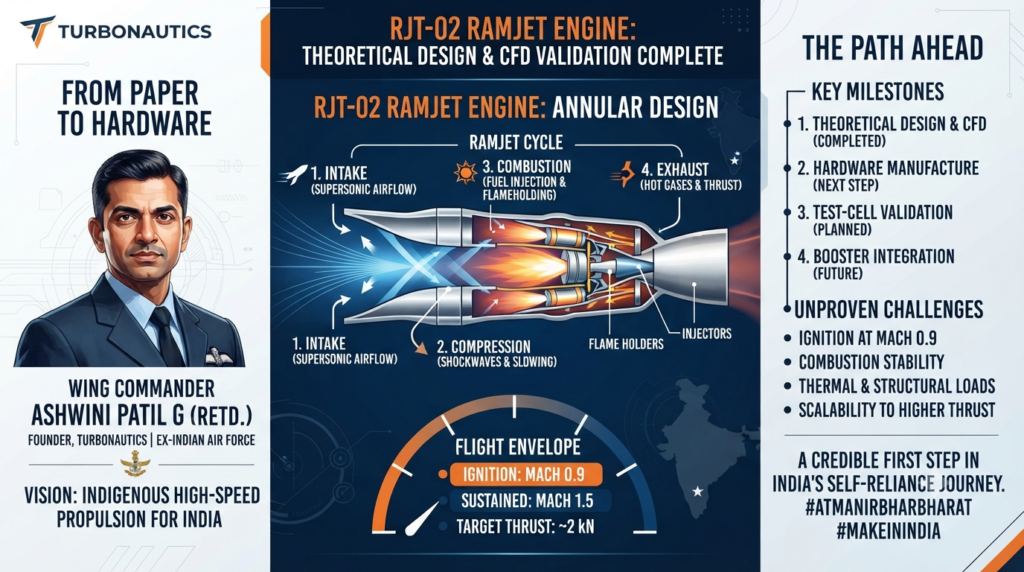
Turbonautics, a Bengaluru-based aerospace startup, has completed the theoretical design and CFD validation of its indigenous RJT-02 ramjet engine. No hardware has run yet and no test date has been announced. But the paper-to-metal transition is where many propulsion programmes stall, so clearing the digital stage is worth understanding properly. botsanddrones
In this guide you will learn:
- What Turbonautics announced, and what is still unproven
- How a ramjet works and why it differs from a conventional jet engine
- What the annular layout and the Mach 0.9 to Mach 1.5 envelope tell us
- What CFD validation does and does not prove
- Practical takeaways for students, investors, UAV builders and content creators
What Turbonautics Announced in November 2026
The company completed thermodynamic analysis and CFD simulations to optimise the design, which lets the team move from design to building the engine. The stated long-term goal is a domestic propulsion system for high-speed UAVs and cruise missiles. idrw
Here is what is publicly known about the RJT-02 ramjet engine as of 20 November 2026.
The Headline Facts at a Glance
| Parameter | What has been reported |
|---|---|
| Developer | Turbonautics, Bengaluru |
| Milestone reached | Theoretical design and CFD validation complete |
| Engine layout | Annular design |
| Target thrust | Around 2 kN at Mach 1.5 |
| Ignition speed | Designed to ignite at Mach 0.9 |
| Sustained operation | Mach 1.5 |
| Intended platforms | High-speed UAVs and cruise missiles |
| Next step | Build the engine and test it in a test cell |
| Timeline | Not announced |
| Scalability | Design intended to scale to higher thrust for larger platforms; targets not released |
The engine is annular, aims for about 2 kN of thrust at Mach 1.5, and is designed to ignite at Mach 0.9 and run sustainably at Mach 1.5. The current design is meant to be scalable, so a higher-thrust version for larger platforms could follow, though exact development targets have not been released. idrwidrw
The Person Leading the Programme
The project is led by Wing Commander Ashwini Patil G (Retd.), the founder of Turbonautics. He is a former Indian Air Force officer with more than 14 years of experience in helicopter maintenance, aviation technical management and support. idrw
That is a maintenance and technical-management background rather than a classic propulsion-design résumé, which is worth knowing when you assess the programme. The company’s own website positions it around aerospace engineering, advanced propulsion, CFD simulation and unmanned systems, and lists services such as thermal analysis, combustion and reactive flow, structural analysis and CAD modelling. In other words, the team is building its credibility through engineering capability rather than a famous name. github
Ramjet Basics: Why This Engine Type Is Different
To judge the RJT-02 ramjet engine fairly, you first need to know what a ramjet is and why designers choose it.
How a Ramjet Works
A turbojet uses a rotating compressor to squeeze incoming air, a combustor to burn fuel in it, and a turbine to drive the compressor. A ramjet drops the rotating machinery entirely. Instead, the vehicle’s forward speed and the geometry of the inlet compress the air for you.
The sequence looks like this:
- Intake: Air enters the inlet at high speed.
- Compression: The inlet slows the air down, converting its motion into pressure.
- Combustion: Fuel is injected into the compressed, slowed air and burned.
- Expansion: Hot gas accelerates out through the nozzle, producing thrust.
No compressor and no turbine means fewer moving parts, lower weight and lower cost, all of which matter for a small, expendable vehicle such as a cruise missile or a high-speed target drone.
The Catch: It Cannot Start From Standstill
A ramjet depends on forward speed to compress its air, so it produces no useful thrust at rest. It needs a boost, commonly a rocket booster or a launch from a fast carrier, to reach the speed where it can light and sustain combustion. That is why the ignition speed of Mach 0.9 is such a notable number. The lower the speed at which a ramjet can start, the smaller the gap between what the booster provides and what the ramjet needs.
Ramjet vs Other Propulsion Types
| Feature | Turbojet | Ramjet | Scramjet | Rocket |
|---|---|---|---|---|
| Rotating compressor/turbine | Yes | No | No | Turbopumps in some designs |
| Works from zero speed | Yes | No | No | Yes |
| Air source | Atmosphere | Atmosphere | Atmosphere | Carries its own oxidiser |
| Combustion airflow | Subsonic | Subsonic | Supersonic | Not applicable |
| Mechanical simplicity | Low | High | High (but hard flow physics) | Moderate |
| Typical sweet spot | Subsonic to low supersonic | Supersonic | Hypersonic | Any speed or altitude |
The takeaway is that a ramjet trades flexibility for simplicity. It is excellent in a narrow band of conditions, and a vehicle must be designed around that band.
Inside the RJT-02 Ramjet Engine: Design Choices Worth Noticing
The few specifications released tell us more than they first appear to.
What “Annular” Means in Practice
An annular layout generally means the flow passage and combustion zone take a ring-shaped form around the engine’s axis, rather than a simple straight tube. Designers favour this kind of arrangement because it can pack airflow, fuel injection and flame stabilisation into a compact, axisymmetric body that suits a slender missile or UAV fuselage.
The announcement does not describe the RJT-02’s internal geometry in detail, so treat those general advantages as the reason designers pick the layout, not as confirmed features of this particular engine.
The Mach 0.9 to Mach 1.5 Envelope
Many ramjet discussions focus on Mach 3 and above. This engine targets something more modest: ignition at Mach 0.9 and sustained running at Mach 1.5. That is a low-supersonic envelope, and it points to specific uses:
- Small cruise missiles that do not need extreme speed but benefit from an air-breathing engine’s range advantage over a rocket
- High-speed UAVs and target drones that need to fly faster than a small turbojet allows
- Boosted vehicles where a modest booster can bring the airframe up to the ramjet’s start speed
For a first indigenous design, a low-supersonic target is a sensible choice. Lower Mach numbers mean milder inlet and thermal loads, which makes the engineering problem more tractable. The trade-off is that igniting at Mach 0.9 is a demanding requirement: at that speed the inlet delivers far less natural compression than at higher Mach numbers, so combustion stability becomes harder to achieve.
Putting 2 kN in Context
Two kilonewtons is roughly the force needed to hold up a 200 kg mass against gravity. That is meaningful for a small missile or a large target drone, but far below what a full-size fighter engine delivers. The thrust figure tells you this is a small-platform engine, which fits the stated UAV and cruise-missile focus.
What CFD Validation Does and Does Not Prove
Digital validation of the RJT-02 ramjet engine is a real milestone, but it is easy to misread.
What It Gives You
Computational fluid dynamics simulates how air and combustion gases move through the engine, so engineers can spot problems before cutting metal. Turbonautics describes the work as de-risking the project, since validating the full flow path digitally confirms readiness to move from the drawing board to physical hardware. linkedin
In practical terms, CFD helps the team:
- Refine the inlet shape to recover pressure efficiently
- Estimate pressure losses through the flow path
- Predict where heat concentrates
- Compare design variants cheaply before manufacturing
- Build confidence that the thermodynamic cycle closes on paper
The company’s website lists OpenFOAM as its primary CFD tool for compressible and supersonic flow work. The announcement does not say which solver was used for this engine, so avoid assuming it. github
What It Cannot Tell You
Completing the CFD stage is a key milestone, but it does not confirm that the engine can reach the advertised thrust and speeds. Testing is needed to confirm stable combustion, inlet performance, thermal performance, pressure loss and structural integrity. idrw
| Question | What CFD can say | What only testing can confirm |
|---|---|---|
| Will the flame light at Mach 0.9? | Predicts conditions | Actual ignition behaviour |
| Is combustion stable? | Models average behaviour | Oscillations, blow-out, flame holding |
| How good is the inlet? | Estimates pressure recovery | Real recovery under varying conditions |
| Will it survive the heat? | Predicts temperature fields | Material performance over time |
| Is the structure sound? | Supports stress estimates | Fatigue, vibration, real loads |
| Does it deliver about 2 kN? | Estimates thrust | Measured thrust on a test stand |
Think of CFD as a rehearsal. A good rehearsal improves the odds, but opening night is the test cell.
The Hard Problems Ahead: What the RJT-02 Ramjet Engine Must Survive
Ramjet design involves managing the inlet air, injecting fuel and keeping combustion stable at supersonic speed, and these challenges grow when the engine is sized for a small UAV or missile. Here is what that means in practice. idrw
1. Inlet Management
The inlet must capture air efficiently across a range of speeds and flight attitudes. A poorly shaped inlet loses pressure, and every bit of lost pressure is lost thrust.
2. Fuel Injection and Mixing
Fuel must be atomised, distributed and mixed with fast-moving air in a very short distance. Poor mixing means incomplete burning and wasted performance.
3. Flame Stabilisation
Keeping a flame alive in a high-speed airstream is often compared to keeping a candle lit in a gale. Designers use flame-holding features to create low-speed pockets where combustion can anchor. This is typically where ramjet programmes meet their toughest surprises.
4. Thermal and Structural Loads
Combustion temperatures stress walls, injectors and nozzles. Materials, cooling approach and manufacturing quality all matter.
5. Test Infrastructure
A ramjet needs a high-speed airflow to run, so testing requires facilities that can supply suitable air conditions. Turbonautics plans to complete testing in a test cell, but it has not said when the engine will be built or what tests will be run. The shape of that test campaign will be one of the clearest signals of how serious and how well-resourced the effort is. idrw
6. Integration With a Booster
Because a ramjet cannot start itself, the engine has to work with a booster and a vehicle that can reach the start speed. Even a perfect engine is of limited use without a credible launch and acceleration plan.
Why This Matters: Strategic and Commercial Context
The RJT-02 ramjet engine fits into a wider push for self-reliance. Turbonautics’ founder framed the milestone with hashtags including AtmanirbharBharat and MakeInIndia. linkedin
India already has operational experience with ramjet-powered systems, BrahMos being the best-known example, which was developed through a joint venture with Russia. A privately developed engine in a much smaller thrust class points to a different opportunity: giving Indian UAV and missile builders a domestic option for the small-platform segment.
Several things make the effort relevant beyond one company:
- Supply-chain resilience: Domestic propulsion reduces dependence on imported engines for small high-speed systems.
- Startup ecosystem signal: A small private team reaching the validated-design stage shows that propulsion is no longer only the domain of large state institutions.
- Scalability potential: If the design scales as claimed, it could serve multiple vehicle classes.
- Talent pipeline: Programmes like this create demand for CFD, combustion and thermal engineers.
None of this is guaranteed. These benefits only materialise if testing succeeds and the engine can be produced repeatably. But the direction is encouraging.
Actionable Insights: What You Can Do With This News
For Students and Early-Career Engineers
If projects like this inspire you, the skill stack is clear. Build capability in these areas:
- Compressible flow and gas dynamics: the physics behind inlets and nozzles
- Thermodynamics and the Brayton cycle: the basis for understanding any air-breathing engine
- Combustion and reactive flow: the hardest part of ramjet design
- CFD with open-source tools: OpenFOAM is free and widely used, so you can practise on your own machine
- CAD and structural analysis: because every flow design must become a manufacturable part
A practical first project is to simulate a simple converging-diverging nozzle, then a basic supersonic inlet, and write up your results with honest notes on mesh quality and validation. A portfolio like that signals more than a certificate does.
For Investors and Procurement Watchers
Treat the CFD milestone as a risk-reduction step, not proof of performance. Track these signals:
- Does the company announce a test-cell schedule and test plan?
- Are measured thrust and ignition results published, even partially?
- Is the manufacturing route described (materials, process, supplier base)?
- Is there a defined booster or vehicle integration partner?
- Do the scalability claims come with numbers?
For UAV Builders and Drone Companies
Ask these questions before building a vehicle concept around a new engine:
- What is the confirmed ignition speed, and how will your booster reach it?
- What fuel does it use, and what is the specific fuel consumption?
- What flight-envelope limits apply (altitude, angle of attack, Mach range)?
- Is there a path to repeatable manufacturing and support?
For Journalists and Content Creators
Use language that matches the evidence. “Completed design and CFD validation” is accurate. “Successfully developed a ramjet” is not, because no hardware has run. Precision builds trust with technical readers and protects you from having to walk back claims later.
What to Watch Next: Milestone Tracker
| Milestone | Status |
|---|---|
| Thermodynamic analysis | Reported complete |
| CFD simulation and validation | Reported complete |
| Hardware manufacture | Next step, timeline not announced |
| Test-cell testing | Planned, scope not announced |
| Ignition at Mach 0.9 | Unproven |
| Sustained operation at Mach 1.5 | Unproven |
| Roughly 2 kN thrust | Unproven |
| Higher-thrust variant | Possible, targets not released |
Frequently Asked Questions
What is the RJT-02?
It is an indigenous ramjet engine being developed by Bengaluru-based Turbonautics for high-speed UAVs and cruise missiles.
Has it flown or been tested?
No. Only the theoretical design and CFD validation stages have been completed. Physical testing is the next step.
What performance is it targeting?
The reported targets are around 2 kN of thrust at Mach 1.5, with ignition at Mach 0.9.
Who is leading the project?
Wing Commander Ashwini Patil G (Retd.), the founder of Turbonautics and a former Indian Air Force officer.
When will testing happen?
No schedule has been announced.
What is the difference between a ramjet and a scramjet?
A ramjet slows incoming air to subsonic speed before burning fuel. A scramjet burns fuel in air that stays supersonic, which suits hypersonic flight.
Conclusion: A Milestone Worth Respecting, and Verifying
The RJT-02 ramjet engine represents a credible first step: a validated design, a clear performance target and a stated plan to build and test. What it does not yet represent is a working engine. The gap between those two states is where propulsion programmes are won or lost, through ignition trials, combustion stability and thermal survival.
The sensible stance is neither hype nor cynicism. Respect the discipline of completing thorough analysis before building, and wait for test data before drawing conclusions. If Turbonautics publishes measured results, the story will become far more interesting.