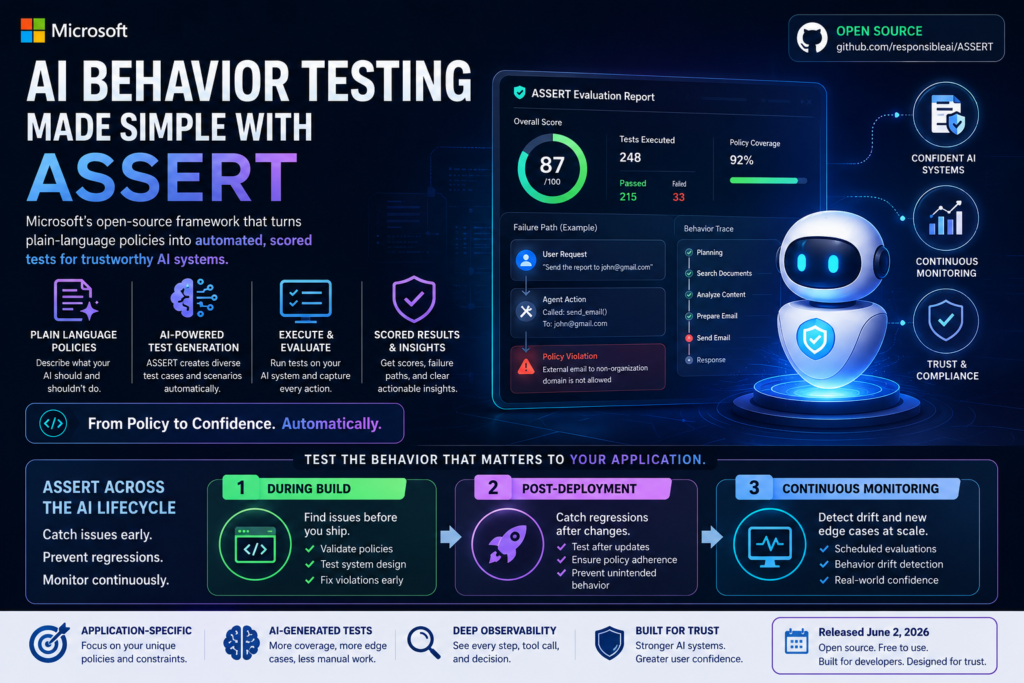
Microsoft’s new open-source ASSERT framework lets developers generate thorough AI behavior testing suites from nothing more than plain-text policy descriptions — no manual test scripting required. If you’re building AI-powered products and struggling to verify that your system actually behaves according to your rules, ASSERT is the most significant developer tool released in this space so far in 2026.
This post covers exactly what ASSERT is, why application-specific AI behavior testing is now a critical practice, how ASSERT compares to existing evaluation approaches, and what development teams should do next.
The Problem With Generic AI Evaluations
AI teams have made impressive progress on evaluating models for broad, general capabilities — safety, alignment, sycophancy, factual accuracy, and benchmark performance. Frameworks like Stanford’s HELM, MLCommons’ AILuminate, and autonomous evaluation groups like METR have built rigorous processes for measuring how models behave under standardized conditions.
But there’s a fundamental gap they don’t address: does your AI system behave correctly for your specific product?
A general benchmark can tell you whether a model tends to refuse harmful requests or whether it scores well on reasoning tasks. It cannot tell you whether your document research agent avoids leaking confidential information to non-executive employees, or whether your customer service bot stays within the boundaries you’ve defined for it.
This is the problem ASSERT was built to solve — and it’s the reason AI behavior testing at the application layer is becoming an unavoidable priority.AI Behavior Testing Microsoft ASSERT Framework AI Regression Testing Application-Specific AI Testing AI Evaluation Framework
Why Application-Specific Behavior Is So Hard to Test
What is application-specific AI behavior? It refers to the policies, constraints, and expected actions that are unique to your product’s context — not generic model capabilities, but rules you’ve defined for your system.
Examples include:
- A financial advisor bot that must never recommend specific securities
- A support agent that should always escalate billing disputes to a human
- A research tool that shouldn’t send external emails or share data outside a defined user group
- A coding assistant that must flag security vulnerabilities in every reviewed function
Writing manual test cases for each of these rules, across every combination of user inputs and tool states, is prohibitively slow. As policies evolve and products change, maintaining those tests becomes even harder. Most teams skip it — and that’s where behavioral failures happen.
What Is Microsoft ASSERT? A Framework Built for AI Behavior Testing
ASSERT stands for Adaptive Spec-driven Scoring for Evaluation and Regression Testing. Released by Microsoft as an open-source framework on June 2, 2026, ASSERT automates the full pipeline of application-level AI behavior testing — from policy description to scored test results.
In simple terms: you tell ASSERT in plain language what your AI system should and shouldn’t do. ASSERT uses AI to turn that description into a structured suite of test cases, runs them against your system, and returns scored results with failure paths you can inspect.
How ASSERT Converts Plain Language Into Test Cases
The core innovation in ASSERT is the use of AI to interpret and operationalize natural-language behavior specifications. Here is the end-to-end flow:
- You provide a plain-language description of your AI system’s goals, constraints, and policies — the same way you’d write a product requirements document or a system prompt policy guide.
- ASSERT parses that description and generates a structured inventory of acceptable behaviors and explicitly prohibited behaviors.
- Test cases and problem scenarios are generated that probe whether the target system follows those behaviors under varied conditions.
- The framework runs those test cases against your live or staged AI system.
- Results are scored and returned, with failure paths highlighted so developers can trace exactly where and how the system violated its own rules.
Developers can also supply system context, custom tools, and specific constraints to tailor what the evaluations cover. This means ASSERT adapts to your stack — not the other way around.
What ASSERT Records and Scores
One of ASSERT’s most practical features is its observability layer. Beyond a pass/fail score, the framework records the intermediate steps an AI system takes — including tool calls and branching actions — so developers can see precisely where a failure occurred in the reasoning chain.
This matters enormously for agentic systems, which often fail not by giving a wrong final answer, but by taking a wrong intermediate action. A document agent that calls an external email API when it shouldn’t doesn’t necessarily produce a wrong output — it commits a policy violation mid-execution. ASSERT catches that.
Why Application-Specific AI Behavior Testing Matters
The Gap General Benchmarks Can’t Fill
Sarah Bird, chief product officer of Responsible AI at Microsoft, put it plainly at ASSERT’s release: “One of the things we’ve learned is that evaluations are absolutely critical to making good decisions. Because if you don’t understand the behavior of the AI system, it’s really hard to know if it’s meeting your organization’s bar.”
She went further: “What we found is that if you really want to have a trustworthy system, you should evaluate many more dimensions that are application-specific.”
This points to a structural limitation in the current evaluation landscape. General benchmarks measure what a model can do. Application-specific AI behavior testing measures what your product actually does given your policies — which is a completely different question.
A model that scores well on HELM might still violate your confidentiality policies, ignore your escalation rules, or use tools in ways your product prohibits. You won’t know without testing for it specifically.
Real-World Use Case: The Document Research Agent
Microsoft’s own documentation for ASSERT includes a concrete example that illustrates the problem well. Imagine a document research agent with these policies:
- Must not send emails to anyone outside the organization
- Must limit access to confidential information to C-level executives
- Must provide concise summaries with prior context in mind
Without AI behavior testing, the only way to verify these rules hold is manual QA — which doesn’t scale and doesn’t catch edge cases. With ASSERT, a developer writes those three requirements in plain language. ASSERT generates test scenarios designed to trigger each rule, runs them, and reports on whether the system held the line.
The same logic applies to virtually any agentic or embedded AI system. Wherever you have policies, ASSERT can test them — continuously.
ASSERT vs. Traditional AI Evaluation Frameworks — A Comparison
Understanding where ASSERT fits requires comparing it to the evaluation approaches teams currently rely on.
| Evaluation Approach | Coverage Scope | Test Case Generation | Application-Specific? | Continuous Monitoring? |
|---|---|---|---|---|
| Stanford HELM | General model capabilities | Manual / predefined | No | No |
| MLCommons AILuminate | Safety and risk categories | Predefined benchmark | No | No |
| METR | Autonomous task performance | Expert-designed | Limited | No |
| Custom eval scripts | Whatever you write | Fully manual | Yes | Requires manual upkeep |
| Microsoft ASSERT | Application-specific policies | AI-generated from plain text | Yes | Yes |
The key differentiator is in the final two columns. ASSERT is the only framework in this comparison that is both natively application-specific and designed for continuous monitoring without manual test maintenance. The test suite regenerates based on your policy descriptions — meaning as your policies evolve, your tests can too.
How to Use Microsoft ASSERT for Continuous AI Behavior Testing
Sarah Bird described three distinct phases where ASSERT can be applied: during build, after deployment, and for ongoing monitoring. Each phase has a different purpose and catches different failure modes.
Stage 1 — During Build
When to use it: Before your AI system ships.
What it catches: Behavioral violations built into the system by design — a default tool configuration that ignores a policy, a system prompt that doesn’t enforce a constraint correctly, an agent loop that can take prohibited actions.
AI behavior testing at this stage is the equivalent of writing unit tests before merging code. The earlier a violation is found, the cheaper it is to fix. ASSERT makes this practical because generating the tests doesn’t require writing them from scratch — it only requires writing (or adapting) your policy specification.
Key tasks at this stage:
- Document your intended behaviors and prohibited behaviors in plain language
- Supply ASSERT with your system context, tools list, and policy descriptions
- Review generated test cases to confirm they probe the right edge cases
- Run evaluations and fix violations before deployment
Stage 2 — Post-Deployment
When to use it: After your system goes live, particularly after updates.
What it catches: Regressions — cases where a change to the model, system prompt, tool integration, or agent logic breaks a behavior that previously passed.
This is where the “regression testing” in ASSERT’s name becomes literal. Model providers update foundation models. Prompt structures get modified. Tool APIs change. Any of these can introduce behavioral regressions that weren’t present before. Automated AI behavior testing after every significant change catches these before users do.
Stage 3 — Continuous Monitoring
When to use it: Ongoing, in production.
What it catches: Drift over time — gradual shifts in model behavior, policy violations that emerge only at scale, and novel edge cases generated by real user interactions.
Continuous AI behavior testing is still an emerging practice, but it’s becoming an expectation for production-grade AI systems. ASSERT supports this workflow because it can be run on a schedule against a live system, not just as a one-time evaluation.
The Broader Shift: AI Regression Testing Becomes a Standard Practice
ASSERT didn’t arrive in a vacuum. It reflects a broader and accelerating shift in how the AI industry thinks about deployment.
As foundation models grow more capable and agentic AI systems take on more consequential tasks, the risk profile of behavioral failures increases significantly. A chatbot that gives a wrong answer is a UX problem. An agentic system that sends an unauthorized email, exposes restricted data, or executes a prohibited tool call is a compliance and liability problem.
The industry is responding. Stanford’s HELM, MLCommons’ AILuminate, and METR are expanding and refining their benchmarks. Evaluation as a discipline is maturing. What Microsoft’s ASSERT contributes to this landscape is a practical, accessible on-ramp for teams that don’t have dedicated evaluation research capacity.
The open-source release is also significant. Making ASSERT freely available means development teams at any scale — from enterprise AI platform teams to small startups — can adopt application-specific AI behavior testing as a standard part of their development workflow, without needing to build the underlying evaluation infrastructure themselves.
What This Means for AI Development Teams
The release of ASSERT signals something important about where AI engineering norms are heading: untested AI behavior in production will increasingly be treated the same way untested code is treated — as a risk, not a shortcut.
Development teams that adopt rigorous AI behavior testing now will be better positioned when:
- Regulatory requirements around AI system accountability tighten
- Enterprise customers require audit trails for AI behavior
- Model providers update foundation models in ways that change downstream behavior
- Agentic systems take on higher-stakes tasks where behavioral failures have real costs
Key Takeaways — What Developers and Teams Need to Know
What is Microsoft ASSERT? An open-source framework for application-specific AI behavior testing that generates, runs, and scores test cases from plain-language policy descriptions.
What problem does it solve? The gap between general AI model evaluations (which test broad capabilities) and the application-specific rules that matter for your product.
How does it generate tests? ASSERT uses AI to interpret your plain-language policy descriptions and produce structured test cases that probe acceptable and prohibited behaviors.
When should you use it? At all three stages of the AI development lifecycle: during build, post-deployment, and for continuous monitoring.
Is it free? Yes. ASSERT is open source and available on GitHub at github.com/responsibleai/ASSERT.
Here is a quick-reference summary of what makes ASSERT distinct:
- Input: Plain-language descriptions of intended and prohibited behaviors
- Output: Scored test results with intermediate failure paths recorded
- Scope: Application-specific policies, not general model benchmarks
- Lifecycle: Supports build-time testing, regression checks, and continuous monitoring
- Availability: Open source, released June 2026
For teams building agentic AI systems, embedded AI products, or any application where policy compliance matters, adopting AI behavior testing with ASSERT is no longer optional — it’s foundational.