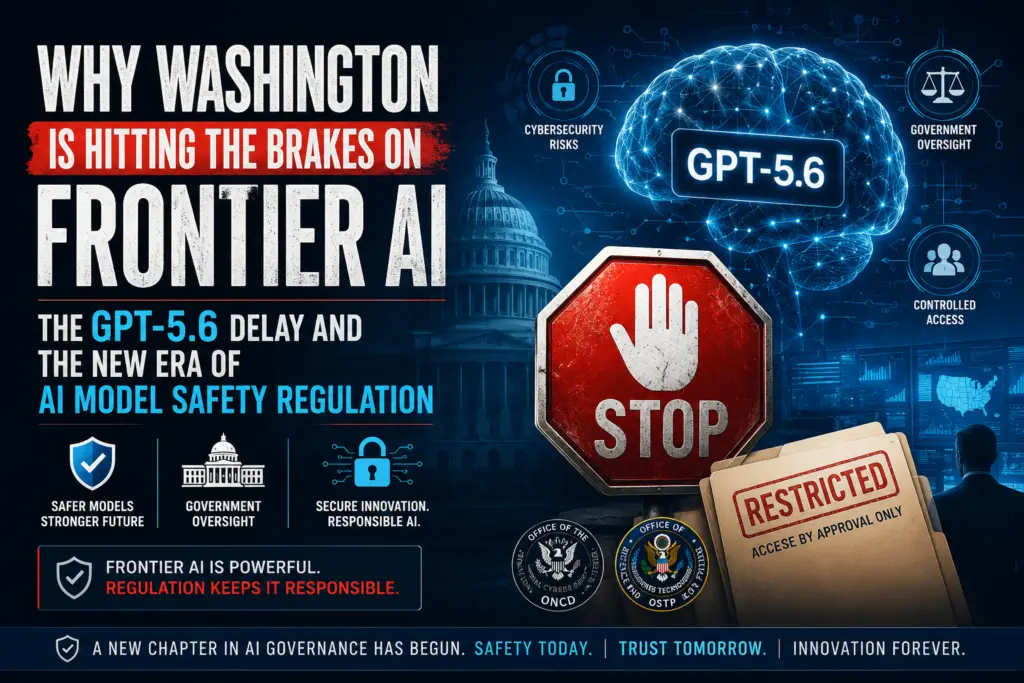
The Trump administration has asked OpenAI to restrict the release of its newest model, GPT-5.6, to a select group of vetted partners rather than the general public — and that single decision signals a seismic shift in how powerful AI is governed in the United States. AI model safety regulation is no longer a theoretical debate happening in academic journals; it is now an active, government-enforced policy shaping the products millions of people use every day.
What Just Happened? The GPT-5.6 Delay, Explained
On June 25, 2026, TechCrunch and The Information reported that OpenAI will not be releasing GPT-5.6 to the public in the way it has launched previous models. Instead of an open rollout, the company will distribute the model customer by customer, with the US government approving each instance of access during an initial preview period. Only if that limited release goes smoothly does OpenAI expect to follow with a broader public launch — potentially a couple of weeks later.
This is not a voluntary product decision on OpenAI’s part. According to The Information, the Trump administration explicitly told OpenAI to take this approach.
The White House Steps In
At an internal staff meeting, CEO Sam Altman reportedly told employees that the government would be “approving access customer by customer” during the preview window. The framing is significant: a private AI company’s product launch is now subject to federal approval, a level of direct government involvement that would have been almost unthinkable in the AI industry just two years ago.
OpenAI’s own staff apparently worked closely with government officials on the specifics of the upcoming release, which means this isn’t purely an external mandate being imposed — it reflects a new kind of public-private coordination around frontier AI governance.
Which Government Agencies Were Involved?
Two specific offices within the White House were named as requesting the limited release:
- The Office of the National Cyber Director (ONCD) — the agency responsible for national cybersecurity strategy and coordination.
- The Office of Science and Technology Policy (OSTP) — the White House’s primary advisory body on science, engineering, and technology issues.
Together, these offices represent both the security and the strategic-innovation sides of the administration’s AI posture. Their joint involvement suggests the concern is not purely one of cybersecurity risk — it’s also about maintaining government visibility and control as frontier AI capabilities continue to escalate.
What Is AI Model Safety Regulation?
AI model safety regulation refers to rules, policies, or agreements — whether statutory, executive, or voluntary — that govern when, how, and to whom powerful artificial intelligence models can be released. The goal is to reduce the risk that a model’s capabilities are exploited for harmful purposes before the wider public, businesses, and security researchers have the tools and awareness to defend against them.
This kind of regulation exists on a spectrum. On one end is pure self-governance, where AI labs independently decide whether a model is safe to release. On the other end is formal statutory law, where a legislature defines specific requirements and penalties. The current US approach sits somewhere in the middle: executive-branch pressure and voluntary agreements, underpinned by a growing executive order framework.
Government AI oversightGPT-5.6 delayFrontier AI governanceAI cybersecurity regulation
Why Frontier Models Are a Different Beast
Not all AI models carry the same risk profile. A language model that helps you draft emails is a fundamentally different technology from a frontier cyber-capable model that can autonomously identify and exploit software vulnerabilities. The latter category — which includes OpenAI’s GPT-5.6 and Anthropic’s Claude Mythos — has capabilities that outpace most existing defensive infrastructure.
Specifically, cybercriminals and nation-state actors who gain access to these systems could theoretically:
- Identify unknown (“zero-day”) vulnerabilities in enterprise software at speeds no human analyst could match.
- Write functional malware automatically, without requiring deep programming expertise.
- Execute end-to-end ransomware attacks with minimal human oversight, as research from NYU Tandon has demonstrated is already possible with existing LLMs.
It is precisely this asymmetry between offensive and defensive capability that has pushed the Trump administration — which originally positioned itself as taking a “hands off” approach to AI — toward active government AI oversight of new model releases.
The Anthropic Precedent — Project Glasswing and Claude Mythos
The OpenAI situation did not emerge in a vacuum. Anthropic created the template for this approach months earlier with the launch of Claude Mythos, its most powerful frontier cyber model, which was intentionally withheld from the public.
What Is Project Glasswing?
Project Glasswing is Anthropic’s controlled-access program through which Claude Mythos is being made available exclusively to a small group of trusted, vetted organizations. Rather than a general release, Anthropic chose to limit distribution on the grounds that Mythos is too capable to put into unrestricted circulation. Anthropic argued the model could cause more harm than good if it fell into the wrong hands.
The program sparked immediate debate in the AI industry. Critics accused Anthropic of using safety language as a marketing gimmick to create artificial scarcity and exclusivity around its most capable model. Supporters argued the decision was a legitimate and responsible attempt to prevent a powerful cyber tool from being weaponized. The truth, as with most nuanced policy questions, likely sits somewhere between those poles.
What is clear is that Anthropic’s framework gave the federal government a visible, working model of how structured access controls on frontier AI could function in practice — and the Trump administration appears to have noticed.
Voluntary Restraint vs. Government Mandate
There is a crucial distinction between what Anthropic did with Mythos and what is now happening with GPT-5.6. Anthropic made a proactive, internal decision to restrict access. OpenAI, by contrast, is responding to an external government directive. Both outcomes look similar from the outside — a powerful model kept away from general audiences — but the governance mechanism is entirely different.
This distinction will matter enormously as AI model safety regulation continues to evolve. Voluntary restraint is agile and company-specific. Government mandates are slower and broader in application, but carry legal and political weight that internal policies do not.
Government AI oversightGPT-5.6 delayFrontier AI governanceAI cybersecurity regulation
Controlled Release Side by Side: OpenAI GPT-5.6 vs. Anthropic Claude Mythos
| Dimension | OpenAI GPT-5.6 | Anthropic Claude Mythos |
|---|---|---|
| Release Approach | Government-mandated limited rollout | Voluntary controlled access |
| Who Controls Access | US government (ONCD + OSTP) approves each user | Anthropic via Project Glasswing |
| Target Recipients | Select vetted enterprise partners | Small group of trusted organizations |
| Path to Public Release | Broader launch if limited preview succeeds | No public release currently announced |
| Regulatory Framework | Executive pressure + June 2026 Executive Order | Internal safety policy |
| Originating Decision | Externally imposed on OpenAI | Self-initiated by Anthropic |
| Public Stated Reason | National security and safety concerns | Model too powerful for unrestricted use |
| Industry Reaction | Early; debate ongoing | Mixed — skepticism vs. validation |
The table above illustrates that while both models are being held back from general audiences, the power dynamics behind those decisions are fundamentally different. OpenAI is subject to government approval; Anthropic retains internal control. Both approaches are shaping what frontier AI governance looks like in the United States in 2026.
Why AI Model Safety Regulation Is Accelerating in 2026
The Cyber Threat Factor
Cybercriminals have used automated tools for decades, but the arrival of large language models has qualitatively changed the threat landscape. LLMs can write functional malware, generate convincing phishing campaigns at scale, and — as frontier models grow more capable — execute entire cyberattack chains autonomously. The specific concern driving government interest in AI model safety regulation is that frontier cyber models can both identify and exploit software vulnerabilities at speeds no human security team can match.
Most enterprise software environments contain hidden bugs — unpatched vulnerabilities that serve as entry points into corporate or government networks. A sufficiently capable frontier AI model in adversarial hands could systematically scan for and exploit these vulnerabilities across thousands of systems simultaneously. That is not a hypothetical threat; it is an extrapolation from capabilities that research institutions have already documented in existing, publicly available models.
Trump’s June 2026 Executive Order on AI Oversight
The intervention on GPT-5.6 is consistent with a broader policy trajectory. Earlier in June 2026, President Trump signed an executive order directing certain AI companies to voluntarily submit new models to the government for testing and evaluation before releasing them publicly. That order represented a notable pivot for an administration that had previously been skeptical of regulatory interference in the technology sector.
The word “voluntarily” in the executive order is doing a lot of work. In practice, the pressure applied to OpenAI around GPT-5.6 suggests that “voluntary” compliance carries real expectations — and potentially real consequences for non-compliance. This is a common pattern in emerging regulatory domains: voluntary frameworks create the scaffolding that is later formalized into binding rules.
What Cybercriminals Can Do with Frontier Models
Research has increasingly demonstrated that frontier AI is not just a productivity tool — it is a dual-use technology with genuine offensive potential. Key documented capabilities include:
- Malware generation: Large language models can produce functional malicious code with minimal prompting, lowering the technical barrier for attacks.
- Autonomous ransomware execution: Research from NYU Tandon School of Engineering has shown that existing LLMs can execute complete ransomware attacks without continuous human direction.
- Vulnerability discovery: Frontier models can analyze codebases and identify security flaws faster and at greater scale than traditional automated scanning tools.
- Social engineering at scale: AI can generate highly personalized phishing content by synthesizing publicly available information about targets.
These capabilities make a compelling case for some level of AI model safety regulation — though the optimal form and degree of that regulation remains hotly contested.
What This Means for Businesses and Developers
For most organizations, the immediate practical question is: how does AI model safety regulation affect access to the tools they’ve been building with?
Here is what the current landscape means in concrete terms:
- Access to GPT-5.6 will be gated, at least initially. If you are not among the vetted partners that OpenAI selects during the preview window, you will not have access to the model until — and unless — a broader release follows.
- API availability timelines may shift unpredictably. Government approval processes are rarely fast. If regulators request additional testing or information, public availability could be delayed beyond the “couple of weeks” that Altman reportedly mentioned.
- Enterprise compliance requirements may grow. As government oversight of frontier AI deepens, businesses using these models in sensitive industries (finance, healthcare, defense contracting) should anticipate new documentation and use-case reporting requirements.
- Vendor diversification matters more than ever. Dependency on a single frontier AI provider creates risk if that provider’s most capable models are subject to access restrictions. Organizations should evaluate multi-vendor strategies.
- Security teams should accelerate AI literacy. Whether or not frontier models are publicly available, the capabilities they represent exist. Security professionals need to understand these tools to defend against them, even if they cannot access them directly.
Will GPT-5.6 Ever See a Full Public Release?
That depends on two things: the success of the limited preview and the continued policy posture of the Trump administration. Based on what Altman reportedly told staff, OpenAI views the restricted launch as a temporary phase, not a permanent state. However, if the government review process surfaces significant safety concerns — or if geopolitical pressures shift — a broader release is not guaranteed on any particular timeline.
Is Government AI Oversight Good or Bad for Innovation?
This is the central tension that the GPT-5.6 situation crystallizes. Proponents and critics of this emerging oversight framework hold genuinely opposing views that both deserve serious consideration.
The Case For Slowing Down
The asymmetry between AI’s offensive and defensive applications is real. Releasing a model capable of autonomously executing cyberattacks into a world where most organizations are not yet equipped to defend against AI-assisted threats creates unnecessary risk. Government review processes, while imperfect, at least provide a mechanism for identifying the most dangerous use cases before they proliferate.
There is also a coordination argument: in the absence of international frameworks for frontier AI model governance, unilateral US oversight at least ensures that the country’s most capable AI tools are being evaluated by entities with national security expertise and intelligence access that private companies simply do not have.
The Case Against Government Interference
Critics of government AI oversight in this form make several points. First, government review processes are slow, opaque, and often conducted by officials who lack the technical expertise to meaningfully evaluate frontier model capabilities. Second, the “voluntary” framework is voluntary in name only — companies face implicit pressure to comply, without the legal clarity and due process protections that formal regulation would provide.
Third, and perhaps most importantly, restricting access in the US does not restrict capability globally. If other countries — particularly China — are developing comparable frontier models without similar restrictions, then US-based restrictions that slow domestic deployment may hand a competitive advantage to adversaries without meaningfully improving global security.
Key Takeaways & Frequently Asked Questions
What is the GPT-5.6 situation in a nutshell?
The Trump administration asked OpenAI to restrict the release of GPT-5.6 to vetted partners rather than the public, with the government approving access on a customer-by-customer basis. This is a direct form of AI model safety regulation applied to a commercial AI product.
Why is the government involved in AI model releases?
Federal agencies — specifically the Office of the National Cyber Director and the Office of Science and Technology Policy — have flagged concerns about the offensive cyber capabilities of frontier AI models. A June 2026 executive order formalized the expectation that AI companies would submit new models for government evaluation before public release.
What is Project Glasswing?
Project Glasswing is Anthropic’s controlled-access program for Claude Mythos, its most powerful frontier cyber model. Unlike the OpenAI situation, Anthropic’s restrictions were self-imposed rather than government-mandated — but both represent the same emerging norm of controlled, gated frontier model deployment.
What should businesses do right now?
- Monitor official communications from OpenAI for GPT-5.6 access timelines.
- Begin or accelerate evaluations of alternative frontier AI providers.
- Engage legal and compliance teams to assess emerging AI procurement requirements.
- Invest in internal AI security literacy, regardless of access to specific models.
Is this the beginning of formal AI regulation in the US?
Almost certainly yes. The current executive-order-and-voluntary-compliance framework is the scaffolding. Formal statutory regulation — with specific requirements, timelines, and penalties — is the likely next step, particularly as AI capabilities continue to accelerate and public awareness of dual-use risks grows.
The GPT-5.6 delay is more than a product launch story. It is a policy inflection point — the moment when AI model safety regulation moved from theoretical debate to operational reality for the companies building the world’s most powerful AI systems. Whether the government’s approach turns out to be a reasonable safeguard or an innovation-stifling overreach, the era of unchecked frontier AI releases appears to be over.
What comes next is anyone’s guess, but several trends seem near-certain. Government review processes will become more formalized, moving from informal “we’d like you to do this” conversations toward codified timelines and criteria. The number of agencies involved in frontier AI oversight will expand — the ONCD and OSTP are unlikely to be the last federal bodies with a seat at the table. And the definition of which models qualify for heightened scrutiny will broaden as capabilities continue to scale.
For businesses, developers, and policy observers, the most important takeaway is this: AI model safety regulation is now a structural feature of the AI landscape, not a temporary political moment. Companies that treat it as background noise do so at their operational and reputational peril. Those that engage early — whether through public comment processes, direct government partnership, or internal compliance readiness — will be far better positioned as the rules continue to take shape. Understanding this new landscape is not optional for anyone building, buying, or competing with AI.