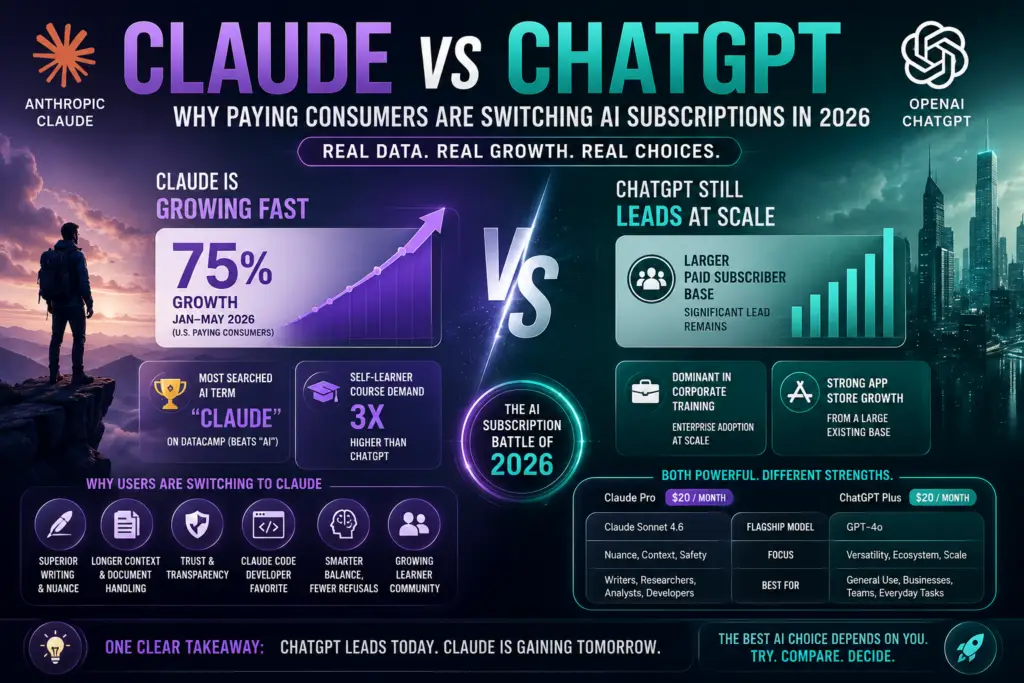
Anthropic’s Claude is gaining fast on ChatGPT in the paid consumer market — and the data is hard to ignore. Fresh transaction analysis covering 28 million U.S. consumers shows Claude’s paying subscriber base grew roughly 75% between January and mid-May 2026, a trajectory that’s forcing a rewrite of a narrative that once seemed settled: that ChatGPT owned the consumer AI subscription market, full stop.
This article unpacks what the numbers actually mean, why consumers are opening their wallets for Claude, and what anyone evaluating a paid AI subscription today needs to know.
What the Data Actually Shows About Claude’s Paid Growth
Before diving into the Claude vs ChatGPT debate, it’s worth understanding where this data comes from — because the source matters a great deal.
Credit Card Transactions: A Ground-Level View
Indagari, a credit card transaction analysis company, tracks anonymized purchase data from approximately 28 million U.S. consumers. Unlike self-reported surveys or web traffic estimates, this methodology captures actual spending — subscriptions renewed, API token packages purchased, upgrade tiers unlocked.
The signal it sends for Anthropic is unambiguous. Claude’s paid consumer revenue has been climbing week-over-week throughout 2026, with the cumulative gain sitting at around 75% since the start of the year through mid-May. Critically, that growth did not peak and fade after a single news cycle. It continued even after a highly publicized spike in March, when Anthropic publicly refused to let its models be used by the Trump administration for mass surveillance or autonomous weapons applications.
What that tells us: the growth isn’t purely a PR bounce. Consumers are finding enough value in Claude to keep paying.
The DataCamp Signal: What Learners Are Choosing
A second, independent data point comes from DataCamp, an online learning platform with roughly 20 million users that teaches AI skills to both individual consumers and corporate employees.
The finding here is striking: “Claude” has become the most searched term on DataCamp’s platform — more popular than the search term “AI” itself. Among self-directed learners (as opposed to employees sent through corporate training programs), demand for Claude courses is outpacing ChatGPT courses by a ratio of three to one. In the 30 days prior to the TechCrunch report published June 25, 2026, demand for Claude-specific courses increased 18 times over.
For context: corporate training programs still skew heavily toward ChatGPT. But the individual, self-motivated learner — arguably the most valuable leading indicator of where the market moves next — is gravitating toward Claude.
Claude vs ChatGPT: A Side-by-Side Comparison
Here’s a structured look at how Claude vs ChatGPT stack up across the dimensions that matter most to paying consumers in mid-2026.
| Feature / Dimension | Claude (Anthropic) | ChatGPT (OpenAI) |
|---|---|---|
| Primary paid tier | Claude Pro ($20/mo) | ChatGPT Plus ($20/mo) |
| Flagship model (consumer) | Claude Sonnet 4.6 | GPT-4o |
| Consumer growth trend (2026) | ~75% growth Jan–May 2026 | Slower growth (large base) |
| Self-learner course demand | Outpacing ChatGPT 3:1 (DataCamp) | Still dominant in corporate training |
| Most-searched AI term (DataCamp) | Yes (“Claude” > “AI”) | Previously dominant |
| Absolute paid subscriber volume | Growing fast; still behind | Significantly larger base |
| Ethics / policy reputation | High-profile stance vs. surveillance | More neutral public posture |
| Developer / API focus | Strong (Claude Code, enterprise) | Strong (broad ecosystem) |
| App store growth (Sensor Tower 2026) | Strong year-over-year growth | Strong, but from a larger base |
| IPO status | Filed to go public (June 2026) | Expected IPO track |
Key takeaway: In the Claude vs ChatGPT comparison, ChatGPT still holds a substantial lead in absolute subscriber numbers. Claude’s advantage is in momentum — it is growing faster among paying consumers and is particularly strong with the self-directed learner segment.
Why Paying Consumers Are Switching to Claude
Several converging factors explain why the Claude vs ChatGPT equation is shifting among paying users specifically (as opposed to free-tier users, where ChatGPT’s scale advantage is even more pronounced).
- Writing quality and nuance. Many power users — writers, analysts, researchers — report that Claude produces prose that feels less formulaic, with stronger command of tone and voice. For anyone paying $20/month to improve their written output, this matters.
- Longer context windows and document handling. Claude’s ability to ingest and reason over long documents has been a differentiator for users working with dense research, legal documents, or extensive codebases.
- Trust and transparency signals. Anthropic’s very public refusal to enable government surveillance tools sent a message to privacy-conscious consumers. For a segment of the market, ethics is a subscription driver.
- Claude Code’s halo effect. Claude Code — Anthropic’s command-line coding agent — earned strong word-of-mouth among developers. That reputation has bled into general consumer perception, elevating Claude’s brand among technically literate buyers.
- Reduced “refusal fatigue.” A common complaint about ChatGPT among power users has been over-cautious refusals on borderline but legitimate tasks. Users who have migrated to Claude often cite a better balance between safety guardrails and practical helpfulness.
- The DataCamp feedback loop. As Claude courses grow in popularity on learning platforms, more users get hands-on experience with the model — and a portion of those learners convert to paid subscribers.
- Novelty and competition. Some consumers are simply hedging, maintaining subscriptions to both services. The paid AI subscription market is not yet winner-take-all, and many users treat the $20/month price point as affordable enough to experiment.
The Numbers in Context: What 75% Growth Really Means
75% growth sounds enormous — and in isolation, it is. But the Claude vs ChatGPT story is also a story about starting points.
ChatGPT’s Scale Advantage Is Still Enormous
Sensor Tower’s State of AI 2026 report shows Claude growing well across mobile and desktop platforms, but still occupying a much smaller absolute footprint than ChatGPT. The Indagari credit card data tells the same story from the spending side: ChatGPT collects significantly more consumer dollars than Claude does, even as the gap narrows.
This matters for a few reasons. First, network effects favor incumbent platforms. The more people use ChatGPT, the more templates, integrations, and third-party tools get built around it — which reinforces usage. Second, corporate adoption moves slowly. Enterprise deals and bulk training licenses take time to renegotiate, giving ChatGPT durable revenue stability even if individual consumer sentiment shifts.
Why the Trajectory Matters More Than the Gap
That said, the trajectory of the Claude vs ChatGPT competition may be more important than the current snapshot.
Markets that look stable often aren’t. A platform that grows 75% in five months while its competitor grows modestly is compressing the gap at a rate that changes the competitive picture within a year or two, not a decade. If Claude maintains even half that growth rate while ChatGPT grows at its current pace, the two platforms converge meaningfully in paid consumer revenue well before 2028.
The DataCamp data reinforces this interpretation. Learners are a leading indicator. Today’s self-directed student who completes a Claude course is tomorrow’s practitioner who recommends Claude to colleagues, writes about it online, and pushes their employer toward Anthropic’s enterprise tier. The fact that this cohort is already choosing Claude over ChatGPT by a 3-to-1 margin is the kind of signal that precedes market share shifts, not follows them.
Did Anthropic’s Ethics Stance Actually Drive Subscriptions?
This is a genuinely interesting question buried inside the Claude vs ChatGPT market story. In March 2026, Anthropic refused to allow its models to be used for mass surveillance of Americans or autonomous weapons systems by the Trump administration. The refusal triggered a wave of media coverage and, the Indagari data suggests, a spike in new paying subscribers.
What’s notable is what happened next: growth continued after the spike. That suggests the ethics story wasn’t just a one-time news-driven bump. It appears to have introduced Claude to a segment of consumers who were persuadable — people who were aware of AI assistants but hadn’t committed to a paid plan — and those consumers stuck around.
This is a meaningful lesson for the broader AI subscription market. For a portion of paying consumers, the company’s public values are a product differentiator. Willingness to turn down government contracts over ethical concerns functions, for this segment, the way a quality certification might for a B2B buyer: it signals something about how the product will behave.
The dynamic is complicated, however, by Anthropic’s more recent government friction. In June 2026, the U.S. government banned Anthropic from allowing its most powerful cybersecurity-focused models — Mythos 5 and Fable 5 — from being used by non-Americans, leading Anthropic to pull those models from the market entirely. The long-term consumer impact of that dispute remains to be seen. So far, the Indagari data shows continued growth in both consumer and enterprise segments despite this headwind.
Claude AI vs ChatGPT 2026AI subscription comparisonClaude Pro vs ChatGPT PlusBest AI chatbot 2026
What This Shift Means for the Paid AI Subscription Market
The emerging Claude vs ChatGPT dynamic has implications beyond the two companies themselves.
The paid AI subscription market is maturing. Early adopters chose ChatGPT because it was first and dominant. The cohort now entering the paid market is more discerning — they’ve tried free tiers, read reviews, taken courses, and formed opinions. This group is more likely to switch based on quality and values alignment, less likely to stick with a default.
Sub-segment targeting will define the next phase. ChatGPT built a broad base. Claude has found traction with specific, high-value sub-segments: developers (through Claude Code), privacy-conscious consumers, and long-form writers. As the market grows, winning specific niches may matter as much as winning overall share.
Both companies approaching IPO raises the stakes. Anthropic filed to go public in June 2026; OpenAI is widely expected to follow a similar path. Public market investors will scrutinize the consumer metrics alongside enterprise revenue. A strong paid consumer trajectory is not just a growth story — it’s a margin story, a brand story, and a long-term defensibility story. Claude’s current momentum makes Anthropic’s IPO narrative meaningfully more compelling.
AI subscription fatigue is a real risk for both. As more tools charge monthly fees, consumers will rationalize their subscriptions more aggressively. The platform that delivers the most tangible, daily-use value wins retention. The Claude vs ChatGPT battle will be won or lost in the 30-day renewal decision, not at the initial sign-up.
Should You Switch from ChatGPT to Claude? Direct Answers
Is Claude better than ChatGPT for everyday consumers?
It depends on your use case. For long-form writing, nuanced analysis, coding assistance, and working with large documents, many power users find Claude superior. For broad task coverage, third-party integrations, and plugin ecosystems, ChatGPT’s larger installed base creates more surrounding infrastructure. The honest Claude vs ChatGPT answer is: try both on your actual tasks before committing.
Is a Claude subscription worth $20 a month?
The data suggests a growing number of paying consumers believe so — and that this belief is sticky, not just novelty-driven. If your primary use cases are writing, research, or code, Claude Pro at $20/month is competitive with ChatGPT Plus at the same price point. The value comparison is effectively a wash on price; it comes down to which model serves your specific workflows.
Will Claude overtake ChatGPT?
Not in the near term on absolute subscriber numbers. But the Claude vs ChatGPT gap in the paid consumer segment is compressing, and the leading indicators — learning platform search trends, growth rates, ethical positioning — favor continued momentum for Anthropic. Whether that translates into a true market leadership shift depends heavily on what both companies ship in the next 12 months.
Does it matter which company’s values I align with?
The data suggests it matters to a meaningful segment of paying consumers. Anthropic’s public ethics decisions appear to have had a measurable effect on subscription growth. If alignment between your values and your AI provider’s behavior matters to you, it’s a legitimate factor in the Claude vs ChatGPT decision.
The Bottom Line
The Claude vs ChatGPT competition has evolved into one of the most closely watched battles in the artificial intelligence industry. What was once considered a market with a clear leader has become far more competitive as Anthropic continues to attract paying subscribers at an impressive pace. Recent transaction data, learning platform trends, and user behavior all indicate that Claude vs ChatGPT is no longer a one-sided comparison. Instead, it represents two mature AI platforms competing on innovation, user experience, trust, and long-term value.
Despite Claude’s remarkable momentum, ChatGPT still maintains significant advantages. Its larger global user base, extensive third-party ecosystem, widespread enterprise adoption, and broad feature set continue to make it the default AI assistant for millions of individuals and businesses. Anyone evaluating Claude vs ChatGPT should recognize that ChatGPT remains an industry leader because of its scale, continuous product improvements, and mature infrastructure rather than simply its first-mover advantage.
At the same time, Claude has established itself as much more than an alternative. For writers, researchers, developers, students, and professionals who regularly work with lengthy documents or require nuanced reasoning, Claude vs ChatGPT often becomes a workflow decision rather than a popularity contest. Many users appreciate Claude’s natural writing style, extended context window, thoughtful responses, and emphasis on transparency. These strengths have helped Anthropic build credibility among power users who value quality over familiarity.
Another important takeaway from the Claude vs ChatGPT discussion is that consumer expectations have changed dramatically. Early adopters were satisfied simply having access to advanced AI. Today’s subscribers are far more selective. They compare output quality, reasoning ability, coding assistance, pricing, privacy policies, and overall reliability before committing to a monthly subscription. This shift is creating stronger competition, ultimately benefiting consumers as both companies continue investing heavily in new capabilities.
Looking ahead, the next year will likely determine how the Claude vs ChatGPT rivalry develops. Anthropic’s rapid growth demonstrates that consumers are willing to switch platforms when they experience better performance or stronger alignment with their priorities. Meanwhile, OpenAI continues to expand ChatGPT with new models, integrations, productivity features, and enterprise offerings designed to strengthen its leadership position. Continuous innovation from both companies means users can expect faster improvements and more capable AI assistants throughout 2026 and beyond.
Ultimately, there is no universal winner in the Claude vs ChatGPT debate because the ideal choice depends on individual needs. If your daily work revolves around long-form writing, research, document analysis, or advanced reasoning, Claude may deliver greater value. If you depend on an extensive ecosystem, productivity integrations, multimodal capabilities, and widespread business adoption, ChatGPT remains an outstanding option.
The most practical approach is to evaluate both platforms using your own real-world tasks instead of relying solely on benchmarks or online opinions. Run identical prompts, compare response quality, assess workflow efficiency, and determine which platform consistently produces better results for your specific requirements. The Claude vs ChatGPT landscape is evolving rapidly, and today’s best choice may continue improving tomorrow.
One thing is certain: Claude vs ChatGPT has become the defining competition in the consumer AI subscription market. Rather than asking which company is winning today, users should focus on which platform helps them work smarter, create faster, and achieve better outcomes. As innovation accelerates and competition intensifies, consumers stand to benefit the most from this exciting new era of artificial intelligence.