AI ମଡେଲ୍ ଯାଞ୍ଚ (Verification): Anthropic-ର ‘FlashProve’ କିପରି ନିର୍ଦ୍ଦିଷ୍ଟ AI ମଡେଲ୍ର ଉତ୍ତରକୁ ପ୍ରମାଣିତ କରିପାରିବ
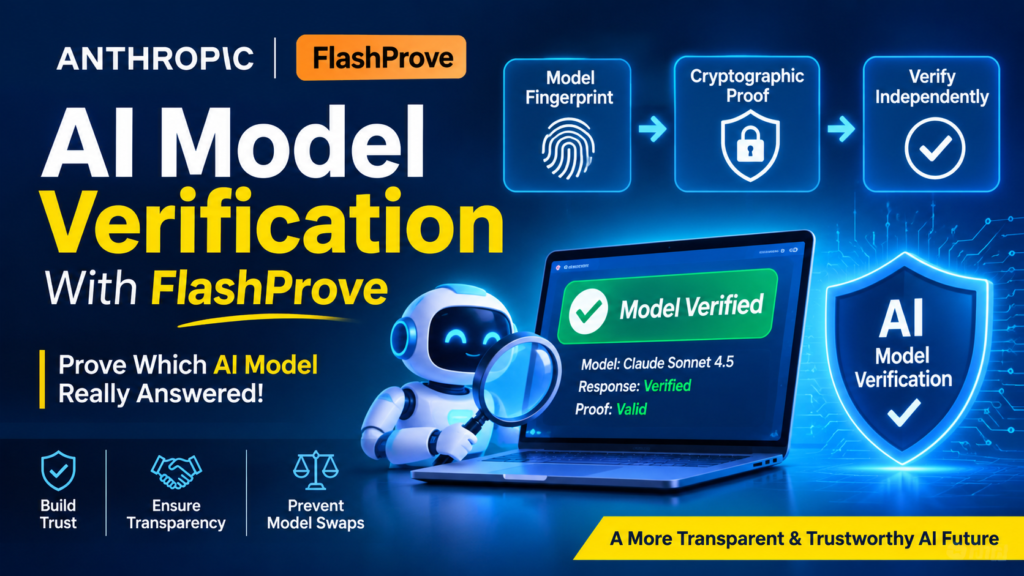
AI model verification is the ability to prove, with mathematics instead of trust, that a specific AI model produced a specific response. On November 3, 2026, TechCrunch reported that Anthropic is working on an open-source system called FlashProve that aims to deliver exactly that, using a cryptographic proof that behaves much like an email signature.
Every day, millions of people and thousands of companies send prompts to AI services and accept the answers on faith. The product page names a model, the invoice names the same model, and the API response carries a label saying so. Yet nothing in that chain lets an outsider confirm what actually ran. FlashProve is Anthropic’s research attempt to close that gap, and it is also very early: the researchers say there are no plans to deploy it at Anthropic or any other lab.
This guide explains what was announced, how the system works, what the prototype reportedly costs, where it falls short, and what builders and students in India should take from it.
This new approach to AI model verification could change how businesses evaluate the reliability of AI services.
Key Takeaways
- What it is: FlashProve is an open-source system for “provable inference,” a cryptographic proof that an output came from a specific model.
- How it works: A lab publishes a “fingerprint” for each model, then attaches proofs to outputs that anyone can check against that fingerprint. The model’s weights stay private.
- Why it matters: It targets secret model swaps, including swaps by the very lab that runs the model.
- Status: A research prototype. A technical specification and code are public, but there are no deployment plans.
- The catch: The reported prototype needs roughly 70 to 95 times the GPU time of normal inference and handles short contexts, so this kind of AI model verification is not ready for everyday chat.
What Is AI Model Verification?
AI model verification is the process of confirming, through independent evidence, that an output came from a particular model rather than a substitute. It answers one narrow question: which model produced this response?
That makes it different from two nearby ideas that are often confused with it:
- Model evaluation asks how good a model is at a task. It says nothing about whether the model you tested is the one serving your traffic.
- User identity verification asks who the human is. It concerns the person at the keyboard, not the model behind the screen.
AI model verification sits between the two. It treats the model itself as something that must be able to show credentials, the same way a website shows a certificate before you type in a password.
Reliable AI model verification is becoming essential as companies depend on multiple AI providers.
Why Can’t We Check Model Identity Today?
Because every signal available to a customer originates with the provider. You choose a model name in an API call, the provider returns a response, and you trust that the two match. A response contains text, not proof.
That trust assumption creates three risks:
- Cost-cutting substitution. A provider could route some requests to a cheaper, weaker model while billing for a premium one.
- Performance inflation. A provider could quietly serve a stronger, more expensive model during a benchmark, making the product look better than the one that ships to customers.
- Tampering. A compromised inference server could alter responses without users noticing which model, or which modified version of it, answered.
Anthropic’s researchers describe the first two scenarios, according to TechCrunch’s reporting. The third appears in a secondary report on the release.
What Is “Provable Inference”?
Provable inference is a cryptographic proof, essentially a mathematical guarantee, that a given output came from a specific model. TechCrunch reports that the researchers intend it to hold up against impostors, including the lab that built and operates the model. The comparison used in coverage is a cryptographic email signature: a recipient can check that a message came from the claimed sender without taking the sender’s word for it.
The phrase “including the lab itself” is the important part. Most trust mechanisms in AI today assume an honest provider. Provable inference is designed for the case where you cannot assume that.
Why Does AI Model Verification Matter Now?
This section is analysis rather than reporting, but the pressures behind it are easy to see.
Models are sold in tiers. Labs now offer families of models at different capability and price points. Wherever a price gap exists, an incentive to quietly serve the cheaper option exists too. Most providers are presumably honest, but customers currently have no way to confirm it.
AI now does consequential work. When a company says a “frontier cybersecurity model” scanned a software library, or that an appropriate model approved a business plan, the claim only carries weight if the named model really did the work. TechCrunch lists exactly these examples as things FlashProve could help verify.
Benchmarks drive buying decisions. Published scores influence purchasing, funding and policy. If a tested model differs from the shipped one, those numbers mislead everyone downstream.
Regulators are paying attention. Rules that apply to specific models are only enforceable if someone can check which model is running. AI model verification would give auditors a tool better than a company’s own statement.
What Did Anthropic Announce?
According to reporting from TechCrunch and others, Anthropic published a research blog post on Tuesday, November 3, 2026, describing FlashProve. (At least one secondary outlet dates the announcement to November 2, so check Anthropic’s post for the exact timestamp.) The key facts, as reported:
- FlashProve is open source, with a technical specification and working code for parts of the system published on GitHub.
- It is meant to prove which model generated a given output without revealing the model’s weights.
- For the system to work, AI labs would publish a “fingerprint” for each model they release.
- It is designed so that verification can run on a local device.
- Anthropic describes the release as intermediate progress, not a finished research agenda, and says there are no plans to deploy it at Anthropic or any other lab.
One secondary report, from Lapaas Voice, attributes the work to Anthropic’s Frontier Red Team and describes a demonstration on Meta’s Llama 4 Maverick model. Treat that detail as single-sourced until you have read Anthropic’s own technical report.Anthropic FlashProve
Provable AI Inference
Cryptographic AI Verification
Zero-Knowledge Proofs for AIAnthropic FlashProve
Provable AI Inference
Cryptographic AI Verification
Zero-Knowledge Proofs for AIAnthropic FlashProve
Provable AI Inference
Cryptographic AI Verification
Zero-Knowledge Proofs for AI
Is FlashProve Available to Use Today?
Partly. The specification and code are public for researchers and developers to examine, but FlashProve is a research prototype. You cannot ask Claude, ChatGPT or Gemini to attach a FlashProve proof to your answers today, and Anthropic has said it has no plans to deploy the system in production.
How Does FlashProve Work?
FlashProve follows a three-stage pattern: commit, prove, verify. The description below combines TechCrunch’s reporting with a more detailed secondary report that says the system uses a zero-knowledge proof technique called zkSNARK. Details may change as outside experts scrutinize the technical report.
Stage 1: The Provider Publishes a Model Fingerprint
Before serving any traffic, the lab creates a cryptographic commitment to the model’s weights. Think of it as a tamper-evident seal stamped on one exact version of the model. The lab publishes this fingerprint openly, while the weights themselves stay secret.
Stage 2: The Provider Generates a Proof With Each Response
When a user sends a prompt, the provider runs the model and also produces a proof that links the prompt and response to the committed fingerprint. If a different model had produced the text, it should not be able to produce a valid proof for the original fingerprint. That property is what stops model substitution from going unnoticed.
Stage 3: Anyone Can Verify the Proof
The user checks the proof against three things: the prompt, the response and the published fingerprint. Anthropic reportedly designed verification to be light enough to run on a local device, and the secondary report says a CPU is sufficient. That matters because the expensive work happens on the provider’s side, while checking stays cheap for the customer.
Why Do Zero-Knowledge Proofs Keep Weights Private?
A zero-knowledge proof lets one party show that a statement is true without revealing the secret behind it. Here, the statement is “this output came from the model behind that fingerprint,” and the secret is the weights. The same secondary report notes a limit: the current implementation protects the weights but does not hide the model’s architecture.
Weights are among the most valuable assets a frontier lab owns. Requiring labs to publish them for auditing would be a non-starter. Zero-knowledge proofs for AI make AI model verification possible without that sacrifice.
What Does the FlashProve Prototype Cost?
Performance is where the honest picture gets sobering. The figures below come from a single secondary report (Lapaas Voice) summarizing Anthropic’s demonstration on Llama 4 Maverick. I could not read Anthropic’s technical report directly, so verify these numbers against the primary source before quoting them.
| Metric | Reported value |
|---|---|
| Tested model | Llama 4 Maverick (mixture-of-experts) |
| Total parameters | About 400 billion |
| Active parameters per token | About 17 billion |
| Hardware | One NVIDIA H100 GPU |
| Proof generation speed | About 110 tokens per second |
| Proof size | 18.78 MB |
| Context per request | 1,024 tokens |
| Verification time | About 17 seconds |
| Extra GPU time vs. standard inference | About 70 to 95 times |
The same report describes these results as substantial progress over earlier open-source cryptographic verification systems, while stressing that proof generation takes far more compute than ordinary inference.
What Do These Numbers Mean in Practice?
This is my interpretation of the reported figures, not a claim from Anthropic. A 70-to-95-times overhead means proofs are far too expensive to attach to every chatbot reply. A proof of nearly 19 MB for a 1,024-token request is also heavy. The profile fits high-stakes, low-volume situations such as an audit, a regulatory check or a disputed benchmark, rather than consumer chat. Today’s AI model verification is a research tool, and it will need big efficiency gains before it becomes a product feature.
What Could AI Model Verification Be Used For?
Based on use cases described in TechCrunch’s coverage and the secondary reports, AI model verification could support several jobs:
- Detecting model substitution. Customers could confirm they received the model they paid for.
- Trustworthy evaluations. Independent researchers could confirm that the model under test is the model the developer claims.
- Verifying third-party claims. TechCrunch cites examples such as a claim that a software library was scanned for vulnerabilities by a frontier cybersecurity model, or that a business plan was approved by an appropriate model.
- Spotting compromised servers. Proofs could help flag responses from unauthorized or tampered inference systems.
- Supporting regulation. Regulators could, in principle, check that a company serves an approved model under specific safety or legal requirements.
The third item may become the most commercially interesting. As AI-assisted work becomes a selling point, from security audits to code reviews, buyers will want evidence, not marketing.
Does FlashProve Prove an Answer Is Correct?
No. It proves origin, not truth. A valid proof says a particular model produced the text. It does not say the text is accurate, safe or well reasoned. A highly capable model can still be wrong, and AI model verification does not change that.
What Are FlashProve’s Limits?
Anthropic frames this as intermediate progress, and the secondary report lists several constraints:
- Short context. The prototype reportedly supports requests up to 1,024 tokens, far below the context windows of modern models.
- Architecture focus. The current work centers on mixture-of-experts models; other architectures need more engineering.
- Decoding limits. The proof reportedly covers an integer representation of the model under greedy decoding, so responses sampled in other ways may not match the verified computation.
- Heavy compute. The 70-to-95-times GPU overhead is a major barrier.
- Implementation audits. Even with formal proofs of key security properties, the executable code still needs careful review, according to the same report.
- No deployment plan. Anthropic says it is not planning to deploy the system.
How Does FlashProve Compare With Other Trust Approaches?
The table below is a general comparison I prepared to show where provable inference fits. It is a simplification, not a benchmark.
| Approach | What you must trust | Proves which model answered? | Keeps weights private? | Maturity |
|---|---|---|---|---|
| Provider’s word (API model label) | The provider | No | Yes | Universal today |
| Hardware attestation (confidential inference) | Chip vendor and attestation chain | Partly, if hardware and software are trusted | Yes | Early; hardware support uneven |
| Third-party benchmarking | Test design and statistics | No, only suggestive | Yes | Common |
| FlashProve (provable inference) | Mathematics and a public fingerprint | Yes, within the prototype’s scope | Yes | Research prototype |
The hardware row has a real precedent. Anthropic published earlier research on confidential inference in June 2025 that explored hardware-rooted attestation, and its authors noted that not every accelerator fully supports confidential computing. FlashProve’s pitch is different: it moves trust from a company or a chip maker to public mathematics. That is why cryptographic AI model verification is appealing, and also why it costs so much compute.
Two Kinds of AI Identity: Who You Are and Which Model Answers
Anthropic’s identity story in 2026 runs in two directions. In June, TechCrunch reported that an updated privacy policy, taking effect July 8, says Anthropic will ask some users to prove their age or identity in certain cases. Other reports say the checks run through a third party called Persona, and Anthropic has said it does not use the identity data to train its models.
FlashProve points the other way. Instead of the user proving who they are to the provider, the provider proves which model it is to the user. Together they sketch a future in which trust is checked at both ends of an AI conversation. That framing is my interpretation, not an Anthropic statement.
What Does This Mean for India’s AI Builders and Students?
This section is analysis, not reporting. Many Indian startups, IT services firms and enterprise teams build on third-party model APIs. For them, “which model answered” is a procurement, compliance and reputation question. If a client asks whether an AI-assisted audit really used the model you named, a verifiable answer beats a screenshot.
Three practical takeaways:
- Expect model identity to become a contract topic. Even without cryptographic proofs, enterprise buyers can ask vendors to document model versions and change notices.
- Treat verification skills as a career signal. Applied cryptography, zero-knowledge systems and ML infrastructure are specialized areas where few engineers have depth. Students and freshers who learn how commitments and proofs work will stand out.
- Watch the open-source release. Because the specification and code are public, Indian researchers can study, test and contribute to AI model verification work instead of waiting for a vendor product.
What Can Builders Do Now?
You do not need FlashProve to start tightening your own model supply chain:
- Pin model versions in production calls and log the identifier returned with each response.
- Record request metadata such as timestamps and routing details so you can investigate anomalies.
- Run periodic regression tests on a fixed prompt set to notice unexplained behavior changes. This can suggest drift but cannot prove substitution.
- Ask vendors in writing how they handle model versioning, fallbacks and change notices.
- Read the specification. Skim Anthropic’s technical write-up and GitHub material to understand what a real proof guarantees.
- Track fingerprint publishing. The approach only works if labs publish fingerprints, so watch for any lab that commits to it.
Frequently Asked Questions
What is FlashProve?
FlashProve is an open-source system from Anthropic researchers that aims to cryptographically prove which AI model generated a given output. The goal is called provable inference.
How is FlashProve different from AI watermarking?
Watermarking marks content as machine-generated. FlashProve ties an output to a specific model. They solve different problems: one says “an AI wrote this,” the other says “this particular model wrote this.”
Does FlashProve reveal a model’s weights?
No. Labs would publish a fingerprint instead, and verification does not expose the weights. The secondary report notes that the model’s architecture is not hidden.
Can I use FlashProve with Claude, ChatGPT or Gemini?
Not today. Anthropic says there are no plans to deploy it at Anthropic or any other lab.
Why does local verification matter?
It means a customer does not need the provider’s expensive hardware to check a proof, so verification does not depend on trusting the provider’s own systems.
How soon could AI model verification reach real products?
No timeline exists. The overhead, short context limit and architecture restrictions all need to improve first, so expect more research progress before any product.
Conclusion: Trust, but Now Verify
FlashProve does not solve AI trust. It proves something narrow and valuable: that a response came from the model it claims, even if the operator would prefer otherwise. Today it is a prototype with heavy costs and tight limits. Yet it moves AI model verification from a vague wish to a concrete, open, inspectable design, and that makes it worth following.
If you build with AI, the lesson is already usable: treat model identity as something you document, log and contractually pin down, then be ready for a future where you can demand proof.
AI ମଡେଲ୍ ଯାଞ୍ଚ (Verification): Anthropic-ର ‘FlashProve’ କିପରି ନିର୍ଦ୍ଦିଷ୍ଟ AI ମଡେଲ୍ର ଉତ୍ତରକୁ ପ୍ରମାଣିତ କରିପାରିବ
AI ମଡେଲ୍ ଯାଞ୍ଚ ହେଉଛି ଏକ ପ୍ରକ୍ରିୟା, ଯେଉଁଠାରେ କେବଳ ବିଶ୍ୱାସ ଉପରେ ନିର୍ଭର ନକରି, ଗାଣିତିକ ପ୍ରମାଣ ମାଧ୍ୟମରେ ଏହା ସୁନିଶ୍ଚିତ କରାଯାଏ ଯେ ଏକ ନିର୍ଦ୍ଦିଷ୍ଟ AI ମଡେଲ୍ ହିଁ ଏକ ନିର୍ଦ୍ଦିଷ୍ଟ ଉତ୍ତର ପ୍ରଦାନ କରିଛି। ୩ ନଭେମ୍ବର, ୨୦୨୬ ରେ, ‘TechCrunch’ ରିପୋର୍ଟ କରିଛି ଯେ Anthropic ‘FlashProve’ ନାମକ ଏକ ଓପନ୍-ସୋର୍ସ (open-source) ସିଷ୍ଟମ୍ ଉପରେ କାମ କରୁଛି। ଏହାର ଲକ୍ଷ୍ୟ ହେଉଛି ଏକ କ୍ରିପ୍ଟୋଗ୍ରାଫିକ୍ (cryptographic) ପ୍ରମାଣ ବ୍ୟବହାର କରି ଏହା ସ୍ପଷ୍ଟ କରିବା ଯେ ଉତ୍ତରଟି କେଉଁ ମଡେଲ୍ ଦ୍ୱାରା ଦିଆଯାଇଛି; ଏହି ପ୍ରମାଣଟି ଠିକ୍ ଏକ ଇମେଲ୍ ସିଗନେଚର୍ (email signature) ପରି କାମ କରେ।
ପ୍ରତିଦିନ, ଲକ୍ଷ ଲକ୍ଷ ଲୋକ ଏବଂ ହଜାର ହଜାର କମ୍ପାନୀ AI ସେବାଗୁଡ଼ିକୁ ବିଭିନ୍ନ ପ୍ରଶ୍ନ ବା ‘ପ୍ରମ୍ପ୍ଟ’ (prompts) ପଠାନ୍ତି ଏବଂ ମିଳିଥିବା ଉତ୍ତରଗୁଡ଼ିକୁ ବିଶ୍ୱାସର ସହ ଗ୍ରହଣ କରନ୍ତି। ଉତ୍ପାଦ ପୃଷ୍ଠାରେ ଏକ ମଡେଲ୍ର ନାମ ଥାଏ, ଇନଭଏସ୍ରେ ମଧ୍ୟ ସେହି ସମାନ ମଡେଲ୍ର ନାମ ଥାଏ ଏବଂ API ଉତ୍ତରରେ ମଧ୍ୟ ସେହିପରି ଏକ ଲେବଲ୍ ଥାଏ। ତଥାପି, ଏହି ସମଗ୍ର ପ୍ରକ୍ରିୟାରେ ବାହାରର କୌଣସି ବ୍ୟକ୍ତିଙ୍କ ପାଇଁ ପ୍ରକୃତରେ କେଉଁ ମଡେଲ୍ କାମ କରିଛି, ତାହା ନିଶ୍ଚିତ କରିବାର କୌଣସି ଉପାୟ ନାହିଁ। Anthropic-ର ‘FlashProve’ ହେଉଛି ଏହି ଅଭାବକୁ ଦୂର କରିବା ପାଇଁ ଏକ ଗବେଷଣାମୂଳକ ପ୍ରୟାସ। ତେବେ, ଏହା ବର୍ତ୍ତମାନ ବହୁତ ପ୍ରାରମ୍ଭିକ ପର୍ଯ୍ୟାୟରେ ରହିଛି; ଗବେଷକମାନଙ୍କ କହିବା ଅନୁଯାୟୀ, Anthropic କିମ୍ବା ଅନ୍ୟ କୌଣସି ଲ୍ୟାବ୍ରେ ଏହାକୁ ବ୍ୟବହାର (deploy) କରିବାର କୌଣସି ଯୋଜନା ବର୍ତ୍ତମାନ ନାହିଁ।
ଏହି ଗାଇଡ୍ରେ ବ୍ୟାଖ୍ୟା କରାଯାଇଛି ଯେ କ’ଣ ଘୋଷଣା କରାଯାଇଛି, ଏହି ସିଷ୍ଟମ୍ କିପରି କାମ କରେ, ଏହାର ପ୍ରୋଟୋଟାଇପ୍ (ନମୁନା) ପାଇଁ କେତେ ଖର୍ଚ୍ଚ ହୋଇପାରେ, ଏହାର ସୀମାବଦ୍ଧତା କ’ଣ ଏବଂ ଭାରତର ଡେଭଲପର୍ (builders) ତଥା ଛାତ୍ରଛାତ୍ରୀମାନେ ଏଥିରୁ କ’ଣ ଶିଖିପାରିବେ।
ମୁଖ୍ୟ ବିଷୟଗୁଡ଼ିକ
ଏହା କ’ଣ: FlashProve ହେଉଛି “ପ୍ରମାଣଯୋଗ୍ୟ ଅନୁମାନ” (provable inference) ପାଇ ଏହା ଅନ୍ୟ ଦୁଇଟି ଧାରଣାଠାରୁ ଭିନ୍ନ, ଯାହା ସହିତ ପ୍ରାୟତଃ ଏହାକୁ ନେଇ ଦ୍ୱନ୍ଦ୍ୱ ସୃଷ୍ଟି ହୋଇଥାଏ:
‘ମଡେଲ୍ ମୂଲ୍ୟାଙ୍କନ’ (Model evaluation) ପ୍ରଶ୍ନ କରେ ଯେ ଏକ ନିର୍ଦ୍ଦିଷ୍ଟ କାର୍ଯ୍ୟ କରିବାରେ ମଡେଲଟି କେତେ ଭଲ ଅଟେ। କିନ୍ତୁ ଆପଣ ଯେଉଁ ମଡେଲକୁ ପରୀକ୍ଷା କରିଛନ୍ତି, ତାହା ହିଁ ପ୍ରକୃତରେ ଆପଣଙ୍କ ଟ୍ରାଫିକ୍ (ବ୍ୟବହାରକାରୀଙ୍କ ଅନୁରୋଧ) ପରିଚାଳନା କରୁଛି କି ନାହିଁ, ସେ ବିଷୟରେ ଏହା କିଛି କୁହେ ନାହିଁ।
‘ବ୍ୟବହାରକାରୀଙ୍କ ପରିଚୟ ଯାଞ୍ଚ’ (User identity verification) ପ୍ରଶ୍ନ କରେ ଯେ ବ୍ୟକ୍ତି ଜଣକ କିଏ। ଏହା କମ୍ପ୍ୟୁଟର ସାମ୍ନାରେ ବସିଥିବା ବ୍ୟକ୍ତିଙ୍କ ସହ ଜଡ଼ିତ, ପରଦା ପଛରେ ଥିବା ମଡେଲ୍ ସହ ନୁହେଁ।
‘AI ମଡେଲ୍ ଯାଞ୍ଚ’ (AI model verification) ଏହି ଦୁଇଟିର ମଧ୍ୟବର୍ତ୍ତୀ ସ୍ଥାନରେ ରହିଥାଏ। ଏହା ମଡେଲକୁ ଏପରି ଏକ ସତ୍ତା ଭାବରେ ବିବେଚନା କରେ ଯାହା ନିଜର ପରିଚୟ ବା ପ୍ରମାଣପତ୍ର (credentials) ଦେଖାଇବାକୁ ସକ୍ଷମ ହେବା ଆବଶ୍ୟକ; ଠିକ୍ ଯେପରି ଆପଣ ପାସୱାର୍ଡ ଦେବା ପୂର୍ବରୁ ଏକ ୱେବସାଇଟ୍ ନିଜର ସାର୍ଟିଫିକେଟ୍ (ପ୍ରମାଣପତ୍ର) ପ୍ରଦର୍ଶନ କରିଥାଏ।
ଆଜି ଆମେ କାହିଁକି ମଡେଲର ପରିଚୟ ଯାଞ୍ଚ କରିପାରୁନାହୁଁ?
କାରଣ ଗ୍ରାହକଙ୍କ ପାଖରେ ପହଞ୍ଚୁଥିବା ପ୍ରତ୍ୟେକ ସୂଚନା ବା ସିଗନାଲ୍ ସେବା ପ୍ରଦାନକାରୀଙ୍କ (provider) ପାଖରୁ ଆସିଥାଏ। ଆପଣ ଏକ API କଲ୍ ମାଧ୍ୟମରେ ଏକ ମଡେଲର ନାମ ଚୟନ କରନ୍ତି, ସେବା ପ୍ରଦାନକାରୀ ଏକ ଉତ୍ତର (response) ପଠାନ୍ତି, ଏବଂ ଆପଣ ବିଶ୍ୱାସ କରନ୍ତି ଯେ ଉଭୟ ମେଳ ଖାଉଛନ୍ତି। କିନ୍ତୁ ସେହି ଉତ୍ତରରେ କେବଳ ତଥ୍ୟ (text) ଥାଏ, କୌଣସି ପ୍ରମାଣ ନଥାଏ।
ଏହି ବିଶ୍ୱାସ ଉପରେ ଆଧାରିତ ବ୍ୟବସ୍ଥା ତିନୋଟି ବିପଦ ସୃଷ୍ଟି କରେ:
ଖର୍ଚ୍ଚ କମାଇବା ପାଇଁ ମଡେଲ୍ ବଦଳାଇବା। ସେବା ପ୍ରଦାନକାରୀ କିଛି ଅନୁରୋଧକୁ ଏକ ଶସ୍ତା ଓ ଦୁର୍ବଳ ମଡେଲ୍ ପାଖକୁ ପଠାଇପାରନ୍ତି, କିନ୍ତୁ ଗ୍ରାହକଙ୍କଠାରୁ ଏକ ଉନ୍ନତ (premium) ମଡେଲ୍ ପାଇଁ ଅର୍ଥ ଆଦାୟ କରିପାରନ୍ତି।
କାର୍ଯ୍ୟଦକ୍ଷତାକୁ ଅତିରଞ୍ଜିତ କରି ଦେଖାଇବା। ସେବା ପ୍ରଦାନକାରୀ କୌଣସି ପରୀକ୍ଷଣ (benchmark) ସମୟରେ ଗୋପନରେ ଏକ ଅଧିକ ଶକ୍ତିଶାଳୀ ଓ ମହଙ୍ଗା ମଡେଲ୍ ବ୍ୟବହାର କରିପାରନ୍ତି, ଯାହା ଫଳରେ ଉତ୍ପାଦଟି ପ୍ରକୃତରେ ଗ୍ରାହକଙ୍କୁ ଦିଆଯାଉଥିବା ମଡେଲ୍ ତୁଳନାରେ ଏହି ବିଭାଗ ରିପୋର୍ଟିଂ ନୁହେଁ ବରଂ ବିଶ୍ଳେଷଣ, କିନ୍ତୁ ଏହା ପଛରେ ଥିବା ଚାପ ସହଜରେ ଦେଖାଯାଏ।
ମଡେଲଗୁଡ଼ିକ ସ୍ତରଗୁଡ଼ିକରେ ବିକ୍ରି ହୁଏ। ଲ୍ୟାବ୍ଗୁଡ଼ିକ ଏବେ ବିଭିନ୍ନ କ୍ଷମତା ଏବଂ ମୂଲ୍ୟ ବିନ୍ଦୁରେ ମଡେଲ୍ଗୁଡ଼ିକର ପରିବାର ପ୍ରଦାନ କରନ୍ତି। ଯେଉଁଠାରେ ମୂଲ୍ୟ ବ୍ୟବଧାନ ଅଛି, ସେଠାରେ ଶସ୍ତା ବିକଳ୍ପକୁ ନୀରବରେ ସେବା କରିବା ପାଇଁ ଏକ ପ୍ରୋତ୍ସାହନ ମଧ୍ୟ ରହିଛି। ଅଧିକାଂଶ ପ୍ରଦାନକାରୀ ସମ୍ଭବତଃ ସଚ୍ଚୋଟ, କିନ୍ତୁ ଗ୍ରାହକମାନଙ୍କ ପାଖରେ ବର୍ତ୍ତମାନ ଏହାକୁ ନିଶ୍ଚିତ କରିବାର କୌଣସି ଉପାୟ ନାହିଁ।
AI ବର୍ତ୍ତମାନ ପରିଣାମସ୍ୱରୂପ କାର୍ଯ୍ୟ କରେ। ଯେତେବେଳେ ଏକ କମ୍ପାନୀ କୁହେ ଯେ ଏକ “ସୀମାନ୍ତ ସାଇବରସୁରକ୍ଷା ମଡେଲ୍” ଏକ ସଫ୍ଟୱେର୍ ଲାଇବ୍ରେରୀକୁ ସ୍କାନ୍ କରିଛି, କିମ୍ବା ଏକ ଉପଯୁକ୍ତ ମଡେଲ୍ ଏକ ବ୍ୟବସାୟ ଯୋଜନାକୁ ଅନୁମୋଦନ କରିଛି, ତେବେ ଦାବି କେବଳ ସେତେବେଳେ ଗୁରୁତ୍ୱ ବହନ କରେ ଯଦି ନାମିତ ମଡେଲ୍ ପ୍ରକୃତରେ କାମ କରିଥିବ। TechCrunch ଏହି ଉଦାହରଣଗୁଡ଼ିକୁ ଠିକ୍ ଭାବରେ ତାଲିକାଭୁକ୍ତ କରେ କାରଣ FlashProve ଯାଞ୍ଚ କରିବାରେ ସାହାଯ୍ୟ କରିପାରେ।
ବେଞ୍ଚମାର୍କ କ୍ରୟ ନିଷ୍ପତ୍ତିକୁ ଚାଳିତ କରେ। ପ୍ରକାଶିତ ସ୍କୋର ପ୍ରଭାବିତ କରେ କ୍ରୟ, ପାଣ୍ଠି ଯୋଗାଣ ଏବଂ ନୀତି ନିର୍ଦ୍ଧାରଣ କ୍ଷେତ୍ରରେ ଏହା ଗୁରୁତ୍ୱପୂର୍ଣ୍ଣ। ଯଦି ପରୀକ୍ଷା କରାଯାଇଥିବା ମଡେଲ୍ ଏବଂ ବ୍ୟବହାରକାରୀଙ୍କ ନିକଟରେ ପହଞ୍ଚିଥିବା ମଡେଲ୍ ମଧ୍ୟରେ ପାର୍ଥକ୍ୟ ଥାଏ, ତେବେ ଏହି ତଥ୍ୟ ସମ୍ବନ୍ଧୀୟ ସମସ୍ତଙ୍କୁ ବିଭ୍ରାନ୍ତ କରିପାରେ।
ନିୟାମକମାନେ ଏଥିପ୍ରତି ଧ୍ୟାନ ଦେଉଛନ୍ତି। ନିର୍ଦ୍ଦିଷ୍ଟ ମଡେଲ୍ଗୁଡ଼ିକ ପାଇଁ ଉଦ୍ଦିଷ୍ଟ ନିୟମାବଳୀ କେବଳ ସେତେବେଳେ ଲାଗୁ କରାଯାଇପାରିବ, ଯେତେବେଳେ କୌଣସି ମଡେଲ୍ କାର୍ଯ୍ୟ କରୁଛି କି ନାହିଁ ତାହା ଯାଞ୍ଚ କରିବାର ସୁବିଧା ଥିବ। AI ମଡେଲ୍ ଯାଞ୍ଚ ପ୍ରକ୍ରିୟା (verification) ଅଡିଟରମାନଙ୍କୁ ଏପରି ଏକ ସାଧନ ଯୋଗାଇବ, ଯାହା କମ୍ପାନୀର ନିଜସ୍ୱ ବିବୃତି ଅପେକ୍ଷା ଅଧିକ ନିର୍ଭରଯୋଗ୍ୟ ହେବ।
Anthropic କ’ଣ ଘୋଷଣା କଲା?
TechCrunch ଏବଂ ଅନ୍ୟାନ୍ୟ ଗଣମାଧ୍ୟମର ରିପୋର୍ଟ ଅନୁଯାୟୀ, Anthropic ମଙ୍ଗଳବାର, ନଭେମ୍ବର ୩, ୨୦୨୬ ରେ ଏକ ଗବେଷଣାମୂଳକ ବ୍ଲଗ୍ ପୋଷ୍ଟ ପ୍ରକାଶ କରିଛି, ଯେଉଁଥିରେ ‘FlashProve’ ବିଷୟରେ ବର୍ଣ୍ଣନା କରାଯାଇଛି। (ଅନ୍ୟ ଏକ ଉତ୍ସ ଅନୁଯାୟୀ ଏହି ଘୋଷଣା ନଭେମ୍ବର ୨ ତାରିଖରେ ହୋଇଥିଲା, ତେଣୁ ସଠିକ୍ ସମୟ ଜାଣିବା ପାଇଁ Anthropic ର ମୂଳ ପୋଷ୍ଟ ଦେଖନ୍ତୁ।) ରିପୋର୍ଟ ଅନୁଯାୟୀ ମୁଖ୍ୟ ତଥ୍ୟଗୁଡ଼ିକ ହେଲା:
FlashProve ଏକ ‘ଓପନ୍ ସୋର୍ସ’ (open source) ବ୍ୟବସ୍ଥା; ଏହାର ବୈଷୟିକ ବିବରଣୀ ଏବଂ ସିଷ୍ଟମର କିଛି ଅଂଶ ପାଇଁ ଆବଶ୍ୟକ କୋଡ୍ GitHub ରେ ଉପଲବ୍ଧ ଅଛି।
ଏହାର ଉଦ୍ଦେଶ୍ୟ ହେଲା, ମଡେଲ୍ର ‘ୱେଟ୍’ (weights – ଯାହା ମଡେଲ୍ର ଆଭ୍ୟନ୍ତରୀଣ ଗଠନ ସହ ଜଡ଼ିତ) ପ୍ରକାଶ ନକରି, କେଉଁ ମଡେଲ୍ ଏକ ନିର୍ଦ୍ଦିଷ୍ଟ ଫଳାଫଳ (output) ପ୍ରସ୍ତୁତ କରିଛି, ତାହା ପ୍ରମାଣିତ କରିବା।
ଏହି ବ୍ୟବସ୍ଥା କାର୍ଯ୍ୟ କରିବା ପାଇଁ, AI ଲ୍ୟାବ୍ଗୁଡ଼ିକୁ ସେମାନେ ଜାରି କରୁଥିବା ପ୍ରତ୍ୟେକ ମଡେଲ୍ ପାଇଁ ଏକ “ଫିଙ୍ଗରପ୍ରିଣ୍ଟ” (ଅନନ୍ୟ ପରିଚୟ) ପ୍ରକାଶ କରିବାକୁ ପଡ଼ିବ।
ଏହାକୁ ଏପରି ଭାବରେ ଡିଜାଇନ୍ କରାଯାଇଛି ଯେପରି ଯାଞ୍ଚ ପ୍ରକ୍ରିୟା ଏକ ସ୍ଥାନୀୟ ଡିଭାଇସ୍ରେ (local device) ସମ୍ପାଦିତ ହୋଇପାରିବ।
Anthropic ଏହାକୁ ଏକ ସମ୍ପୂର୍ଣ୍ଣ ଗବେଷଣା ପ୍ରକଳ୍ପ ବଦଳରେ ଏକ ମଧ୍ୟବର୍ତ୍ତୀ ପର୍ଯ୍ୟାୟ ବାହ୍ୟ ବିଶେଷଜ୍ଞମାନେ ବୈଷୟିକ ରିପୋର୍ଟକୁ ଯାଞ୍ଚ କରିବା ସମୟରେ ଏଥିରେ ଥିବା ବିବରଣୀ ବଦଳିପାରେ।
ପର୍ଯ୍ୟାୟ ୧: ପ୍ରଦାନକାରୀ (Provider) ଏକ ‘ମଡେଲ୍ ଫିଙ୍ଗରପ୍ରିଣ୍ଟ’ (Model Fingerprint) ପ୍ରକାଶ କରନ୍ତି
ଯେକୌଣସି ୟୁଜର୍ଙ୍କ ଅନୁରୋଧ (prompt) ଗ୍ରହଣ କରିବା ପୂର୍ବରୁ, ଲାବ୍ (lab) ମଡେଲ୍ର ‘ୱେଟ୍ସ୍’ (weights – ମଡେଲ୍ର ନିର୍ଣ୍ଣାୟକ ମାନ) ପାଇଁ ଏକ ‘କ୍ରିପ୍ଟୋଗ୍ରାଫିକ୍ କମିଟମେଣ୍ଟ’ (cryptographic commitment) ପ୍ରସ୍ତୁତ କରେ। ଏହାକୁ ଆପଣ ଏକ ନିର୍ଦ୍ଦିଷ୍ଟ ମଡେଲ୍ ସଂସ୍କରଣ ଉପରେ ଲଗାଯାଇଥିବା ଏପରି ଏକ ସିଲ୍ ଭାବରେ ବିଚାର କରିପାରିବେ, ଯାହା ସହିତ କୌଣସି ଅନୁଚିତ ପରିବର୍ତ୍ତନ କରାଗଲେ ତାହା ତୁରନ୍ତ ଜଣାପଡ଼ିଯିବ। ଲାବ୍ ଏହି ‘ଫିଙ୍ଗରପ୍ରିଣ୍ଟ’କୁ ସର୍ବସାଧାରଣରେ ପ୍ରକାଶ କରେ, କିନ୍ତୁ ମଡେଲ୍ର ପ୍ରକୃତ ‘ୱେଟ୍ସ୍’ ଗୁପ୍ତ ରହେ।
ପର୍ଯ୍ୟାୟ ୨: ପ୍ରଦାନକାରୀ ପ୍ରତ୍ୟେକ ଉତ୍ତର (Response) ସହିତ ଏକ ‘ପ୍ରମାଣ’ (Proof) ସୃଷ୍ଟି କରନ୍ତି
ଯେତେବେଳେ ଜଣେ ୟୁଜର୍ କୌଣସି ପ୍ରମ୍ପ୍ଟ (prompt) ପଠାନ୍ତି, ପ୍ରଦାନକାରୀ ସେହି ମଡେଲ୍କୁ ଚଳାନ୍ତି ଏବଂ ଏକ ‘ପ୍ରମାଣ’ ମଧ୍ୟ ପ୍ରସ୍ତୁତ କରନ୍ତି। ଏହି ପ୍ରମାଣଟି ୟୁଜର୍ଙ୍କ ପ୍ରମ୍ପ୍ଟ ଏବଂ ମିଳିଥିବା ଉତ୍ତରକୁ, ପୂର୍ବରୁ ପ୍ରକାଶିତ ‘ଫିଙ୍ଗରପ୍ରିଣ୍ଟ’ ସହିତ ଯୋଡ଼ିଥାଏ। ଯଦି ଅନ୍ୟ କୌଣସି ମଡେଲ୍ ଦ୍ୱାରା ସେହି ଉତ୍ତର ପ୍ରସ୍ତୁତ କରାଯାଇଥାନ୍ତା, ତେବେ ତାହା ମୂଳ ‘ଫିଙ୍ଗରପ୍ରିଣ୍ଟ’ ପାଇଁ କୌଣସି ବୈଧ ପ୍ରମାଣ ସୃଷ୍ଟି କରିପାରିନଥାନ୍ତା। ଏହି ବୈଶିଷ୍ଟ୍ୟ ଯୋଗୁଁ, ମଡେଲ୍କୁ ଅନ୍ୟ କୌଣସି ମଡେଲ୍ ଦ୍ୱାରା ବଦଳାଇ ଦିଆଗଲେ ତାହା ଲୁଚି ରହିପାରିବ ନାହିଁ।
ପର୍ଯ୍ୟାୟ ୩: ଯେକେହି ମଧ୍ୟ ଏହି ପ୍ରମାଣକୁ ଯାଞ୍ଚ କରିପାରିବେ
ୟୁଜର୍ ତିନୋଟି ଜିନିଷକୁ ଆଧାର କରି ଏହି ପ୍ରମାଣକୁ ଯାଞ୍ଚ କରନ୍ତି: ପ୍ରମ୍ପ୍ଟ (prompt), ଉତ୍ତର (response) ଏବଂ ପ୍ରକାଶିତ ‘ଫିଙ୍ଗରପ୍ରିଣ୍ଟ’। ଖବର ଅନୁଯାୟୀ, ‘ଆନ୍ଥ୍ରୋପିକ୍’ (Anthropic) ଏହି ଯାଞ୍ଚ ପ୍ରକ୍ରିୟାକୁ ଏତେ ସରଳ ଓ ହାଲୁକା କରି ପ୍ରସ୍ତୁତ କରିଛି ଯେ ଏହା ଏକ ସାଧାରଣ ଡିଭାଇସ୍ରେ ମଧ୍ୟ ଚାଲିପାରିବ; ଅନ୍ୟ ଏକ ରିପୋର୍ଟ ଅନୁସାରେ, ଏଥିପାଇଁ କେବଳ ଏକ ସାଧାରଣ CPU ଯଥେଷ୍ଟ ଅଟେ। ଏହା ଗୁରୁ ମେଟ୍ରିକ୍ ରିପୋର୍ଟ କରାଯାଇଥିବା ମୂଲ୍ୟ
ପରୀକ୍ଷିତ ମଡେଲ୍ ଲାମା 4 ମାଭେରିକ୍ (ବିଶେଷଜ୍ଞଙ୍କ ମିଶ୍ରଣ)
ମୋଟ ପାରାମିଟର ପ୍ରାୟ 400 ବିଲିୟନ
ପ୍ରତି ଟୋକନ୍ ସକ୍ରିୟ ପାରାମିଟର ପ୍ରାୟ 17 ବିଲିୟନ
ହାର୍ଡୱେର୍ ଏକ NVIDIA H100 GPU
ପ୍ରମାଣ ଜେନେରେସନ୍ ଗତି ପ୍ରାୟ 110 ଟୋକନ୍ ପ୍ରତି ସେକେଣ୍ଡ
ପ୍ରମାଣ ଆକାର 18.78 MB
ପ୍ରତି ଅନୁରୋଧ ପ୍ରସଙ୍ଗ 1,024 ଟୋକନ୍
ଯାଞ୍ଚ ସମୟ ପ୍ରାୟ 17 ସେକେଣ୍ଡ
ଅତିରିକ୍ତ GPU ସମୟ ବନାମ ମାନକ ଅନୁମାନ ପ୍ରାୟ 70 ରୁ 95 ଥର
ସମାନ ରିପୋର୍ଟ ଏହି ଫଳାଫଳଗୁଡ଼ିକୁ ପୂର୍ବ ଖୋଲା-ଉତ୍ସ କ୍ରିପ୍ଟୋଗ୍ରାଫିକ୍ ଯାଞ୍ଚ ସିଷ୍ଟମ ତୁଳନାରେ ଯଥେଷ୍ଟ ଅଗ୍ରଗତି ଭାବରେ ବର୍ଣ୍ଣନା କରେ, ଯେତେବେଳେ ପ୍ରମାଣ ଜେନେରେସନ୍ ସାଧାରଣ ଅନୁମାନ ଅପେକ୍ଷା ବହୁତ ଅଧିକ ଗଣନା ନେଇଥାଏ ବୋଲି ଗୁରୁତ୍ୱାରୋପ କରେ।
ଅଭ୍ୟାସରେ ଏହି ସଂଖ୍ୟାଗୁଡ଼ିକର ଅର୍ଥ କ’ଣ?
ଏହା ରିପୋର୍ଟ କରାଯାଇଥିବା ସଂଖ୍ୟାଗୁଡ଼ିକର ମୋର ବ୍ୟାଖ୍ୟା, ଆନ୍ଥ୍ରୋପିକ୍ ଠାରୁ ଦାବି ନୁହେଁ। 70 ରୁ 95 ଗୁଣ ଓଭରହେଡ୍ ଅର୍ଥ ହେଉଛି ପ୍ରମାଣଗୁଡ଼ିକ ଅତ୍ୟଧିକ ମହଙ୍ଗା ଚାଟବଟ୍ର ପ୍ରତ୍ୟେକ ଉତ୍ତର ସହିତ ଏହାକୁ ଯୋଡ଼ାଯାଇପାରେ। ୧,୦୨୪ ଟୋକନ୍ (token) ବିଶିଷ୍ଟ ଏକ ଅନୁରୋଧ ପାଇଁ ପ୍ରାୟ ୧୯ MB ଆକାରର ‘ପ୍ରୁଫ୍’ (ପ୍ରମାଣ) ବହୁତ ଅଧିକ ବୋଲି କୁହାଯାଇପାରେ। ଏହି ବ୍ୟବସ୍ଥା ସାଧାରଣ ଉପଭୋକ୍ତା ଚାଟିଂ ପାଇଁ ଉପଯୁକ୍ତ ନୁହେଁ, ବରଂ ଏହା ଅଡିଟ୍ (ଯାଞ୍ଚ), ନିୟାମକ ଯାଞ୍ଚ କିମ୍ବା ବିବାଦୀୟ ବେଞ୍ଚମାର୍କ ପରି ଗୁରୁତ୍ୱପୂର୍ଣ୍ଣ କିନ୍ତୁ କମ୍ ପରିମାଣର କାର୍ଯ୍ୟ ପାଇଁ ଅଧିକ ଉପଯୋଗୀ। ବର୍ତ୍ତମାନର AI ମଡେଲ୍ ଯାଞ୍ଚ ପ୍ରକ୍ରିୟା କେବଳ ଏକ ଗବେଷଣାମୂଳକ ଉପକରଣ ଅଟେ। ଏହାକୁ ଏକ ବ୍ୟବସାୟିକ ଉତ୍ପାଦର ଅଂଶ କରିବା ପୂର୍ବରୁ, ଏହାର କାର୍ଯ୍ୟଦକ୍ଷତାରେ ବ୍ୟାପକ ଉନ୍ନତି ଆଣିବା ଆବଶ୍ୟକ।
AI ମଡେଲ୍ ଯାଞ୍ଚ ପ୍ରକ୍ରିୟା କେଉଁ କାର୍ଯ୍ୟରେ ବ୍ୟବହୃତ ହୋଇପାରେ?
‘ଟେକ୍କ୍ରଞ୍ଚ’ (TechCrunch) ଏବଂ ଅନ୍ୟାନ୍ୟ ରିପୋର୍ଟରେ ଉଲ୍ଲେଖ କରାଯାଇଥିବା ଉଦାହରଣଗୁଡ଼ିକ ଆଧାରରେ, AI ମଡେଲ୍ ଯାଞ୍ଚ ପ୍ରକ୍ରିୟା ନିମ୍ନଲିଖିତ କାର୍ଯ୍ୟଗୁଡ଼ିକରେ ସହାୟକ ହୋଇପାରେ:
ମଡେଲ୍ ବଦଳାଇ ଦିଆଯାଇଛି କି ନାହିଁ ତାହା ଚିହ୍ନଟ କରିବା। ଗ୍ରାହକମାନେ ନିଶ୍ଚିତ ହୋଇପାରିବେ ଯେ ସେମାନେ ଯେଉଁ ମଡେଲ୍ ପାଇଁ ଅର୍ଥ ପ୍ରଦାନ କରିଛନ୍ତି, ସେମାନଙ୍କୁ ସେହି ମଡେଲ୍ଟି ହିଁ ମିଳିଛି।
ବିଶ୍ୱାସଯୋଗ୍ୟ ମୂଲ୍ୟାଙ୍କନ। ସ୍ୱାଧୀନ ଗବେଷକମାନେ ଯାଞ୍ଚ କରିପାରିବେ ଯେ ପରୀକ୍ଷା କରାଯାଉଥିବା ମଡେଲ୍ଟି ପ୍ରକୃତରେ ସେହି ମଡେଲ୍ କି ନାହିଁ, ଯାହା ବିଷୟରେ ଡେଭଲପର୍ (ନିର୍ମାତା) ଦାବି କରୁଛନ୍ତି।
ତୃତୀୟ ପକ୍ଷର ଦାବିକୁ ଯାଞ୍ଚ କରିବା। ‘ଟେକ୍କ୍ରଞ୍ଚ’ କିଛି ଉଦାହରଣ ଦେଇଛି; ଯେପରିକି, କୌଣସି ସଫ୍ଟୱେର୍ ଲାଇବ୍ରେରୀରେ ଥିବା ତ୍ରୁଟି (vulnerabilities) ଖୋଜିବା ପାଇଁ ଏକ ଉନ୍ନତ ସାଇବର ସୁରକ୍ଷା AI ମଡେଲ୍ ବ୍ୟବହାର କରାଯାଇଛି, କିମ୍ବା କୌଣସି ବ୍ୟବସାୟିକ ଯୋଜନାକୁ ଏକ ନିର୍ଦ୍ଦିଷ୍ଟ ମଡେଲ୍ ଦ୍ୱାରା ଅନୁମୋଦନ କରାଯାଇଛି—ଏହିପରି ଦାବିଗୁଡ଼ିକର ସତ୍ୟତା ଯାଞ୍ଚ କରିବା।
ଅନଧିକୃତ କିମ୍ବା ତ୍ରୁଟିପୂର୍ଣ୍ଣ ସର୍ଭର ଚିହ୍ନଟ କରିବା। ଏହି ପ୍ରମାଣଗୁଡ଼ିକ ସାହାଯ୍ୟରେ, ଯଦି କୌଣସି ଅନଧିକୃତ କିମ୍ବା ପରିବର୍ ଏହି ପ୍ରମାଣ (proof) ‘ଗ୍ରିଡି ଡିକୋଡିଂ’ (greedy decoding) ଅଧୀନରେ ମଡେଲର ଏକ ପୂର୍ଣ୍ଣସଂଖ୍ୟା ଉପସ୍ଥାପନାକୁ ଅନ୍ତର୍ଭୁକ୍ତ କରେ ବୋଲି ଜଣାପଡ଼ିଛି; ତେଣୁ ଅନ୍ୟ ଉପାୟରେ ପ୍ରାପ୍ତ ଉତ୍ତରଗୁଡ଼ିକ ଏହି ଯାଞ୍ଚ କରାଯାଇଥିବା ଗଣନା ସହିତ ମେଳ ନ ଖାଇପାରେ।
ଅତ୍ୟଧିକ କମ୍ପ୍ୟୁଟେସନାଲ୍ ଭାର (Heavy compute): GPU ଉପରେ ୭୦ ରୁ ୯୫ ଗୁଣ ଅଧିକ ଚାପ ପଡ଼ିବା ଏକ ପ୍ରମୁଖ ବାଧା ଅଟେ।
କାର୍ଯ୍ୟକାରିତା ଯାଞ୍ଚ (Implementation audits): ଉକ୍ତ ରିପୋର୍ଟ ଅନୁଯାୟୀ, ମୁଖ୍ୟ ସୁରକ୍ଷା ବୈଶିଷ୍ଟ୍ୟଗୁଡ଼ିକ ପାଇଁ ଆନୁଷ୍ଠାନିକ ପ୍ରମାଣ ଥିଲେ ମଧ୍ୟ, ପ୍ରକୃତ କାର୍ଯ୍ୟକାରୀ କୋଡ୍କୁ (executable code) ଯତ୍ନର ସହ ଯାଞ୍ଚ କରିବା ଆବଶ୍ୟକ।
କୌଣସି ନିୟୋଜନ ଯୋଜନା ନାହିଁ: ‘ଆନ୍ଥ୍ରୋପିକ୍’ (Anthropic) କହିଛି ଯେ ସେମାନେ ଏହି ସିଷ୍ଟମକୁ ବ୍ୟବହାର କ୍ଷେତ୍ରରେ (deploy) ଆଣିବାକୁ ଯୋଜନା କରୁନାହାନ୍ତି।
ଅନ୍ୟାନ୍ୟ ‘ବିଶ୍ୱାସ-ଆଧାରିତ’ (trust-based) ପଦ୍ଧତି ତୁଳନାରେ ‘ଫ୍ଲାସ୍ପ୍ରୁଭ୍’ (FlashProve) କିପରି ଭିନ୍ନ?
ନିମ୍ନରେ ଦିଆଯାଇଥିବା ସାରଣୀଟି ଏକ ସାଧାରଣ ତୁଳନା, ଯାହା ‘ପ୍ରମାଣଯୋଗ୍ୟ ଅନୁମାନ’ (provable inference) କେଉଁଠାରେ ଉପଯୁକ୍ତ ହୁଏ ତାହା ଦର୍ଶାଇବା ପାଇଁ ପ୍ରସ୍ତୁତ କରାଯାଇଛି। ଏହା ଏକ ସରଳୀକୃତ ରୂପ, କୌଣସି ମାନକ (benchmark) ନୁହେଁ।
ପଦ୍ଧତି | ଆପଣଙ୍କୁ କାହାକୁ ବିଶ୍ୱାସ କରିବାକୁ ପଡ଼ିବ | କେଉଁ ମଡେଲ ଉତ୍ତର ଦେଇଛି ତାହା ପ୍ରମାଣିତ ହୁଏ କି? | ‘ୱେଟ୍ସ୍’ (weights) ଗୋପନ ରହେ କି? | ବିକାଶ ସ୍ତର
ପ୍ରଦାନକାରୀଙ୍କ କଥା (API ମଡେଲ୍ ଲେବଲ୍) | ପ୍ରଦାନକାରୀ (Provider) | ନା | ହଁ | ବର୍ତ୍ତମାନ ସର୍ବବ୍ୟାପୀ
ହାର୍ଡୱେର୍ ଆଟେଷ୍ଟେସନ୍ (ଗୋପନୀୟ ଅନୁମାନ) | ଚିପ୍ ନିର୍ମାତା ଏବଂ ଆଟେଷ୍ଟେସନ୍ ଶୃଙ୍ଖଳା | ଆଂଶିକ ଭାବେ (ଯଦି ହାର୍ଡୱେର୍ ଓ ସଫ୍ଟୱେର୍ ବିଶ୍ୱାସଯୋଗ୍ୟ ହୁଅନ୍ତି) | ହଁ | ପ୍ରାରମ୍ଭିକ ପର୍ଯ୍ୟାୟ; ହାର୍ଡୱେର୍ ସମର୍ଥନ ସବୁଠାରେ ସମାନ ନୁହେଁ
ତୃତୀୟ ପକ୍ଷ ବେଞ୍ଚମାର୍କିଂ | ପରୀକ୍ଷା ଡିଜାଇନ୍ ଏବଂ ପରିସଂଖ୍ୟାନ | ନା (କେବଳ ସୂଚନାମୂଳକ) |
ହଁ | ସାଧାରଣ
ଫ୍ଲାସ୍ପ୍ରୁଭ୍ (ପ୍ରମାଣଯୋଗ୍ୟ ଅନୁମାନ) | ଗଣିତ ଏବଂ ଏକ ସାର୍ବଜନୀନ ଫିଙ୍ଗରପ୍ରିଣ୍ଟ (public fingerprint) | ହଁ ( ଉପଭୋକ୍ତା ପ୍ରଦାତାଙ୍କ ନିକଟରେ କିଏ ତାହା ପ୍ରମାଣ କରିବା ପରିବର୍ତ୍ତେ, ପ୍ରଦାତା ପ୍ରମାଣ କରନ୍ତି ଯେ ଏହା ଉପଭୋକ୍ତାଙ୍କ ନିକଟରେ କେଉଁ ମଡେଲ୍ ତାହା। ସେମାନେ ଏକାଠି ଏକ ଭବିଷ୍ୟତର ସ୍କେଚ୍ କରନ୍ତି ଯେଉଁଥିରେ AI କଥାବାର୍ତ୍ତାର ଉଭୟ ପ୍ରାନ୍ତରେ ବିଶ୍ୱାସ ଯାଞ୍ଚ କରାଯାଏ। ସେହି ଫ୍ରେମିଂ ହେଉଛି ମୋର ବ୍ୟାଖ୍ୟା, ଏକ ମାନବିକ ବିବୃତ୍ତି ନୁହେଁ।
ଭାରତର AI ନିର୍ମାତା ଏବଂ ଛାତ୍ରମାନଙ୍କ ପାଇଁ ଏହାର ଅର୍ଥ କ’ଣ?
ଏହି ବିଭାଗଟି ବିଶ୍ଳେଷଣ, ରିପୋର୍ଟିଂ ନୁହେଁ। ଅନେକ ଭାରତୀୟ ଷ୍ଟାର୍ଟଅପ୍, IT ସେବା ଫାର୍ମ ଏବଂ ଏଣ୍ଟରପ୍ରାଇଜ୍ ଦଳ ତୃତୀୟ-ପକ୍ଷ ମଡେଲ୍ API ଉପରେ ନିର୍ମାଣ କରନ୍ତି। ସେମାନଙ୍କ ପାଇଁ, “କେଉଁ ମଡେଲ୍ ଉତ୍ତର ଦେଇଛି” ଏକ କ୍ରୟ, ଅନୁପାଳନ ଏବଂ ପ୍ରତିଷ୍ଠା ପ୍ରଶ୍ନ। ଯଦି ଜଣେ କ୍ଲାଏଣ୍ଟ ପଚାରନ୍ତି ଯେ ଏକ AI-ସହାୟିତ ଅଡିଟ୍ ପ୍ରକୃତରେ ଆପଣ ନାମିତ ମଡେଲ୍ ବ୍ୟବହାର କରିଛି କି ନାହିଁ, ତେବେ ଏକ ଯାଞ୍ଚଯୋଗ୍ୟ ଉତ୍ତର ଏକ ସ୍କ୍ରିନସଟ୍ ଠାରୁ ଅଧିକ।
ତିନୋଟି ବ୍ୟବହାରିକ ପଦକ୍ଷେପ:
ମଡେଲ୍ ପରିଚୟ ଏକ ଚୁକ୍ତିନାମା ବିଷୟ ହେବା ଆଶା କରନ୍ତୁ। କ୍ରିପ୍ଟୋଗ୍ରାଫିକ୍ ପ୍ରମାଣ ବିନା ମଧ୍ୟ, ଏଣ୍ଟରପ୍ରାଇଜ୍ କ୍ରେତାମାନେ ବିକ୍ରେତାମାନଙ୍କୁ ମଡେଲ୍ ସଂସ୍କରଣ (model versions) ଏବଂ ପରିବର୍ତ୍ତନ ସମ୍ବନ୍ଧୀୟ ସୂଚନା (change notices) ଲିଖିତ ଭାବେ ଉପସ୍ଥାପନ କରିବାକୁ କହିପାରିବେ।
ଯାଞ୍ଚ (verification) ସମ୍ବନ୍ଧୀୟ ଦକ୍ଷତାକୁ ଏକ ବୃତ୍ତିଗତ ଯୋଗ୍ୟତା ଭାବରେ ବିବେଚନା କରନ୍ତୁ। ‘ଆପ୍ଲାଏଡ୍ କ୍ରିପ୍ଟୋଗ୍ରାଫି’ (applied cryptography), ‘ଜିରୋ-ନଲେଜ୍ ସିଷ୍ଟମ୍’ (zero-knowledge systems) ଏବଂ ‘ML ଇନ୍ଫ୍ରାଷ୍ଟ୍ରକ୍ଚର୍’ (ML infrastructure) ଭଳି ବିଶେଷ କ୍ଷେତ୍ରଗୁଡ଼ିକରେ ବହୁତ କମ୍ ଇଞ୍ଜିନିୟରଙ୍କର ଗଭୀର ଜ୍ଞାନ ରହିଛି। ଯେଉଁ ଛାତ୍ରଛାତ୍ରୀ କିମ୍ବା ନୂତନ କର୍ମୀମାନେ ‘କମିଟମେଣ୍ଟ୍’ (commitments) ଏବଂ ‘ପ୍ରୁଫ୍’ (proofs) କିପରି କାମ କରେ, ତାହା ଶିଖିନିଅନ୍ତି, ସେମାନେ ଅନ୍ୟମାନଙ୍କ ଠାରୁ ଭିନ୍ନ ଏବଂ ଆଗରେ ରହିବେ।
‘ଓପନ୍-ସୋର୍ସ’ (open-source) ରିଲିଜ୍ ଉପରେ ନଜର ରଖନ୍ତୁ। ଯେହେତୁ ଏହାର ନିର୍ଦ୍ଦିଷ୍ଟ ବିବରଣୀ (specification) ଏବଂ କୋଡ୍ ସର୍ବସାଧାରଣଙ୍କ ପାଇଁ ଉପଲବ୍ଧ, ତେଣୁ ଭାରତୀୟ ଗବେଷକମାନେ କୌଣସି ବିକ୍ରେତାଙ୍କ ଉତ୍ପାଦକୁ ଅପେକ୍ଷା ନ କରି, AI ମଡେଲ୍ ଯାଞ୍ଚ ପ୍ରକ୍ରିୟାରେ ଅଧ୍ୟୟନ, ପରୀକ୍ଷଣ ଏବଂ ଯୋଗଦାନ କରିପାରିବେ।
ବର୍ତ୍ତମାନ ବିକାଶକାରୀମାନେ (Builders) କ’ଣ କରିପାରିବେ?
ନିଜର ମଡେଲ୍ ସପ୍ଲାଏ ଚେନ୍କୁ ଅଧିକ ସୁରକ୍ଷିତ କରିବା ପାଇଁ ଆପଣଙ୍କୁ ‘FlashProve’ ଉପରେ ନିର୍ଭର କରିବାର ଆବଶ୍ୟକତା ନାହିଁ:
ପ୍ରଡକ୍ସନ୍ କଲ୍ (production calls) ସମୟରେ ମଡେଲ୍ ସଂସ୍କରଣକୁ ନିର୍ଦ୍ଦିଷ୍ଟ କରନ୍ତୁ ଏବଂ ପ୍ରତ୍ୟେକ ଉତ୍ତର (response) ସହିତ ମିଳୁଥିବା ପରିଚୟକାରୀ (identifier) କୁ ରେକର୍ଡ କରନ୍ତୁ।
ଅନୁରୋଧ ସମ୍ବନ୍ଧୀୟ ମେଟାଡାଟା (ଯେପରିକି ଟାଇମ୍ଷ୍ଟାମ୍ପ୍ ଏବଂ ରୁଟିଂ ବିବରଣୀ) ରେକର୍ଡ କରନ୍ତୁ, ଯାହା ଫଳରେ ଆପଣ କୌଣସି ଅସ୍ୱାଭାବିକ ଘଟଣା ଘଟିଲେ ତାହାର ତଦନ୍ତ କରିପାରିବେ।
ନିର୍ଦ୍ଦିଷ୍ଟ ପ୍ରମ୍ପ୍ଟ (prompt) ସେଟ୍ ବ୍ୟବହାର କରି ନିୟମିତ ଭାବେ ‘ରିଗ୍ରେସନ୍ ଟେଷ୍ଟ୍’ (regression tests) କରନ୍ତୁ, ଯାହା ଦ୍ୱାରା କୌଣସି ଅସ୍ପଷ୍ଟ ବ୍ୟବହାରଗତ ପରିବର୍ତ୍ତନକୁ ଚିହ୍ନଟ କରାଯାଇପାରିବ। ଏହା ମଡେଲ୍ର କାର୍ଯ୍ୟଶୈଳୀରେ ପରିବର୍ତ୍ତନ (drift) ଆସିଥିବାର ସଙ୍କେତ ଦେଇପାରେ, କିନ୍ତୁ ଏହା ଏକ ମଡେଲ୍କୁ ଅନ୍ୟ ଏକ ମଡେଲ୍ ଦ୍ୱାରା ବଦଳ ଏହାର ଅର୍ଥ ହେଉଛି ଜଣେ ଗ୍ରାହକଙ୍କୁ ପ୍ରମାଣ ଯାଞ୍ଚ କରିବା ପାଇଁ ପ୍ରଦାତାଙ୍କ ମହଙ୍ଗା ହାର୍ଡୱେୟାରର ଆବଶ୍ୟକତା ନାହିଁ, ତେଣୁ ଯାଞ୍ଚ ପ୍ରଦାନକାରୀଙ୍କ ନିଜସ୍ୱ ସିଷ୍ଟମ ଉପରେ ବିଶ୍ୱାସ କରିବା ଉପରେ ନିର୍ଭର କରେ ନାହିଁ।
କେତେ ଶୀଘ୍ର AI ମଡେଲ୍ ଯାଞ୍ଚ ପ୍ରକୃତ ଉତ୍ପାଦରେ ପହଞ୍ଚିପାରିବ?
କୌଣସି ସମୟସୀମା ନାହିଁ। ଓଭରହେଡ୍, ସଂକ୍ଷିପ୍ତ ପ୍ରସଙ୍ଗ ସୀମା ଏବଂ ସ୍ଥାପତ୍ୟ ପ୍ରତିବନ୍ଧକଗୁଡ଼ିକୁ ପ୍ରଥମେ ଉନ୍ନତ କରିବା ଆବଶ୍ୟକ, ତେଣୁ ଯେକୌଣସି ଉତ୍ପାଦ ପୂର୍ବରୁ ଅଧିକ ଗବେଷଣା ପ୍ରଗତି ଆଶା କରନ୍ତୁ।
ନିଷ୍କର୍ଷ: ବିଶ୍ୱାସ କରନ୍ତୁ, କିନ୍ତୁ ଏବେ ଯାଞ୍ଚ କରନ୍ତୁ
FlashProve AI ବିଶ୍ୱାସକୁ ସମାଧାନ କରେ ନାହିଁ। ଏହା କିଛି ସଂକୀର୍ଣ୍ଣ ଏବଂ ମୂଲ୍ୟବାନ ପ୍ରମାଣିତ କରେ: ଏହା ଦାବି କରୁଥିବା ମଡେଲ୍ ରୁ ଏକ ପ୍ରତିକ୍ରିୟା ଆସିଥିଲା, ଯଦିଓ ଅପରେଟର ଅନ୍ୟଥା ପସନ୍ଦ କରିବେ। ଆଜି ଏହା ଭାରୀ ଖର୍ଚ୍ଚ ଏବଂ କଡ଼ା ସୀମା ସହିତ ଏକ ପ୍ରୋଟୋଟାଇପ୍। ତଥାପି ଏହା AI ମଡେଲ୍ ଯାଞ୍ଚକୁ ଏକ ଅସ୍ପଷ୍ଟ ଇଚ୍ଛାରୁ ଏକ କଂକ୍ରିଟ୍, ଖୋଲା, ଯାଞ୍ଚଯୋଗ୍ୟ ଡିଜାଇନ୍ ଆଡ଼କୁ ଘୁଞ୍ଚାଏ, ଏବଂ ଏହା ଏହାକୁ ଅନୁସରଣ କରିବା ଯୋଗ୍ୟ କରିଥାଏ।
ଯଦି ଆପଣ AI ସହିତ ନିର୍ମାଣ କରନ୍ତି, ତେବେ ପାଠ ପୂର୍ବରୁ ବ୍ୟବହାରଯୋଗ୍ୟ: ମଡେଲ୍ ପରିଚୟକୁ ଆପଣ ଡକ୍ୟୁମେଣ୍ଟ, ଲଗ୍ ଏବଂ ଚୁକ୍ତିଗତ ଭାବରେ ପିନ୍ ଡାଉନ୍ କରୁଥିବା କିଛି ଭାବରେ ବ୍ୟବହାର କରନ୍ତୁ, ତା’ପରେ ଏକ ଭବିଷ୍ୟତ ପାଇଁ ପ୍ରସ୍ତୁତ ରୁହନ୍ତୁ ଯେଉଁଠାରେ ଆପଣ ପ୍ରମାଣ ଦାବି କରିପାରିବେ।