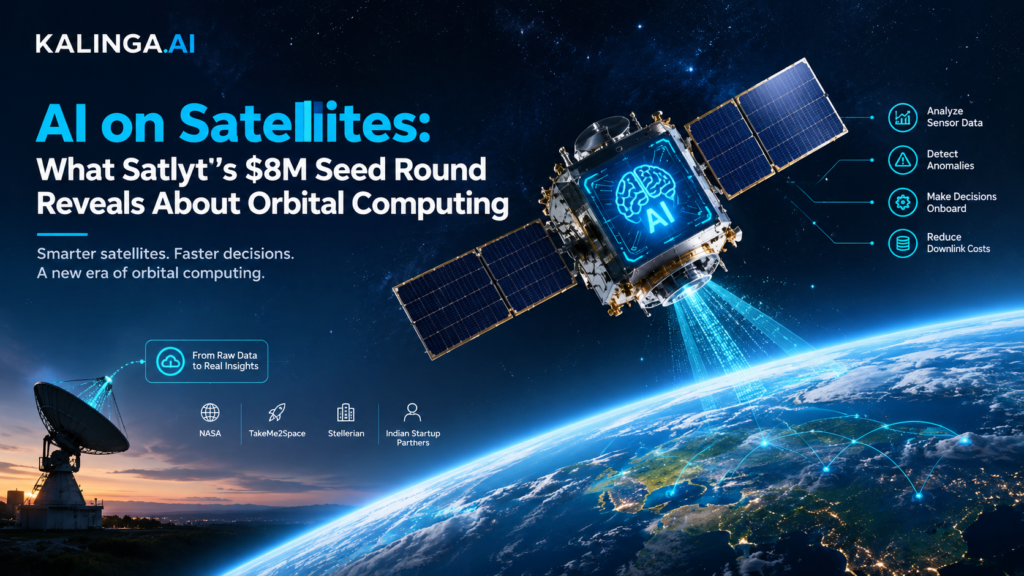
AI on satellites means running machine-learning models directly on spacecraft, so they can analyze sensor data and make decisions in orbit instead of waiting for instructions from the ground. Satlyt, a startup headquartered in Sunnyvale, California, and Nairobi, has raised an $8 million seed round to build the software that makes this possible across many companies’ satellites, according to TechCrunch’s October 1, 2026 report, and that software is scheduled to launch on a SpaceX rocket the same week.
Most spacecraft still lean on flight controllers on the ground whenever something goes wrong. Every message back to Earth costs money and takes time. Satlyt is betting that the next big layer of the space economy is not another rocket or another satellite, but the operating software that lets satellites think for themselves. This guide explains what that means, who is behind it, what has been proven so far, and what it could mean for builders and students, including those in India.
Key Takeaways
- Funding: Satlyt raised an $8 million seed round led by Houston-based Non Sibi Ventures, a firm where partner Bernard Harris spent more than 20 years as a NASA astronaut.
- Product: Satlyt builds software, not spacecraft. Its founder compares the model to VMware and Snowflake, platforms that hide infrastructure complexity from users.
- Proof point: Satlyt deployed Google DeepMind’s Gemma model on a Momentus spacecraft, and the model cut the size of a transmission about onboard software errors by more than 60%.
- Launch: Its software flies on a spacecraft built by TakeMe2Space, an Indian startup, with NASA, Stellerian, and TakeMe2Space as the three customers.
- Next milestone: A shared computing system spanning two satellites, which the company expects to attempt next year.
- Ambition: The founder wants Satlyt live on 20% of satellites by the end of the decade. That is a goal, not a forecast.
What Is AI on Satellites?
Definition
AI on satellites is the practice of running trained machine-learning models on the computers inside a spacecraft. The satellite uses those models to interpret its own sensor readings, diagnose its own faults, and decide what data is worth sending to Earth.
Expansion
Think of the difference between a security camera that streams every second of footage to a distant server and a smart camera that only uploads clips when it detects something unusual. The second one saves bandwidth, reacts faster, and puts less load on the network. Satellites face a harder version of the same problem, because their link to Earth is limited, intermittent, and expensive.
The field is also called onboard AI, edge AI in space, or part of the broader category of orbital computing. The common thread is that computation happens where the data is created, not where the engineers sit.
How is this different from normal satellite automation?
Traditional satellite automation follows rules written in advance: if a value crosses a threshold, run a prescribed procedure. A machine-learning model can instead interpret messier signals and summarize what it finds. This is a general distinction rather than a claim from the TechCrunch report, but it explains why companies are interested in putting models, rather than only scripts, on board.
Why does downlink make this valuable?
Sending data from a spacecraft to Earth is called downlink. According to TechCrunch, downlink is expensive and often slow. If a spacecraft can process sensor readings itself, or resolve an anomaly without waiting for the ground, it can send down a small result instead of a large raw file. That is the economic logic behind Satlyt’s first products.
Ground processing vs. onboard processing
The table below is an editorial comparison built from the reporting and general engineering logic.
| Factor | Ground-based processing | Onboard AI processing |
| Where decisions are made | Flight controllers and ground systems | The spacecraft itself, using AI models |
| Downlink demand | High, because raw data and long error reports travel to Earth | Lower, because the satellite can send summaries or results |
| Response to anomalies | Waits for a human team on the ground | Can begin resolving issues aboard |
| Hardware requirement | Standard spacecraft computers | More capable processors, and few high-powered GPUs are in orbit today |
| Cost profile | Recurring downlink and operations costs | Upfront hardware and software cost, with potential recurring savings |
| Best early use cases | Routine telemetry review | Anomaly handling and sensor-data processing in orbit |
Who Is Behind Satlyt?
Rama Afullo: from Google and SpaceX to his own company
Satlyt’s founder and CEO is Rama Afullo, a Kenyan American engineer. He previously worked in Google’s cloud computing business and then had a brief stint at SpaceX’s Starlink communications network in 2024. Those experiences convinced him that computers in space had untapped potential.
Afullo told TechCrunch that he tried to pitch the idea inside both companies and was turned down by both. So he left SpaceX and co-founded Satlyt. The irony is that SpaceX has since gone all-in on orbital data centers, according to the report.
The team
A photo caption in the TechCrunch article identifies the team as CEO Rama Afullo, CTO Nelson Psenjen, and engineers Leina Moli and Junn Wangari. The company operates between Sunnyvale and Nairobi, which makes it a notable example of a space-software company with a strong African founding connection.
The $8M Seed Round
Who invested?
The round was led by Non Sibi Ventures, a Houston-based firm. Bernard Harris, a partner at the firm, served as a NASA astronaut for more than 20 years, and TechCrunch says that background helped ground the firm’s conviction in a novel, space-based business.
Why did the investors say yes?
Non Sibi partner Kent Lucas told TechCrunch that Satlyt does not depend on the most ambitious version of space data centers, a vision that faces uncertain economics and a launch bottleneck. In his view, Afullo’s company can succeed simply as the number of satellites going up increases. In other words, the investment thesis rests on satellite volume rather than on a full-scale orbital cloud.
That distinction matters. It tells readers that the near-term opportunity in AI on satellites is less about building giant computing clusters in space and more about making existing and upcoming spacecraft smarter and cheaper to run.
What Does Satlyt Actually Build?
What is the product?
Satlyt is building software to operate AI models on satellites. It is not building spacecraft, unlike SpaceX, Google, or startups such as Starcloud and Cowboy Space Company. Afullo compares the model to VMware and Snowflake, companies whose platforms let customers run complex software without worrying about the underlying infrastructure.
What is the pitch to satellite builders?
Afullo’s pitch, as TechCrunch relays it, is that Satlyt turns a satellite into a revenue-generating managed service. Instead of treating a satellite as a fixed-function machine that only does its original job, an operator could host additional workloads on it, and Satlyt’s software would handle the orchestration.
What does it mean to be the “Android” of orbital computing?
Afullo uses a consumer-technology analogy. If companies like SpaceX building orbital data centers are the iPhone, a closed and vertically integrated product, he wants Satlyt to be Android: a horizontally integrated, open ecosystem. The practical meaning is software that works across many companies’ satellites rather than only on one vendor’s hardware.
Proof Points: What Has Satlyt Already Shown?
How many missions has the software flown?
Satlyt has already flown its software on two demonstration missions, according to the report.
What did the Gemma deployment achieve?
Earlier this year, Satlyt deployed Google DeepMind’s Gemma AI model onboard a spacecraft operated by Momentus. TechCrunch reports that the model reduced the size of a transmission about onboard software errors by more than 60%. Afullo says efficiencies of that kind can save hundreds of thousands of dollars per satellite each year.
Two cautions are worth keeping in mind. First, the savings figure is the founder’s estimate, not an independently audited number. Second, a transmission-size reduction on one mission is a promising signal, not proof that the same result will hold across every satellite type.
What is the initial focus?
The first focus is operational efficiency for spacecraft. Today, spacecraft typically depend on ground controllers to solve problems. Satlyt’s software aims to let the spacecraft handle more of that itself, and to process sensor readings on board rather than on the ground. That is a pragmatic, revenue-oriented entry point for AI on satellites, and it does not require a fleet of powerful GPUs in orbit.
The Launch: Three Customers, One Spacecraft
What is flying and on what?
This week’s launch puts Satlyt’s software onboard a spacecraft built by TakeMe2Space, an Indian startup that builds computing hardware for satellites. The launch is on a SpaceX rocket, and it also carries the first prototype of Google’s space data center effort, Project Suncatcher.
Who are the three customers?
The mission involves three customers, each testing something different:
| Customer | Role in the mission |
| NASA | Paying Satlyt to test protocols for cloud computing in space |
| Stellerian | A startup focused on space surveillance, meaning tracking objects in orbit, testing image-processing workloads |
| TakeMe2Space | The spacecraft builder, demonstrating that its satellite can host other companies’ software |
The third customer is the most strategically interesting. If a satellite can host other companies’ software, it begins to look less like a single-purpose machine and more like a small piece of shared infrastructure.
Open vs. Closed: The Orbital Computing Platform Debate
What is the difference between the two approaches?
The table below summarizes the contrast Afullo draws, plus the logic behind each model. The right-hand column reflects the founder’s framing rather than a neutral industry verdict.
| Dimension | Closed, vertically integrated approach | Open, horizontal approach |
| Example cited | SpaceX-style orbital data centers (the “iPhone”) | Satlyt’s software layer (the “Android”) |
| Who builds the spacecraft | The same company that runs the platform | Many different spacecraft builders |
| Who builds the software | The platform owner | Satlyt, working across vendors |
| Main advantage | Tight integration between hardware, launch, and software | Broad compatibility and a wider potential market |
| Main risk | Customers depend on a single vendor | Needs hardware partners and consistent standards |
| Growth driver | The owner’s own constellation | The number of satellites that adopt the software |
Why does this matter for the industry?
Platform wars have a long history in consumer computing, and the analogy resonates for a reason. Open ecosystems tend to scale by being everywhere, while integrated ecosystems tend to win by being polished. Whether orbital computing follows the same pattern is an open question, but the framing helps readers understand where Satlyt wants to compete.
Orbital Data Centers: Where Does Satlyt Fit?
Is Satlyt building a space data center?
Not directly. Satlyt is not building spacecraft, and it does not depend on the most ambitious version of orbital data centers. It is positioning itself as the software layer that could sit on top of satellites from many builders.
How crowded is the field?
TechCrunch names SpaceX, Google, Starcloud, and Cowboy Space Company among the companies pursuing space-based computing. SpaceX has gone all-in on orbital data centers, and Google’s Project Suncatcher is launching its first prototype alongside Satlyt’s software. That gives Satlyt a useful vantage point: it is flying on the same launch as one of the biggest names in the space.
What is the current hardware reality?
Right now, few high-powered GPUs are in orbit. For that reason, the most likely opportunity today is the kind of workload Satlyt is already targeting: anomaly handling and on-satellite data processing. Afullo expects that by the end of the decade virtually every spacecraft builder will be putting GPUs and similar advanced processors in their satellites. If he is right, the market for software that manages those processors grows with them.
What is the next technical milestone?
Satlyt’s next project is to show that it can create a shared computing system, a cloud, spanning two different satellites. The company expects to attempt that next year. If it works, Satlyt could become a third-party provider of a true compute cloud in orbit for spacecraft builders.
Business Model and Growth Targets
How does Satlyt plan to make money?
The managed-service framing suggests recurring revenue from satellite operators who want their spacecraft to do more than their original mission. Revenue could come from hosting workloads, reducing downlink costs, or both. TechCrunch does not publish detailed pricing, so any specific revenue model beyond the managed-service pitch would be speculation.
What is the 20% goal?
Afullo hopes Satlyt will be live on 20% of satellites by the end of the decade. He argues that launching a satellite without a GPU would be doing the operator a disservice. Treat the 20% figure as a founder’s ambition. It is useful for understanding the scale of his thinking, but it is not a market forecast.
Risks and Open Questions
This section is editorial analysis, not reporting from the TechCrunch article.
- Hardware dependence. AI on satellites needs capable processors. If spacecraft builders adopt GPUs more slowly than expected, the addressable market grows more slowly too.
- Platform gravity. Integrated players such as SpaceX and Google control their own hardware and launch. An open software layer has to convince many different builders to adopt it.
- Independent verification. The headline numbers, including the 60% transmission reduction and the hundreds-of-thousands-of-dollars savings estimate, come from the company and its reporting. Wider deployments will test them.
- Launch bottleneck. The investors themselves flagged a launch bottleneck for the grander space data center vision. Software-first companies are less exposed, but not immune.
- Standards. An “Android of orbit” implies shared interfaces and standards. Getting competing spacecraft builders to agree is a business challenge as much as a technical one.
What It Means for India
This section is editorial perspective for Kalinga.ai readers.
Why should Indian students and founders pay attention?
One of the three companies in this week’s mission is TakeMe2Space, an Indian startup building computing hardware for satellites. That is a signal that Indian hardware and software talent can plug into the global orbital computing stack, not only observe it.
Which skills are relevant?
The skills behind AI on satellites overlap with fields many Indian engineering and data-science students already study:
- Efficient model deployment on small, power-limited devices
- Embedded systems and real-time software
- Anomaly detection and fault diagnosis
- Image processing for remote sensing and space surveillance
- Cloud orchestration and distributed systems
The Gemma deployment is also a reminder that open, compact models can be useful in unexpected environments, which is good news for learners who cannot access frontier-scale compute.
How to Evaluate a Space-AI Startup: A Quick Checklist
If you are a student, analyst, or founder tracking this sector, these questions separate substance from hype:
- Has the software flown on real spacecraft, and how many missions?
- Does the company build hardware, software, or both?
- Who are the paying customers, and what are they testing?
- What measurable result has been shown, such as a reduction in downlink size?
- Does the business depend on the largest version of the space data center vision, or does it work with today’s satellites?
- Which hardware partners support the platform?
Satlyt scores reasonably on several of these: two demonstration missions, named customers on the upcoming flight, a quantified result, and a model that does not require space data centers to succeed. The harder tests, including the two-satellite cloud, are still ahead.
Frequently Asked Questions
What is AI on satellites?
AI on satellites is the use of machine-learning models running aboard spacecraft to process data and make decisions in orbit. The aim is to reduce reliance on ground controllers and cut expensive, slow downlink of raw data.
What does Satlyt do?
Satlyt builds software that runs AI models on satellites and is designed to work across different companies’ spacecraft. It does not build its own satellites.
How much did Satlyt raise, and who led the round?
Satlyt raised an $8 million seed round, led by Houston-based Non Sibi Ventures, according to TechCrunch.
What is orbital computing?
Orbital computing is the practice of performing computation on hardware in space rather than on Earth. It ranges from small onboard processing tasks to the larger vision of data centers in orbit.
Does Satlyt need space data centers to succeed?
According to its lead investor’s comments to TechCrunch, no. The company’s growth can be driven by the number of satellites launched, regardless of whether full-scale space data centers materialize.
What is Project Suncatcher?
Project Suncatcher is Google’s space data center effort. Its first prototype is launching alongside Satlyt’s software, as reported by TechCrunch.
When will Satlyt attempt a cloud spanning two satellites?
The company expects to attempt it next year, according to the report.
Conclusion: A Software Bet on Smarter Satellites
Satlyt’s $8 million seed round is a small number in a sector where rockets and spacecraft cost far more, but it highlights an important shift. The conversation about AI on satellites is moving from “can we put computers in orbit?” to “who writes the software that makes them useful?” Satlyt wants to be that software layer, open and compatible across builders, and it has begun to back the claim with demonstration missions, a quantified efficiency result, and a launch carrying three distinct customers.
The coming months will show whether the open-platform strategy can compete with integrated giants, and whether the two-satellite cloud works. For now, the story is a useful lens on where AI infrastructure is heading: closer to the data, and increasingly beyond the planet.
Want to build the skills behind tomorrow’s AI infrastructure? Explore the AI guides, news analysis, and hands-on training programs at Kalinga.ai, designed for students, freshers, and young professionals in Odisha and across India.