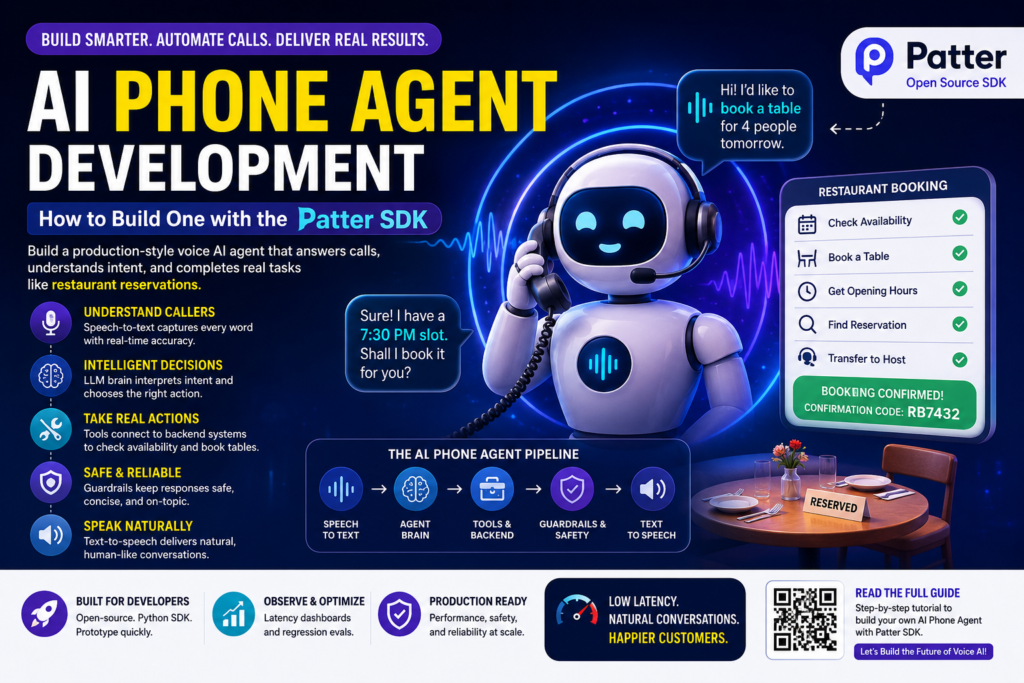
An AI phone agent is a voice-based software system that answers calls, understands what the caller wants, calls backend tools, and completes real tasks like booking a table — and the fastest way to build one today is with a purpose-built framework like the open-source Patter SDK. This guide walks through exactly how a production-style voice AI agent is structured, using a restaurant reservation system as the working example, based on a hands-on Patter SDK tutorial.
If you’ve ever wondered how tools like restaurant reservation lines, appointment schedulers, or customer service bots hold a conversation without a human on the other end, this article breaks down the full pipeline — from dynamic caller variables and tool registration to safety guardrails, latency dashboards, and regression evals.
What Is an AI Phone Agent?
An AI phone agent is a conversational software system that handles inbound or outbound phone calls using a combination of speech recognition, a language-model “brain,” callable backend tools, and safety guardrails. Unlike a simple text chatbot, a voice agent operates under real-time constraints: it must transcribe speech, decide what to say or do, execute business logic, and synthesize a spoken response — all within a latency budget that keeps the exchange feeling natural rather than robotic.
At a technical level, a modern phone-based AI agent is built from five core layers:
- Speech-to-text (STT): converts the caller’s voice into text the system can reason over
- Agent brain: the decision-making logic, often an LLM, that interprets intent and chooses a response or action
- Tool layer: callable functions that connect the agent to real backend systems, such as a reservation database
- Guardrails: rules that keep responses safe, on-topic, and free of leaked private data
- Text-to-speech (TTS): converts the generated response back into audio for the caller
Every automated phone agent — whether it’s answering for a restaurant, a clinic, or a delivery service — is essentially an orchestration of these five layers running in a loop for every conversational turn.
Why Restaurant Booking Is a Great Use Case for a Voice AI Agent
Restaurant booking is one of the clearest real-world tests for a conversational voice system because it combines structured data — dates, party sizes, time slots — with open-ended conversation, including small talk, interruptions, and requests for a human. A restaurant booking assistant has to:
- Extract structured slots (date, time, party size, name) from unstructured speech
- Check live availability against a backend system
- Confirm a booking and generate a reference code
- Handle edge cases like a fully booked slot or a caller who wants a human host instead
This mix of clear success criteria (did it book the table correctly?) and conversational nuance (did it sound natural doing it?) makes restaurant booking a popular benchmark scenario for testing any new AI phone agent framework, including Patter.
Core Components of a Patter SDK Voice Agent
The Patter SDK, an open-source Python framework, is designed to let developers prototype a full voice-agent workflow without needing live telephony credentials. Below is a breakdown of the components that make up a working phone-based AI agent in Patter.
Dynamic Caller Variables
Every real phone call needs personalization. In a Patter-based voice agent, caller variables such as name, loyalty tier, and restaurant identity are injected directly into the system prompt and first-message template. This means the same underlying agent logic can greet “Priya, our Gold member” on one call and a first-time caller on the next, without duplicating code or writing separate scripts for each customer segment.
Tool Registration and Backend Integration
An automated phone agent is only as useful as the actions it can actually perform. In the Patter tutorial, a small tool registry is built using a @tool decorator that registers Python functions — checking table availability, booking a table, retrieving opening hours, looking up an existing reservation by confirmation code, and transferring the call to a human host. Each tool is backed by an in-memory database that resets between simulated calls, keeping test runs deterministic and repeatable.
Output Guardrails for Safety and Scope
Guardrails are what separate a production-ready voice AI agent from a fragile demo. In this workflow, five guardrail functions run in sequence on every generated response:
- Scope guardrail — blocks off-topic requests like medical or legal questions and redirects the caller back to booking
- Internal ID guardrail — hides internal customer record identifiers from spoken output
- PII redaction guardrail — strips emails and phone numbers before they’re spoken back
- Profanity guardrail — filters a small set of banned words
- Conciseness guardrail — trims responses to at most two sentences, since long spoken replies feel unnatural on a phone call
Because these guardrails run on every single output, the assistant stays predictable and safe even when the underlying language model produces unexpected phrasing.
Simulated Speech-to-Text and Text-to-Speech Layers
Rather than requiring a live telephony connection, the tutorial simulates STT and TTS behavior with lightweight functions that model realistic latency. The fake STT function strips filler words, similar to how a real transcription model like Whisper behaves, and returns a modeled latency in milliseconds. The fake TTS function estimates time-to-first-audio based on response length. This lets developers test and tune a voice agent’s conversational timing entirely offline before connecting to a real speech provider.
How the Agent Brain Powers Conversational Logic
The “brain” of the system is a state-machine-style function that tracks conversation state across turns, including intent — booking, lookup, or hours — and partially collected slots like party size, date, and seating time. Rather than relying purely on a language model for every decision, the brain uses pattern matching to detect requests for a human, out-of-scope topics, reservation lookups by confirmation code, and hours inquiries, before falling into a structured slot-filling flow for bookings.
This hybrid approach — deterministic logic for structured tasks, with an optional fallback to a real LLM for freeform small talk — is a common pattern in production AI phone agent design. It keeps the core booking flow fast, testable, and cheap to run, while still leaving room for natural conversation when needed.
Q: Does a voice agent need a large language model for every response? A: No. Many production systems use deterministic logic for high-stakes, structured tasks, like confirming a booking, and reserve the LLM for open-ended conversation. This reduces cost, cuts latency, and lowers the risk of a hallucinated action being taken on a live call.
Step-by-Step: Building Your First Voice Agent with Patter
Here’s the practical build sequence used in the tutorial, which mirrors how most teams should approach conversational phone agent development.
Step 1 — Set Up the SDK, Tools, and Backend
Import the Patter SDK, with a fallback pip install if it isn’t already present, define caller variables, and register callable tools with a decorator. Build a small in-memory backend representing real data — in this case, table availability, existing reservations, and business hours.
Step 2 — Add Guardrails and Simulated Speech Layers
Layer in output guardrails for scope, privacy, tone, and length. Add simulated STT and TTS functions so conversational timing can be tested without a live phone number.
Step 3 — Build the Agent Brain and Call Simulator
Write the core decision logic that interprets caller input and conversation state, then wrap it in a call simulator that runs a scripted list of caller lines end-to-end and logs every turn — including which tool was called and how long each stage took.
Step 4 — Add Latency Dashboards and Regression Evals
Print a dashboard summarizing agent turns, tool calls, p50/p95 latency, average STT/TTS time, and estimated cost per call. Then build a small eval harness with deterministic pass/fail checks — confirming the agent successfully books a table, hides internal customer IDs, refuses out-of-scope medical questions, transfers to a human on request, and gracefully handles a fully booked slot.
Step 5 — Move to Real Calls
Once your simulated AI phone agent passes its evals, the same tool definitions, guardrails, and prompts can be pointed at a real telephony carrier, such as Twilio, and a real-time voice model, such as OpenAI Realtime, with inbound serving, tunneling, dashboard monitoring, call recording, and outbound calling support.
Latency and Cost Metrics Every Voice Agent Should Track
Latency is the single biggest factor separating a natural-feeling voice assistant from a frustrating one. The Patter tutorial models four latency components per turn:
- STT latency — time to transcribe the caller’s speech
- LLM/brain latency — time to decide on a response or tool call
- Tool latency — time to execute a backend function like checking availability
- TTS latency — time to synthesize the spoken reply
Tracking p50 and p95 total latency per turn, alongside average STT and TTS time and an estimated per-call spend, gives developers a realistic picture of how their system will perform and cost at scale — well before it ever touches a live phone line. A well-tuned agent typically keeps p95 total turn latency low enough that pauses don’t feel awkward, since callers notice delays far more readily in voice than in text — a two-second gap that reads as normal in a chat window feels like dead air on a phone call.
Cost tracking matters just as much as speed. Because each turn combines an STT charge, an LLM call, an optional tool execution, and a TTS charge, per-call spend can add up quickly at volume. Modeling estimated cost alongside latency during the simulation stage — before a single real call is placed — lets teams catch expensive conversational patterns, like overly long responses or unnecessary tool calls, while they’re still cheap to fix.
Patter SDK vs. Other Voice AI Approaches
| Feature | Patter SDK (simulation-first) | Raw LLM + custom glue code | Full-stack voice AI platforms |
|---|---|---|---|
| Setup time | Low — Python decorators for tools | High — manual STT/TTS/orchestration wiring | Low, but less code-level control |
| Telephony required to start testing | No — fully simulated calls | Often yes | Usually yes |
| Guardrail support | Built-in guardrail chaining | Manual implementation | Varies by vendor |
| Regression testing | Built-in eval harness pattern | Manual scripting | Varies by vendor |
| Path to production | Same code, swap in Twilio/OpenAI Realtime | Custom integration work | Vendor-managed deployment |
| Best for | Developers who want to prototype and test an agent before going live | Teams wanting full control over every layer | Teams prioritizing speed over customization |
This comparison highlights why a simulation-first approach like Patter appeals to developers building an AI phone agent: it front-loads testing and safety validation before any carrier costs or live-call risk enters the picture.
Where Voice AI Agents Are Being Deployed Beyond Restaurants
The same architecture used for restaurant reservations generalizes well across other industries that rely on high call volume and repetitive scheduling logic:
- Healthcare front desks — appointment scheduling, prescription refill requests routed to a pharmacist, and insurance verification questions
- Field service and home repair — dispatch scheduling, technician arrival windows, and rescheduling requests
- Retail and delivery — order status lookups, return initiation, and store hours
- Property management — maintenance request intake and viewing appointment scheduling
In each case, the same five-layer structure applies: dynamic variables for personalization, a tool layer connected to the real backend system of record, guardrails tuned to the domain’s sensitive topics, and an eval suite that mirrors the industry’s most common call patterns.
What changes between industries is mostly the guardrail configuration and the tool set, not the underlying architecture. A healthcare front desk needs stricter scope guardrails around anything resembling diagnosis or treatment advice, while a retail order-status line needs stronger identity verification before reading back order details over the phone. Teams adapting this pattern should start by listing every backend action a human staff member currently performs on a call — checking a record, updating a booking, escalating an issue — and turning each one into a discrete, testable tool, exactly as the restaurant example does with availability checks and table bookings.
Best Practices for Deploying a Production Voice Agent
Based on the structure of this workflow, a few best practices stand out for anyone building an AI phone agent for a real business:
- Test with scripted conversations before going live. Scripted, deterministic call simulations catch logic errors that are far more expensive to discover on a real customer call.
- Keep guardrails layered and explicit. Chaining separate guardrail functions for scope, privacy, tone, and length makes each rule easy to audit and update independently.
- Track latency at every layer, not just the total. Knowing whether a slowdown comes from STT, the brain, a tool call, or TTS makes debugging dramatically faster.
- Build a regression eval suite early. Automated checks for booking success, PII protection, scope enforcement, and human handoff prevent silent regressions as the agent brain evolves.
- Design for graceful failure. A well-built system should offer alternatives, like a different time slot, when the first attempt fails, rather than dead-ending the conversation.
- Reset backend state between test calls. Deterministic, isolated test runs make it much easier to catch bugs that only appear with specific combinations of inputs.
Common Questions About AI Phone Agents
Q: Can a voice agent be tested without a real phone number? A: Yes. Frameworks like Patter allow developers to run fully scripted call simulations with modeled STT/TTS latency, so the entire conversational flow, tool logic, and guardrails can be validated before any telephony credentials are involved.
Q: What’s the difference between an AI phone agent and a text-based chatbot? A: A voice agent operates under real-time voice constraints — it has to manage speech transcription latency, synthesis latency, and naturally short spoken responses — whereas a text chatbot has no equivalent audio pipeline or turn-timing pressure to manage.
Q: How does a phone-based AI agent avoid leaking sensitive information? A: Through output guardrails that run on every generated response, using regex-based redaction of emails, phone numbers, and internal customer record IDs before the text is ever converted to speech.
Q: What happens when the system can’t help with a request? A: A well-designed voice agent routes the caller to a human using a dedicated transfer tool, rather than attempting to improvise an answer outside its intended scope.
Q: Is an open-source framework like Patter suitable for production use? A: The simulation-first design is meant to validate logic, guardrails, and timing before deployment; moving to production involves connecting the same tested code to a real carrier and a real-time voice model, so teams should treat the simulation stage as a testing ground rather than the finish line.
Conclusion
Building a reliable AI phone agent comes down to combining five things well: dynamic personalization, callable backend tools, layered guardrails, realistic latency modeling, and automated regression testing. The Patter SDK tutorial demonstrates this entire pipeline using a restaurant booking scenario, showing how a fully simulated voice agent can be built, tested, and validated in a notebook environment before ever touching a real telephony provider like Twilio or a real-time voice model like OpenAI Realtime. For developers exploring voice AI, this simulation-first approach offers a faster, safer path from prototype to production than wiring together STT, TTS, and orchestration logic from scratch.