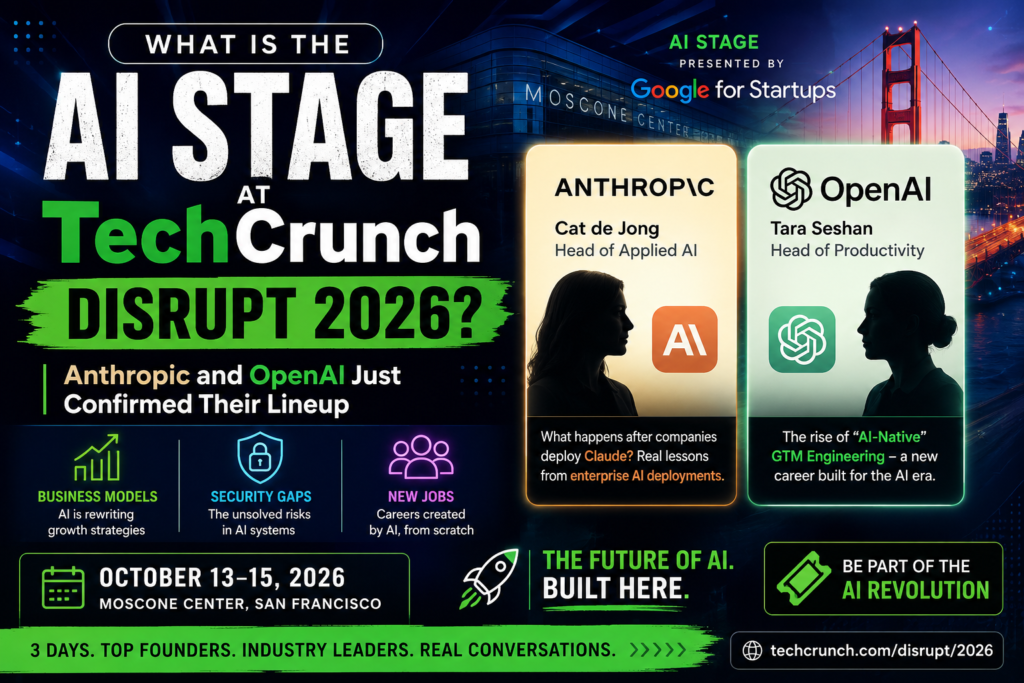
Picture this: a college fresher in Bhubaneswar refreshing their LinkedIn feed and seeing that Anthropic and OpenAI, the two companies most students associate with ChatGPT and Claude, are both speaking at the same event in San Francisco this October. That event is the AI Stage at TechCrunch Disrupt 2026, and the direct answer is this: it’s a dedicated speaker track running October 13–15, 2026 at Moscone Center, presented by Google for Startups, where Anthropic’s Head of Applied AI and OpenAI’s Head of Productivity will join founders, security leaders, and VCs to discuss how AI is rewriting business models, exposing new security gaps, and creating entirely new job categories. If you’re trying to understand what’s actually happening at this event, and why it matters even if you’re watching from India, this guide breaks it down without the jargon. TechCrunch
This isn’t just another conference recap. For students and young professionals building careers around AI, the AI Stage at TechCrunch Disrupt 2026 is a useful signal of where the industry’s biggest players think the next 12 months are headed, pricing, security, and jobs that didn’t exist two years ago.
What Exactly Is the AI Stage at TechCrunch Disrupt 2026?
The AI Stage at TechCrunch Disrupt 2026 is a themed programming track within the larger TechCrunch Disrupt conference, focused entirely on artificial intelligence. Rather than scattering AI talks across the whole event, TechCrunch groups them into one stage so attendees interested specifically in AI trends, enterprise deployment, and startup strategy can follow one continuous thread.
Question: Where and when is the AI Stage at TechCrunch Disrupt 2026 happening?
It runs from October 13–15 in San Francisco at Moscone Center, as part of the broader TechCrunch Disrupt 2026 event. The AI Stage itself is presented by Google for Startups, and organizers have said more speaker announcements are still to come. TechCrunch + 2
This year’s edition of the AI Stage at TechCrunch Disrupt 2026 is built around three core themes that TechCrunch has explicitly flagged: the business models AI is rewriting, the unsolved security gaps in AI systems, and the entirely new job categories AI has created from scratch. For students tracking where the AI job market is moving, that third theme alone is worth paying attention to. TechCrunch
Why Are Anthropic and OpenAI Both Speaking at the Same Event?
Direct answer: Anthropic and OpenAI are usually framed as rivals in headlines, but at the AI Stage at TechCrunch Disrupt 2026, both companies are sending representatives to talk about deployment and workflow change rather than competing product launches, which is exactly the kind of practical, non-marketing content TechCrunch says the stage is designed for.
Enterprise AI deployment is a term worth defining here: it refers to the process of an organization actually rolling out an AI system, like a chatbot or an autonomous agent, into its real, everyday business operations, as opposed to just testing it in a small pilot. Anthropic’s session is built entirely around this idea. It expands on it by contrasting companies that get value from AI quickly against those still stuck running pilots more than a year later.
Anthropic’s Session: What Happens After Companies Deploy Claude
According to the event listing, Cat de Jong, Head of Applied AI at Anthropic, works directly with enterprises putting Claude to work across their most critical workflows. Her session is framed as looking past the announcement stage of AI adoption and into what actually happens next. TechCrunch
The talk description says it will cover where deployments succeed immediately, where they stall, and what separates organizations extracting real value from those still running pilots eighteen months in. TechCrunch bills it as pulling back the curtain on what applied AI actually looks like inside the world’s most closely watched AI company. TechCrunchTechCrunch
OpenAI’s Session: The Rise of “AI-Native” GTM Engineering
OpenAI’s contribution to the AI Stage at TechCrunch Disrupt 2026 comes from Tara Seshan, Head of Productivity at OpenAI, and centers on a role that essentially didn’t exist a couple of years ago. TechCrunch
GTM engineering (go-to-market engineering) is a hybrid role that blends sales, marketing, and technical/coding skills to build AI-powered systems that help companies find and convert customers faster. The session description notes that two years ago, GTM engineering did not exist, today it is one of the fastest-growing roles in the industry, with independent practitioners building million-dollar businesses. TechCrunch says attendees will walk away understanding what AI-native GTM looks like in practice and how it’s changing the way companies grow. TechCrunchTechCrunch
The Other Big Names Joining the AI Stage at TechCrunch Disrupt 2026
Anthropic and OpenAI are the headline names, but the full AI Stage at TechCrunch Disrupt 2026 lineup is broader. Here’s a scannable breakdown of who else is confirmed and what they’re tackling:
- Arsalan Tavakoli (Databricks), Co-founder and SVP of Field Engineering, discussing what enterprise AI security actually requires in 2026, including observability and governance frameworks. TechCrunchTechCrunch
- Ric Smith (Okta), President of Product & Technology, speaking on why application-level permission models are fundamentally flawed for securing autonomous AI agents. TechCrunchTechCrunch
- Dean Leitersdorf (Decart) and Amit Jain (Luma AI), both CEOs, discussing real-time inference and physical reasoning in visual/video AI. TechCrunch
- Arvind Jain (Glean), Barr Moses (Monte Carlo), Cathy Gao (Sapphire Ventures), Aaron Jacobson (NEA), a panel on how to price AI products sustainably and build defensible moats as models get commoditized. TechCrunch
- Kareem Amin (Clay), Co-founder and CEO, expanding on GTM engineering as tech’s next big job category. TechCrunchTechCrunch
- Chet Kapoor (AWS), Katie Moussouris (Luta Security), Wendy Nather (1Password), a joint session on securing AI inside cloud infrastructure at enterprise scale.
Question: What’s the common thread across all these AI Stage sessions?
Every session circles back to one of three themes TechCrunch set for the stage: pricing AI products as models become commoditized, rebuilding security for autonomous AI agents, and new job roles created directly by AI adoption. None of the sessions are product launches, they’re framed as practitioner conversations.
AI Stage Themes: A Quick Comparison
| Theme | Core Question Being Asked | Key Speakers |
| Enterprise AI Deployment | Why do some companies get value fast while others stay stuck in pilots? | Cat de Jong (Anthropic) |
| AI-Native Go-To-Market | What does a GTM function look like when it’s built around AI from day one? | Tara Seshan (OpenAI), Kareem Amin (Clay) |
| Agentic AI Security | How do you secure AI systems that make autonomous decisions at machine speed? | Arsalan Tavakoli (Databricks), Ric Smith (Okta), Chet Kapoor (AWS) |
| AI Product Pricing & Moats | How do you price and defend an AI product once the underlying model is a commodity? | Arvind Jain (Glean), Barr Moses (Monte Carlo), VC panelists |
| Video & Visual AI | What happens when video generation becomes genuine visual reasoning? | Dean Leitersdorf (Decart), Amit Jain (Luma AI) |
Why Should Students and Freshers in India Care About the AI Stage?
Question: I’m not attending in person, does the AI Stage at TechCrunch Disrupt 2026 still matter to me?
Yes, because the topics being discussed (agent security, GTM engineering, enterprise AI adoption) are exactly the skill areas showing up in hiring trends globally, including in India’s growing AI and SaaS sector. Even without a ticket, tracking what gets discussed on stages like this gives you an early read on which roles and skills are becoming valuable.
A few reasons this specific lineup is worth noting for early-career professionals:
- New job categories are being named in real time. GTM engineering wasn’t a recognized title two years ago; now it’s being discussed on a major industry stage, which usually signals hiring demand is about to catch up.
- Security is shifting from “add-on” to “infrastructure.” Multiple sessions independently emphasize that agent security has to be rebuilt from the ground up, a strong hint for anyone considering cybersecurity + AI as a specialization.
- “Applied AI” roles are becoming a career track of their own, distinct from research roles, Anthropic’s own session title centers on this.
- Pricing and business strategy for AI products is now a boardroom-level conversation, not just an engineering one, which matters if you’re aiming for product or strategy roles rather than pure coding roles.
How the AI Stage Fits Into the Larger TechCrunch Disrupt 2026 Event
TechCrunch Disrupt 2026 is a multi-stage event, and the AI Stage is one part of a bigger conference. Attendees get access to every other stage, Startup Battlefield, networking opportunities, and the exhibition floor, alongside 10,000+ startup, tech, and VC leaders expected to attend. TechCrunch has also flagged that ticket pricing is in its final discount window, with savings reportedly available for those who register early. TechCrunch + 2
Question: Is the AI Stage lineup final?
No. TechCrunch explicitly notes “more announcements to come” for the AI Stage, so the list of speakers covered here, while accurate as of late August 2026, is likely to grow before the October event. TechCrunch
FAQ: AI Stage at TechCrunch Disrupt 2026
Q1: When and where is the AI Stage at TechCrunch Disrupt 2026?
It takes place October 13–15, 2026, at Moscone Center in San Francisco, as part of the wider TechCrunch Disrupt 2026 conference. TechCrunch
Q2: Who is representing Anthropic at the AI Stage?
Cat de Jong, Anthropic’s Head of Applied AI, will speak about patterns in how enterprises actually deploy and get value from Claude. TechCrunch
Q3: Who is representing OpenAI at the AI Stage?
Tara Seshan, OpenAI’s Head of Productivity, will discuss the rise of AI-native go-to-market (GTM) engineering as a new job category. TechCrunch
Q4: What are the main themes of the AI Stage this year?
TechCrunch has grouped sessions around AI pricing models, agent security gaps, and new job categories created by AI, presented by Google for Startups. TechCrunch
Q5: Is the AI Stage only about Anthropic and OpenAI?
No, the lineup also includes leaders from Databricks, Okta, AWS, Decart, Luma AI, Glean, Monte Carlo, Clay, Sapphire Ventures, NEA, Luta Security, and 1Password, covering security, video AI, and business strategy. TechCrunch
Q6: How can I attend or follow the AI Stage at TechCrunch Disrupt 2026?
Tickets are sold through TechCrunch’s official Disrupt 2026 event page, where discounted pricing is available for a limited window; those not attending in person can typically follow session recaps on TechCrunch’s site afterward. TechCrunch
Keep Following the AI Conversation with Kalinga.ai
If sessions like Anthropic’s “applied AI” deep-dive or OpenAI’s take on GTM engineering caught your interest, that’s exactly the kind of real-world AI career shift we break down regularly on Kalinga.ai, check out our AI careers and industry-trends section for more explainers like this one, written for readers in Odisha and beyond.