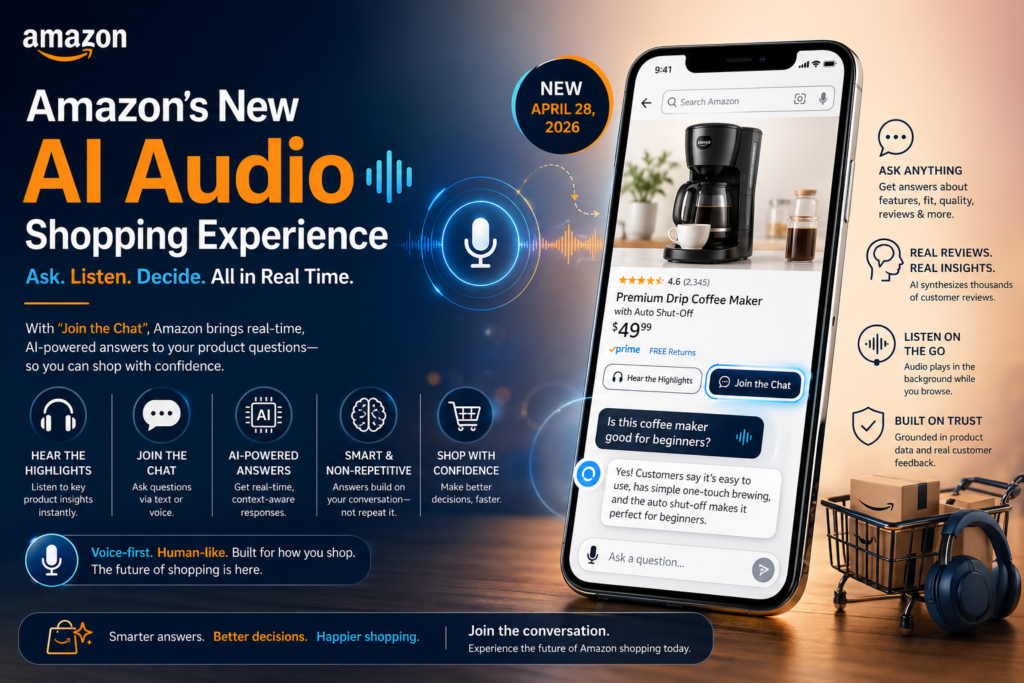
Amazon’s new AI audio shopping experience lets you ask questions about any product and get spoken, conversational answers in real time — no more scrolling through hundreds of reviews to find what you need. Launched on April 28, 2026, this feature marks the most significant evolution in product discovery since the search bar itself. amazon ai audio shopping experience
What Is Amazon’s “Join the Chat” Feature?
Definition: “Join the Chat” is an interactive, AI-powered layer built on top of Amazon’s existing “Hear the Highlights” audio feature. It allows shoppers to ask specific questions about a product — via text or voice — and receive conversational, non-repetitive audio answers generated in real time by what Amazon calls “AI-powered shopping experts.”
Think of it as a knowledgeable store associate who has read every product specification sheet, every customer review, and every Q&A thread, and is available to you instantly, 24/7, at no extra cost.
What Problem Does It Solve?
Traditional product pages dump information on you: a title, bullet points, a description written by the seller, hundreds of reviews of varying quality, and a Q&A section that may or may not have been answered. For a considered purchase, this can mean 10–15 minutes of reading before you feel confident.
Amazon’s AI audio shopping experience collapses that process dramatically. Instead of reading for context, you simply ask: “Is this coffee maker good for a beginner?” or “Do customers say the sweater fabric feels itchy?” — and you get a direct spoken answer that synthesizes all available information.
How Amazon’s AI Audio Shopping Experience Works
Here is the step-by-step flow for using the feature on the Amazon Shopping app:
- Open a product page in the Amazon Shopping app (U.S. only, as of April 2026).
- Tap “Hear the Highlights” — a button located just below the product image. This triggers a short AI-generated audio summary of the product’s key features and customer sentiment.
- Tap the “Join the Chat” icon to move from passive listening to active conversation.
- Ask your question via text or voice. The AI builds its answer based on product data, customer reviews, and your prior questions in the session.
- Continue browsing — the audio plays in the background, so you can keep scrolling while you listen.
What Makes the AI Responses Different?
The system is designed to be contextually aware within a session. Each answer builds on the previous one, and the AI explicitly avoids repeating information it has already delivered. Amazon describes the intent as mirroring the experience of speaking with an informed store employee — someone who remembers what they told you two minutes ago and moves the conversation forward.
This non-repetitive, context-building behavior is what distinguishes the Amazon AI audio shopping experience from a simple chatbot FAQ lookup.
“Hear the Highlights” vs. “Join the Chat” — What’s the Difference?
Both features are part of Amazon’s audio-first shopping push, but they serve different user needs. Here is a clear comparison:
| Feature | Hear the Highlights | Join the Chat |
|---|---|---|
| Type | Passive audio summary | Interactive Q&A conversation |
| User action | Tap to listen | Tap + ask a question |
| Content source | Product data + reviews | Product data + reviews + session context |
| Response format | Pre-generated summary | Real-time generated answer |
| Context memory | None | Yes — builds on prior questions |
| Input method | None (listen only) | Text or voice |
| Available on | Millions of product pages | Select products (expanding) |
| Best for | Quick overview before deciding to dig deeper | Specific purchase decision questions |
Bottom line: “Hear the Highlights” is the entry point; “Join the Chat” is where the Amazon AI audio shopping experience becomes genuinely powerful.(amazon ai audio shopping experience, Amazon Join the Chat, AI shopping assistant Amazon, voice commerce shopping, Amazon conversational shopping)
Why the Amazon AI Audio Shopping Experience Is a Turning Point for E-Commerce
The launch of this feature is not just a product update — it signals a broader structural shift in how people will interact with online retail.
1. From Text-First to Voice-First Product Discovery
E-commerce was built on text search: you type keywords, you get a list of results, you click, you read. That paradigm has been incrementally refined for 30 years. The Amazon AI audio shopping experience is the first mainstream attempt to flip the modality entirely. You speak (or type a natural question), and the platform speaks back.
This mirrors how humans actually shop in physical stores. Nobody walks into a kitchen appliance store and silently reads brochures. They ask a sales associate questions. Amazon is now simulating that dynamic at scale.
2. Reducing Purchase Friction at the Decision Stage
The highest-friction moment in e-commerce is not the checkout — it is the moment of doubt just before the “Add to Cart” click. Customers abandon carts because they are not confident the product will meet their specific needs.
The Amazon AI audio shopping experience directly targets this friction. By giving shoppers an on-demand, personalized Q&A channel, Amazon is addressing the information gap that causes hesitation. For sellers, this has significant implications: a well-optimized product listing with rich, accurate data will perform better in AI-generated responses, directly influencing conversion rates.
3. A New Dimension of Accessibility
Audio-first shopping also opens the platform to users who struggle with dense text-heavy pages: people with visual impairments, older shoppers who prefer listening to reading, or anyone multitasking while commuting. The Amazon AI audio shopping experience is not just a convenience feature — it is an accessibility upgrade at scale.
How This Fits Amazon’s Broader AI Shopping Strategy
The “Join the Chat” feature does not exist in isolation. It is the latest addition to a growing suite of generative AI tools Amazon has been rolling out across its shopping platform.
Amazon’s AI Shopping Ecosystem (2025–2026)
- Rufus — Amazon’s generative AI assistant, launched in 2024 and expanded through 2025. Rufus helps customers research and compare products through a conversational chat interface embedded in the app. According to TechCrunch, Rufus drove measurable sales impact during Black Friday 2025.
- Interests — An AI feature that continuously monitors new product listings and surfaces items aligned with a shopper’s stated preferences and past behavior. It functions as a passive, always-on shopping agent.
- Help Me Decide — Launched in late 2025, this tool synthesizes a user’s search and browsing history to proactively recommend products with an explanation of why they are recommended — a significant step beyond collaborative filtering.
- Hear the Highlights — Introduced in testing in May 2025, now live across millions of U.S. product pages. This is the audio layer on which “Join the Chat” is built.
- Join the Chat — The newest layer, enabling the full Amazon AI audio shopping experience with real-time, interactive, session-aware Q&A.
Together, these tools form a coherent strategy: transform Amazon from a catalog you browse into an intelligent shopping advisor you converse with.
What This Means for Sellers, Brands, and Marketers
If you list products on Amazon, the rise of the Amazon AI audio shopping experience changes your content strategy in three important ways.
Structured Product Data Becomes Critical
The AI draws its answers from the information available in your product listing: title, bullet points, description, A+ content, and customer reviews. If your listing has vague or incomplete bullet points, the AI cannot give confident, helpful answers. Thin content = thin AI responses = lower conversion.
Actionable takeaway: Audit your listings for specificity. Instead of “great for beginners,” write “features a one-touch brew button and auto-shutoff, making setup and cleanup suitable for first-time coffee machine users.” The AI can work with specifics; it cannot manufacture them.
Review Quality and Volume Matter More Than Ever
The Amazon AI audio shopping experience explicitly synthesizes customer feedback. Products with more reviews, and reviews that answer common pre-purchase questions in detail, will generate better AI responses. This gives a new strategic dimension to your review acquisition efforts.
Keywords Are Shifting Toward Natural Language
Historically, Amazon SEO has meant exact-match keyword stuffing in titles and bullet points. As AI intermediates more product discovery, natural language patterns — the questions customers actually ask — become the new optimization target. Think: “Is this waterproof?”, “How long does the battery last?”, “What size should I order if I’m between sizes?”
Build your listing content to answer these questions directly, and you will perform better both in classic search and in AI-generated responses.
Is Amazon’s AI-Powered Audio Feature the Future of Product Discovery?
Short answer: Yes — for considered purchases, voice-interactive AI is likely to become the default, not the exception.
Here is the broader trajectory to understand:
The Amazon AI audio shopping experience represents the convergence of three trends that have been building for years: the maturation of large language models capable of nuanced Q&A, the normalization of voice interaction through smart speakers and mobile assistants, and the e-commerce industry’s long-standing need to replicate the in-store consultation experience digitally.
What Amazon has done is take these three converging forces and deliver them inside the most-visited shopping platform on earth. The competitive pressure on other retailers — Walmart, Target, and international players — to match this capability will be immediate.
The open question is whether consumers will trust AI-generated product assessments at the same level they trust human reviews. Amazon’s design choice to explicitly ground responses in customer review data (rather than producing purely AI-synthesized claims) is a smart trust-building mechanism. The AI is positioned as a synthesizer and guide, not an independent authority.
Over time, as the system learns which product attributes shoppers care about most — durability, ease of use, sizing accuracy, value for money — expect the quality and specificity of the Amazon AI audio shopping experience to improve substantially.
Frequently Asked Questions
What is Amazon’s “Join the Chat” feature?
“Join the Chat” is an AI-powered interactive Q&A experience within the Amazon Shopping app. Shoppers can ask specific questions about a product via text or voice and receive real-time, conversational audio responses generated from product data and customer reviews.
How is “Join the Chat” different from Rufus?
Rufus is a general-purpose generative AI shopping assistant that helps with product research and comparison across the entire Amazon catalog. “Join the Chat” is product-specific — it operates within a single product page and builds on the “Hear the Highlights” audio summary layer, offering a more focused, session-aware conversation.
Is the Amazon AI audio shopping experience available globally?
As of April 2026, the feature is available in the U.S. only on the Amazon Shopping app.
Does the AI just repeat information from the product description?
No. Amazon has specifically designed the system to build on prior responses within a session and avoid repetition. It synthesizes product specifications, customer review sentiment, and Q&A data to generate relevant answers — not copy-paste summaries of the listing description.
What should sellers do to prepare for AI-driven product discovery?
Sellers should focus on three areas: enriching product listings with specific, factual information; actively acquiring detailed customer reviews that address common pre-purchase questions; and structuring content around natural language queries rather than keyword-dense fragments.
The Bottom Line
The Amazon AI audio shopping experience is more than just another feature launch inside the Amazon app—it represents a major shift in how consumers will discover, evaluate, and purchase products online in the coming years. For decades, e-commerce has relied heavily on a text-first model. Customers typed a query into a search bar, browsed endless product listings, clicked into pages, compared reviews, scanned product descriptions, and eventually made a decision. While that process worked, it was rarely efficient. It demanded attention, time, and patience from shoppers, especially when making high-consideration purchases such as electronics, home appliances, kitchen products, or fashion items.
Now, the Amazon AI audio shopping experience is introducing a more natural and frictionless alternative. Instead of manually reading hundreds of product reviews or comparing multiple tabs, shoppers can simply ask questions and receive real-time spoken answers generated by Amazon’s AI. This dramatically changes the shopping workflow. A customer considering a coffee machine no longer needs to scroll through reviews searching for comments about durability or beginner-friendliness. They can ask directly, “Is this coffee maker easy to use for beginners?” and receive an instant contextual response.
This convenience is what makes the Amazon AI audio shopping experience so strategically important. It solves one of the biggest pain points in online shopping: uncertainty before purchase. Many abandoned carts happen not because shoppers dislike a product, but because they are unsure whether it will actually meet their needs. A lack of confidence at the final decision-making stage leads users to postpone purchases, leave platforms, or search elsewhere for validation. By providing instant AI-driven clarification, Amazon reduces hesitation and moves customers toward faster purchasing decisions.
Another reason the Amazon AI audio shopping experience matters is because it aligns with broader consumer behavior trends. Voice interaction is no longer experimental. Millions of users are already comfortable talking to virtual assistants through smartphones, smart speakers, and in-car systems. Asking questions verbally feels intuitive, fast, and human. Amazon is leveraging this existing habit by embedding voice-based conversational commerce directly into the shopping flow.
This shift toward conversational commerce is significant because shopping has always been inherently conversational in physical environments. In brick-and-mortar stores, customers naturally ask questions: Which laptop is better for students? Is this material durable? Will this size fit me? Traditional e-commerce removed that layer of interaction, replacing it with static product pages and user-generated reviews. The Amazon AI audio shopping experience restores the missing dialogue by simulating a knowledgeable store assistant that is always available.
For sellers and brands, this evolution introduces both opportunity and responsibility. The quality of product listings is no longer only about visual appeal or keyword optimization. AI-generated answers are only as good as the underlying product data. If a listing is vague, incomplete, or poorly structured, the AI will struggle to provide useful responses. On the other hand, listings with rich specifications, detailed bullet points, strong A+ content, and comprehensive customer reviews will be positioned advantageously.
This means brands must rethink content strategy in the age of the Amazon AI audio shopping experience. Instead of writing generic product descriptions, sellers should proactively answer likely customer questions inside their listings. Specificity becomes critical. Rather than saying “high-quality battery life,” a better statement is “up to 12 hours of continuous battery performance for office and streaming use.” AI systems work best when they have clear, factual information to synthesize.
Customer reviews also gain a new layer of strategic importance. Historically, reviews primarily influenced human readers browsing product pages. Now, they also feed directly into AI-generated summaries and conversational answers. A product with abundant, detailed reviews discussing comfort, durability, performance, and sizing will create stronger AI outputs than a product with sparse or shallow feedback. In practice, this means review acquisition strategies will become even more valuable for sellers operating on Amazon.
The accessibility implications of the Amazon AI audio shopping experience are equally important. Online shopping interfaces can be overwhelming, especially for users who struggle with dense text-heavy layouts. Older shoppers, visually impaired users, and multitasking customers all benefit from an audio-first layer. A shopper cooking dinner or commuting can continue listening to product information without being locked into reading a screen. This convenience transforms shopping from an active research task into a more passive, integrated daily activity.
Looking beyond Amazon itself, the launch of the Amazon AI audio shopping experience will likely influence the entire retail ecosystem. When the largest e-commerce platform introduces a new interaction model, competitors are forced to pay attention. Retailers such as Walmart, Target, Shopify-powered brands, and international marketplaces will almost certainly accelerate their own conversational commerce initiatives. Consumers quickly normalize convenience, and once users experience AI-assisted product guidance, static product pages will begin to feel outdated.
This creates a broader industry trend: the evolution of e-commerce from catalog browsing to intelligent shopping guidance. The future is less about searching through endless inventory and more about receiving curated, contextual assistance. In that sense, the Amazon AI audio shopping experience is not simply a feature—it is a foundational UX shift.
There are, of course, challenges ahead. Trust remains one of the biggest variables. Consumers may still question whether AI-generated responses are unbiased or overly optimized to encourage conversions. Amazon appears aware of this concern, which is why it grounds responses in product details, customer reviews, and Q&A data rather than positioning the AI as an independent authority. This is a smart move because trust in shopping is built through evidence, not automation alone.
Over time, as Amazon refines its models, the Amazon AI audio shopping experience will likely become even more personalized. Future iterations could integrate purchase history, preference memory, and lifestyle context to generate sharper recommendations. Imagine asking not just “Is this good?” but “Is this a better option than the headphones I bought last year?” That level of contextual intelligence is where conversational commerce is ultimately heading.
In the bigger picture, the Amazon AI audio shopping experience signals the maturation of AI in everyday consumer behavior. We are moving from AI as a novelty feature to AI as embedded infrastructure. It is becoming invisible, useful, and deeply integrated into decision-making moments.
For shoppers, this means faster answers, reduced friction, and more confident purchases. For sellers, it means better content quality, stronger review ecosystems, and optimization for conversational discovery. For the industry, it means the beginning of a new era where shopping is less about navigating information overload and more about asking simple questions and receiving intelligent answers instantly.
The conclusion is clear: the Amazon AI audio shopping experience is not a temporary experiment. It is an early blueprint for the future of online retail. Brands that adapt early will gain an advantage, shoppers will benefit from a smoother decision-making process, and conversational AI will continue reshaping how digital commerce works at scale. The age of scrolling endlessly through reviews is fading. The age of asking, listening, and deciding has officially arrived.