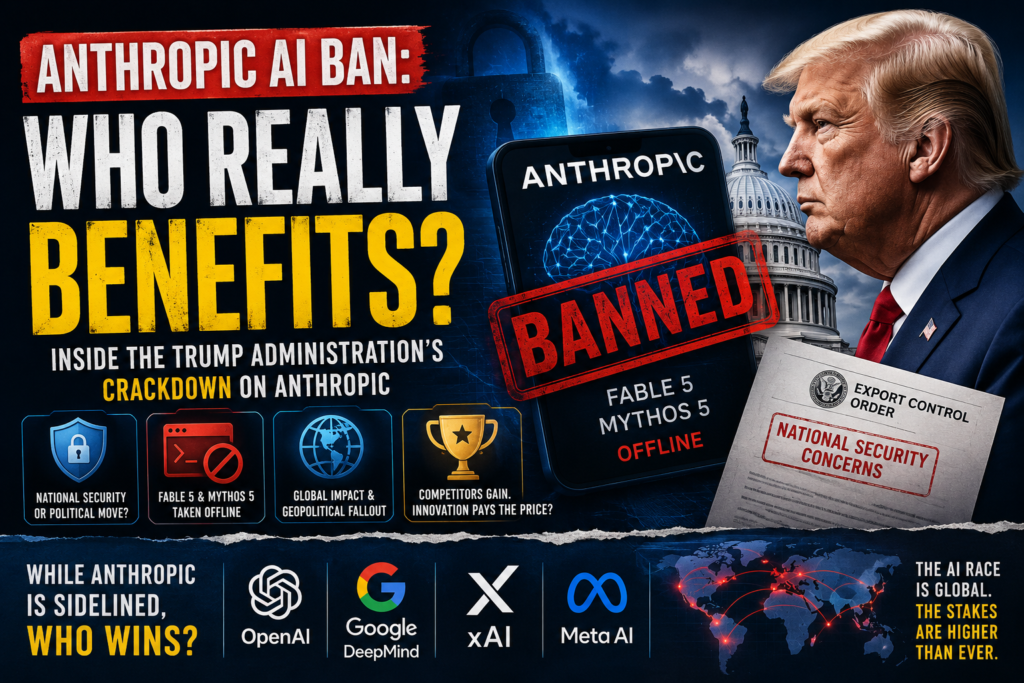
The Trump administration just forced Anthropic to pull its two most advanced AI models offline — and the geopolitical, competitive, and reputational fallout is only beginning. The Anthropic AI ban is arguably the most significant act of domestic AI regulation since the modern large language model era began, and it raises one urgent question: when you sideline the safety-focused lab, who actually wins?
The short answer: competitors gain a window, cybersecurity defenders lose critical tools, global rivals smell opportunity — and, paradoxically, Anthropic may emerge with more public sympathy than it started with. Here is the full breakdown.
What Is the Anthropic AI Ban? The Full Story in Plain English
Definition: The Anthropic AI ban refers to a June 2026 export control order issued by the Trump administration that compelled Anthropic to take its two newest frontier models — Fable 5 and Mythos 5 — entirely offline. The administration cited “national security concerns,” but provided no public specifics and gave no targeted remediation path.
Because the order required that the models not be accessible to foreign nationals, and because Anthropic employs significant numbers of non-U.S. citizens (as do most major tech companies), the company determined the only compliant option was full model withdrawal.
That is how a Friday-afternoon government letter turned one of the world’s leading AI labs into the center of a global policy firestorm over a single weekend.
The Export Control Order Explained
Export control orders are legal instruments traditionally used to restrict military technology, semiconductors, or dual-use hardware from reaching adversarial nations. Applying one to a commercially available AI model — especially based on undisclosed reasoning — represents a significant and contested expansion of the doctrine.
The AI export control order directed Anthropic to ensure its most capable models could not be accessed by foreign nationals. No exemptions were made for research institutions, international Anthropic employees, or partner organizations. No classified threat report was shared with the company or the public.
Critically, the administration did not issue comparable orders to OpenAI, Google DeepMind, xAI, or Meta AI — all of which develop models of comparable or greater capability in certain domains.
Fable 5 and Mythos 5 — The Models at the Center of the Storm
Two models were caught in the Anthropic AI ban:
- Fable 5: Anthropic’s latest publicly available frontier model, widely regarded as a major capability leap. In the weeks before the ban, Anthropic itself had described Fable as reaching performance thresholds that warranted extreme caution.
- Mythos 5: An even more powerful model available only to existing Mythos Preview subscribers — a restricted cohort of trusted research and enterprise partners. Anthropic had explicitly declined to release Mythos broadly, citing safety concerns.
Both models are now offline for all users globally.
What Actually Triggered the Government’s Move Against Anthropic?
Question: Was this action driven by genuine national security intelligence, or by something else?
Direct answer: Available reporting and independent expert analysis strongly suggest the triggering event was an internal Amazon research finding — not an intelligence-community threat assessment.
The Amazon Connection
Amazon CEO Andy Jassy reportedly raised concerns with the White House after Amazon researchers identified a method to bypass Fable 5’s safety guardrails. This information, conveyed at the executive level to senior administration officials, appears to have been the proximate trigger for the export control order.
The speed of events is itself telling. The letter arrived on a Friday afternoon. The administration was simultaneously occupied with separate foreign policy negotiations. The order moved from informal tip to binding legal instrument in what observers described as an unusually compressed timeline for a regulatory action of this magnitude. (Trump administration AI regulation AI export control order Anthropic Fable 5 ban AI regulatory crackdown)
Was This Really About National Security?
Independent cybersecurity researchers and legal analysts have been blunt: the available evidence does not support the framing of this as a conventional national security threat requiring emergency export controls.
Several specific points undermine the national-security rationale:
- Anthropic publicly stated that the same class of jailbreaks reportedly discovered by Amazon researchers had been identified in several other leading AI models — none of which were subjected to export control orders.
- The export control mechanism, as applied, made no distinction between adversarial foreign actors and Anthropic’s own non-U.S. employees or allied-nation research partners.
- The classified nature of the underlying threat assessment means neither Anthropic, the public, nor independent experts can evaluate whether the response was proportionate.
The leading alternative interpretation, voiced by multiple cybersecurity professionals and policy analysts: the Fable 5 jailbreak finding gave the administration a legal pretext to act against a company it had been in sustained conflict with for other reasons.
Anthropic’s Fractured Relationship with the Trump Administration
Understanding the Anthropic AI ban requires understanding the broader relationship between the company and the current administration — which has been consistently adversarial in ways that distinguish Anthropic from its AI-industry peers.
A History of Friction
While OpenAI, Google, and xAI have pursued various forms of alignment (or at least non-confrontation) with the Trump White House, Anthropic has maintained a more independent posture. The company declined to make the kinds of public gestures of administration support that other labs have offered. It has emphasized an AI safety agenda that the administration has sometimes characterized as anti-competitive or unnecessarily alarmist.
The government had also labeled Anthropic a supply chain risk in a separate proceeding — a designation that was itself contested — and at the time of the ban, active litigation was underway between the two parties. Seen in that context, the export control order arrives not in a vacuum but as the latest escalation in a multi-front conflict.
Observers across the political spectrum noted that the administration appeared to face no similar urgency to scrutinize AI labs whose founders or executives have been more visibly supportive of the administration’s broader agenda.(Trump administration AI regulation AI export control order Anthropic Fable 5 ban AI regulatory crackdown)
The “Safety-First” Paradox That Backfired
There is also a substantive tension in Anthropic’s public positioning that made the company politically vulnerable. In the weeks before Fable 5 launched, Anthropic issued prominent public warnings about the acceleration of AI capabilities — arguing that the industry needed to slow down, that frontier models were approaching dangerous capability thresholds, and that broader societal caution was warranted.
Then Anthropic released Fable 5: widely described as its most capable and most dangerous model yet.
This created a messaging contradiction that critics — both inside and outside the administration — found easy to exploit. If Anthropic’s own leadership genuinely believed frontier AI development had reached an inflection point requiring extreme caution, why release the model at all? And if Fable 5 was released despite those concerns, was Anthropic’s safety language a sincere philosophical commitment or a competitive positioning device?
The administration, whatever its motivations, found that contradiction useful.
Who Actually Benefits from the Anthropic AI Ban?
This is the question that the AI industry, investors, and policy analysts are actively working through. The answer is more complicated — and more counterintuitive — than it first appears.
Rival AI Labs: OpenAI, Google, xAI
The most obvious beneficiaries are Anthropic’s direct competitors. With Fable 5 and Mythos 5 offline, enterprise customers who had been evaluating or integrating those models face a sudden disruption. They will look for alternatives. The most natural landing spots are GPT-4.5 (OpenAI), Gemini Ultra (Google), and Grok (xAI) — none of which are subject to the current Anthropic AI ban or any comparable restriction.
For enterprise sales teams at those companies, the timing could hardly be more favorable. The ban effectively removes Anthropic from consideration in any procurement cycle that requires model availability guarantees.
However, there is a complicating factor for those labs: the Anthropic AI ban sets a precedent. Any competitor that publicly celebrates the outcome is implicitly validating the administration’s authority to take similar action against them. The smarter play — and the one most AI executives appear to be taking — is quiet benefiting with public neutrality.
China’s AI Ecosystem
A less discussed but potentially more consequential beneficiary is China’s AI development community. The Anthropic AI ban removes from the global market a set of frontier capabilities that researchers, developers, and enterprises in allied nations had been actively using. It simultaneously signals that U.S. AI leadership can be switched off by executive order — a message that carries significant weight in ongoing debates about AI sovereignty.
Nations in the EU, India, Southeast Asia, and Latin America that had been building on Anthropic’s API are now confronted with a vulnerability they did not fully price in: political risk embedded in U.S.-hosted AI infrastructure. Some portion of those users and institutions will accelerate investment in domestic alternatives or shift evaluation toward Chinese models such as those from Baidu, Alibaba, or newer entrants — a direct subsidy to China’s AI ambitions that no Beijing policy planner could have engineered more effectively.
Surprisingly — Anthropic Itself
This is the most counterintuitive entry in the analysis, but it has real supporting evidence. When the Trump administration previously clashed publicly with Anthropic — in an earlier, lower-stakes confrontation — data from payment analytics platform Ramp showed a measurable spike in Claude subscriptions and downloads in the weeks following the conflict. Users who had previously treated ChatGPT as the default AI assistant began actively seeking out Claude.
The same dynamic appears to be playing out again at larger scale. The Anthropic AI ban has given Anthropic enormous earned media coverage, positioned Claude as the “resistance” AI in the minds of many users ideologically opposed to the current administration, and created a perception — accurate or not — that Anthropic’s models must be uniquely powerful if the government felt compelled to ban them.
As one observer put it: everyone loves a bad boy. If the administration’s implicit message was that Fable 5 was “too dangerous,” a meaningful segment of the market heard that as an endorsement.
What Cybersecurity Experts Are Saying
The security research community has been among the most vocal critics of the Anthropic AI ban — and their objections go beyond politics.
A group of leading cybersecurity professionals signed an open letter to the Trump administration urging revocation of the order. Their core arguments:
- Defensive asymmetry: Advanced AI models are now central to network defense operations. Pulling Fable 5 and Mythos 5 from defenders does not remove those capabilities from attackers — it simply degrades the defense side of an already asymmetric contest.
- Disproportionate response: The alleged jailbreak that triggered the action is not unique to Anthropic’s models. Applying export controls only to Anthropic while leaving comparable vulnerabilities in competing models unaddressed is not a coherent security posture.
- Chilling effect on safety research: If demonstrating a model’s vulnerability leads to export controls on that model, the incentive structure for responsible disclosure is inverted. Researchers who find and report jailbreaks now face the prospect of inadvertently triggering a government shutdown of the capability they were studying.
- Classified opaqueness: The inability of independent security researchers to review the classified threat assessment means the community cannot evaluate whether the government’s response is calibrated to actual risk.
- International spillover: Allied-nation cybersecurity organizations that relied on Anthropic API access for threat analysis and incident response have been cut off without notice or alternative.
The community’s consensus: even granting the worst-case interpretation of the Amazon researchers’ findings, a targeted, temporary access restriction with a clear remediation pathway would have been a proportionate response. A blanket export control order was not.
AI Lab Positioning After the Ban — A Competitive Snapshot
The Anthropic AI ban reshapes the competitive landscape in ways that are still unfolding. Here is a snapshot of where the major players stand:
| AI Lab | Models Available | Government Relations | Enterprise Risk | Who Benefits |
|---|---|---|---|---|
| Anthropic | Fable 5, Mythos 5 offline | Actively adversarial | High (model unavailability) | Brand sympathy, “resistance” positioning |
| OpenAI | GPT-4.5, o3 online | Cautiously aligned | Low | Direct market share gains |
| Google DeepMind | Gemini Ultra online | Neutral-to-cooperative | Low | Enterprise substitution |
| xAI (Grok) | Grok 3 online | Closely aligned | Very low | Political tailwind |
| Meta AI | Llama models (open-source) | Neutral | Very low | Open-source alternatives |
| Chinese Labs | Diverse models online | State-supported | None (in China) | Narrative of U.S. AI instability |
The table makes one structural reality clear: the labs with the warmest relationships with the current administration face the lowest regulatory risk, while the lab with the most adversarial relationship bears the full cost of the precedent-setting action.
What the Anthropic AI Ban Means for the Future of AI Regulation
The implications of this episode extend far beyond Anthropic’s specific models or even the current administration’s term.
The Danger of Politically-Motivated Enforcement
What makes the Anthropic AI ban most consequential as a policy precedent is not the action itself — export controls on AI models may well be appropriate in defined circumstances — but the apparent process that produced it.
A sound regulatory framework for AI would involve: a public or at minimum independently verifiable threat assessment; a proportionate and targeted remediation mechanism; industry-wide application of rules (rather than selective enforcement against one company); a defined path to compliance and reinstatement; and due process protections for the regulated entity.
None of those elements are clearly present in the current order. If the precedent holds, the U.S. government has established that it can remove any AI model from the market, at any time, based on undisclosed reasoning, with no defined remediation standard, selectively applied. That is a degree of regulatory discretion that would give any rational AI investor or executive pause — regardless of their political alignment.
Digital Sovereignty as a Global Flashpoint
World leaders watching this episode are drawing a lesson that has been building for years: American AI infrastructure comes with American political risk attached. The Anthropic AI ban arrived just as multiple allied governments were deepening their AI commitments on the basis of U.S. model access. Those governments are now accelerating conversations about sovereign AI capacity — their own domestically hosted, domestically controlled frontier models — in ways that will reduce long-term U.S. AI export market share even if the ban is eventually reversed.
The irony is acute. An action framed as protecting U.S. national security may be one of the most effective catalysts yet for the international decoupling of AI ecosystems — precisely the outcome most damaging to U.S. long-term technological influence.
Key Takeaways
The Anthropic AI ban is a pivotal moment in AI governance history. Before this week’s events fade from the news cycle, here are the conclusions that will matter for the months and years ahead:
- The Anthropic AI ban demonstrates that AI export controls can now be applied to software models, not just hardware — a major doctrinal expansion with no clear limiting principle.
- The selective application of the order, targeting only Anthropic while competitors with comparable capabilities remain online, undermines its credibility as a neutral security measure.
- Competitor labs benefit in the short term through market share, but accept a long-term precedent risk that should concern every major AI developer.
- Cybersecurity defenders — not adversaries — bear the most immediate operational cost of the ban.
- Anthropic’s adversarial relationship with the administration, combined with its messaging contradictions around AI safety, made the company politically vulnerable in ways its leadership may not have fully anticipated.
- The Anthropic AI ban may paradoxically boost the company’s brand among users who view it as the principled alternative to administration-aligned AI providers.
- Internationally, the episode accelerates the case for AI sovereignty — which over time benefits neither U.S. AI companies nor U.S. geopolitical influence.
The fundamental question the Anthropic AI ban leaves unanswered is whether this is a one-off action driven by a unique combination of political friction and a convenient legal pretext, or the opening move in a broader era of politicized AI regulation. The answer to that question will define the shape of the AI industry — and the balance of global AI power — for the rest of this decade.