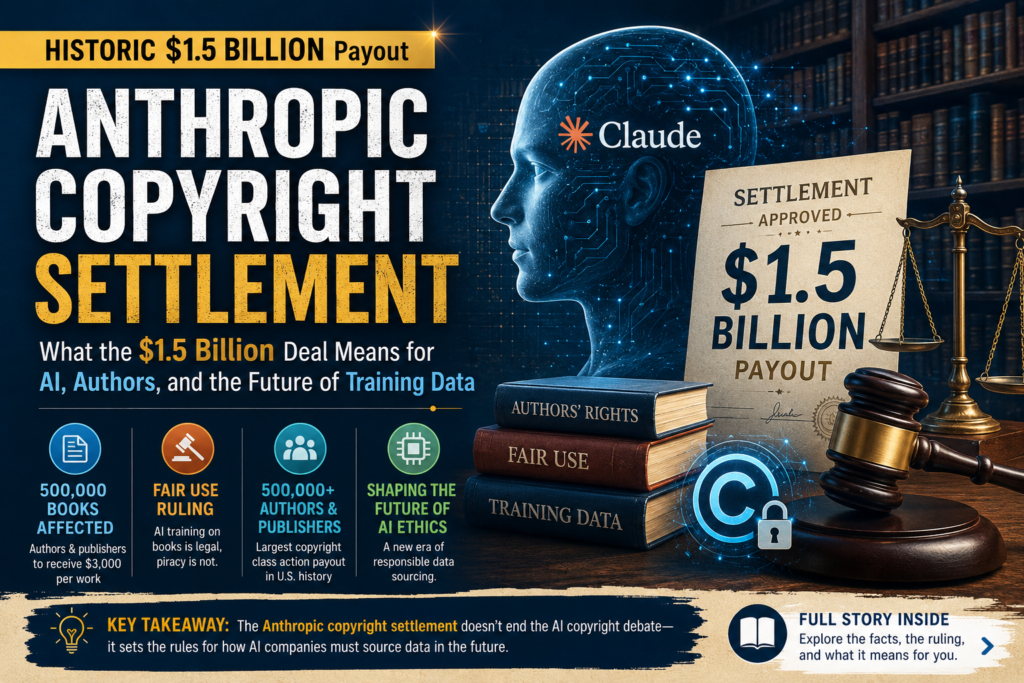
A federal judge gave final approval to the Anthropic copyright settlement on July 20, 2026, clearing the way for the AI company to pay $1.5 billion to roughly 500,000 authors and publishers whose books it pirated to train its Claude chatbot. It is the largest copyright class action payout in U.S. history — but it does not settle the bigger legal question of whether AI training on copyrighted work is lawful industry-wide.
For anyone trying to make sense of what just happened, here is the short version: Anthropic didn’t lose on the question of whether training an AI model on books is legal. It lost — and agreed to pay — because of how it acquired millions of those books in the first place.
Background: How AI Companies Ended Up in Court Over Training Data
Generative AI models learn language patterns by processing enormous volumes of text, and books have long been considered some of the highest-quality training material available — professionally edited, grammatically consistent, and rich in narrative structure. That made them attractive to labs racing to build increasingly capable large language models. It also made them a legal liability the moment companies started sourcing that text from shadow libraries instead of licensed catalogs.
Library Genesis and Pirate Library Mirror, the two shadow libraries at the center of this case, have existed for years as unauthorized repositories of digital books, widely used by researchers and, evidently, by AI developers building training corpora. Authors and publishing houses had criticized these repositories long before generative AI became mainstream, but the emergence of commercial AI chatbots gave the issue new financial stakes: for the first time, a company’s use of pirated text was directly tied to a product generating billions of dollars in revenue.
That backdrop is what set the stage for the current wave of litigation, of which this case is simply the first to reach a conclusion.
What Is the Anthropic Copyright Settlement?
The Anthropic copyright settlement is a $1.5 billion class action agreement resolving claims that Anthropic illegally downloaded and stored millions of copyrighted books from pirate websites to build its AI training library. U.S. District Judge Araceli Martinez-Olguin signed off on the deal on Monday, July 20, 2026, capping a process that began with preliminary approval more than a year earlier.
Under the terms, rightsholders receive $3,000 per work across an estimated 500,000 eligible books, split among the authors and publishers who hold the copyrights. According to the Authors Guild, Anthropic’s payments are structured across several installments, with the bulk of the fund flowing to the settlement administrator once the claims process closes and legal fees are deducted.
Who Filed the Lawsuit and When?
Authors first sued Anthropic in 2024, arguing the company trained Claude on datasets it knew contained hundreds of thousands of copyrighted books lifted from piracy websites. The case was heard by Judge William Alsup of the U.S. District Court for the Northern District of California, one of the most closely watched jurists in the AI copyright space. Alsup has since retired, and Judge Martinez-Olguin inherited the case to bring it to final approval.
Why Did Anthropic Settle Instead of Going to Trial?
Anthropic settled because a separate trial over piracy damages — scheduled for December 2025 — carried the risk of a jury award reaching into the hundreds of billions of dollars. Once Alsup ruled that the piracy question could proceed to trial independent of the AI-training question, the company’s legal exposure became far larger than a negotiated deal, making settlement the more predictable outcome.
This is the core nuance that separates the case from a typical AI lawsuit: Anthropic did not lose on the question of whether training AI on books is legal. It lost on how it obtained the books in the first place.
The Two Sources of Anthropic’s Training Library
Anthropic built its book-training library from two very different sources, and the legal treatment of each was not the same:
- Purchased and scanned books — Anthropic bought physical copies and digitized them, which the court found to be lawful.
- Pirated books from shadow libraries — Anthropic downloaded and stored millions of books from sites like Library Genesis (LibGen) and Pirate Library Mirror (PiLiMi), which the court found illegal regardless of how the books were later used.
That second category — not the act of AI training itself — is what triggered the record payout.
The Fair Use Ruling Behind the Deal
Is training an AI model on copyrighted books legal? According to Judge Alsup’s ruling, yes — training Claude on copyrighted text counts as fair use under U.S. copyright law. This finding is widely regarded as a turning point for the AI industry, because it directly addresses the question every major AI lab has been fighting in court: can you legally learn from copyrighted material without a license?
Alsup’s fair use ruling and the settlement itself are often confused, but they answer two separate questions:
- Is AI training on copyrighted books fair use? Yes, according to Alsup’s ruling — though this finding technically applies only to the three named plaintiffs, not the full certified class.
- Was it legal to acquire those books from pirate sites? No. Alsup found that downloading and storing pirated books for a “central library” was illegal on its own terms, separate from how the books were eventually used.
This distinction matters enormously for anyone trying to understand what the Anthropic copyright settlement actually decided — and what it left open.
Why the Distinction Matters for Every AI Company
Any company training a large language model on text scraped or sourced from the internet now has a clear playbook to avoid Anthropic’s outcome: acquire content lawfully — through purchase, licensing, or public domain sources — rather than through shadow libraries or pirated archives. The fair use finding gives AI labs room to train on copyrighted material, but it offers zero protection for how that material was obtained. Piracy remains piracy, regardless of what happens to the data afterward.
What the Settlement Resolves — and What It Doesn’t
The settlement closes out one specific case. It does not create binding precedent for the rest of the AI industry, for a simple procedural reason: because Anthropic settled rather than appealed, the case will never reach an appeals court. Alsup’s fair use ruling remains a single district court decision, meaning other judges are free to reach different conclusions based on their own facts.
That’s exactly what is playing out elsewhere. A string of AI copyright lawsuits are still active against companies including Google, Meta, Midjourney, and OpenAI, each testing whether training generative AI models on copyrighted material is lawful. Just days before final approval, a group of publishers — including Hachette, Cengage, Elsevier, and author Scott Turow — filed a new class action against Google over Gemini’s training data, a sign that the broader legal fight is intensifying rather than winding down.
Quick Answer: Does This Case Set a Legal Precedent for the AI Industry?
No. The Anthropic copyright settlement resolves claims against one company in one case. Because it was settled rather than litigated to a final appellate judgment, it does not bind other courts, and companies like Google, Meta, and OpenAI still face their own separate copyright disputes that could be decided differently.
How Much Will Authors and Publishers Receive?
Eligible rightsholders receive $3,000 per registered work, provided the book carried an ISBN or ASIN registered with the U.S. Copyright Office within the qualifying window. Reporting on the case indicates that more than 91% of eligible class members had already filed claims by the time of final approval, covering the large majority of the roughly 500,000 works in the settlement class.
| Settlement Detail | Figure |
|---|---|
| Total value | $1.5 billion |
| Payout per registered work | $3,000 |
| Estimated works covered | ~500,000 |
| Claims filed by approval date | Over 91% of eligible class |
| Presiding judge (final approval) | Araceli Martinez-Olguin |
| Presiding judge (original ruling) | William Alsup (retired) |
| Case filed | 2024 |
| Preliminary approval | 2025 |
| Final approval | July 20, 2026 |
Not every author sees this as a fair outcome, even with the record-setting total. Some class members argue that $3,000 per work undervalues what a licensing deal might have paid and that legal fees consume a disproportionate share of the fund.
How the Claims Process Actually Worked
Getting from a pirated-book allegation to an actual check involved several distinct stages, and understanding them helps explain why final approval took so long to arrive.
- Class certification. The court certified a class covering rightsholders of books Anthropic acquired from LibGen and PiLiMi, provided those works were registered with the U.S. Copyright Office in a timely manner and carried an ISBN or ASIN.
- Direct notice. More than 506,000 potential class members, representing roughly 480,000 works, received direct notice that they may be entitled to a payment.
- Claims filing. Rightsholders had until a set deadline to file a claim confirming ownership; ultimately, more than 91% of eligible class members did so.
- Objections and opt-outs. A small number of class members — a few hundred opt-outs and around 50 formal objections — challenged either their exclusion or the settlement’s overall fairness.
- Final approval hearing. The court weighed those objections before Judge Martinez-Olguin ruled the settlement “fair and adequate,” clearing the way for payments to begin.
- Staggered funding. Anthropic’s contribution to the settlement fund is being paid in installments rather than a single lump sum, tied to specific milestones after preliminary and final approval.
Why Some Authors Still Don’t View This as a Win
Even though this is the largest deal of its kind, many authors and creators remain unsatisfied — and understanding why requires separating the size of the payout from the legal outcome it represents.
- The fair use ruling stands. Authors did not win the argument that AI training itself requires permission or a license; that question was resolved in Anthropic’s favor for the named plaintiffs.
- No industry-wide precedent was set. Because the case settled, other AI companies aren’t bound by Alsup’s reasoning and can litigate the same question fresh in their own cases.
- Exclusions narrowed the class. Works without timely U.S. Copyright Office registration, and non-U.S.-registered works, were excluded from the settlement entirely.
- Publisher registration failures cost some authors. In select cases, publishers who were contractually responsible for registering a copyright failed to do so, disqualifying otherwise-eligible authors — though at least one publisher, Macmillan, has pledged to compensate affected authors directly.
- Objections were formally raised and rejected. A small number of class members objected that the deal undervalued claims or over-compensated attorneys; Judge Martinez-Olguin considered and rejected those objections before granting final approval.
How This Case Compares to Other AI Copyright Lawsuits
This settlement is the most advanced of the major AI training-data disputes, but it’s far from the only one. Here’s how it stacks up against other ongoing cases as of mid-2026:
| Company | Status | Core Dispute |
|---|---|---|
| Anthropic | Settled, final approval granted (July 2026) | Piracy of books via LibGen/PiLiMi to train Claude |
| Active lawsuit filed by major publishers (July 2026) | Alleged use of copyrighted works to train Gemini | |
| OpenAI | Multiple active suits | Alleged unauthorized use of copyrighted text and media |
| Meta | Active litigation | Alleged use of pirated book datasets for LLM training |
| Midjourney | Active litigation | Alleged training on copyrighted visual art |
This comparison is a useful reminder: a single record-breaking payout doesn’t resolve how courts will treat AI training data across the industry. Each company’s outcome depends on its own facts, its own data sourcing methods, and its own judge.
What This Means for the AI Industry Going Forward
For AI companies, the practical lesson isn’t about whether training on copyrighted material is legal — Alsup’s fair use finding suggests it can be, under the right conditions. The lesson is about how the training data was acquired. Piracy-sourced datasets carry legal exposure independent of the training process itself, and that exposure can run into the billions of dollars once a class of rightsholders is certified.
For publishers and authors, the case establishes a financial benchmark — $3,000 per pirated work — that may influence how future claims and settlements in the AI copyright space are valued, even though it isn’t a binding legal standard. Expect litigants in the Google, Meta, OpenAI, and Midjourney cases to reference this figure as a negotiating anchor, whether or not the underlying facts of piracy versus licensed acquisition match.
What Should Authors and Publishers Watch Next?
- Whether other AI companies begin proactively licensing book content to avoid similar litigation.
- How courts in the Google, Meta, and OpenAI cases treat the fair use question differently — or the same way Alsup did.
- Whether Congress or the U.S. Copyright Office moves toward clearer statutory rules for AI training data, rather than leaving the issue to case-by-case litigation.
- How publisher contracts evolve to require timely copyright registration, closing the gap that disqualified some authors from this settlement.
Frequently Asked Questions
How much is the Anthropic copyright settlement worth? It totals $1.5 billion, distributed at $3,000 per eligible work across an estimated 500,000 books.
When was the settlement finalized? Final approval was granted on July 20, 2026, by Judge Araceli Martinez-Olguin, more than a year after Judge William Alsup granted preliminary approval.
Did Anthropic admit that AI training violates copyright law? No. The deal resolves piracy claims related to how Anthropic acquired its training books, not the act of training an AI model on copyrighted text, which Alsup separately ruled is fair use.
Does the Anthropic copyright settlement affect other AI companies like OpenAI or Google? Not directly. Because the case was settled rather than appealed, it sets no binding precedent, and companies including Google, Meta, OpenAI, and Midjourney continue facing their own separate copyright lawsuits.
Who is eligible for a payment under the settlement? Authors and publishers holding U.S. Copyright Office–registered works with an ISBN or ASIN, downloaded by Anthropic from piracy sites like Library Genesis or Pirate Library Mirror, within the qualifying registration window.
Key Takeaways
- The Anthropic copyright settlement is the largest copyright class action payout in U.S. history at $1.5 billion.
- Authors and publishers receive $3,000 per eligible work across roughly 500,000 books.
- The deal resolves a piracy claim — how Anthropic obtained its training books — not the legality of AI training itself.
- Judge Alsup’s separate fair use ruling found that training Claude on copyrighted text was lawful, a decision that remains in effect but isn’t binding beyond this case.
- Because Anthropic settled rather than appealed, no industry-wide precedent was created, leaving Google, Meta, OpenAI, and Midjourney to fight similar battles independently.
- More than 91% of eligible class members had filed claims by the time of final approval.