Imagine owning a slice of a company so valuable that selling just a fraction of it makes you a quarter-billionaire overnight. Now imagine six other people did the exact same thing on the same day, at the same price, in the same transaction.
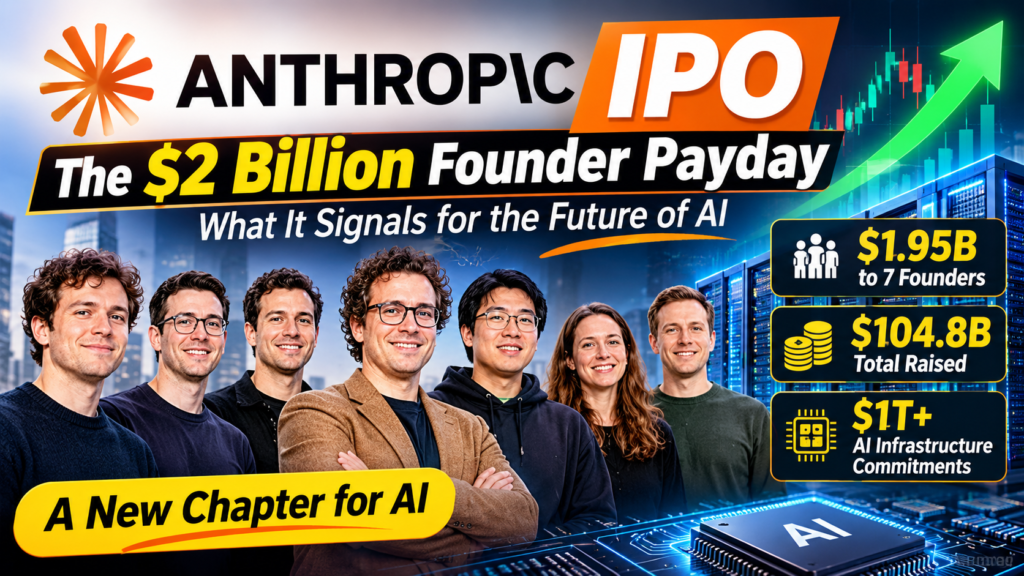
That is what happened on Thursday, November 19, 2026, when Anthropic became a public company. The listing raised more money than any technology debut before it, sent roughly $1.95 billion to the company’s seven co-founders, and, buried beneath the headlines, revealed just how expensive it is to build frontier artificial intelligence.
Most coverage stopped at the eye-popping payout. But the numbers that matter most for investors, founders, and anyone building a career in tech sit a layer deeper. In this guide, we break down the Anthropic IPO from every angle: who got paid, who bought in, who owns what, and why a company that just raised nearly $105 billion still has a financing problem measured in trillions.
The Anthropic IPO at a Glance
Before we dig into the details, here are the headline numbers in one place.
| Metric | Figure |
|---|---|
| Total raised in the offering | $81.3 billion |
| Proceeds that went to the seven founders | $1.95 billion |
| Final IPO price per share | $83 |
| Original midpoint price (price range) | $74 |
| Shares each founder sold | About 3.4 million |
| Approximate payout per founder (before fees and taxes) | About $280 million |
| Actual cash raised for the company | $104.8 billion (up to $117 billion if underwriters take their full allotment) |
| Special Class N non-voting stock sold | $26 billion |
| Combined Amazon + Google ownership | 28% |
| Disclosed infrastructure commitments | $1.05 trillion to $1.08 trillion |
A few things jump out immediately:
- The price was raised. The offering priced at $83 per share, well above the $74 midpoint of the original range, which signals strong demand.
- The founders sold alongside the company. This was not purely a fundraising event for the business; insiders took real money off the table.
- Strategic buyers showed up in force. Some of the biggest names in chips and cloud computing bought a dedicated class of stock.
- The funding gap is still enormous. Even $105 billion is small next to the company’s long-term spending commitments.
Let’s take each of these in turn.
The Founder Payday: Breaking Down $1.95 Billion
How the share math worked
Each of Anthropic’s seven founders put up roughly 3.4 million shares to be sold in the offering. As TechCrunch reported earlier in the month, the plan was designed to give each of them around $250 million.
That target lines up with the original price range. At the $74 midpoint, 3.4 million shares comes out to about a quarter of a billion dollars per founder. Multiply that by seven people and you land in the neighborhood of $1.75 billion.
Why the upgraded price changed everything
The offering did not price at $74. It priced at $83. That nine-dollar jump meant each founder’s roughly 3.4 million shares were worth about $280 million instead of $250 million, which is a bonus of around $30 million apiece compared with the midpoint scenario. Across all seven, that is how the total reached about $1.95 billion.
Two caveats are worth keeping in mind:
- These are gross figures. The payouts are before underwriting fees and taxes, so the amount that lands in a founder’s bank account will be meaningfully lower.
- It is a partial sale. Selling about 3.4 million shares each does not mean the founders have exited. They remain significant owners of a now-public company, with the usual disclosure obligations that come with that status.
The 80% philanthropy pledge, and its fine print
Here is where the story gets more interesting than a typical founder windfall. According to the company’s IPO filings, each founder has pledged to dedicate 80% of their personal equity in Anthropic to philanthropy.
That is a remarkable commitment on its face. But the filings are careful about how they describe it. The company characterized these pledges as voluntary, revocable expressions of each co-founder’s philanthropic intent that do not constitute legally binding obligations.
Our take (analysis): Both things can be true at once. The pledge is a genuine signal of intent, and it is also not a contract. For readers evaluating the company, the useful question is not “will they definitely give it away?” but “how will this be tracked and reported over time?” Public companies tend to face scrutiny on promises like these, and the market will eventually notice whether the follow-through matches the headline.
Where the Money Came From: $104.8 Billion for the Company
The founders’ $1.95 billion is the smallest part of this story. The bigger number is what flowed to the company itself.
Class A and Class N: two kinds of stock
TechCrunch reports that the company raised about $104.8 billion for its own coffers, with a possible $117 billion if the underwriting banks buy their full allotment of shares. That total came from two sources:
- Class A common stock sold in the public offering.
- A special non-voting Class N stock, a previously announced $26 billion placement sold to some of the largest names in the technology industry.
The existence of a separate, non-voting class is a notable design choice. It allows large strategic partners to put serious capital in without gaining governance influence through votes. For a company that has talked openly about the importance of mission and oversight, that structure is not an accident.
Who bought the Class N shares
The roster of buyers reads like a map of the AI supply chain:
| Buyer | Role in the AI ecosystem | Class N purchase |
|---|---|---|
| Nvidia | AI chips and accelerators | $10 billion |
| Cloud and AI chips | $10 billion | |
| AMD | AI chips | Share of the remainder |
| Broadcom | Custom silicon and networking | Share of the remainder |
| Micron | Memory chips | Share of the remainder |
| Microsoft | Cloud computing | Share of the remainder |
| TSMC | Chip manufacturing | Share of the remainder |
Our take (analysis): Notice the pattern. These are not passive financial investors. They are companies that sell the hardware, memory, manufacturing capacity, and cloud services an AI lab consumes. When a customer raises $105 billion, its suppliers benefit. Buying Class N stock deepens relationships with a buyer that will spend heavily on exactly the products those companies make. It is investment and sales strategy rolled into one.
How big is “record-breaking”?
For perspective, TechCrunch points back to Facebook’s 2012 debut, which was a record-breaker in its own right at roughly $16 billion raised on IPO day. The Anthropic IPO raised several times that amount.
That comparison is worth pausing on. Facebook’s debut defined what a mega-IPO looked like for a generation of tech investors. A single offering that dwarfs it tells you how much the scale of capital in this industry has shifted.
Amazon and Google: The 28% Question
One of the most important details in the reporting is who owns the company after the dust settles.
The ownership picture
- Google wound up with 13.4% of the company at the higher IPO price.
- Amazon holds 14.6%.
- Together, the two cloud giants own roughly 28%, according to the company.
The promissory notes twist
Amazon’s stake has an interesting backstory. When Amazon first invested in the startup, it received promissory notes that could later be converted into equity. As part of the offering, it converted only a small percentage of them.
Had Amazon converted everything, it could have owned nearly 24% on its own. That means a large amount of potential ownership remains unconverted, which is worth understanding for anyone trying to model the company’s cap table over time.
What concentrated ownership means
Our take (analysis): A 28% combined stake held by two competing cloud providers is a double-edged feature.
- The upside: Deep, long-term commitments from two of the most capable infrastructure companies on earth. That helps with access to compute, one of the scarcest resources in the industry.
- The tension: Both owners are also rivals in AI. Both sell competing products. Investors should watch how the company manages independence and avoids favoring one partner over another.
- The safeguard: The non-voting Class N structure for the strategic chipmakers and cloud buyers suggests the company is conscious of governance risks and is trying to design around them.
The Real Story: A $1 Trillion Infrastructure Bill
If you only remember one section of this article, make it this one.
The headline figure, nearly $105 billion raised, sounds like it should end any conversation about whether the company has enough money. It does not. According to the reporting, the raise gives the company close to $230 billion of working capital when you include cash it already had on hand. And yet the company’s future spending needs are far larger.
The commitments, in plain numbers
| Time horizon | Compute and infrastructure commitments |
|---|---|
| Next 12 months (as of the quarter ended September 30, 2026) | About $70.7 billion |
| Through the end of 2030 | About $451.6 billion |
| Total disclosed ballpark, including conditional or unpriced items | $1.05 trillion to $1.08 trillion |
TechCrunch notes that the company has also racked up hundreds of billions of other commitments that are either conditional, meaning they may not happen, or have not been priced yet.
How to read these numbers
Raising $105 billion and still facing a roughly $1 trillion commitment horizon is not a contradiction. It is a description of the business model. Frontier AI development is capital-intensive in a way few industries have ever been. Training and serving large models requires:
- Enormous quantities of advanced chips
- Data centers and the power to run them
- Long-term supply contracts for memory and networking
- Cloud capacity reserved years in advance
Our take (analysis): This is why the investor lineup makes sense. The company is not just raising money; it is locking in the supply chain. The chipmakers and cloud providers on the Class N list are the same firms the company will be paying for years to come.
It also explains why a public listing was attractive. Public markets offer a deeper, repeatable pool of capital than private rounds. A company with a trillion-dollar horizon cannot rely on occasional fundraising events. It needs a durable relationship with the capital markets.
What the Anthropic IPO Signals for the Wider AI Industry
Beyond one company’s finances, this event tells us something about where the whole sector is heading. Here are the five signals we think matter most.
1. Demand for AI exposure is intense
Pricing above the original range is a classic sign that more buyers wanted shares than the banks had available. Investors are clearly willing to pay up for a stake in a leading AI developer.
2. Compute is the true bottleneck
When the biggest line item in a business plan is infrastructure spending, the companies that control chips, memory, and cloud capacity hold enormous leverage. That is why every one of the Class N buyers is a supplier.
3. Capital intensity will favor the best-funded players
If the cost to compete is measured in hundreds of billions, only a handful of organizations can play at the frontier. Everyone else will build on top of their models, specialize in niches, or partner with them.
4. Governance structures are getting creative
The non-voting Class N stock and the non-binding philanthropy pledges are both examples of newer corporate design choices. Expect more experimentation as AI companies balance commercial pressure with mission-driven promises.
5. The founder liquidity question is now public
Seven co-founders selling shares in the same offering sets a precedent. Employees, early investors, and other startups’ founders will be watching how the market treats insider selling.
Actionable Takeaways: What You Can Do With This Information
It is easy to read a story like this and feel like a spectator. Here is how different readers can turn it into something useful.
If you are an investor
- Read the filing, not just the news. If you are weighing the Anthropic IPO as an investment, note that the commitment figures, the Class N terms, and the Amazon note conversions all come from regulatory documents. The details matter more than the headline.
- Model the infrastructure burden. A company that must spend about $70.7 billion in the next twelve months has a very different risk profile from a typical software business. Think about margins, depreciation, and what happens if demand grows more slowly than expected.
- Watch the lockup and insider activity. The founders have already sold part of their holdings. Track later disclosures to see whether insiders continue to sell.
- Remember this is not advice. We are not financial advisors. Consult a qualified professional before making any investment decision.
If you are a startup founder
- Think about structure early. Dual-class and non-voting stock are tools for bringing in strategic capital without surrendering control. If you expect large strategic investors, plan your share classes accordingly.
- Consider secondary sales. A partial founder sale can be reasonable and even healthy, as long as it is disclosed clearly and handled transparently.
- Treat philanthropy pledges carefully. If you make public giving commitments, be clear about whether they are binding. Ambiguity erodes trust.
- Build relationships with your suppliers. The Class N buyers show that your largest vendors can also become your strategic investors.
If you are a student or early-career professional
- Follow the money to find the jobs. Capital flowing into AI means hiring across engineering, infrastructure, data center operations, supply chain, finance, legal, and policy. The roles are not limited to researchers.
- Learn the infrastructure layer. Skills in cloud architecture, GPU workload optimization, model deployment, and cost management are in demand when compute is the biggest expense.
- Build with the platforms, not against them. Learn to build useful products on top of leading models. Practical projects make a stronger portfolio than theory alone.
- Develop financial literacy. Understanding cap tables, dilution, and equity compensation will help you negotiate offers at startups and public companies alike.
If you are a business leader buying AI
- Expect pricing pressure from infrastructure costs. When a vendor carries a trillion-dollar commitment horizon, pricing decisions will reflect that.
- Avoid single-vendor dependence. Diversify where reasonable, and negotiate contract terms that protect you if prices change.
- Ask about stability. A well-capitalized vendor is a lower counterparty risk. This offering strengthens that position, but the spending commitments are the counterweight.
Risks and Open Questions to Keep in Mind
A balanced view of the Anthropic IPO requires looking at what could go wrong, not just what went right.
- Commitment risk. Obligations in the hundreds of billions create pressure to grow revenue quickly. If growth disappoints, the commitments remain.
- Conditional commitments. The reporting notes that some obligations are conditional and may not happen, which makes the true total harder to pin down.
- Concentration risk. With Amazon and Google owning 28% together, the shareholder base is heavily tilted toward two corporate partners.
- Market volatility. Newly public companies can swing sharply as the market digests lockups, earnings, and sentiment. We have not covered post-listing trading in this article, and you should check live data for the current share price.
- Philanthropy follow-through. The 80% pledge is non-binding. Whether it is honored will only be known over many years.
- Regulatory attention. A company of this size and strategic importance will draw scrutiny from regulators in multiple jurisdictions.
Frequently Asked Questions
How much money did the Anthropic IPO raise?
The offering raised a total of $81.3 billion, according to TechCrunch. Counting the separate $26 billion Class N placement, the amount raised for the company itself was about $104.8 billion, with a possible $117 billion if underwriters purchase their full allotment.
How much did each founder make in the Anthropic IPO?
Each of the seven founders sold about 3.4 million shares at $83 per share, which works out to roughly $280 million each before underwriting fees and taxes. Together, the founders’ proceeds came to about $1.95 billion.
What is Class N stock?
Class N is a special non-voting class of stock. The company sold about $26 billion of it to major technology companies, including Nvidia and Google at $10 billion each, with AMD, Broadcom, Micron, Microsoft, and TSMC splitting the rest.
Who are the biggest shareholders after the Anthropic IPO?
Among the disclosed holders, Amazon has about 14.6% and Google has about 13.4%, for a combined 28%. Amazon could have held nearly 24% had it converted all of its promissory notes.
Are the founders really giving away 80% of their wealth?
Each founder has pledged to dedicate 80% of their personal equity to philanthropy, but the company describes these as voluntary, revocable statements of intent rather than legally binding obligations.
Why does the company still need so much money?
The company has disclosed infrastructure commitments of roughly $1.05 trillion to $1.08 trillion. About $70.7 billion falls due within twelve months of September 30, 2026, and about $451.6 billion is needed before the end of 2030.
Conclusion: The Payout Is the Headline, the Spending Is the Story
The founder payouts make for great headlines. Seven people each collecting around $280 million is the kind of detail that travels fast. But the most important thing the Anthropic IPO tells us has little to do with any individual’s wealth.
It tells us that building at the frontier of AI is one of the most capital-hungry endeavors in business history. It tells us that chipmakers, memory suppliers, and cloud providers are now deeply intertwined with the labs they serve. And it tells us that even after the largest technology offering on record, the funding challenge for the industry is far from over.
For investors, the lesson is to read the commitments as carefully as the proceeds. For founders, it is to think about structure and transparency long before a liquidity event. For students and professionals, it is to build skills in the parts of the AI economy where capital is flowing fastest.
The record has been set. What happens next, in the markets and in the data centers, will be even more interesting than the debut.